Welwitschia mirabilis, an emblem of the Namib, can live for more than 1,000 years and survives along coastal deserts that in places receive under 20 mm of rain a year (see Kew Gardens). Such extreme limits make the plants that persist here both fascinating and essential: they stabilize shifting sands, feed and shade wildlife and people, and hold cultural knowledge used by local communities for generations.
This piece presents 12 notable examples of the region’s plants, grouped by theme — iconic endemics; survival strategies; and ecological and human uses — to show how specialization supports life in one of the world’s oldest deserts. Along the way you’ll find specific numbers (ages, heights, rainfall ranges), places to see these species (NamibRand, Skeleton Coast, Kuiseb River), and pointers to authoritative sources such as SANBI and GBIF. The goal is practical: to introduce 12 striking plants and explain why they matter for nature and people.
Iconic and Endemic Species
“Endemic” means a species occurs naturally only in a defined area; the Namib’s long geological stability and sharp climatic gradients have produced many such plants with narrow ranges and distinctive life histories. These species draw tourists, inform scientific work, and contribute to national identity. Wherever possible this section cites regional reserves and museum histories to ground those claims.
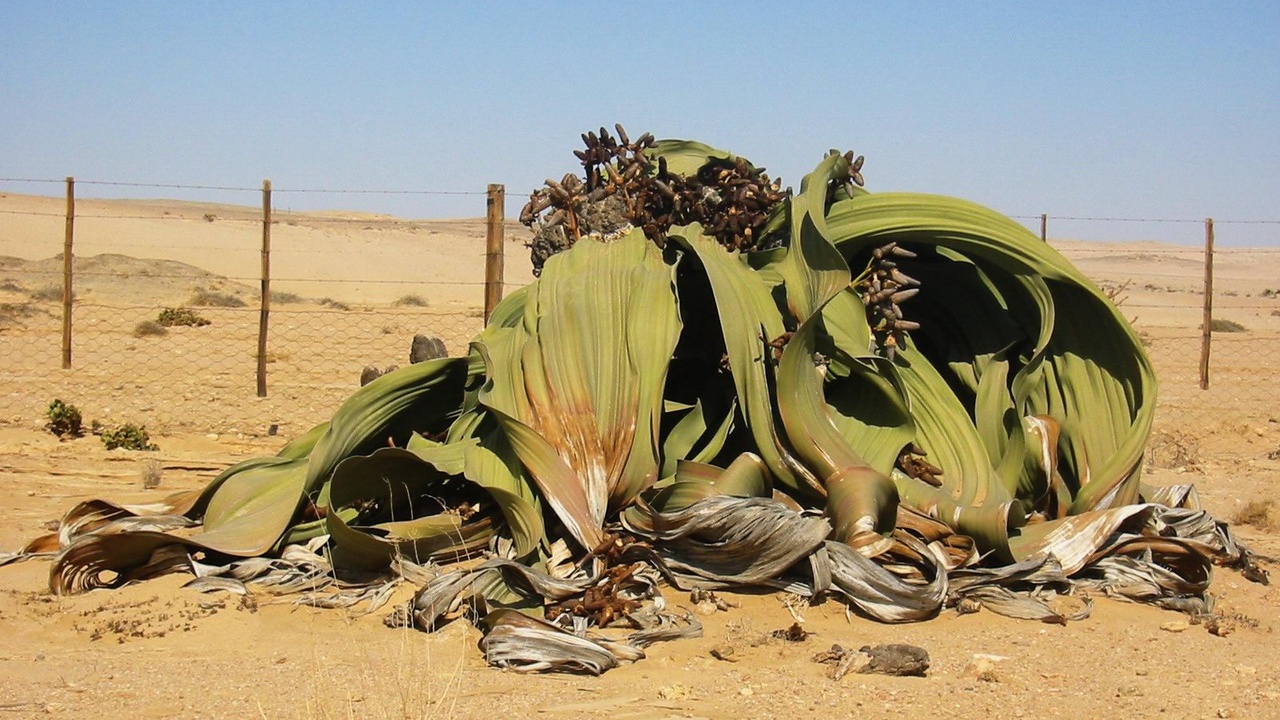
1. Welwitschia mirabilis — the ancient survivor
Welwitschia is a true Namib endemic known for its two continuously growing leaves, a stout woody stem, and extraordinary longevity; many individuals are estimated at over 1,000 years old (collections and age estimates date to mid-19th-century discoveries by Friedrich Welwitsch in 1859 and later descriptions—see Kew and historical accounts).
Restricted to coastal desert belts and adjacent gravel plains, Welwitschia has been a focus of physiological studies on drought tolerance and fog-harvesting. Tourists and researchers commonly view populations in the NamibRand and Skeleton Coast protected areas, and conservationists cite its narrow distribution when assessing protection priorities (NamibRand, SANBI).
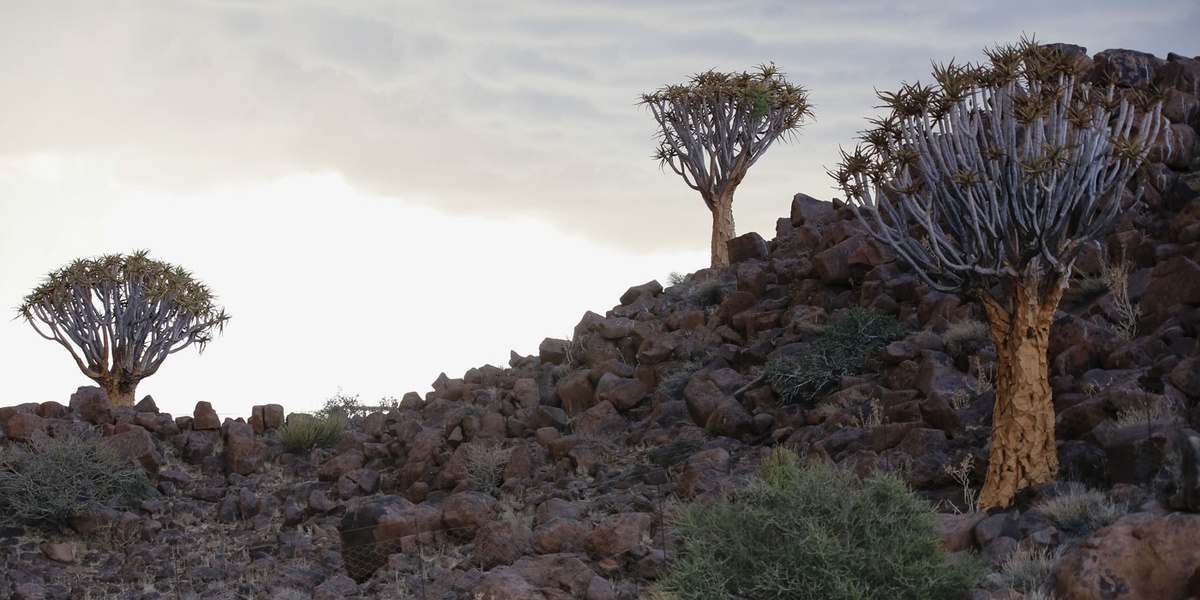
2. Quiver tree (Aloidendron dichotomum) — a silhouette of the dunes
The quiver tree, recently reclassified from Aloe dichotoma to Aloidendron dichotomum, is a tree-like aloe that punctuates rocky hills and valley rims. In favorable sites individuals can reach about 9–12 m in height, though growth is slow.
“Quiver tree forests” near Keetmanshoop and other southern locales are photographic draws and local symbols. Recent surveys show some populations are sensitive to rising temperatures and drought, so their decline is monitored as an indicator of local climate shifts (see regional vegetation studies via GBIF).
3. Nara melon (Acanthosicyos horridus) — food from the dunes
The nara is a spiny, perennial vine endemic to dune systems west of the Kuiseb River, where dense stands form locally important patches. The Topnaar (Trawl) people have harvested nara fruits for generations; traditional harvests are timed to ripening in late summer and autumn and can be a vital food source in lean years.
Beyond food, nara contributes to dune stabilization and supports birds and mammals (ostriches, dik-diks). Local management of nara beds around Walvis Bay and the Kuiseb is guided by community practice and conservation advice from national agencies (SANBI, Namibian Ministry of Environment reports).
4. Hoodia gordonii — a controversial medicinal succulent
Hoodia gordonii is a spiny, low-growing succulent long used by San communities as an appetite suppressant during hunts. Ethnobotanical reports document that local use predates scientific attention by centuries.
Research in the 1990s–2000s isolated a compound often referred to as “P57,” prompting commercial interest and high-profile licensing negotiations that raised questions about benefit sharing and bioprospecting. Namibia has since supported cultivation and regulated harvests to reduce pressure on wild populations while addressing ethical concerns (SANBI and peer-reviewed ethnobotany literature).
Survival Strategies and Adaptations
Plants in the Namib contend with extreme aridity, saline soils, shifting sands and intense sunlight. Strategies include fog capture, succulence, deep roots, dormancy and reflective surfaces; each mechanism has clear ecological consequences for water cycling, soil stability and community composition.
Where available, I cite fog and physiological studies to show how these adaptations operate in measurable terms (fog deposition rates, root depths, salt tolerances).
5. Stipagrostis sabulicola — dune grass that drinks fog
Stipagrostis sabulicola is a perennial dune grass that benefits from coastal fog by intercepting moisture on leaves and stems; controlled observations in NamibRand fog-monitoring plots show fog events can deposit several millilitres of water per square metre, enough to support short growth spurts after fog-rich months.
The grass binds shifting sand, reducing erosion, and becomes emergency forage for wildlife and livestock following fog or rare rain. NamibRand fog studies and vegetation monitoring document post-fog increases in green biomass used by grazers (NamibRand, regional research reports).
6. Lithops spp. — living stones that avoid detection
Lithops and related mesembs mimic stones with a low above-ground profile and, in some species, translucent “leaf windows” that admit light to buried photosynthetic tissue. This form reduces exposed surface area and thus evaporation.
These plants are sought after in the succulent trade, creating conservation concerns from wild collection. Propagation programs and nurseries—alongside national regulations and listings in trade databases—help reduce pressure on wild populations (GBIF, CITES guidance where relevant).
7. Atriplex and other halophytes — thriving where salts concentrate
Atriplex species and other halophytes occupy salt pans and coastal flats where soil electrical conductivity can be many times that of nearby non-saline soils. These plants use strategies such as salt sequestration into leaves or excretion via salt glands to tolerate saline conditions.
Halophytes stabilize soils, provide forage during dry periods and form distinct vegetation mosaics in coastal Namibia. Regional vegetation surveys document Atriplex stands on coastal flats and inland pans, and experimental work quantifies tolerance across salinity gradients (SANBI, salt-tolerance literature).
8. Euphorbia virosa and other ‘gifboom’ species — chemical defense in the desert
Euphorbia virosa, commonly called “gifboom,” produces a toxic latex that deters herbivores and has been used historically in arrow poisons. The plant’s chemical defenses reduce browsing pressure and thus increase survival where resources are scarce.
These toxins are a management concern for pastoralists and require awareness during grazing and fuelwood collection. Ethnobotanical and veterinary reports provide guidance on safe handling and on how traditional knowledge informed historical uses.
Ecological Roles and Human Uses
Desert plants supply forage, medicine, building materials and cultural identity. Measurable links exist between plant resources and livelihoods — for example, community-managed nara harvests around the Kuiseb River — and policies now aim to balance use with conservation.
9. Camelthorn (Vachellia erioloba) — an ecosystem engineer
Camelthorn trees form keystone elements across arid southern Africa. Mature canopies can spread several metres, and many trees live for decades to centuries; their deep roots access groundwater and support understory plants during dry spells.
Pastoralists rely on camelthorns for shade and occasional browse, while birds and mammals use them for nesting and shelter. Overharvesting for fuelwood and land-use change are documented threats, making local management and sustainable-use policies important (regional forestry and conservation reports).
10. Salvadora persica and other multipurpose shrubs — local medicine and tools
Salvadora persica, the toothbrush tree, is used as a chewing stick for oral hygiene and has documented antibacterial compounds in phytochemical studies. Rural communities also use such shrubs for medicinal teas, fencing and small tools.
These multipurpose shrubs provide low-cost health and livelihood benefits; research (including WHO- and university-linked studies) supports some traditional uses, and local small enterprises sometimes add value through crafts or processing.
11. Mesembs and succulents — horticulture, commerce, and conservation
Small succulents such as Conophytum and Mesembryanthemum are popular in horticulture and generate income through nurseries and export. However, wild-collection has driven declines in some species, prompting propagation programs and regulation to protect remaining populations.
When horticulture emphasizes cultivated stock and benefit-sharing, it can reduce pressure on wild plants and support local livelihoods; national agencies and NGOs often collaborate on propagation initiatives and trade monitoring.
12. Desert ephemerals — the boom-and-bust wildflowers after rain
Ephemeral annuals germinate after rare rains and complete their life cycle in days to weeks, relying on long-lived seed banks that persist for years between events. Mass bloom years, recorded intermittently in Namibian conservation reports, can carpet plains and dunes and draw tourists.
These blooms are critical for pollinators and for short-term soil cover that reduces erosion. Park reports and field studies document boom years and the species groups involved, emphasizing the role of seed-bank resilience in desert ecosystems.
Summary
- Welwitschia’s extreme longevity (>1,000 years) and fog-assisted species like Stipagrostis show how water-limited systems persist under very low rainfall—sometimes under 20 mm annually.
- Many iconic plants are narrow endemics (Welwitschia, nara, quiver tree) that support tourism, research and cultural practices while needing targeted conservation in places like NamibRand and the Skeleton Coast (NamibRand, SANBI).
- Adaptations—fog harvesting, succulence, salt management, toxic latex—are mechanistic solutions with measurable outcomes (fog deposition rates, root depth access to groundwater, documented salinity tolerances) that underpin ecosystem services.
- Support conservation and responsible use: consult authoritative resources (SANBI, Kew, GBIF), favor cultivated stock over wild collection, and back community-led programs that protect both people and the unique flora of namibia.