
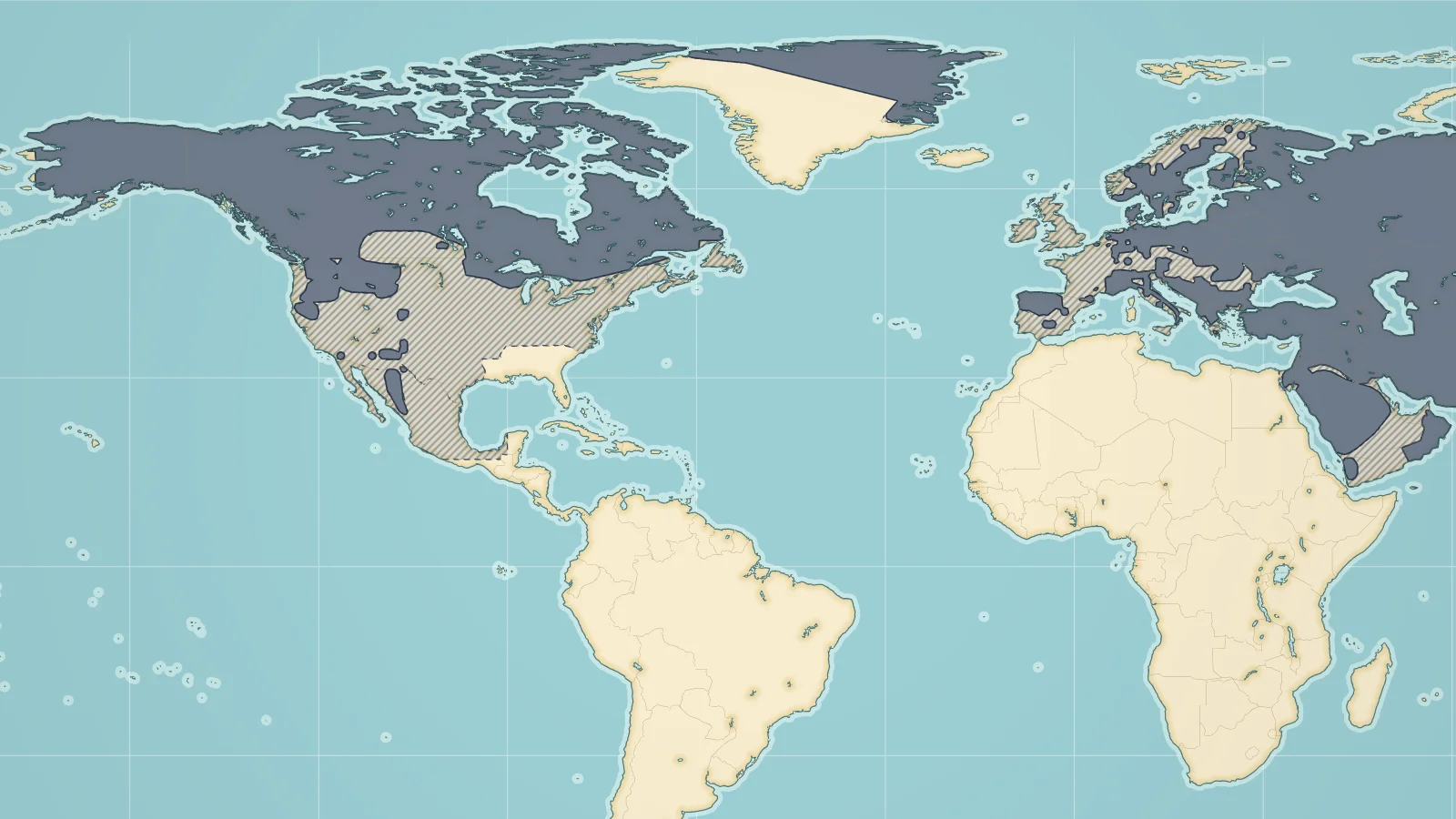
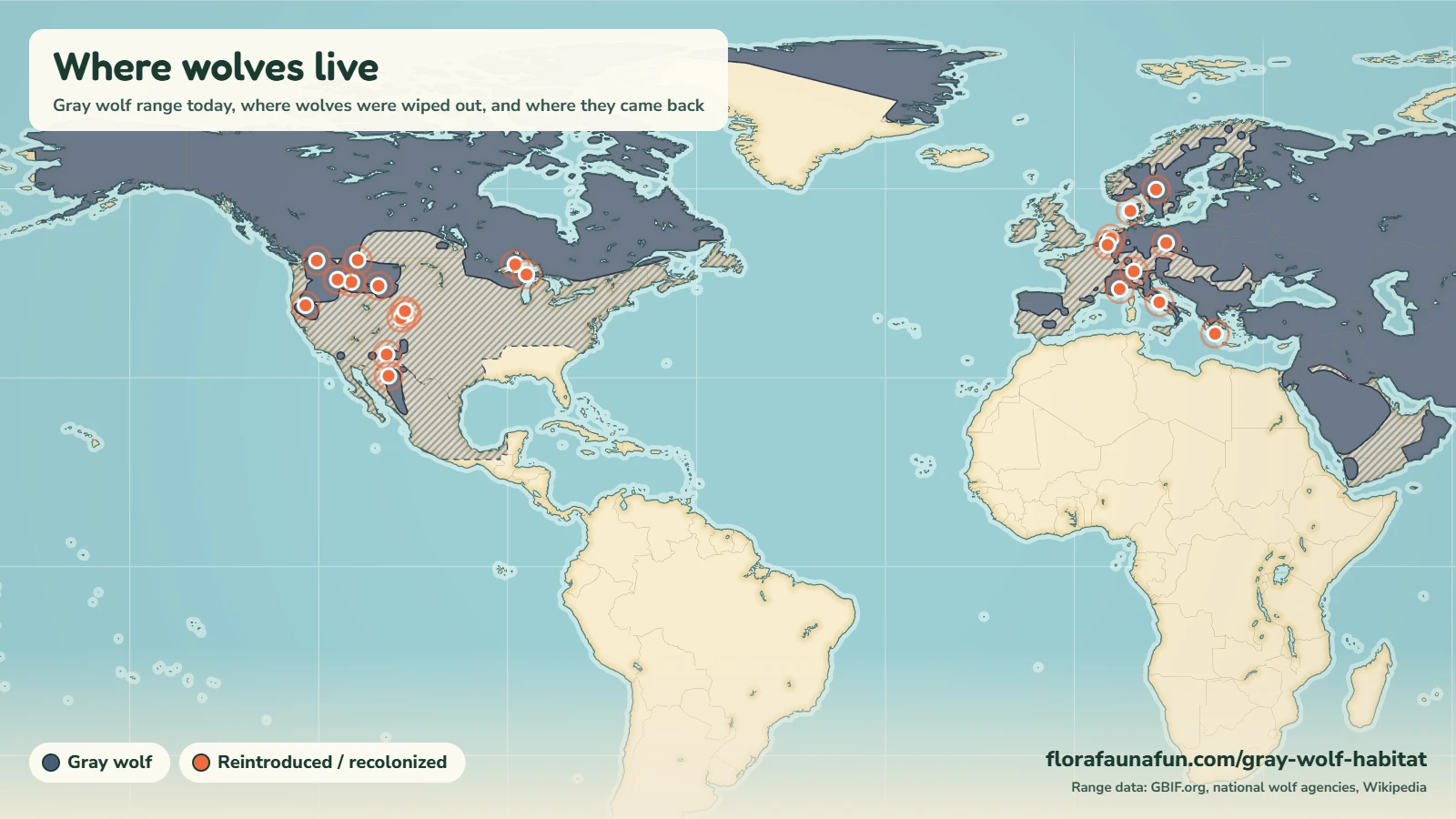
Gray wolves (Canis lupus) live across the Northern Hemisphere: in Canada, Alaska and parts of the lower 48 states, in Europe from Portugal to Russia, and across Asia from Turkey and Arabia to Mongolia, China and India. About 200,000 to 250,000 remain in the wild. Their range once covered most of the Northern Hemisphere, and the map above shows where wolves live now, where they disappeared and where they have been put back.
More maps of where animals live are on the animal habitat maps page.
Gray wolf habitat at a glance
| Region | Where wolves live | Habitat | Roughly how many |
|---|---|---|---|
| North America | Canada, Alaska, the Great Lakes, Northern Rockies, Pacific Northwest, California, Colorado, Southwest | Boreal forest, tundra, mountain forest, plains edge | Canada 50,000 to 60,000; Alaska 7,000 to 11,000 |
| Europe | Russia, the Carpathians and Balkans, Italy, Iberia, Scandinavia, and now Germany, France and the Low Countries | Mountain and lowland forest, farmland mosaics | About 21,500 outside Russia and Belarus |
| Russia, Central Asia and East Asia | Siberia, Kazakhstan, Mongolia, China, the Tibetan plateau | Tundra, taiga, steppe, desert, high plateau | Tens of thousands |
| Middle East and South Asia | Turkey, Iran, Arabia, Israel, India, Pakistan, Nepal | Scrub, grassland, desert edge, high Himalaya | India about 3,170 adults |
The IUCN assessed the species as Least Concern in 2018. That global label hides large gaps: wolves are gone from Western Europe's lowlands, the British Isles, Japan, most of the contiguous United States and much of Mexico.
Where gray wolves live today
North America
Canada holds most of the continent's wolves, an estimated 50,000 to 60,000 across ten provinces and territories. Wolves are absent from Nova Scotia, New Brunswick and Prince Edward Island. Newfoundland's island wolf was extinct by 1911, though wolves live on the Labrador mainland.
In the United States, Alaska has the most wolves, 7,000 to 11,000. In the lower 48 they live in four regions. The Great Lakes population is the largest: Minnesota has about 2,400, Wisconsin about 1,160 and Michigan's Upper Peninsula at least 762. The Northern Rockies, in Montana, Idaho and Wyoming, have about 2,100 to 2,500. The Pacific Northwest and California have a growing population: Washington counted at least 270 wolves at the end of 2025, Oregon at least 230, and California had 12 packs in March 2026. The Southwest has the Mexican wolf, a small gray wolf subspecies, with at least 319 in Arizona and New Mexico at the end of 2025. Colorado now has four packs. As of October 2026, gray wolves in the lower 48 outside the Northern Rockies remain protected under the Endangered Species Act, listed as threatened in Minnesota and endangered elsewhere, and a petition to delist them was filed in August 2026.
Europe
Europe has about 21,500 wolves outside Russia and Belarus, and the population has grown for decades. The core is in Romania, the Balkans, Poland, the Baltic states and the Italian Apennines. Spain and Portugal keep a separate Iberian population in the north-west. Italian wolves spread into the Alps and reached France in 1992. Wolves from Poland recolonized eastern Germany from 2000, and Germany had about 219 packs in 2024/25. Wolves have since reached Belgium, the Netherlands and Denmark. Sweden and Norway share a small Scandinavian population of about 390 that descends mainly from three founders.
Russia, Central Asia and East Asia
Russia has the largest wolf population in Eurasia, around 67,000 by one 2021 estimate. Mongolia has an estimated 10,000 to 20,000 wolves and Kazakhstan about 13,000 by a 2018 estimate. Wolves also live across China's north and west, including the Tibetan plateau, where the Himalayan (Tibetan) wolf lives mostly above 4,000 m. Japan and South Korea lost their wolves in the 1900s.
The Middle East and South Asia
Wolves live in Turkey, Iran, Israel, Saudi Arabia, Oman and Yemen, and from Pakistan across India. The Arabian and Indian wolves are smaller than northern wolves. India has about 3,170 adult Indian wolves, mostly in the semi-arid grasslands and scrub of Madhya Pradesh, Rajasthan, Gujarat and Maharashtra. Himalayan wolves live in the high mountains of India, Nepal, Bhutan and China. Both lineages are debated: some scientists treat the Himalayan wolf and the Indian wolf as separate species, while the IUCN canid specialists still class them as gray wolf subspecies.
Gray wolf habitat types
Gray wolves occupy forests, wetlands, shrubland, grassland, tundra, pasture, desert and rocky mountain slopes, from sea level to about 3,000 m. Four things decide whether a habitat works.
- Prey: wolves live on large hoofed animals. In Eurasia that means moose, red deer, roe deer and wild boar. In North America it means elk, moose, caribou and deer. Where those animals are gone, wolves switch to livestock or small prey, or leave.
- Space: a pack holds a territory of hundreds of square kilometers in poor country and much less where prey is dense.
- Cover for dens: pups are born underground or under roots and rocks, and the den needs to be undisturbed.
- Low persecution: habitat quality matters less than whether people allow wolves to survive. Wolves thrive in farmland mosaics in Italy and Poland and vanish from empty forest where they are shot on sight.
Boreal forest and taiga
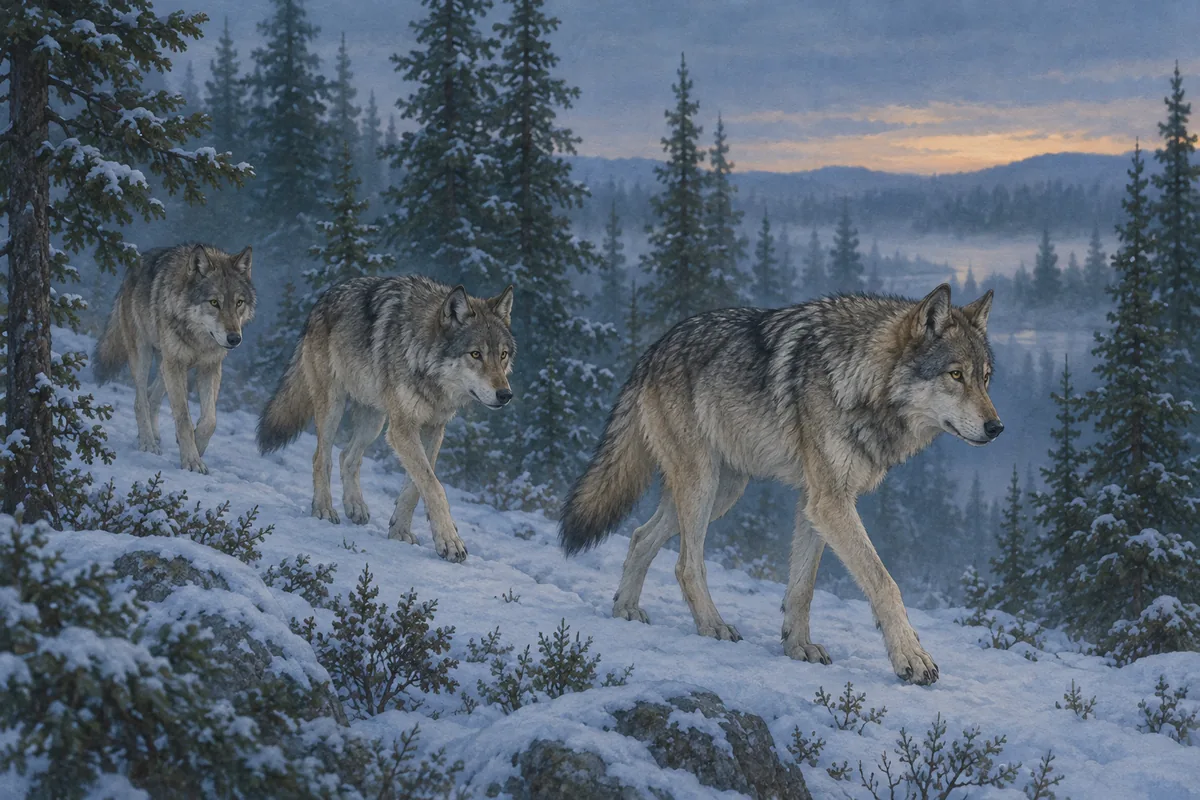
The spruce, pine and larch forests of Canada, Alaska, Scandinavia and Siberia hold the largest unbroken wolf populations. Moose, elk and caribou supply the prey, and few roads mean few conflicts. Minnesota and Michigan's Upper Peninsula carry this forest type into the United States.
Tundra
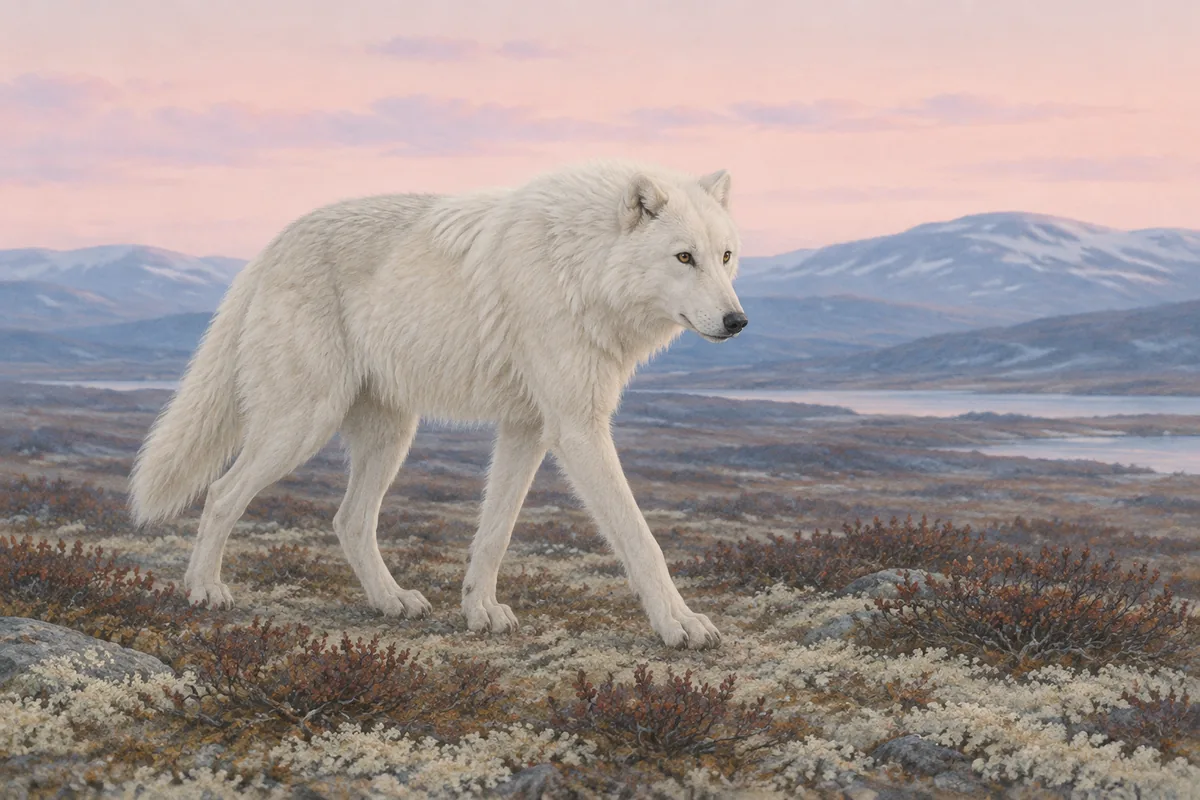
Wolves live north of the tree line in Arctic Canada, Alaska, Greenland and Siberia. Tundra packs follow migrating caribou and hunt muskoxen, and they roam very large territories because prey is thin. Arctic wolves in Nunavut and Greenland are often white.
Steppe and grassland
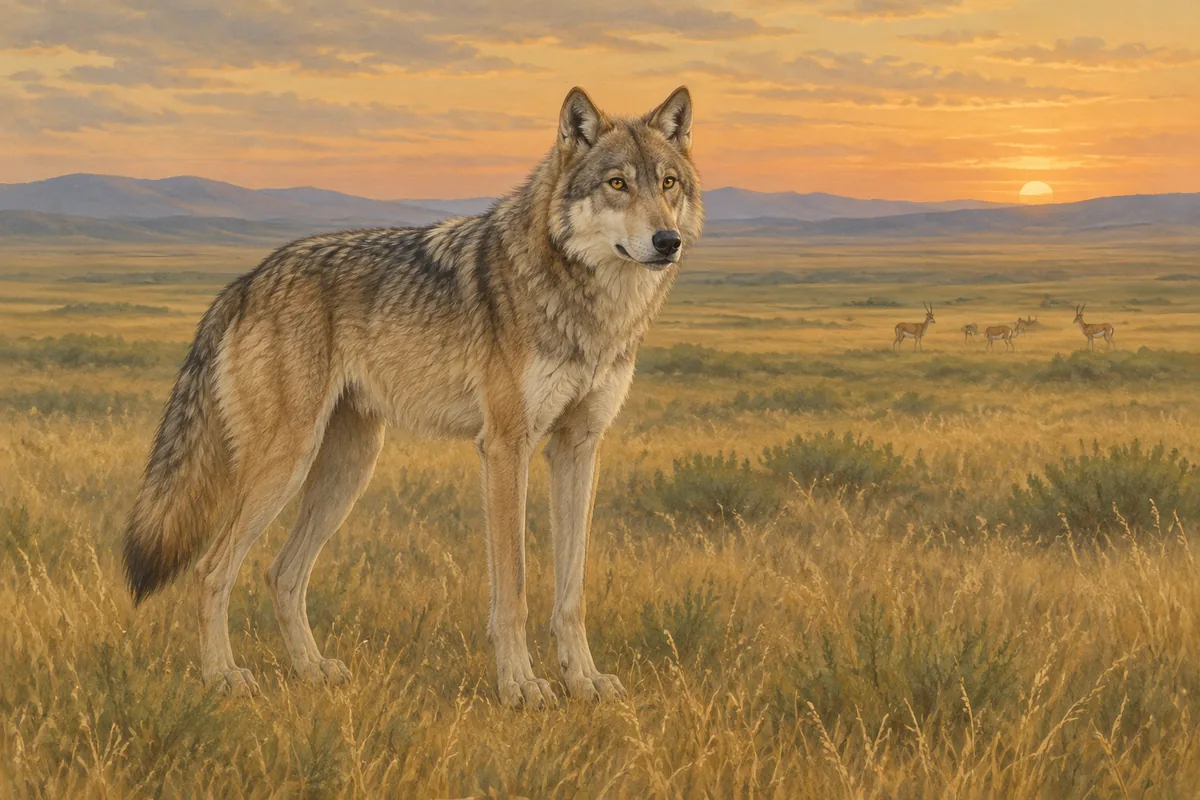
Wolves once hunted bison across the North American plains. Today the great grassland populations are in Mongolia, Kazakhstan and southern Russia, where they take gazelle, saiga and domestic livestock. India's wolves live in a drier version of the same habitat, a mix of grassland, scrub and farmland.
Mountains and temperate forest
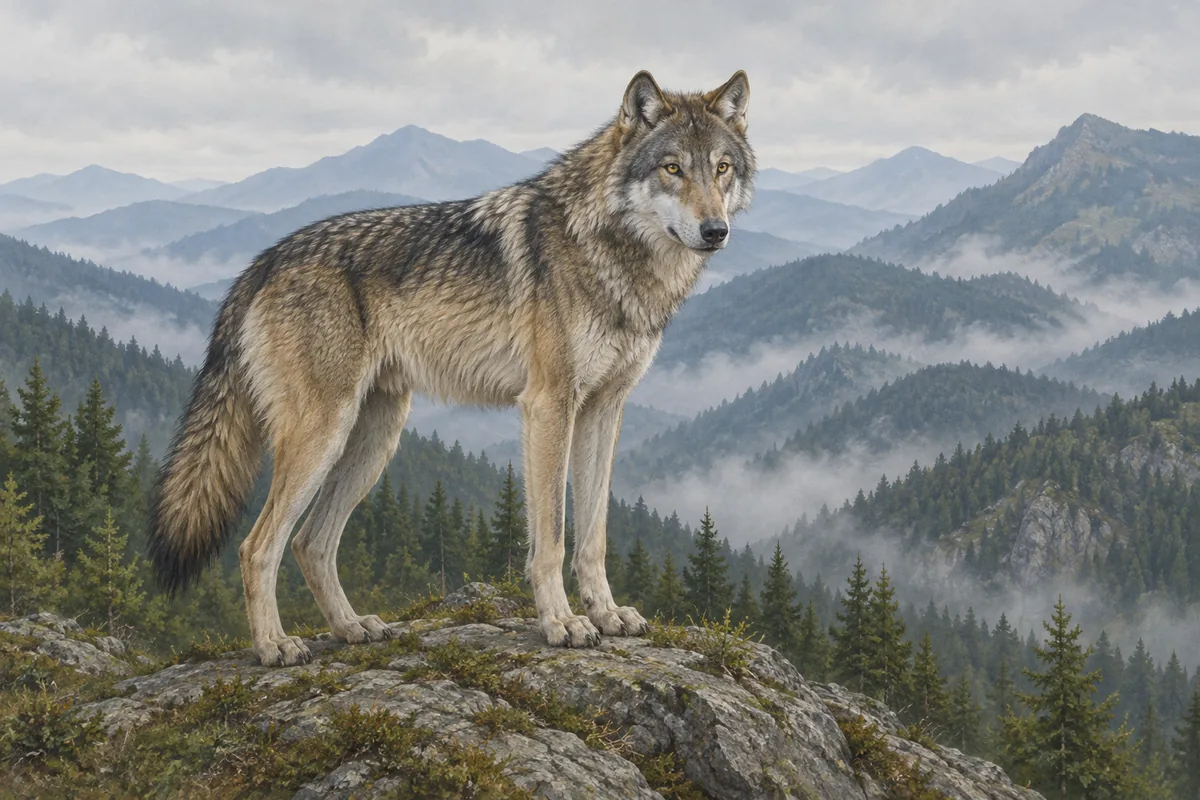
Mountains saved wolves in many countries. The Italian Apennines kept 100 to 110 wolves in 1973, and from there they spread into the Alps and France. Romania's Carpathians, Spain's Cantabrian range and the Rockies work the same way. Himalayan wolves live mostly above 4,000 m. Temperate forests in Poland, Germany and the Balkans hold wolves wherever deer and boar are common.
Desert
The small Arabian wolf lives in desert and semi-desert from Israel and Jordan to Saudi Arabia, Oman and Yemen. At about 20 kg it is among the smallest wolves. It eats rodents, hares, small gazelles and ibex, and takes livestock and refuse near settlements. It is far less common than the wolves of the north.
Where wolves disappeared and why
Wolves lost most of their former range to hunting, poison, bounties and the loss of the deer, elk and bison they hunted. The record is well documented in some places:
- England: gone by about 1500.
- Scotland: traditionally dated to about 1680.
- Ireland: the last wild wolf is said to have been killed in 1786.
- Japan: the Hokkaido wolf died out in 1889 and the Honshu wolf in 1905. Scientists still debate whether the small Honshu wolf was a gray wolf subspecies.
- Yellowstone: the last wolves were killed in 1926.
- Contiguous United States: by the early 1900s wolves survived only in northeast Minnesota.
- Mexico: wolves disappeared from the wild in the 1970s. Five wolves caught between 1977 and 1980 founded the captive breeding program.
- Scandinavia: extinct by the late 1960s.
Wolves are still killed mainly over livestock losses, and the pressure is strongest where they have no legal protection. In Kazakhstan hunters are paid a bounty for each wolf killed.
Reintroductions and the comeback
Some of the sharpest recoveries were planned, others were wolves walking back on their own.
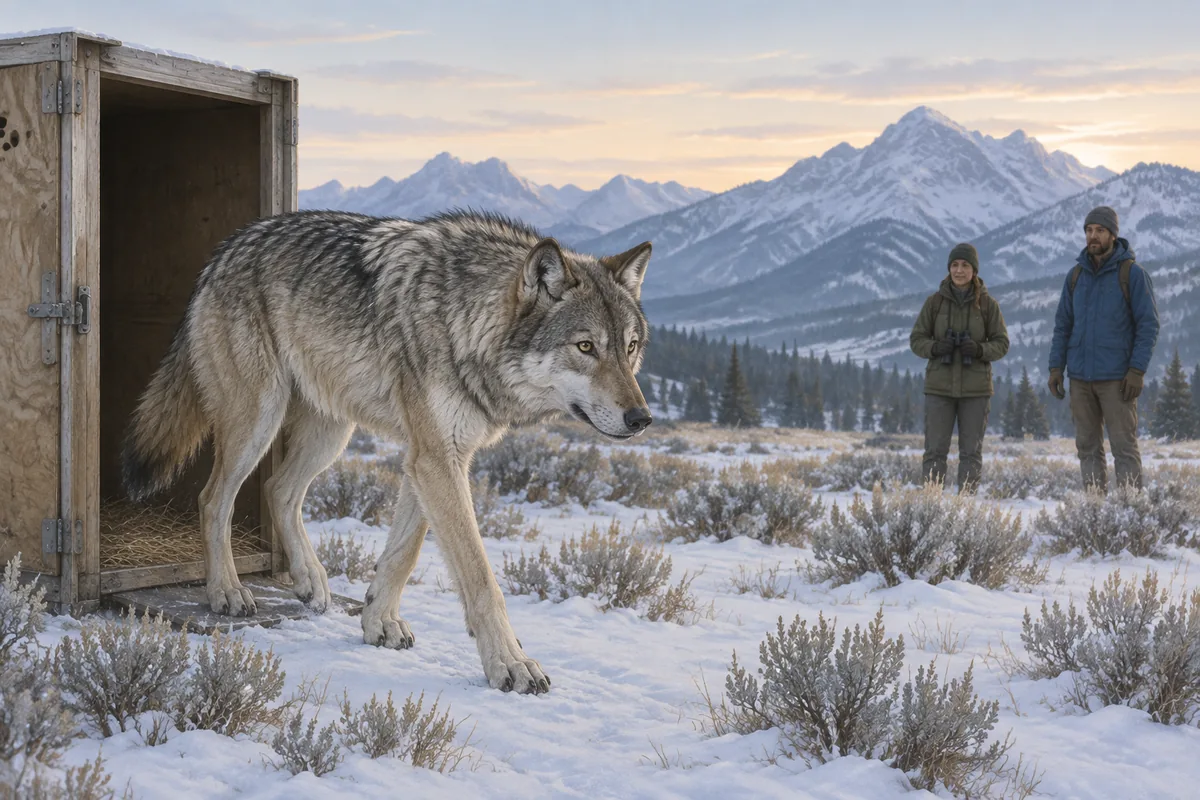
- Yellowstone and central Idaho, 1995 and 1996: 31 wolves from Canada went to Yellowstone and about 35 to central Idaho. Today the Northern Rockies hold about 2,100 to 2,500 wolves.
- Mexican wolf, 1998: eleven captive-bred Mexican wolves were released in Arizona. The first Mexican release followed in 2011, and about 45 wild wolves live in Mexico.
- Colorado, 2023 and 2025: Colorado released 10 wolves from Oregon in December 2023 and 15 from British Columbia in January 2025, after a 2020 voter initiative. No releases have been announced for 2026.
- Isle Royale, 2018 and 2019: 19 wolves were moved to the Michigan island park, whose wolf population had nearly died out.
- California, 2011: a male known as OR-7 walked from Oregon, the first wolf in California since 1924. California had 12 recognized packs by March 2026.
- Washington and Oregon, 2008: wolves from Idaho formed the first packs in decades, including Oregon's Imnaha pack. Oregon's last bounty had been paid in 1947.
- France, 1992: wolves from Italy were confirmed in the Mercantour, the first in France since 1937. About 1,082 live in France today.
- Germany, 2000: wolves from Poland bred in Lusatia, the start of a population of about 219 packs.
- Switzerland, Denmark, the Netherlands and Belgium: the first Swiss pack bred in 2012, Denmark's first pack in about 200 years formed in 2017, the Netherlands' in 2019, and Belgium's wolves first bred in 2019.
Wolves are protected in different ways in each country. In 2025 the Bern Convention (from 7 March) and the EU (from 14 July) lowered wolf protection from strictly protected to protected, which lets member states manage numbers more easily. Sweden began a licensed hunt on 2 January 2025 as part of a plan to halve its wolf population.
Frequently asked questions
Where do gray wolves live in the United States?
Gray wolves live in Alaska, the Great Lakes states (Minnesota, Wisconsin and Michigan's Upper Peninsula), the Northern Rockies (Montana, Idaho and Wyoming), the Pacific Northwest (Washington and Oregon), northern California and Colorado. Mexican wolves live in Arizona and New Mexico. Alaska has the most wolves, 7,000 to 11,000, and Minnesota has the most in the lower 48.
Are there wolves in the UK?
No. Wolves were gone from England by about 1500 and, by tradition, from Scotland by about 1680. The last wild wolf in Ireland is said to have been killed in 1786. Wild wolves live in none of the British Isles today.
Are there wolves in Texas?
No. Mexican wolves once lived in West Texas, and the last wild ones were killed in 1970. The nearest wild wolves live in the mountains of Arizona and New Mexico.
Are there wolves in Colorado?
Yes. Colorado released 10 wolves in December 2023 and 15 more in January 2025, and wolves from Wyoming had also moved into the north of the state. Four packs were confirmed by mid-2026. No further releases have been announced for 2026.
Are there wolves in Japan?
No. The Hokkaido wolf died out in 1889 and the Honshu wolf in 1905. Scientists still debate whether the Honshu wolf was a gray wolf subspecies or something distinct.
Are there wolves in Africa?
Not gray wolves. The wolf-like animals of Africa are the African golden wolf, which lives across North Africa and the Sahel, and the Ethiopian wolf, an Endangered species of the Ethiopian highlands with only about 360 to 440 adults. Both are separate species. Rare Arabian gray wolves may live in Sinai in Egypt.
How many gray wolves are left?
About 200,000 to 250,000 gray wolves live in the wild. Russia has about 67,000, Canada 50,000 to 60,000 and Europe outside Russia and Belarus about 21,500. The IUCN lists the species as Least Concern, although some regional populations, such as the Mexican wolf, remain at risk.
What is a gray wolf's habitat?
Gray wolves live in boreal forest, tundra, temperate forest, mountains, steppe, grassland and desert. They need large prey such as deer, elk or moose, wide territories and enough tolerance from people to survive.
Are red wolves gray wolves?
No. The red wolf (Canis rufus) is usually treated as a separate species, and the American Society of Mammalogists recognized it as one in 2021. It lives wild only on the Albemarle Peninsula in North Carolina, with about 23 to 25 wild animals in 2023. The red wolf, the Ethiopian wolf and the African golden wolf are not gray wolves. The eastern wolf of Ontario and Quebec is debated: some scientists call it a separate species and others a gray wolf subspecies or hybrid.