
 Read the guide
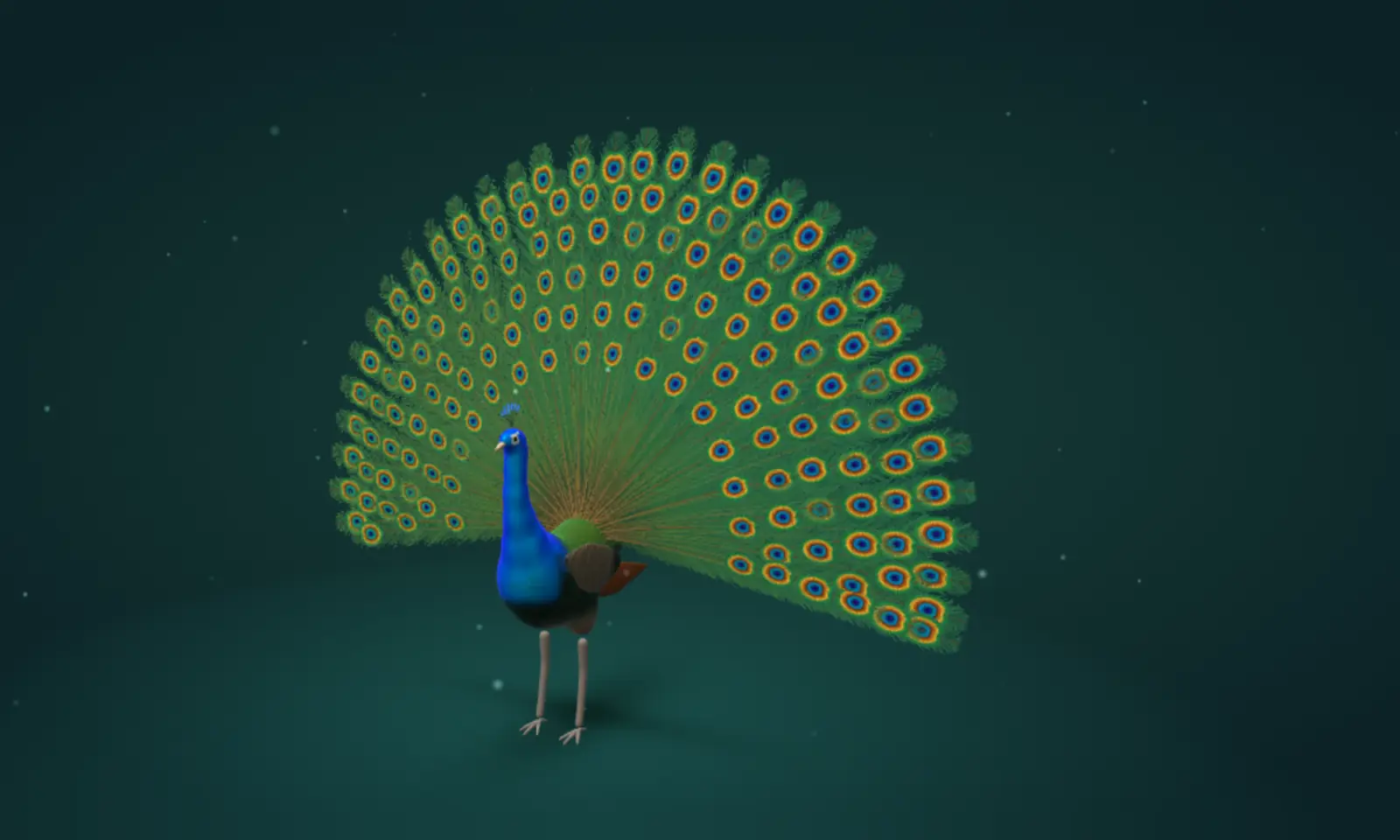
 The model above is a male Indian peafowl (Pavo cristatus), the blue peacock found in parks, zoos and gardens around the world and the national bird of India. Drag to turn it, pinch or hold Ctrl and scroll to zoom, and tap any label to read about that part. The Fan tail button raises the train into a display, and Shake plays the train-rattle peacocks use when courting. The buttons at the top of the controls switch between the peacock, the peahen and a white peacock.
Parts of a peacock
The model labels 12 parts. Here is what each one is and what it does.
Crest
A fan of about two dozen feathers on top of the head. Each one is a bare black shaft tipped with a blue-green tuft. Peahens have the same crest in brown and green. A 2018 study found that crest feathers vibrate at the same frequencies as a displaying male's train, which suggests the crest may help peafowl sense each other's displays.
Eye and face
The white stripe above the eye and the white crescent below it are bare skin, not feathers. The eyes sit on the sides of the head and give the bird a wide view for spotting predators.
Beak
Short, strong and slightly hooked. Peafowl are omnivores. They eat seeds, grain, berries, flower buds and insects, and they kill and eat small lizards, frogs and snakes.
Neck and breast
The blue of the neck is structural colour. It comes from tiny rods of melanin arranged in a regular lattice inside each feather barbule, spaced so they reflect blue light. There is no blue pigment. That is why the colour changes as you rotate the model, and why a crushed feather turns brown.
Back
Green feathers with bronze and black edges cover the back in a scale pattern. The train grows from the lower back.
Wings
The folded wing shows buff coverts with fine black bars over black secondary feathers. Peafowl fly well over short distances and fly up into tall trees every evening to roost.
Primary feathers
The ten outer flight feathers of each wing are chestnut. They are easiest to see when a peacock takes off, or when he lowers his wings during display.
Train
The train is not the tail. It is made of more than 200 greatly lengthened upper tail coverts, the feathers that cover the base of the tail on other birds. An Indian peacock is 100 to 115 cm long without it and 195 to 225 cm with it. He sheds the whole train after the breeding season and grows a new one every year.
Eyespot
Nearly every train feather ends in an eyespot, or ocellus: a purplish-black heart-shaped centre inside rings of blue, copper, green and bronze. Hooks on the barbs lock the eyespot together, so it stays sharp while the loose outer barbs move.
True tail
The real tail is about 20 stiff grey-brown feathers under the train. During display it props the fan up from behind, and its feathers striking the train produce the rattle.
Legs and spurs
Peafowl walk most of the day and run before they fly. Adult males grow a sharp spur on the back of each leg for fighting other males. Peahens usually have none.
Feet
Three toes point forward and one points back. Peafowl scratch the ground for food, dust-bathe in loose soil and grip branches with the hind toe when they roost.
How a peacock displays
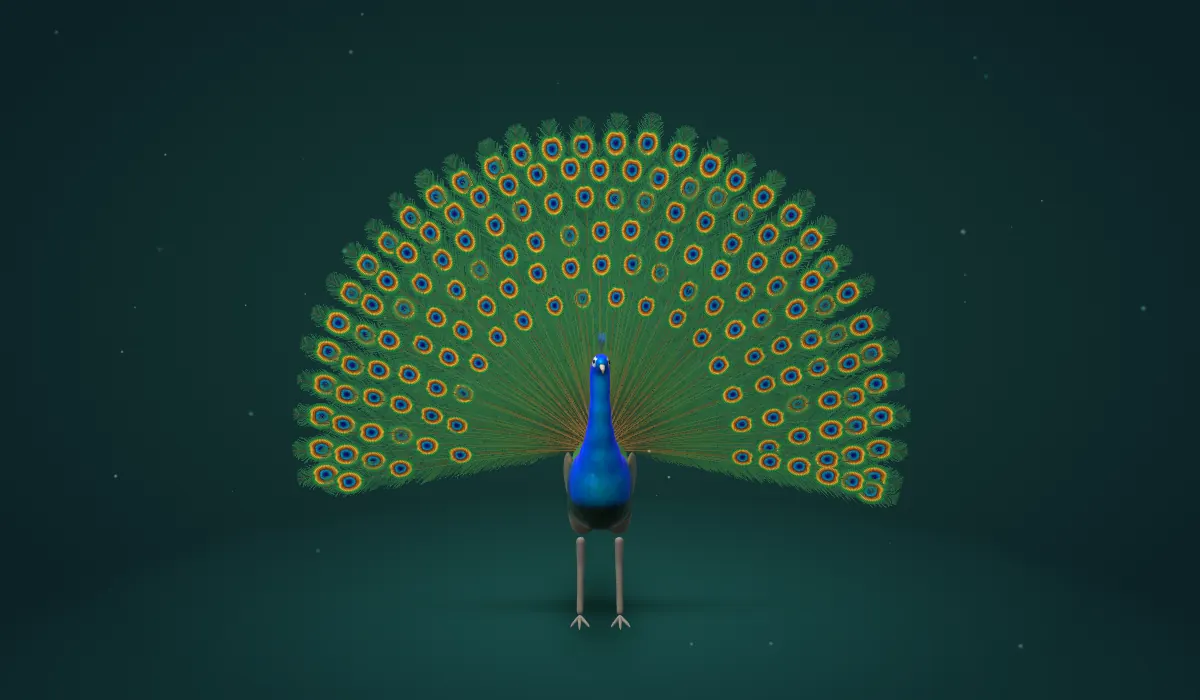
When a male courts a female, he raises the train into a fan about 1.5 m tall, lowers his wings and turns to face her. Then he vibrates the train. High-speed video measured this train-rattling at about 26 shakes per second. The train feathers resonate at that rate, so the display costs less energy than it looks. Through all of it, the eyespots stay almost still while the rest of each feather shimmers around them. Press Fan tail and then Shake to see a version of it on the model.
Peacock vs peahen
"Peacock" strictly means the male. The female is a peahen, and together they are peafowl. Switch the model to Peahen to compare them.
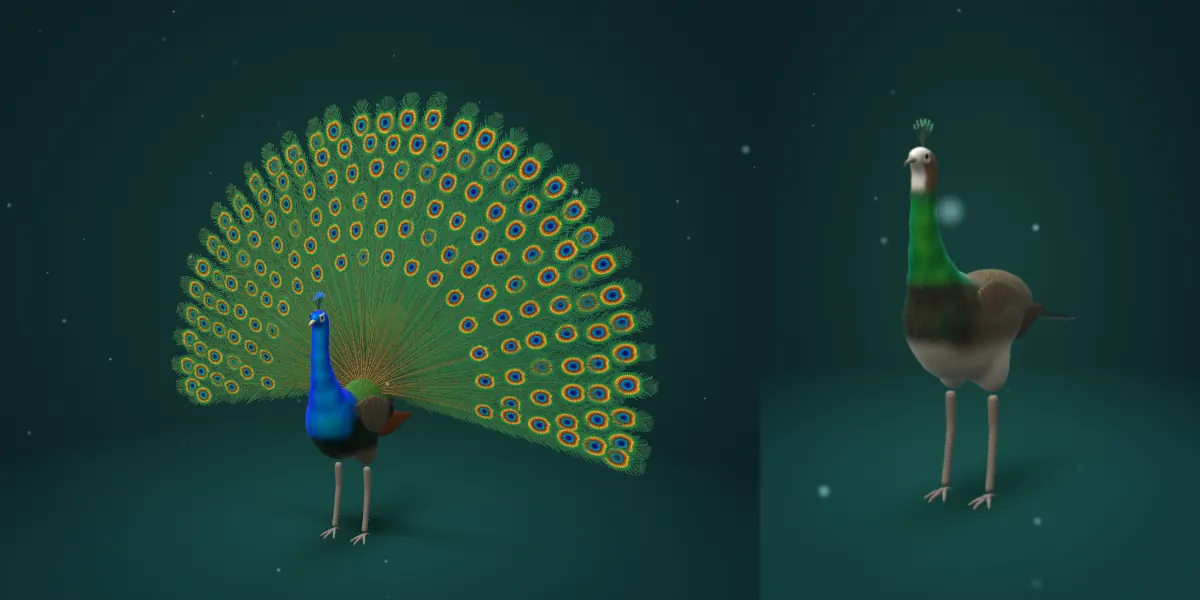
| Peacock (male) | Peahen (female) | |
|---|---|---|
| Train | More than 200 long eyespot feathers | None |
| Neck | Iridescent blue | Metallic green lower neck |
| Face and throat | Blue with white eye patches | White face and throat |
| Body | Green back, black-green belly | Grey-brown back, whitish belly |
| Length | 100 to 115 cm (195 to 225 cm with train) | About 95 cm |
| Weight | 4 to 6 kg | 2.75 to 4 kg |
| Spurs | Yes | Usually not |
The peahen's plain colours hide her while she sits on 3 to 6 eggs in a scrape on the ground for about 28 days.
White peacocks
A white peacock is an Indian peafowl with leucism, a genetic condition that stops melanin from reaching the feathers. Because the blue and green come from melanin structures, the whole bird turns white, including the eyespots, which show only as faint shapes. Leucistic birds are not albinos. Their eyes keep their colour, while albino animals have pink or red eyes. White peafowl are bred in captivity and are rare in the wild. Choose White in the controls to see one.
Frequently asked questions
Which peacock is shown in this 3D model?
The Indian peafowl, Pavo cristatus, the blue peacock most people picture. The other two peafowl species are the green peafowl of Southeast Asia and the Congo peafowl of central Africa.
How many feathers are in a peacock's train?
More than 200. They are upper tail coverts, and nearly all of them end in an eyespot. The true tail underneath has only about 20 feathers.
Why do peacocks shake their tail feathers?
To court peahens. The male vibrates his raised train about 26 times per second, which makes the feathers shimmer and rustle while the eyespots stay still.
Do peacocks lose their tail feathers?
Yes. Peacocks moult the entire train once a year, after the breeding season, and grow a new one before the next.
Can peacocks fly?
Yes. They fly short distances and fly up into tall trees to roost at night, even with a full train.
Are white peacocks albino?
No. White peacocks are leucistic Indian peafowl. Leucism removes pigment from the feathers but not from the eyes, so white peafowl do not have the pink or red eyes of albinos.
Do peahens have a tail?
Yes. Peahens have a short brown tail with pale tips, but no train.