
 Read the guide
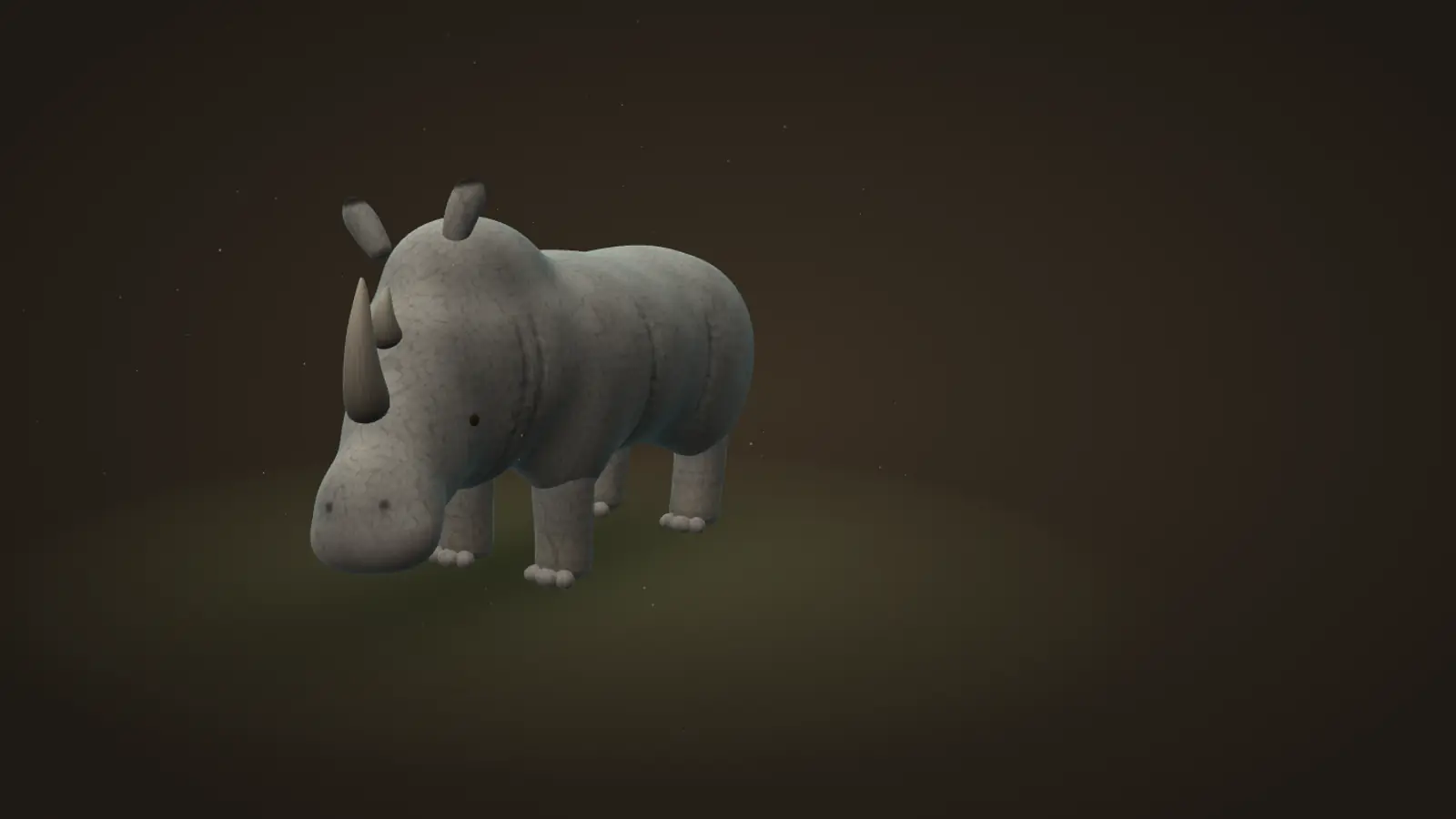
 The model above is a life-size white rhinoceros (Ceratotherium simum), the largest of the five living rhino species. Drag to turn it, pinch or hold Ctrl and scroll to zoom, and tap any label to read about that part. The Black rhino button swaps in the smaller black rhinoceros (Diceros bicornis) so you can compare the two African species, and Size puts a 1.75 m adult next to the animal for scale.
To see where all five rhino species live in the wild, open the rhino habitat map. More animals are on the animal 3D models page.
Parts of a rhinoceros
The model labels 11 parts. Here is what each one is and what it does.
Front horn
The long front horn is solid keratin, the same protein as hair and fingernails. It has no bone inside and is not fused to the skull. On a white rhino it is usually 60 to 90 cm long, and the longest on record measured more than 1.5 m. It keeps growing all its life at roughly 5 to 8 cm a year.
Rear horn
Both African rhinos have a second, shorter horn behind the first, up to about 56 cm long. It grows more slowly, at roughly 2.5 to 5 cm a year. The greater one-horned rhino of India and Nepal and the Javan rhino have only one horn.
Nostrils
Rhinos rely on smell more than sight. They read dung piles and scent marks left by other rhinos to learn who lives nearby, and they use smell to pick up danger before they can see it.
Lip
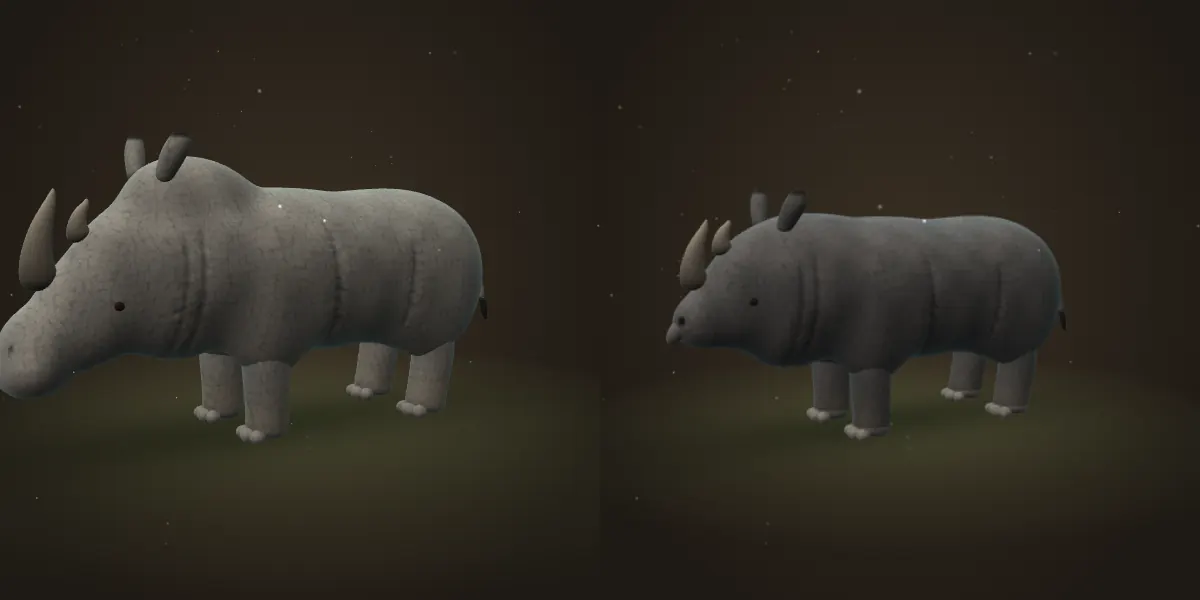
The lip is the quickest way to tell the two African species apart. The white rhino has a wide, flat, square lip that crops short grass like a lawnmower. The black rhino has a pointed, hooked upper lip that grips leaves and twigs, almost like a short finger. Switch the model to Black rhino to see the difference.
Eye
The eyes are small and set on the sides of the head. Rhino eyesight is poor, and they notice moving objects much better than still ones. A person standing still downwind can be hard for a rhino to pick out.
Ears
The ears are tall tubes with a fringe of hair on the rim. Rhinos hear well and turn their ears toward sounds, which matters for an animal that cannot see far.
Neck and hump
The white rhino carries its heavy head low, close to the grass, and the hump on the back of its neck helps hold it there. The hump is mostly muscle and a thick ligament, not fat. The black rhino has no hump and holds its shorter head higher, at the height of the shrubs it eats.
Skin
Rhino skin is 1.5 to 5 cm thick and built from layers of collagen, with deep folds behind the shoulders, in front of the thighs and around the neck. It is still sensitive. It can sunburn and attracts biting insects, so rhinos wallow in mud, which cools them and dries into a protective coat. Apart from the ear fringes, the eyelashes and the tail tip, adult African rhinos are almost hairless.
Legs
Short, thick legs carry about 2 tonnes on a male white rhino. Even so, rhinos are fast. White rhinos can run at about 40 to 50 km/h in short bursts and black rhinos at up to about 55 km/h.
Feet
Every living rhino has three toes on each foot, each ending in a broad nail. The middle toe carries most of the weight, and the footprint shows three rounded lobes.
Tail
The tail is about 70 cm long on a white rhino and ends in a tuft of stiff black hair. White rhinos also mark their range with shared dung piles, called middens, which tell passing rhinos who has been there.
White rhino vs black rhino
Both species are grey. The names have nothing to do with colour. A popular story says "white" comes from the Dutch word wijd, meaning wide, after the white rhino's broad mouth, but historians who looked for evidence found none, and the real origin of the name is unknown.
| White rhino | Black rhino | |
|---|---|---|
| Lip | Wide and square | Pointed and hooked |
| Diet | Grazer (grass) | Browser (leaves, twigs, shrubs) |
| Head | Long, carried low | Shorter, carried higher |
| Neck hump | Yes | No |
| Shoulder height | 1.6 to 1.86 m | 1.32 to 1.8 m |
| Weight | About 1,600 to 2,300 kg | About 800 to 1,400 kg |
| Social life | Females and young live in groups of up to 14 | Mostly solitary |
| Calf on the move | Usually walks in front of its mother | Usually follows behind |
| IUCN status | Near Threatened | Critically Endangered |
How big is a rhino?
Press Size to stand a 1.75 m adult next to the model. A male white rhino measures 1.70 to 1.86 m at the shoulder, so its back is level with the top of a person's head, and its head and horns rise higher still. It is 3.7 to 4.0 m long from nose to rump, a little more than two people lying end to end, and it weighs 2,000 to 2,300 kg, about as much as 25 to 30 adults. The white rhino is the second-largest land mammal after the elephants.
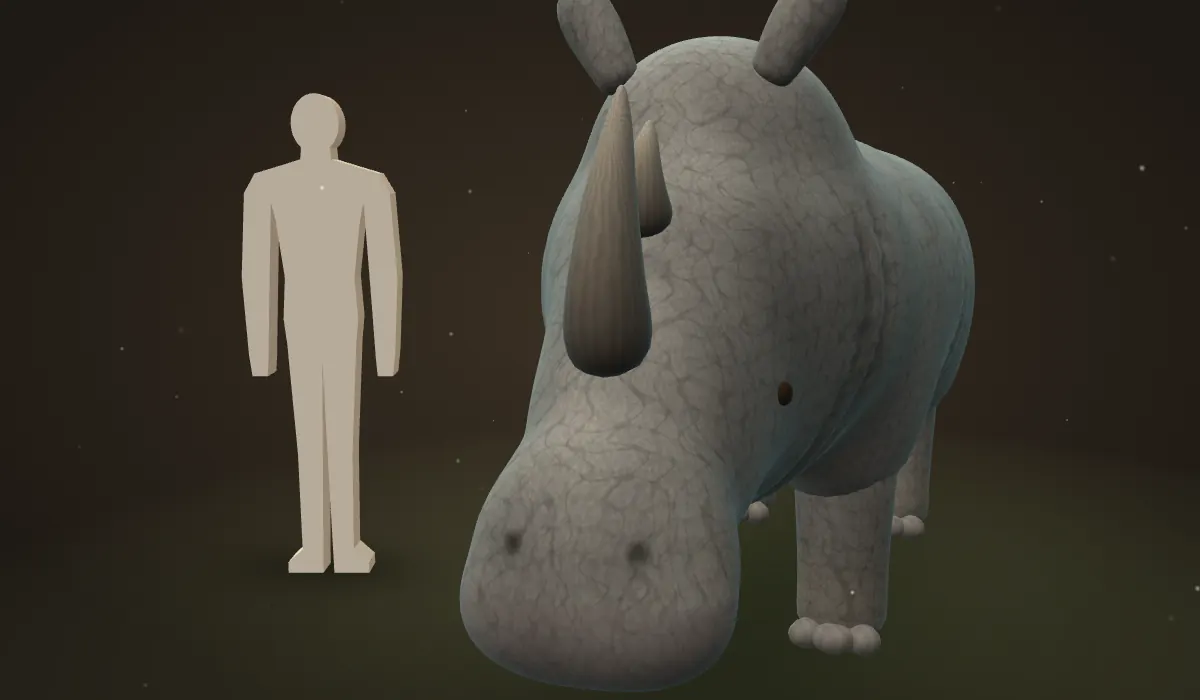
The black rhino is smaller, usually a little below a person's height at the shoulder and 800 to 1,400 kg. The smallest living rhino, the Sumatran rhino, stands only 1.1 to 1.45 m tall.
The five rhino species
About 26,700 rhinos are left in the wild. Two species live in Africa and three in Asia.
- White rhino, Africa: about 15,750 at the end of 2024. Near Threatened. Only two northern white rhinos remain, both females in Kenya. Scientists have made embryos in the lab to try to save the subspecies, but no calf has been born yet.
- Black rhino, Africa: 6,788 at the end of 2024, up 5.2% in a year. Critically Endangered.
- Greater one-horned rhino, India and Nepal: 4,075 in 2025. Vulnerable. Its skin has heavy folds that look like armour plates.
- Javan rhino, one park in Java: about 50. Critically Endangered.
- Sumatran rhino, Indonesia: 34 to 47. Critically Endangered. The smallest rhino and the only hairy one.
Poaching for horn is the main threat. The horn sells illegally in parts of Asia as a medicine or status item, although it has no proven medical effect. One conservation tool is dehorning: vets trim the horn under anaesthetic, and it grows back. In a 2025 study of reserves in South Africa's Greater Kruger area, dehorning cut poaching by 78%.
Frequently asked questions
Which rhinoceros is shown in this 3D model?
The white rhinoceros, Ceratotherium simum, shown by default, and the black rhinoceros, Diceros bicornis, on the Black rhino button. Both are African species with two horns.
What is a rhino horn made of?
Keratin, the protein in human hair and nails. It has no bone core and grows back if it is trimmed.
Are white rhinos white?
No. White and black rhinos are both grey, and often look brown or red from the mud they wallow in. The names do not describe colour.
How tall is a rhino?
A male white rhino stands 1.70 to 1.86 m at the shoulder, about as tall as an adult person. Black rhinos stand 1.32 to 1.8 m.
How fast can a rhino run?
White rhinos reach about 40 to 50 km/h and black rhinos up to about 55 km/h, in short bursts.
Why do birds sit on rhinos?
Oxpeckers ride on rhinos to eat ticks, and they call loudly when people approach. In one study, black rhinos with oxpeckers on their backs noticed approaching people every time, while rhinos without them noticed only 23% of the time. In Swahili the bird is called askari wa kifaru, the rhino's guard.
What is a group of rhinos called?
A crash. White rhinos are the most social species, and females with their young form crashes of up to 14 animals.