
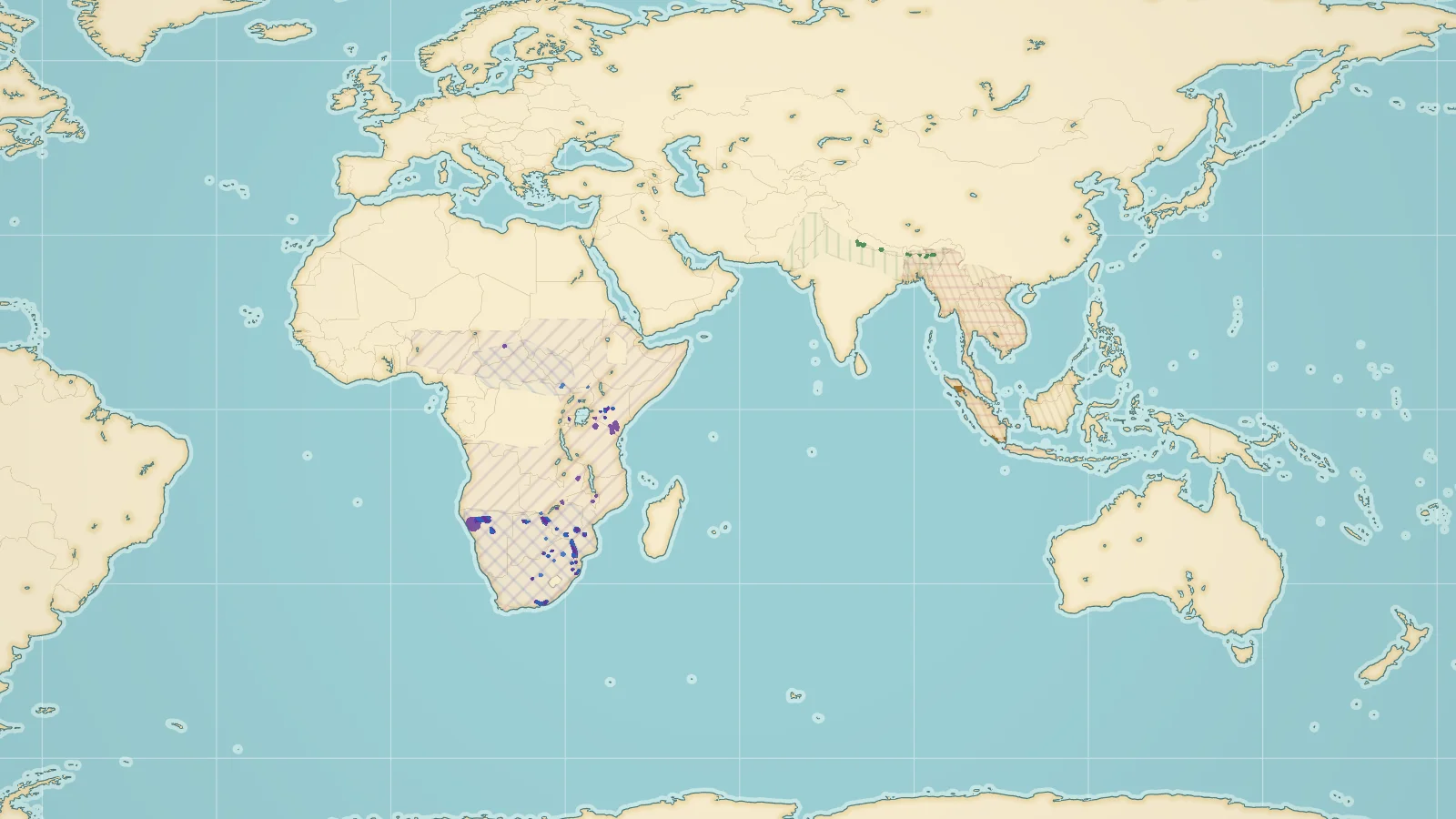
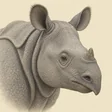
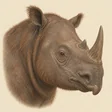
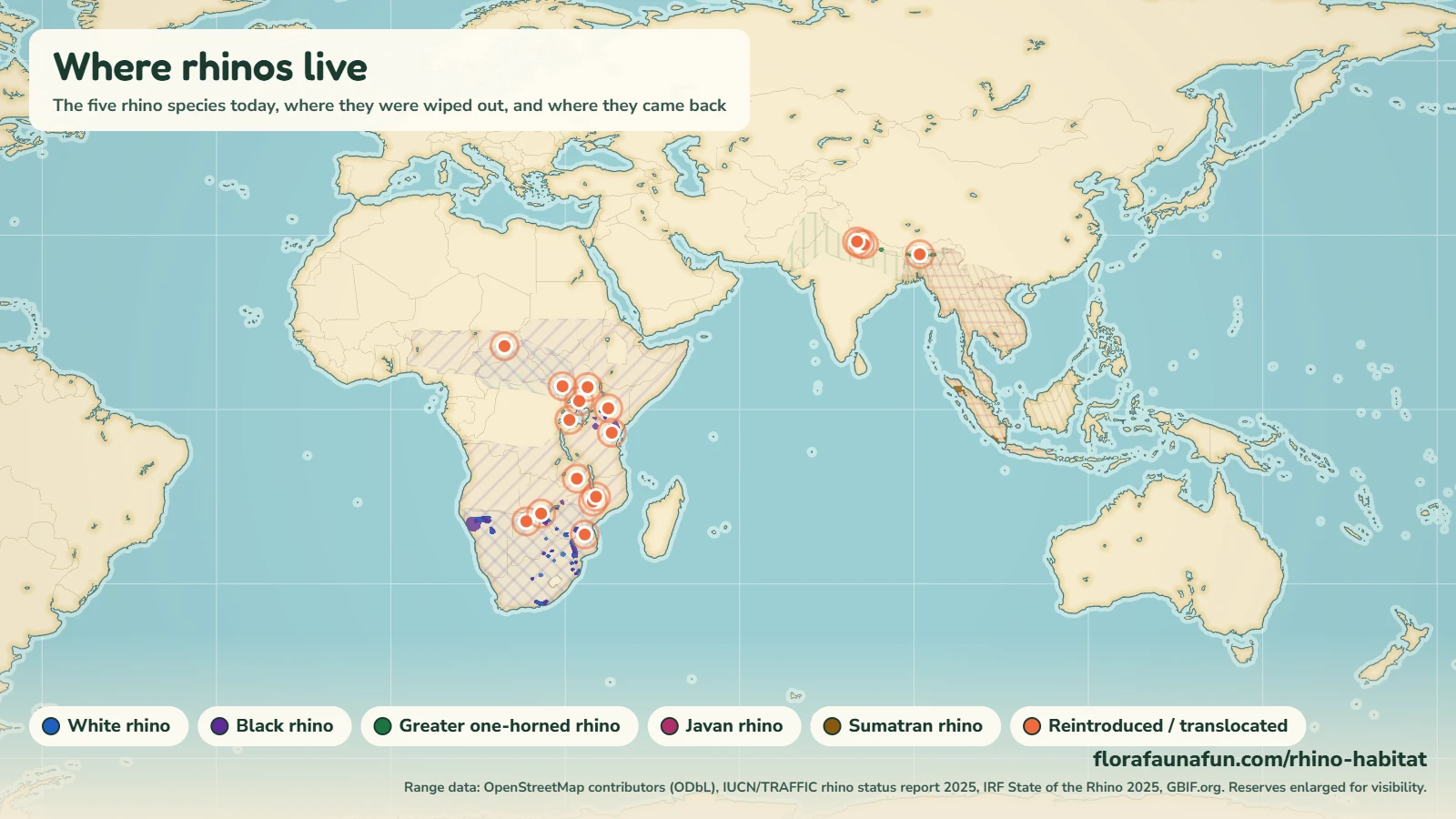
Where do rhinos live? Wild rhinos live in two regions only: eastern and southern Africa, home to the white rhino and the black rhino, and South and Southeast Asia, home to the greater one-horned, Javan and Sumatran rhinos. About 26,700 rhinos of all five species remain in the wild. More than half of them live in one country, South Africa. The map above shows each species' current habitat, the much larger area where rhinos used to live and the parks where rhinos have been moved back.
To see the animals themselves, the rhinoceros 3D model shows a life-size white rhino and black rhino. More maps are on the animal habitat maps page.
Rhino habitat at a glance
| Species | Where it lives | Habitat | How many (latest count) | IUCN status |
|---|---|---|---|---|
| White rhino | South Africa, Namibia, Kenya, Zimbabwe, Botswana and 8 other African countries | Open grassland and savanna | 15,752 (end of 2024) | Near Threatened |
| Black rhino | South Africa, Namibia, Kenya, Zimbabwe, Tanzania and 7 other African countries | Bush, thicket, scrub and desert | 6,788 (end of 2024) | Critically Endangered |
| Greater one-horned rhino | Northeast and north India, southern Nepal | Floodplain grassland and riverine forest | 4,075 (early 2025) | Vulnerable |
| Javan rhino | Ujung Kulon National Park, Java, Indonesia | Lowland tropical rainforest | About 50 (early 2025) | Critically Endangered |
| Sumatran rhino | Sumatra, Indonesia | Hill and mountain rainforest | 34 to 47 (early 2025) | Critically Endangered |
Counts come from the IUCN African and Asian Rhino Specialist Groups, published in the International Rhino Foundation's State of the Rhino 2025 report. Rhinos are not native anywhere in Europe, the Americas or Australia today. The rhinos seen in those places live in zoos and safari parks.
How to read the map
Each species has its own colour. Solid areas are the parks, reserves and conservancies where that species lives today. Most of them are 10 to 100 km across, so each one is drawn with a 12 km margin and never smaller than a 35 km circle. The hatched areas show the former range: everywhere the species lived in historic times. Where white and black rhinos share a reserve, as in Kruger or Ol Pejeta, the fill alternates between the two colours in stripes.
Tap a species in the legend to highlight it. Type a country into the box to see whether wild rhinos live there, which species and roughly how many. The orange pins mark parks that received rhinos by translocation. Tap one to read when the rhinos arrived and where they came from.
Rhino habitat by species
White rhino: grassland and savanna in southern and eastern Africa
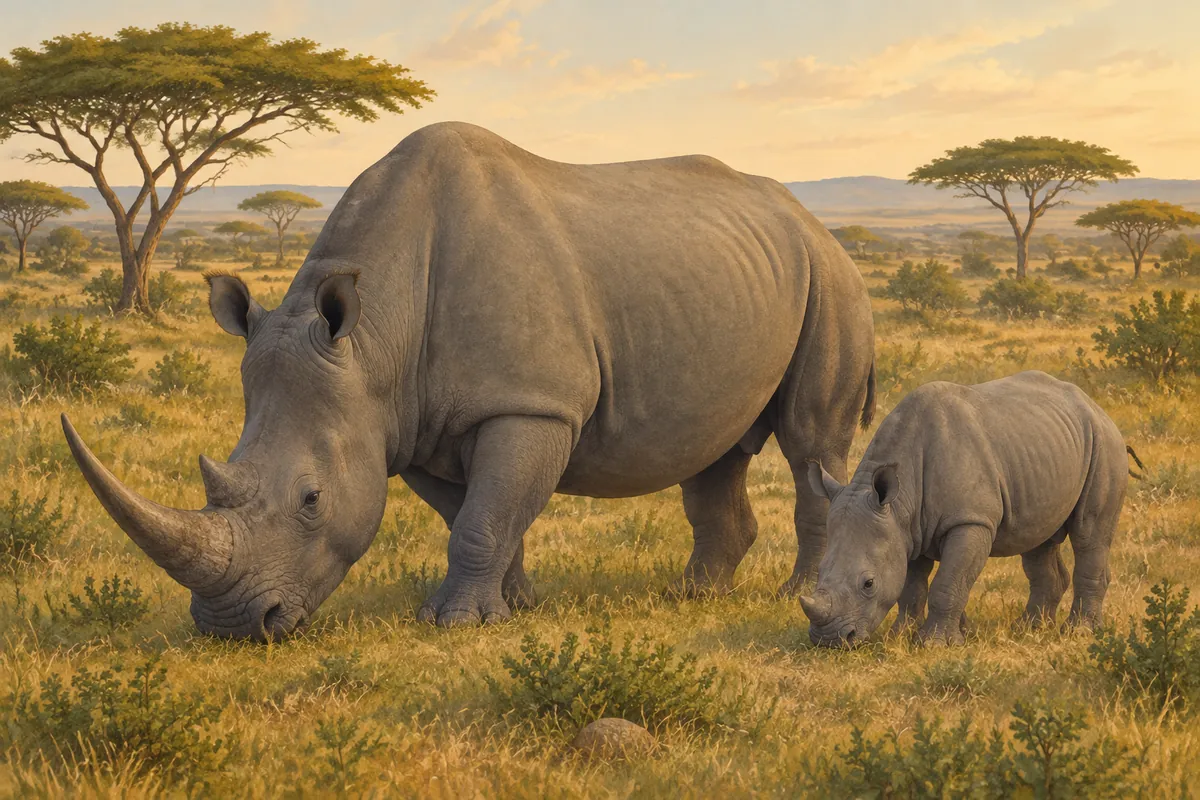
The white rhino (Ceratotherium simum) is a grazer. Its wide, square lip crops short grass, so it lives on flat or rolling grassland and open savanna with water nearby for drinking and wallowing. South Africa holds about 12,100 of the 15,752 white rhinos counted at the end of 2024, mostly in Kruger National Park, Hluhluwe-iMfolozi and hundreds of private reserves. Namibia has about 1,500, Kenya about 1,040, Zimbabwe about 540 and Botswana about 320. Smaller herds live in Eswatini, Zambia, Rwanda, Uganda, Mozambique and the Democratic Republic of the Congo.
That count is down 11 percent from 17,464 in 2023, and poaching in South Africa caused most of the loss. Around 1900 fewer than 100 southern white rhinos survived, all in what is now Hluhluwe-iMfolozi. Every white rhino in Kenya, Zambia and Uganda today descends from animals moved out of South Africa.
The northern white rhino, the other subspecies, once lived in Uganda, South Sudan, Sudan, Chad, the Central African Republic and the DR Congo. It is functionally extinct. The last two, both females, live under guard at Ol Pejeta Conservancy in Kenya. Scientists have produced northern white embryos from stored cells and plan to carry them in southern white surrogate mothers.
Black rhino: bush, thicket and desert
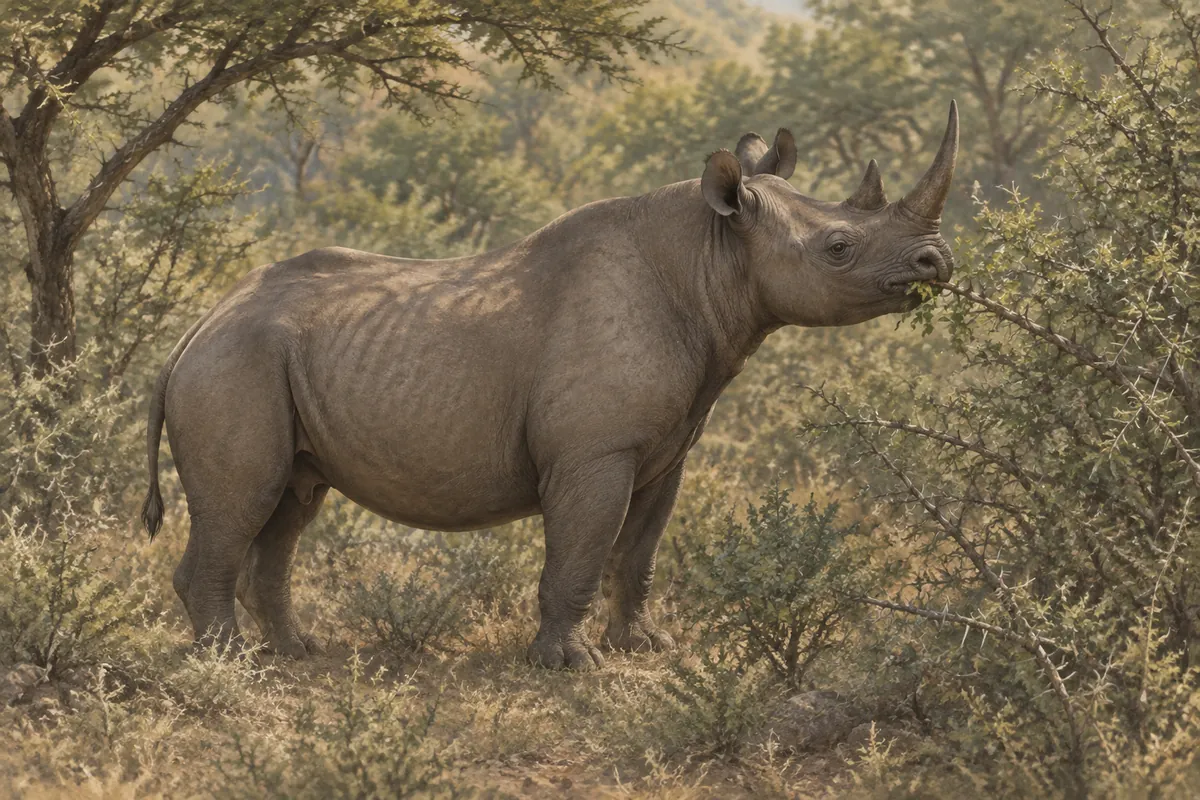
The black rhino (Diceros bicornis) is a browser. It uses its pointed, hooked upper lip to strip leaves and twigs from shrubs, so it lives in dense bush, thornveld, thicket and scrub rather than open grass. It also lives in some of the driest rhino habitat on Earth: a free-ranging population in the Kunene region of northwest Namibia lives in rocky desert and drinks at scattered springs.
At the end of 2024 there were 6,788 black rhinos, up 5.2 percent on 2023. South Africa has about 2,300, Namibia about 2,100, Kenya about 1,060, Zimbabwe about 780 and Tanzania about 270. In 1960 the species numbered about 100,000. Poaching cut it to about 2,300 by the mid-1990s, and it has been recovering slowly since then. The western black rhino of Cameroon was declared extinct in 2011.
Greater one-horned rhino: floodplain grassland in India and Nepal
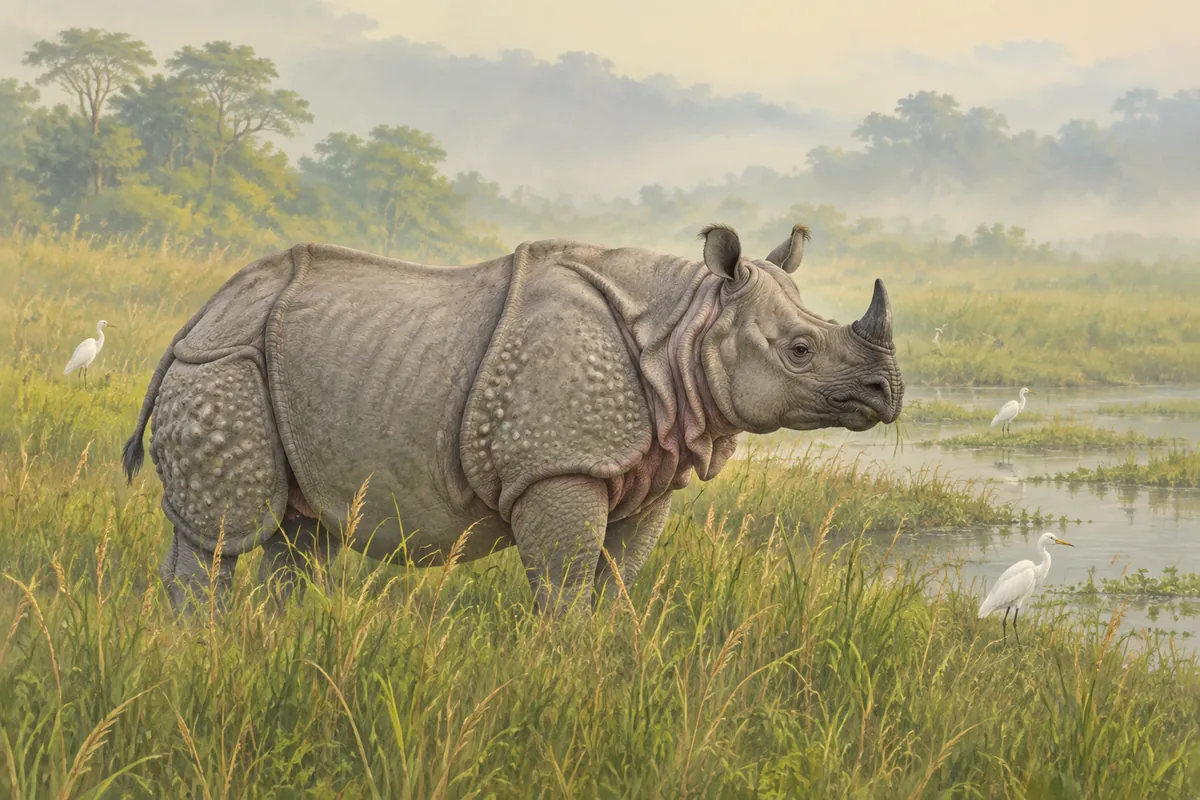
The greater one-horned rhino (Rhinoceros unicornis), also called the Indian rhino, lives in the tall grassland, swamps and riverine forest of river floodplains. It grazes on grass and water plants and spends hot days in pools and wallows. Its range today is a string of protected areas along the Brahmaputra valley in Assam, the Duars of West Bengal and the Terai plains of India and Nepal.
India has about 3,300 (2024), most of them in Kaziranga National Park, with smaller groups in Manas, Orang, Pobitora, Jaldapara, Gorumara and Dudhwa. Nepal counted 752 in 2021, 694 of them in Chitwan National Park and the rest in Bardia, Shuklaphanta and Parsa. Fewer than 100 survived a century ago. The 4,075 alive in early 2025 make this the only rhino species to have recovered on that scale, and the IUCN lists it as Vulnerable rather than Endangered.
Javan rhino: one rainforest park on Java
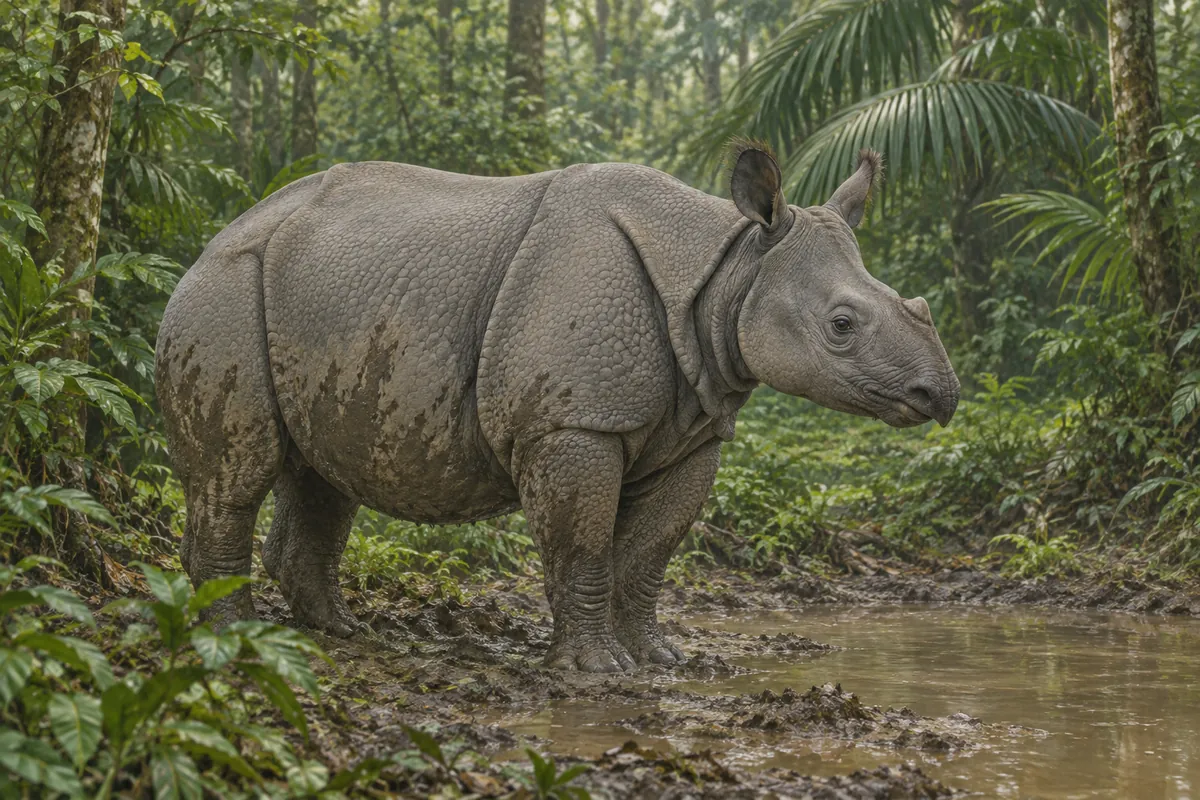
Every wild Javan rhino (Rhinoceros sondaicus) lives in Ujung Kulon National Park, a forested peninsula at the western tip of Java in Indonesia. Its habitat is lowland tropical rainforest with dense undergrowth, streams and mud wallows. It browses on shoots, leaves and fallen fruit.
About 50 remain (early 2025). Estimates had reached 76, but poachers killed up to 26 Javan rhinos between 2019 and 2023. The species once lived from northeast India and Bangladesh through Myanmar, Thailand, Cambodia, Laos and Vietnam to the Malay Peninsula, Sumatra and Java. The last Javan rhino on the mainland was shot in Cat Tien National Park in Vietnam in 2010.
Sumatran rhino: mountain rainforest on Sumatra
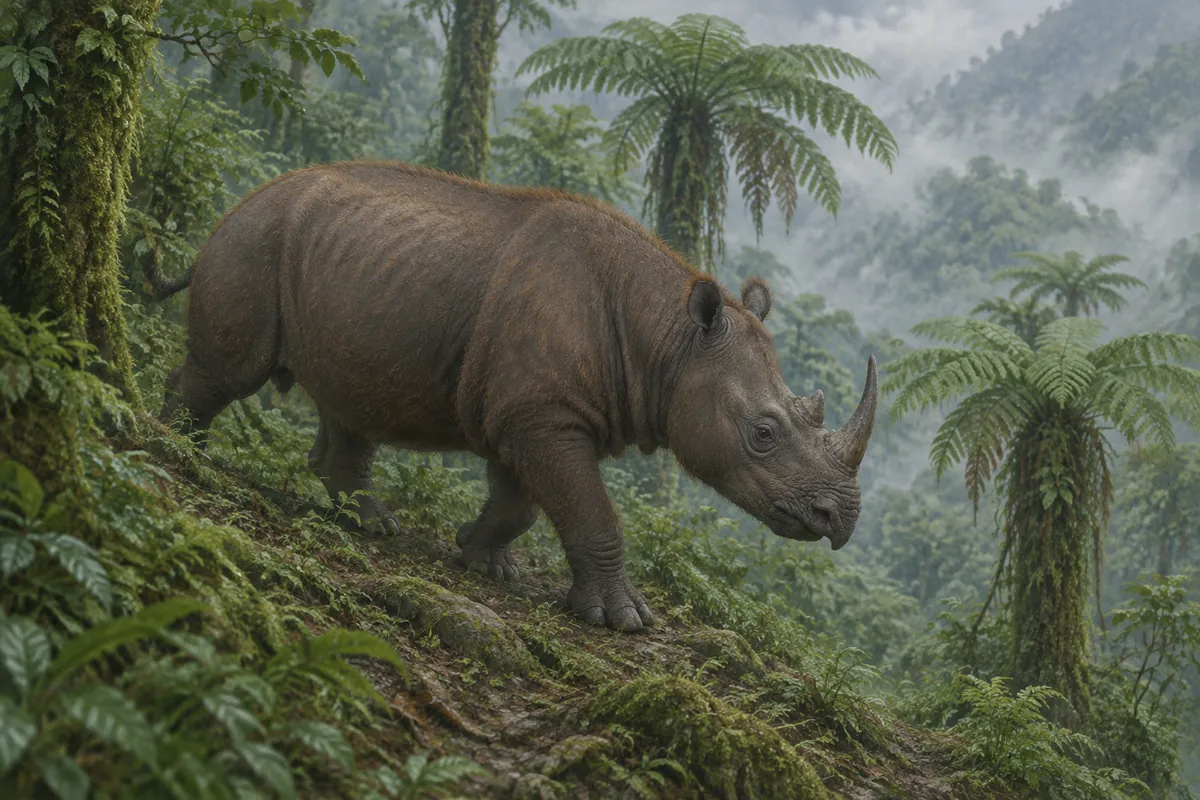
The Sumatran rhino (Dicerorhinus sumatrensis) is the smallest rhino and the only Asian rhino with two horns. Its reddish-brown skin carries a sparse coat of coarse hair. It lives in dense hill and mountain rainforest, often on steep ground near streams, and feeds on saplings, leaves and fruit.
Between 34 and 47 survive, all on Sumatra in Indonesia. Gunung Leuser National Park in the north holds the only group thought large enough to survive on its own. A few live in Bukit Barisan Selatan, and the Sumatran Rhino Sanctuary in Way Kambas runs a breeding programme that has produced five calves. The species was declared extinct in the wild in Malaysia in 2015, and the last Malaysian rhinos died in captivity in 2019. In 2016 a female was captured in East Kalimantan, Indonesian Borneo, and died weeks later. No living rhino has been confirmed on Borneo since then.
Where rhinos used to live
The hatched areas on the map are several times larger than the solid ones. Black rhinos once lived across almost all of Africa south of the Sahara, apart from the Congo rainforest, the Ethiopian highlands and the Horn of Africa. Greater one-horned rhinos lived along the Indus, Ganges and Brahmaputra rivers from Pakistan to the Myanmar border. Sumatran rhinos ranged from the Himalayan foothills of India and Bhutan through Myanmar, Thailand and Indochina to Borneo.
Rhinos are now gone from 20 countries where they lived in historic times, including Sudan, South Sudan, Ethiopia, Somalia, Nigeria, Cameroon, Angola, Pakistan, Bangladesh, Bhutan, Myanmar, Thailand, Cambodia, Laos, Vietnam, China and Malaysia. Hunting for horn and sport caused most of the losses, and farming and settlement then took over the floodplains and savannas they lived on. Rhino horn is keratin, the same protein as hair and fingernails, but it sells at high prices in illegal markets, and that keeps poaching going.
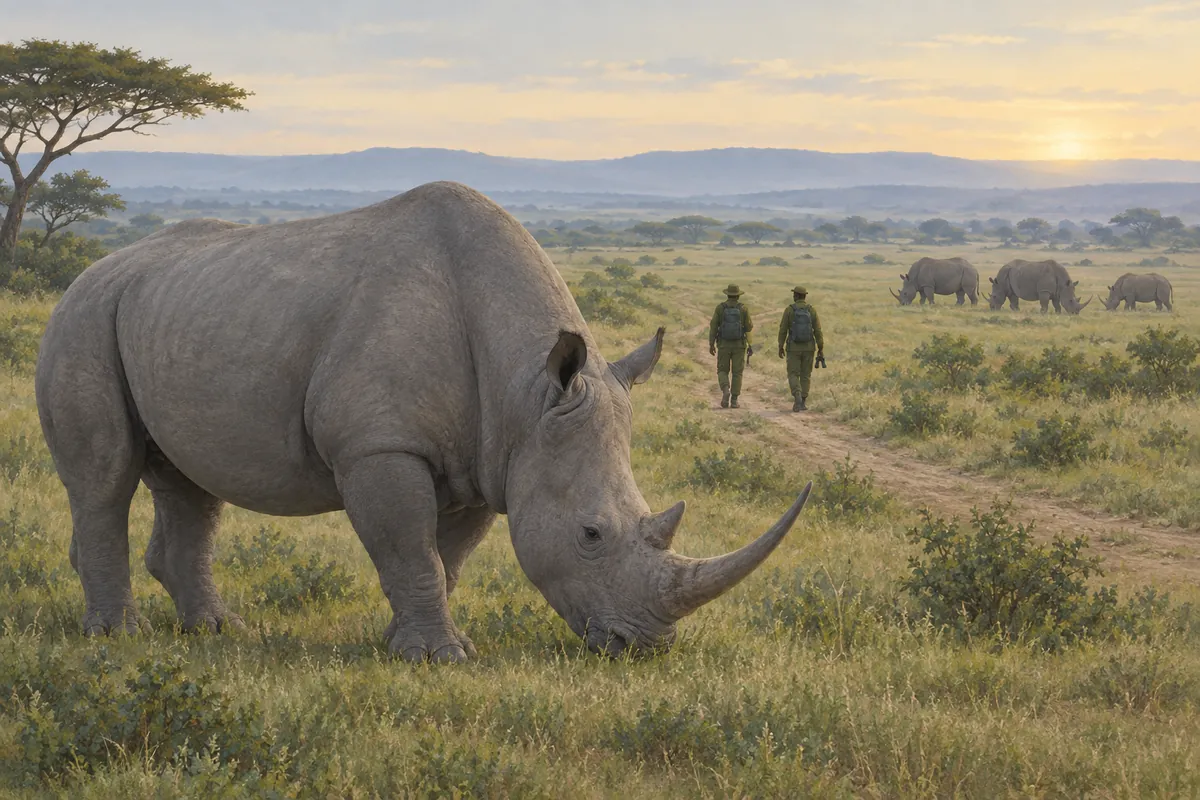
Today almost every rhino lives inside a fenced sanctuary, a guarded national park or a private reserve with armed rangers. That is why the current range on the map is a scatter of small patches rather than one continuous area.
Reintroduced rhino populations
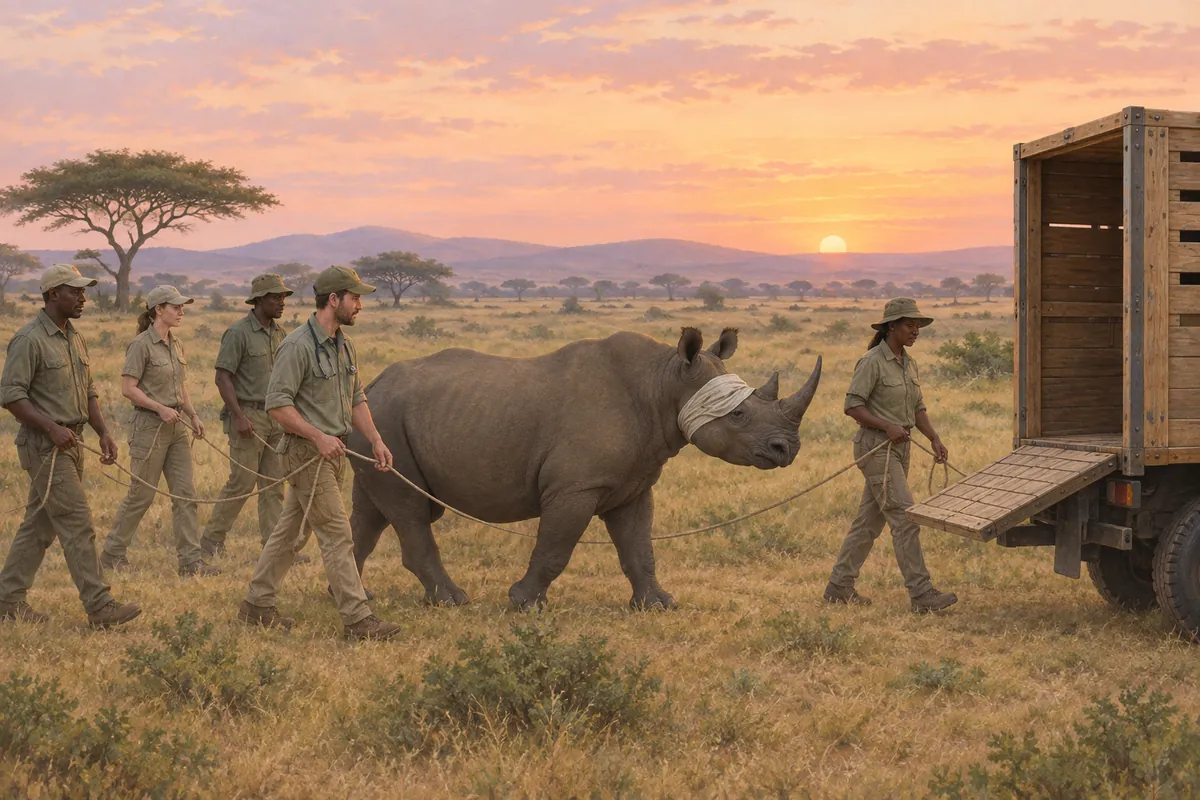
Moving rhinos from crowded or well-protected reserves to parks where the species died out is one of the main tools of rhino conservation. The orange pins on the map mark these sites:
- Akagera National Park, Rwanda: 18 eastern black rhinos arrived from South Africa in 2017, about ten years after the last one disappeared, and 30 white rhinos followed in 2021.
- Zakouma National Park, Chad: six black rhinos were flown in from South Africa in 2018, the first in Chad for almost 50 years. Poachers killed two females in early 2025, and two males remain.
- Garamba National Park, DR Congo: 16 southern white rhinos arrived in 2023 and 24 more in December 2025. The park's last northern white rhino was poached in 2006.
- Ziwa Rhino Sanctuary and Kidepo Valley, Uganda: Uganda's rhinos were wiped out by 1982. Ziwa received its first white rhinos in 2005 and held about 48 in 2025. Kidepo Valley National Park received four white rhinos in March 2026.
- Zinave National Park, Mozambique: 19 white rhinos were trucked 1,600 km from South Africa in 2022, the first in the park for 40 years. Black rhinos followed.
- Majete and Liwonde, Malawi; North Luangwa, Zambia; Mkomazi, Tanzania; the Okavango Delta, Botswana: black rhinos returned to Liwonde in 1993, Mkomazi in 1997, Majete and North Luangwa in 2003, and white and black rhinos to the Okavango in 2001 to 2003.
- Manas and Dudhwa, India; Bardia and Shuklaphanta, Nepal: greater one-horned rhinos were moved to Dudhwa in 1984, to Bardia in 1986 and to Shuklaphanta in 2000. India's Rhino Vision 2020 programme moved at least 22 rhinos within Assam to Manas between 2008 and 2021.
White rhinos in Kenya, Zambia and Uganda live outside the subspecies' original range. Kenya's first white rhinos arrived at Meru in 1966, and Zambia received its first at Mosi-oa-Tunya in 1964. Senegal and Cote d'Ivoire keep a handful of white rhinos in fenced reserves, also outside the historic range.
To see a rhino up close, the rhinoceros 3D model lets you turn a white and a black rhino in your browser and compare their lips, horns and size. For other animals on the same kind of map, see the gray wolf habitat map and the peacock habitat map.
Frequently asked questions
Where do rhinos live?
Wild rhinos live in Africa and Asia only. White and black rhinos live in eastern and southern Africa, mainly in South Africa, Namibia, Kenya and Zimbabwe. Greater one-horned rhinos live in northeast India and southern Nepal. Javan and Sumatran rhinos live only in Indonesia, on Java and Sumatra.
What is a rhino's habitat?
It depends on the species. White rhinos live on grassland and open savanna. Black rhinos live in bush, thicket, scrub and desert. Greater one-horned rhinos live in tall floodplain grassland and swamps. Javan and Sumatran rhinos live in tropical rainforest. All five need water for drinking and mud wallows to keep cool.
Where do white rhinos live?
White rhinos live in southern and eastern Africa. South Africa has about 12,100 of the 15,752 counted at the end of 2024, followed by Namibia, Kenya, Zimbabwe and Botswana. Smaller herds live in Eswatini, Zambia, Rwanda, Uganda, Mozambique and the DR Congo.
Where do black rhinos live?
Black rhinos live in eastern and southern Africa. Of the 6,788 counted at the end of 2024, about 2,300 live in South Africa, 2,100 in Namibia, 1,060 in Kenya, 780 in Zimbabwe and 270 in Tanzania, with smaller groups in Botswana, Eswatini, Malawi, Zambia, Rwanda, Mozambique and Chad.
Where do Indian rhinos live?
The Indian rhino, or greater one-horned rhinoceros, lives in floodplain grassland in Assam, West Bengal and Uttar Pradesh in India and in the Terai of southern Nepal. Kaziranga National Park in Assam and Chitwan National Park in Nepal hold most of the 4,075 alive in early 2025.
Where do Javan rhinos live?
Only in Ujung Kulon National Park, a rainforest peninsula at the western tip of Java in Indonesia. About 50 remain, and no Javan rhinos survive anywhere else, wild or in captivity.
Where do Sumatran rhinos live?
On the Indonesian island of Sumatra, mainly in Gunung Leuser National Park, with a few in Bukit Barisan Selatan and a breeding sanctuary in Way Kambas. Only 34 to 47 remain. They are extinct in the wild in Malaysia.
Are there rhinos in Australia?
No wild rhinos live in Australia, and rhinos were never native there. The rhinos in Australia live in zoos and safari parks, such as Taronga Western Plains Zoo at Dubbo and Monarto Safari Park in South Australia.
Are there rhinos in the US?
No wild rhinos live in the United States. Rhinos in the US live in zoos and wildlife parks, which keep white, black and greater one-horned rhinos.
Are there rhinos in India?
Yes. India has about 3,300 wild greater one-horned rhinos (2024), more than any other country holds of that species. Most live in Kaziranga National Park in Assam, with smaller groups in Manas, Orang, Pobitora, Jaldapara, Gorumara and Dudhwa.
Where did rhinos used to live?
In historic times rhinos lived across most of Africa south of the Sahara and across South and Southeast Asia from Pakistan to Vietnam, the Malay Peninsula and Borneo. They are now gone from 20 of those countries, including Sudan, Angola, Pakistan, Myanmar, Thailand, Vietnam, China and Malaysia.
How many rhinos are left in the wild?
About 26,700: 15,752 white rhinos and 6,788 black rhinos at the end of 2024, plus 4,075 greater one-horned, about 50 Javan and 34 to 47 Sumatran rhinos in early 2025.