Aristotle observed and wrote about dolphin intelligence and social behavior in the 4th century BCE, noting they seemed to display care for injured group members. His notes are striking because they reflect centuries-old human fascination with dolphins and because modern science has confirmed many of his observations about social care and problem-solving.
People care about dolphins for several reasons: they help signal ocean health, they teach us about animal intelligence and culture, and they face threats from fishing, noise, and habitat loss. Conservation choices and responsible wildlife tourism depend on understanding how dolphins live and what makes populations resilient or vulnerable.
Below I outline The characteristics of a dolphin across anatomy, senses, cognition, social life, behavior, and life history—ten specific traits that explain how they thrive in seas worldwide and why scientists and conservationists watch them so closely.
Physical and Sensory Traits

These bodily and sensory traits enable fast swimming, thermoregulation, precise navigation, and effective hunting. Examples range from fusiform anatomy and insulating blubber to biosonar and acute hearing that let dolphins operate in murky, dark, or noisy waters.
1. Streamlined Body Shape and Powerful Tail
Dolphins have a fusiform, torpedo-like body and a muscular, horizontally oriented caudal fluke that produces thrust for propulsion. The streamlined form minimizes drag so they can cruise efficiently and sprint when needed.
Some species reach burst speeds around 35 km/h (about 22 mph), useful for chasing schooling fish or evading sharks. Engineers studying dolphin hydrodynamics have adopted those principles for underwater drones and marine robotics designs, borrowing shape and fin mechanics from species such as the common bottlenose (Tursiops truncatus).
2. Blubber, Skin, and Thermoregulation
Dolphins rely on a layer of blubber plus rapidly renewing skin to conserve heat, store energy, and maintain a smooth surface for hydrodynamics. Blubber thickness varies by species and habitat—cold-water populations tend to carry more insulating fat than tropical dolphins.
The skin continually sloughs and regenerates, which helps reduce drag. Blubber also aids buoyancy and gives energy reserves during long dives or migrations. For general comparisons and species details, see resources from the NOAA and the Smithsonian Ocean.
3. Echolocation (Biosonar)
Many dolphins produce trains of clicks and listen to returning echoes to locate and identify objects—this active biosonar delivers remarkable spatial detail. Click frequencies can extend up toward 150 kHz, giving centimeter-scale resolution at close range in lab and field recordings.
Researchers have recorded wild and captive dolphins using echolocation to detect buried fish, discriminate objects, and navigate dark or turbid waters. Work on dolphin sonar has also informed human sonar design and inspired techniques for passive acoustic monitoring of fish and marine mammals by marine labs and the Smithsonian.
4. Acute Hearing and Vision
Dolphins have excellent underwater hearing and functional vision both below and above the surface. Anatomically, large auditory bullae and specialized inner-ear structures support sensitivity across a wide frequency range, including ultrasonic bands used for echolocation.
Their eyes are adapted to low light, and many species can see well near the surface as well. That auditory sensitivity also makes dolphins vulnerable to underwater noise—ships and naval sonar can cause disturbance and strandings, a concern highlighted by NOAA.
Cognitive and Social Characteristics

Taken together, the characteristics of a dolphin include large brains, social complexity, and advanced communication that support learning, cooperation, and culture across generations.
The common bottlenose dolphin has a brain mass of roughly 1.6 kg and a high encephalization quotient compared with most marine mammals, which helps explain sophisticated behaviors studied by universities and marine labs.
5. High Intelligence and Problem Solving
Dolphins rank among the most intelligent nonhuman animals, showing flexible problem-solving and social learning. Studies document tool use, mirror self-recognition experiments, and complex tasks solved in lab settings.
A classic wild example is “sponging” in Shark Bay, where some bottlenose mothers teach juveniles to wear marine sponges on their rostra while foraging. Mirror tests and controlled experiments suggest self-recognition in at least some dolphins—evidence that influences welfare guidelines and conservation planning (see research published by marine mammal labs and the Smithsonian).
6. Complex Social Structures and Cooperation
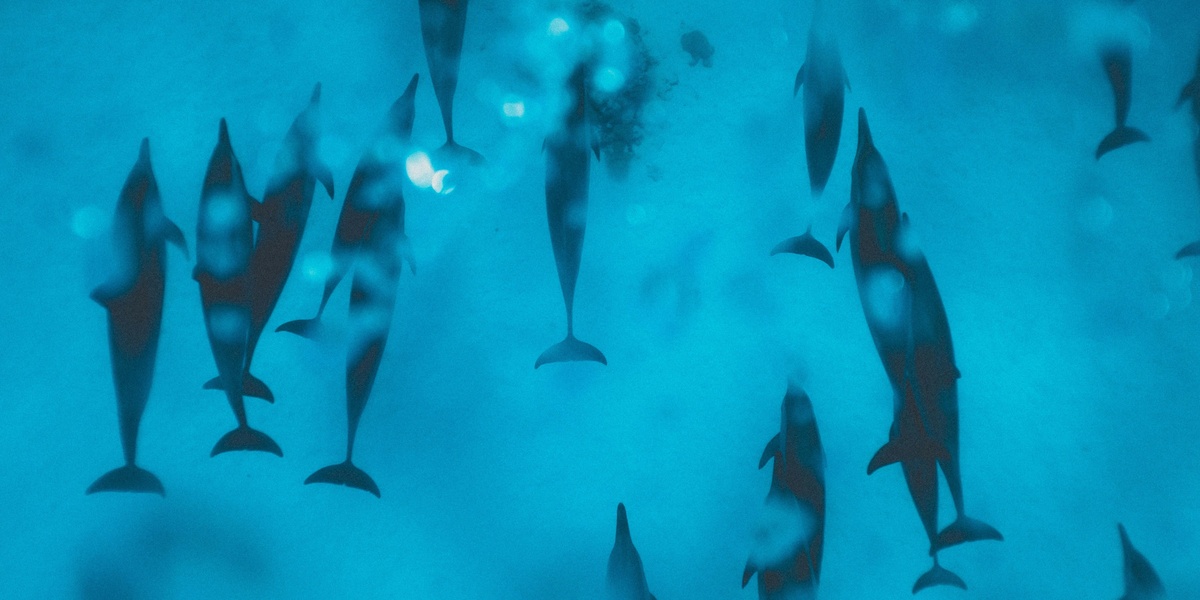
Dolphins typically live in pods with fluid membership and strong cooperative behaviors. Pod sizes vary by species and region but many populations average about 10–30 individuals for everyday grouping.
Cooperative hunting (herding fish into tight balls), alloparenting (group care of calves), and long-term male alliances have all been documented—famously in Shark Bay, Australia—illustrating that social disruption can seriously affect survival and reproduction. Conservation measures need to protect these social fabrics as well as numbers.
7. Sophisticated Communication and Vocal Learning
Dolphins use whistles, clicks, and burst-pulse sounds for social communication and echolocation. Individual “signature whistles” function like names, allowing dolphins to call and find specific companions across distance.
Field studies document vocal learning and regional dialects, with populations developing different repertoires. Understanding these vocal traditions helps researchers build better interaction protocols for tourism and conservation monitoring at marine labs and universities.
Behavioral and Ecological Traits

Dolphins display diverse foraging strategies, locally learned behaviors, and life-history patterns that shape population dynamics. As mid-to-top predators they influence prey communities, and many bottlenose dolphins live four to five decades.
8. Tool Use and Cultural Behaviors
Some dolphin populations exhibit culture: learned behaviors passed from mother to calf and across generations. The best-known example is sponging in Shark Bay (Western Australia), where individuals use marine sponges as protective probes while foraging on the seafloor.
Those techniques spread socially rather than genetically, which means conserving behavioral diversity requires protecting habitat and social networks. Shark Bay researchers and publications document how mothers transmit sponging and how it persists unevenly across the population.
9. Diet, Foraging Strategies, and Ecological Role
Dolphins are carnivores that eat fish, squid, and crustaceans, with diets varying by species and region. Foraging tactics include individual pursuit, cooperative herding, corralling, and even strand-feeding in some coastal groups.
Coastal pods sometimes drive fish toward shore and take turns feeding; other populations use coordinated bubble-netting or drive-and-trap methods. As predators, dolphins help regulate prey populations and serve as indicators of ecosystem health, which is why fisheries interactions and bycatch are conservation priorities.
10. Reproduction, Lifespan, and Life History
Dolphins have relatively slow life histories compared with many fish: gestation in many species runs about 10–12 months, calves depend on mothers for months to years, and maturation can take several years. Bottlenose dolphins commonly live around 40–50 years in the wild.
Slow reproductive rates mean populations recover slowly after declines. That makes threats like entanglement, targeted hunting, habitat loss, and noise especially serious. For life-history summaries consult resources such as the Marine Mammal Center and NOAA.
Summary
- An integrated suite of anatomy and senses—streamlined bodies, blubber, echolocation, and acute hearing—gives dolphins efficient movement, precise navigation, and hunting ability.
- Large brains and social complexity produce problem solving, tool use, vocal learning, and cultural traditions (e.g., Shark Bay sponging), so conserving behavior matters, not just numbers.
- Varied foraging tactics and roles as mid-to-top predators mean dolphins affect food webs and signal ocean health; interactions with fisheries and noise are key conservation issues.
- Slow reproduction—gestation around a year and decades-long lifespans—makes populations vulnerable to human impacts, so protection and informed tourism are vital.
Please consider supporting local marine protected areas or reputable organizations such as NOAA, the Smithsonian Ocean, or the Marine Mammal Center to help safeguard dolphins and their habitats.