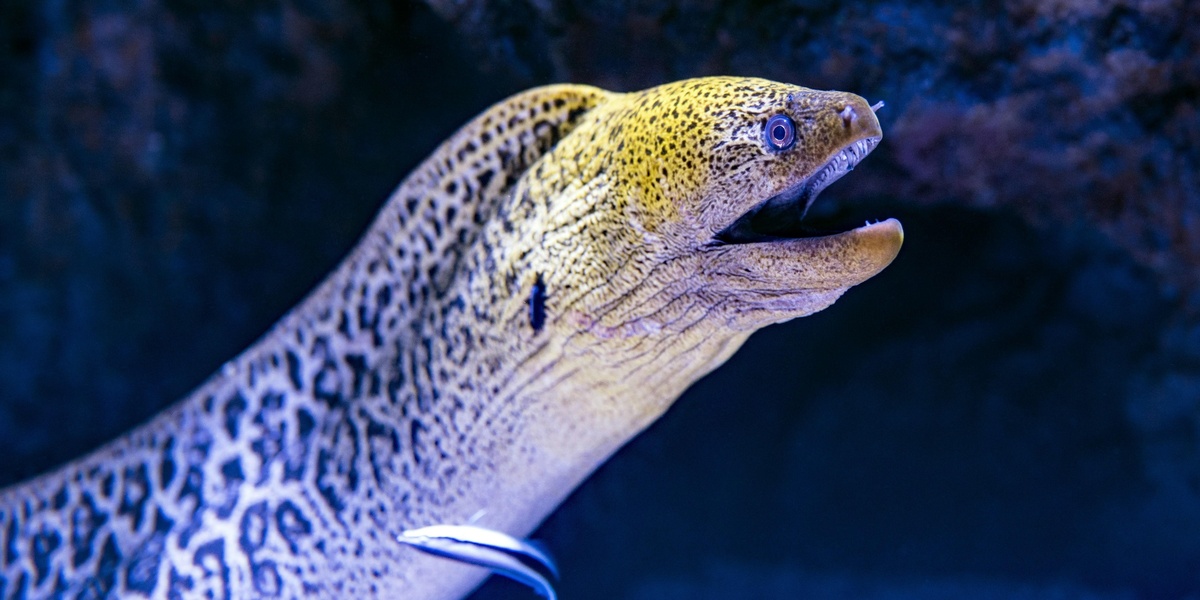
A 19th-century naturalist called a moray “a snake that lives in the sea,” and the phrase still fits when you peer into a reef crevice and see the flash of teeth. There are about 200 species of these secretive predators, and some—like the Giant moray (Gymnothorax javanicus)—reach nearly 3 m. Morays shape reef food webs, appear in public aquaria, and sometimes interact with divers, so they matter to conservationists, hobbyists, and anyone who enjoys reefs. The characteristics of a moray eel combine unusual anatomy, keen senses, and odd behaviors that let it ambush prey from tight holes. This piece breaks those traits into ten defining characteristics, from skin and jaws to life history and human interactions.
Anatomy and Physical Traits
Physical form sets morays apart from most reef fishes. The next four points cover body shape, skin, teeth and jaws, and size variation with species examples and numbers where relevant.
1. Elongated body built for crevices
Morays have long, muscular, laterally compressed bodies ideal for slipping into narrow reef crevices. Smaller species may be around 50 cm long, while large predators such as the Giant moray can approach 3 m. That cylindrical, flexible form lets a moray coil and brace inside a hole, launching rapid lunges to seize passing fish or octopus.
Their musculature provides explosive forward thrusts rather than sustained bursts, so ambush—rather than pursuit—is the usual hunting tactic. Ribbon eels (Rhinomuraena quaesita) and brown morays demonstrate how the same elongated plan can be colored and scaled (or not) for different niches.
2. Mucus-covered skin and lack of true scales
Morays lack the overlapping, enamel-like scales common to many fishes; instead their skin is smooth and covered by a protective mucus layer. That mucus reduces abrasion as they slide in and out of rock and coral, and it can host commensal microbes that—according to reef microbiology studies—may help deter infections.
Removing this mucus (for example, by handling an eel) raises infection risk for the animal. Divers and aquarists are advised not to touch morays; even brief contact strips protective mucus and stresses the fish (NOAA guidance on handling wildlife).
3. Powerful teeth and a second set of pharyngeal jaws
Morays have sharp, recurved teeth that point backward—perfect for seizing slippery prey. More remarkable is their pharyngeal jaw: a second, mobile set of jaws in the throat that reaches forward to pull prey down into the esophagus.
Functional morphology work (including a notable 2014 study) quantified the speed and coordination of those pharyngeal jaws, showing they can thrust forward in a fraction of a second to transport struggling fish or cephalopods. That dual-jaw system makes morays especially effective at handling awkward, wriggling prey.
4. Size variability and species-specific traits
Globally there are roughly 200 moray species, and they vary in size, color, and behavior. Many stay under 1 m; a few top 2–3 m. Some show modest sexual dimorphism, with females or males slightly larger depending on species.
In the aquarium trade the Snowflake moray (Echidna nebulosa) is prized for moderate size and distinctive pattern, while the Giant moray serves as a top mesopredator on many Indo‑Pacific reefs. Careful species choice matters: large species need large tanks and can prey on tankmates.
Senses, Feeding, and Behavior
How morays sense their world determines feeding style and daily rhythm. The next three points describe smell versus vision, ambush and cooperative hunting, and typical activity patterns.
5. Keen sense of smell and relatively poor vision
Morays rely heavily on olfaction; their nostrils and nasal canals are well developed for detecting chemical cues in water. Vision exists, and some species see reasonably in low light, but smell usually guides hunting—especially inside dark crevices.
Researchers and divers have observed scent-driven strikes where a moray tracks a wounded or hiding fish by smell before lunging. Tubular nostril structures in several species further improve sampling of faint odor plumes in complex reef flows.
6. Ambush predator with occasional cooperative hunting
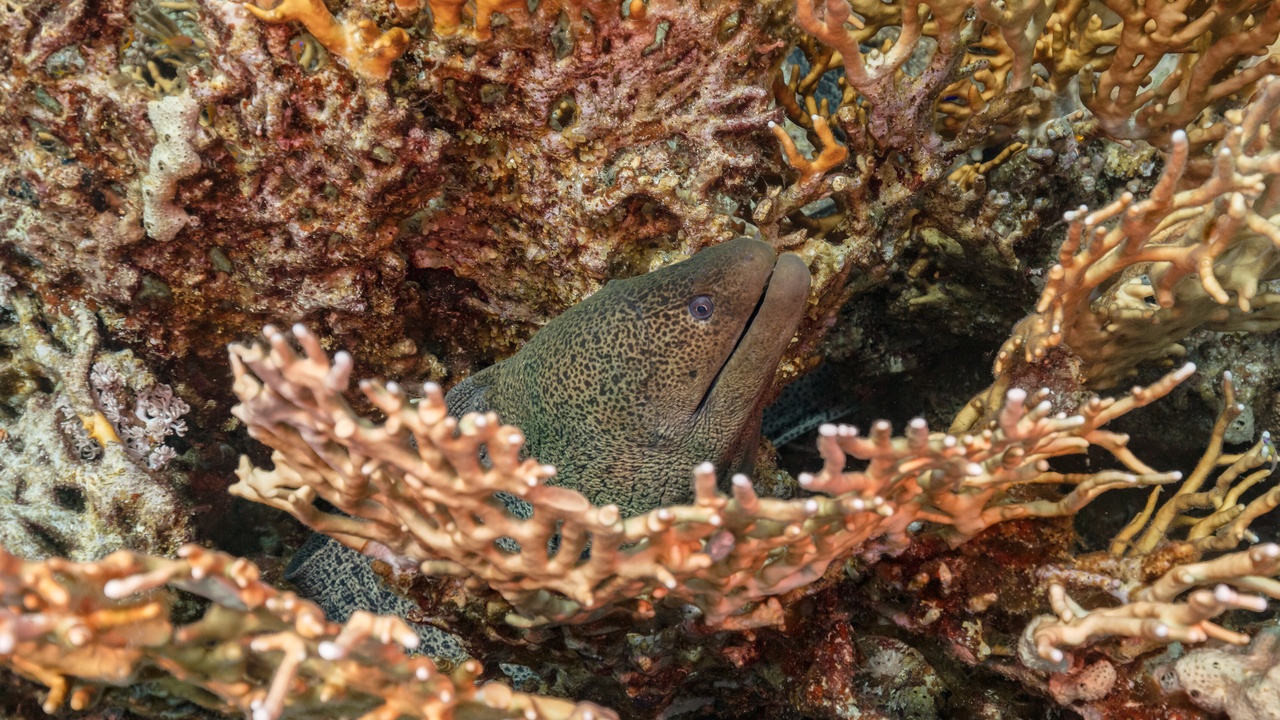
Most morays lie in wait with just the head protruding, then lunge with body thrust and pharyngeal jaws to secure prey such as small reef fish, crustaceans, and octopus. That ambush style conserves energy and exploits the reef’s three‑dimensional structure.
Observers have also documented cooperative hunts between morays and groupers on Indo‑Pacific reefs, where the grouper signals and chases prey from open water while the moray blocks crevices (multiple observational studies describe this behavior). Cooperation increases capture success compared with either hunter alone.
7. Nocturnal or crepuscular habits
Many morays are most active at dusk and during the night, when darkness favors scent-driven ambush and lowers exposure to daytime predators. Peak foraging often occurs just after sunset and before sunrise, though some species visit cleaning stations by day.
For divers, this explains why morays are commonly seen peering from holes on day dives yet become more active on night dives. Nighttime activity also shifts prey dynamics and reduces competition with diurnal hunters.
Ecology, Life History, and Human Interactions
Morays sit at the intersection of reef ecology and human use. The next three points cover where they live, how they reproduce, and how people encounter them in aquaria, fisheries, and culture.
8. Habitat range and reef association
Morays are mainly reef-associated, using coral and rocky crevices across tropical and temperate seas. Species richness peaks in the Indo‑Pacific, while the Atlantic hosts fewer species (roughly a few dozen). Overall, about 200 species occur worldwide.
Coral complexity strongly influences moray abundance; reefs with more holes and overhangs offer refuge and hunting sites. Consequently, coral bleaching and structural degradation reduce available shelter and can lower local moray densities, with cascading effects on reef food webs.
9. Reproductive strategy and life cycle
Morays generally spawn pelagic eggs that hatch into flat, transparent leptocephalus larvae. These larvae drift in plankton and can spend weeks to months in the open ocean before settling to the benthos as small juveniles.
That long larval phase promotes dispersal and connectivity among reef populations; some genetic and larval‑tracking studies show populations linked across tens to hundreds of kilometers. Age at maturity varies by species, but dispersal timing is a key driver of distribution patterns.
10. Human interactions: aquariums, bites, and cultural roles
Morays figure in the aquarium trade and in local fisheries. Species like the Snowflake moray are commonly kept by hobbyists, while large species appear in public aquaria. Owners must provide secure, spacious tanks and appropriate diet because morays will eat smaller tankmates.
Bites are usually defensive—often when a moray is provoked or hand‑fed—and can cause deep wounds due to sharp teeth and potential bacterial infection. Dive operators and wildlife agencies advise against feeding or touching wild morays. Conservation assessments vary by species; some have IUCN listings while many remain data deficient.
Summary
- An elongated, muscular body, mucus-covered skin, and a remarkable dual-jaw system let morays ambush and secure slippery prey; think Giant moray and Snowflake moray as examples.
- Olfaction dominates sensing while vision is modest; ambush tactics, occasional cooperative hunting with groupers, and nocturnal habits shape feeding behavior.
- About 200 species inhabit crevice-rich coral and rocky reefs; pelagic leptocephalus larvae drift for weeks to months, linking distant populations and making reef structure vital for recruitment.
- Human interactions span aquaria and fisheries and include occasional defensive bites—respectful, non‑contact behavior and support for reef protection help both people and morays.