From sunlit meadows to shaded rainforest understories, bright insects add small flashes of color across many habitats. Spotting a vivid pattern or a banded wing often reveals clues about behavior, diet and where an insect lives.
There are 30 colorful insects, ranging from the Asian longhorn beetle to the Zebra longwing. For each entry I list Scientific name, Range, Dominant colors so you can quickly compare appearance and distribution — you’ll find below.
How can I identify colorful insects in the field?
Look for dominant colors and repeated patterns, note the habitat and time of day, and record behavior (flight, resting, host plant). Take clear photos from several angles and use the Scientific name and Range columns below to match IDs with reliable field guides or online databases.
Do bright colors mean an insect is poisonous or dangerous?
Not always — bright colors can signal toxicity (aposematism) or mimic a toxic species, but many colorful insects are harmless. Use the Dominant colors together with the Scientific name and Range in the list below to confirm whether a species is known to be toxic or simply mimetic.
Colorful Insects
| Name | Scientific name | Range | Dominant colors |
|---|---|---|---|
| Monarch butterfly | Danaus plexippus | North America, Central America | Orange black white |
| Blue morpho | Morpho menelaus | Amazon, Central & South America | Iridescent blue brown |
| Tamamushi beetle | Chrysochroa fulgidissima | Japan | Metallic green blue gold |
| Emerald cockroach wasp | Ampulex compressa | Tropical Africa, Asia, Pacific | Metallic green blue |
| Orchid bee | Euglossa dilemma | Central America | Metallic green blue |
| Blue dasher | Pachydiplax longipennis | North America | Sky blue black |
| Scarlet lily beetle | Lilioceris lilii | Europe, Asia, North America (introduced) | Scarlet red black |
| Seven-spot ladybird | Coccinella septempunctata | Europe, North America, Asia | Red black |
| Golden tortoise beetle | Charidotella sexpunctata | North America | Metallic gold red |
| Rosy maple moth | Dryocampa rubicunda | Eastern North America | Pink yellow |
| Painted lady | Vanessa cardui | Worldwide (except polar) | Orange black white |
| Ulysses butterfly | Papilio ulysses | Australia, New Guinea | Brilliant blue black |
| Peacock butterfly | Aglais io | Europe, temperate Asia | Red black blue |
| Atlas moth | Attacus atlas | Southeast Asia | Rust brown cream purple |
| Madagascan sunset moth | Chrysiridia rhipheus | Madagascar | Iridescent green purple red |
| Rosalia longhorn beetle | Rosalia alpina | Europe | Pale blue black |
| Asian longhorn beetle | Anoplophora glabripennis | China, Korea, Japan, North America (introduced) | Black white |
| Rainbow stag beetle | Phalacrognathus muelleri | Australia | Metallic green red copper |
| Green fruit chafer | Dicronorrhina derbyana | West, Central Africa | Metallic green white |
| Schoenherr’s weevil | Eupholus schoenherri | New Guinea | Vivid blue black |
| Green shield bug | Nezara viridula | Worldwide (tropical, temperate) | Bright green |
| Green jewel bug | Chrysocoris stollii | South Asia, Southeast Asia | Metallic green gold |
| Malachite butterfly | Siproeta stelenes | Central, South America, Caribbean | Green black brown |
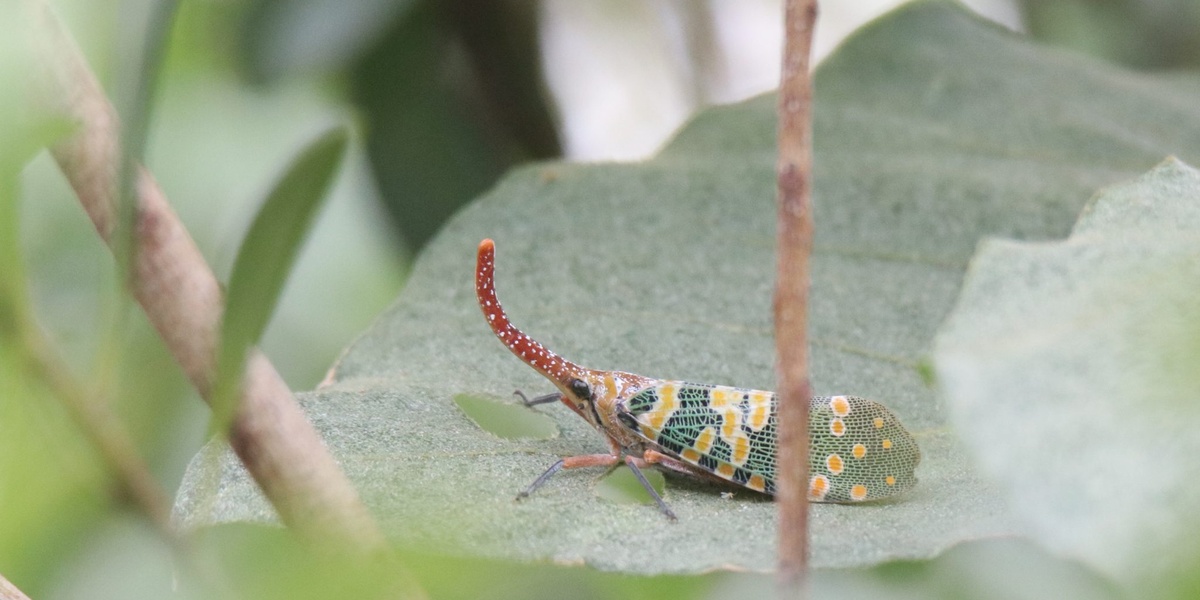
| Lanternfly | Fulgora laternaria | Central, South America | Brown cream red blue |
| Cuckoo wasp | Chrysis ignita | Europe, Asia | Metallic green blue purple |
| Green sweat bee | Agapostemon virescens | North America | Metallic green yellow black |
| Orchid mantis | Hymenopus coronatus | Southeast Asia | Pink white |
| Zebra longwing | Heliconius charithonia | Southeastern US, Central, South America | Black yellow stripes |
| Six-spot burnet | Zygaena filipendulae | Europe | Metallic black red |
| Rainbow grasshopper | Zonocerus variegatus | West, Central Africa | Green yellow red black |
Images and Descriptions
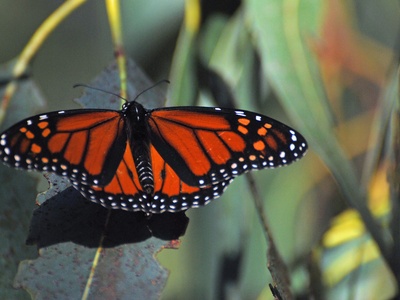
Monarch butterfly
The iconic Monarch displays bright orange wings edged with black and white spots. Found across North America and in Mexican overwintering sites, you’ll spot them on milkweed and in flower gardens; their color signals chemical defenses to predators.
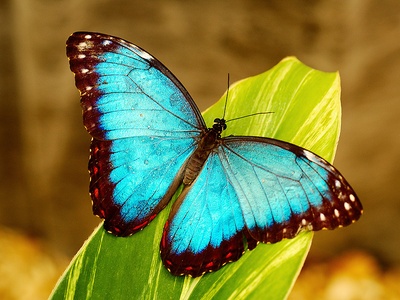
Blue morpho
The Blue Morpho dazzles with large iridescent blue dorsal wings that flash when it flies, contrasting brown undersides. Common in Amazon and Central American rainforests, look for fast gliding males near forest edges and rivers; the blue comes from microscopic wing scales.
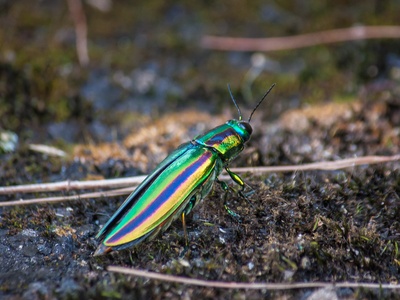
Tamamushi beetle
The Tamamushi jewel beetle shows striking metallic green, blue and gold reflections across its elytra. Native to Japan, it perches on tree trunks and flowers; the shimmering colors come from layered cuticle rather than pigments, creating a jewel-like flash when light hits it.
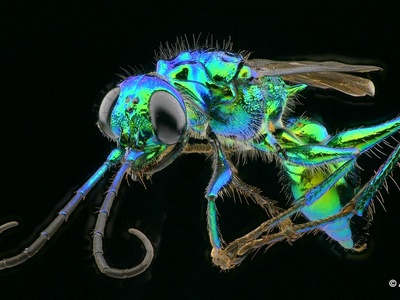
Emerald cockroach wasp
The emerald cockroach wasp gleams metallic green or blue across its slender body. Found in tropical regions of Africa, Asia and Pacific islands, it hunts cockroaches; its color makes it easy to spot on vegetation and flowers while it forages or searches for hosts.
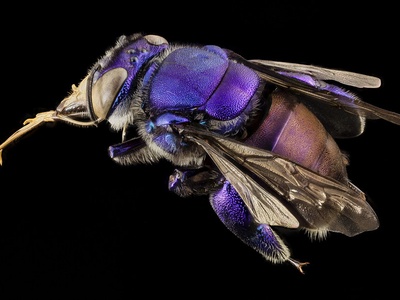
Orchid bee
Orchid bees, including Euglossa dilemma, flash metallic green and blue as they visit forest flowers. Common in Central America, males collect fragrant compounds from orchids; you’ll find them hovering at blossom patches and trapping sunlight on their gleaming thorax and abdomen.
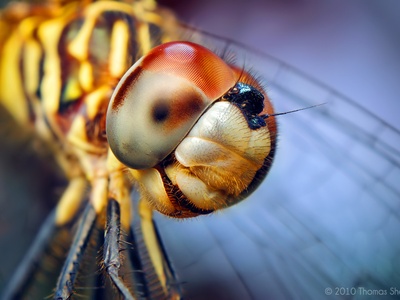
Blue dasher
The Blue Dasher dragonfly sports bright sky-blue males with black markings and clear wings. Widespread across ponds and marshes in North America, it perches on reeds and rocks; watch males patrol sunny waters, where their vivid blue helps attract mates and claim territory.
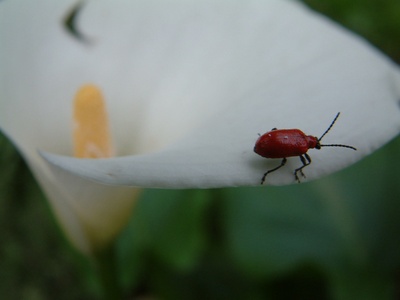
Scarlet lily beetle
The bright scarlet Lily Beetle is unmistakable with glossy red elytra and contrasting black legs and antennae. Native to Europe and Asia and now in North America, you’ll find it on lilies and fritillaries where the red warns or startles gardeners while it feeds on leaves.
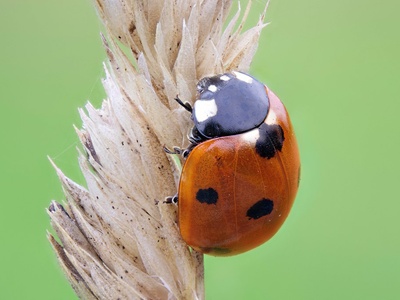
Seven-spot ladybird
The seven-spot ladybird shows bright red elytra with seven black spots and a black head. Common across Europe, Asia and introduced in North America, you’ll find them on aphid-infested plants; their bold red pattern advertises they taste bad to birds.
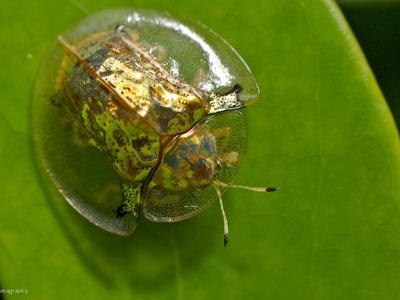
Golden tortoise beetle
The golden tortoise beetle can appear mirror-like gold or rich red when disturbed, with a rounded, flattened shape. Found on morning glories and sweet potatoes in North America, its changing metallic sheen is caused by fluid under the cuticle altering light reflection.
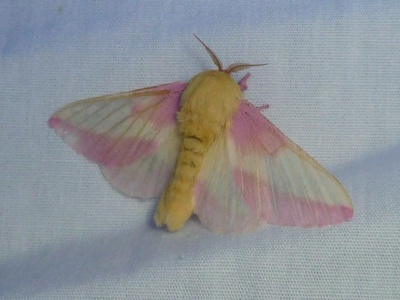
Rosy maple moth
The rosy maple moth shows soft pink and yellow fuzzy wings that look like candy-colored velvet. Common in eastern North America, adults rest on tree trunks and lights at night; their striking pastel palette stands out among common moths and delights backyard observers.

Painted lady
The painted lady is a widespread orange-and-black butterfly with distinctive white spots on the forewings. Found on every continent except Antarctica, look for it in gardens, meadows and along roadsides; their bold markings make them easy to identify on flowers.
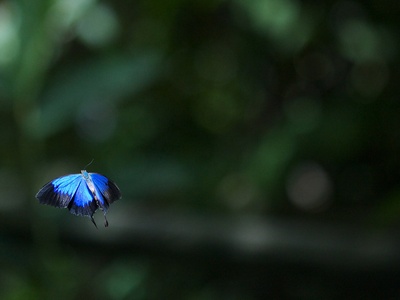
Ulysses butterfly
The Ulysses butterfly flashes brilliant electric-blue wings edged with black when on the wing. Native to Australia and New Guinea, males patrol rainforest clearings and gardens; that vivid blue is a structural color that gleams in sunlight, making them unmistakable.
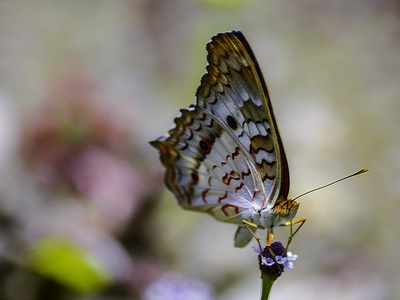
Peacock butterfly
The Peacock butterfly has striking red wings adorned with large eye-spots of blue, yellow and black. Common across Europe and temperate Asia, it basks on sunny walls and flowers; the dramatic eye patterns intimidate predators and make it a favorite of photographers.
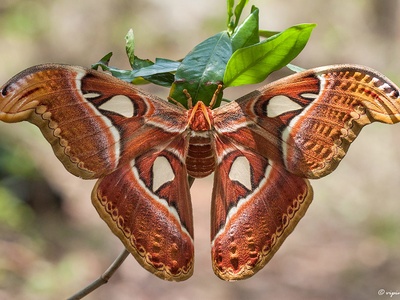
Atlas moth
The Atlas moth boasts enormous rust-brown wings with cream bands and angular tips that resemble snake heads. Found in Southeast Asian forests and gardens, its bold patterning and size are eye-catching; adults are short-lived and their colors blend camouflage and startling shapes.
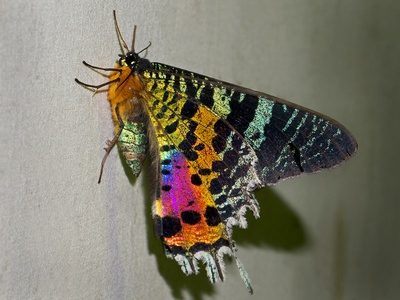
Madagascan sunset moth
The Madagascan sunset moth dazzles with mosaic iridescent green, purple, red and black on its wings. Endemic to Madagascar, you’ll find it near larvae host plants; collectors prize its shimmering colors which arise from microscopic wing structures rather than pigments.
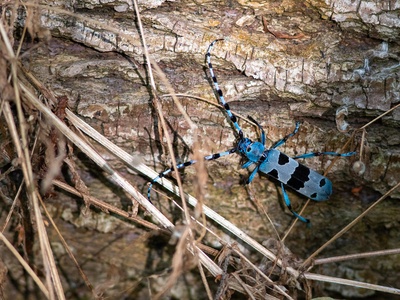
Rosalia longhorn beetle
The Rosalia longhorn beetle shows a striking pale blue-gray body with bold black bands along long antennae. Found on beech and other hardwoods across Europe, it often rests on sunlit trunks and logs where the contrast makes it easy to spot for nature-walkers.
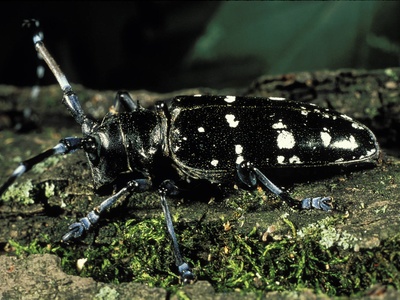
Asian longhorn beetle
The Asian longhorn beetle is glossy black with bold white spots and very long antennae. Native to East Asia and introduced in parts of North America, you’ll find it on hardwood trees; its stark black-and-white pattern makes it visible against bark.
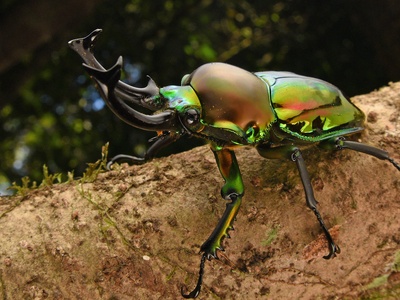
Rainbow stag beetle
The Rainbow stag beetle flashes metallic green to red and copper on its convex elytra. Found in moist Australian forests and under decaying logs, males have shiny mandibles; collectors and hikers prize their jewel-like colors and glossy appearance.
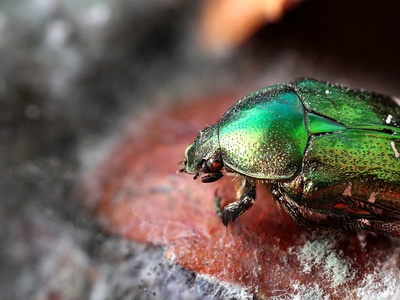
Green fruit chafer
The Green Fruit Chafer gleams metallic emerald with white or cream markings on its elytra. Common in West and Central African woodlands and gardens, it visits fruit and flowers; its glossy green is easy to spot on tree canopies and sunlit foliage.
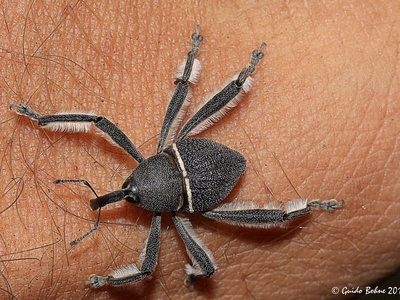
Schoenherr’s weevil
Schoenherr’s weevil displays brilliant electric-blue scales patterned with black bands along its body. Endemic to New Guinea, these striking weevils are often found on foliage and fallen logs; their colorful scales are structural, producing a vivid, toy-like appearance in the rainforest understory.
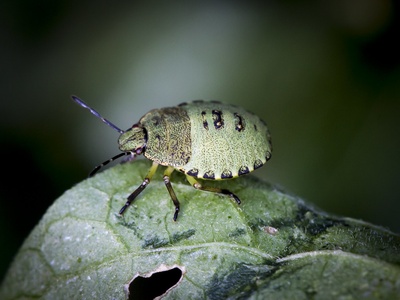
Green shield bug
The green shield bug is a glossy bright green true bug often seen on crops and garden plants. Found across many tropical and temperate regions worldwide, it blends into leaves but stands out because of its smooth, shield-shaped body and occasionally contrasting margins.
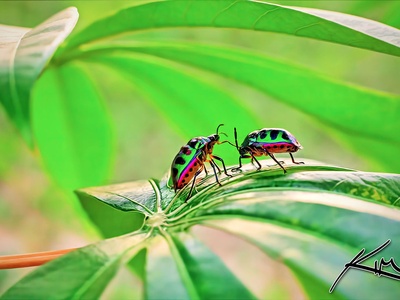
Green jewel bug
The Green Jewel Bug glitters metallic emerald with gold highlights and a rounded, shield-like body. Common in South and Southeast Asia, it frequents shrubs and crops; the brilliant sheen comes from reflective cuticle layers that make them appear jewel-like in sunlight.
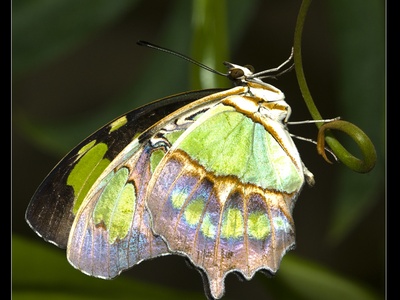
Malachite butterfly
The Malachite butterfly shows bold chartreuse-green wing bands contrasting with black and brown. Found in Central and South America and the Caribbean, it basks in sunlit forest edges and gardens; the vivid green is a standout among rainforest butterfly species.
Lanternfly
The lanternfly has a drab forewing but reveals vivid red, blue and black patterns under its hindwings when flying. Common in Central and South American forests and gardens, you’ll often see them resting on tree trunks until they take a startling, colorful flight.
Cuckoo wasp
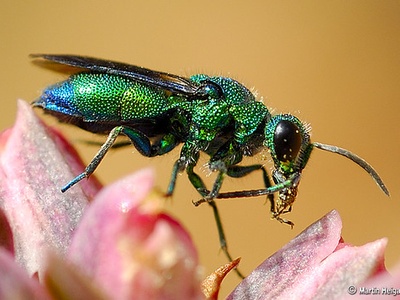
The shimmering cuckoo wasp dazzles with metallic green, blue and purple hues across its sculpted body. Found visiting flowers and nesting sites across Europe and Asia, these tiny parasitic wasps use their tough, shiny cuticle as both camouflage and protection from hosts.
Green sweat bee
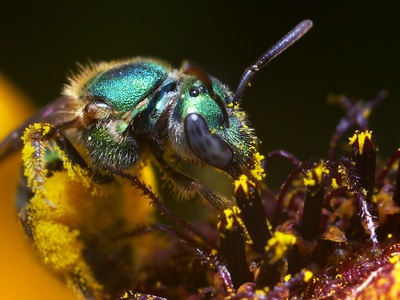
The Green Sweat Bee shines metallic green on the head and thorax with a striped yellow-and-black abdomen. Widespread in North America, you’ll spot them visiting flowers in gardens and meadows; their bright metallic body contrasts with pollen-covered legs during foraging.
Orchid mantis
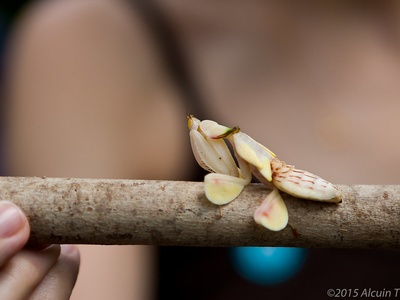
The orchid mantis mimics flower petals with delicate pink and white coloration, ambushing pollinators on blossoms. Native to Southeast Asia, it’s often found on shrubs and orchids; its floral appearance is an extreme example of camouflage that doubles as a colorful hunting strategy.
Zebra longwing
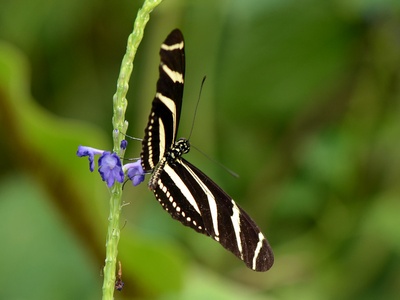
The Zebra Longwing butterfly bears narrow black wings boldly striped with yellow, creating a zebra-like pattern. Found from the southeastern United States through Central and South America, it roosts in groups in hammocks and gardens; their patterned wings signal unpalatability to predators.
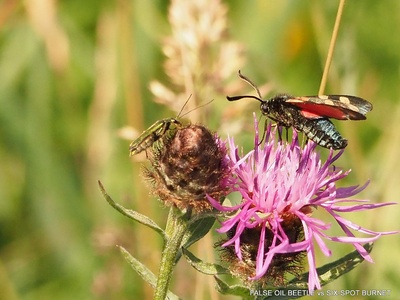
Six-spot burnet
The Six-spot Burnet moth is a day-flying moth with glossy black wings punctuated by six bright red spots. Widespread across Europe in meadows and coastal grasslands, its red warning marks advertise toxicity to birds and make it conspicuous on flowers.
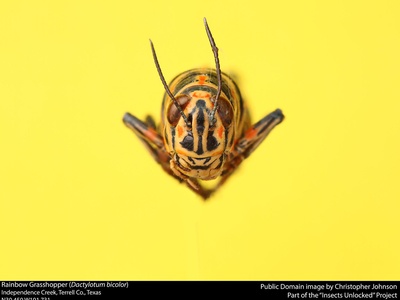
Rainbow grasshopper
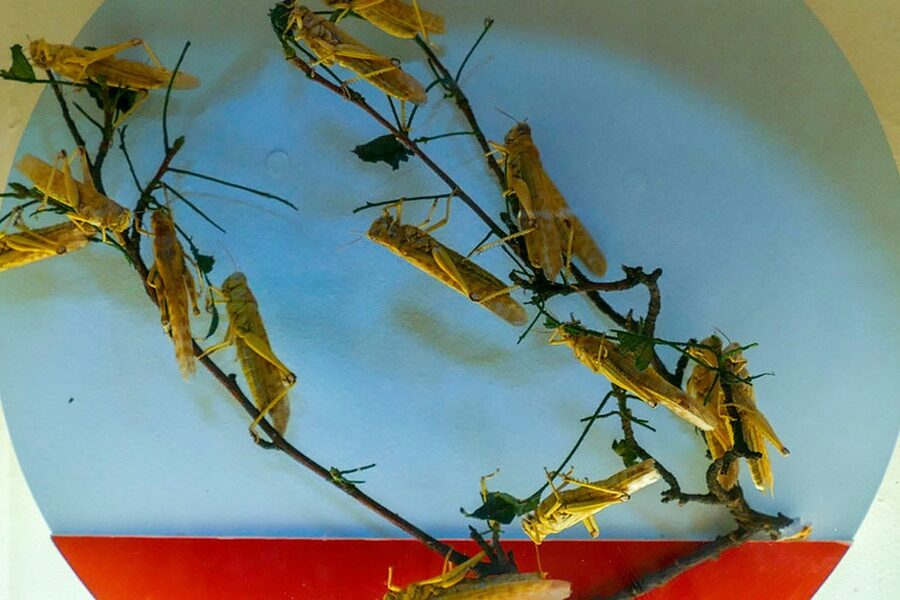
The Rainbow or Variegated Grasshopper shows bold green, yellow and red patterns with dark bands. Common in West and Central African savannas and gardens, it feeds on many plants; the bright aposematic colors warn predators and make it highly visible when hopping.