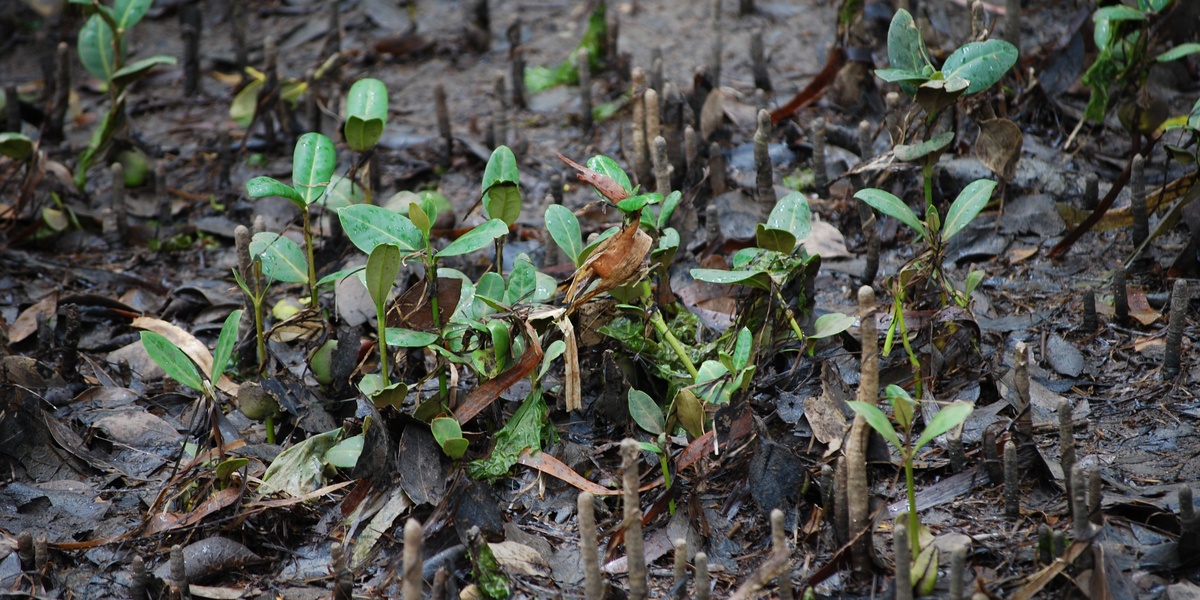
Since the 1980s, the world has lost roughly 35% of its mangrove cover, yet restoration programs have scaled up in the last two decades to reverse that trend in many regions.
Mangrove restoration is one of the most cost-effective, multifunctional conservation tools: it rebuilds habitat, locks away carbon, protects shorelines, and supports local economies—but success depends on the how, where, and who of restoration. Coastal communities gain flood protection and more reliable fisheries, while climate goals benefit from the deep soil carbon these ecosystems store.
This piece lays out nine clear facts about mangrove restoration across ecological, climate and social dimensions—what works, what doesn’t, and why hydrology, species choice, and community governance determine outcomes.
Ecosystem and biodiversity benefits
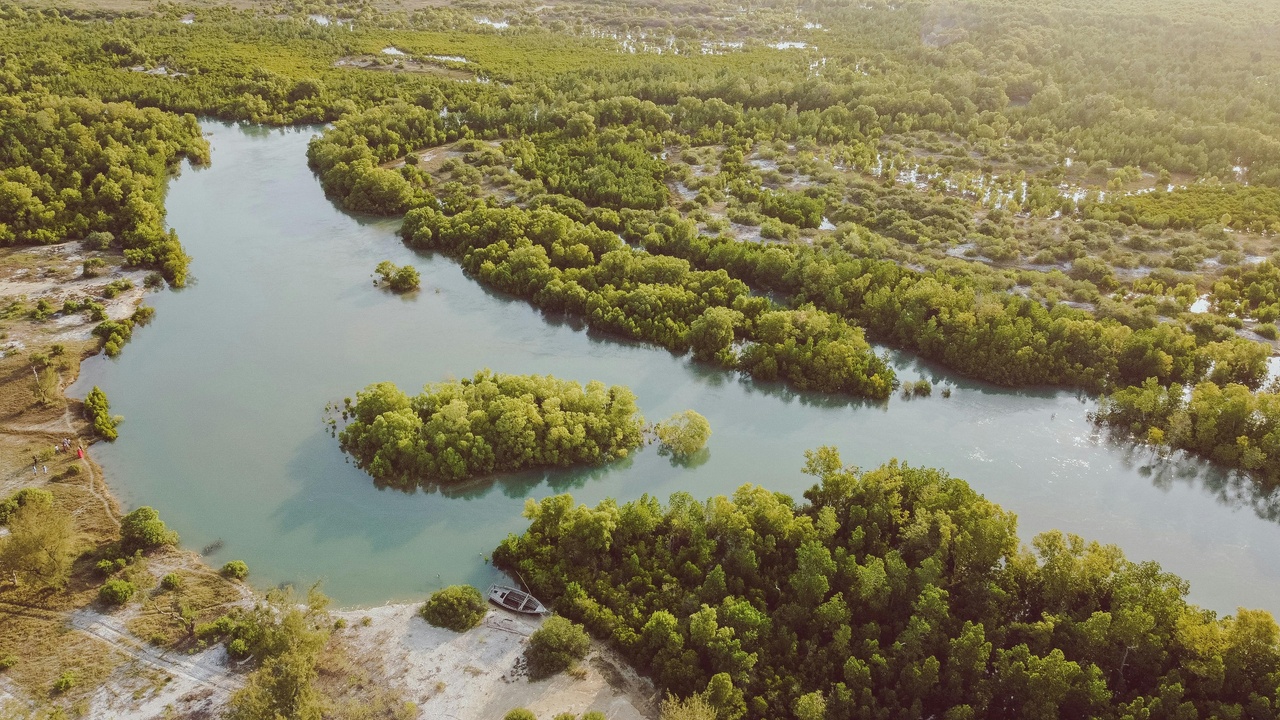
Restoring mangroves reconnects coastal habitat, revives life cycles, and rebuilds ecological function. When projects restore tidal flow and plant appropriate species mixes, formerly degraded mudflats can recover nursery functions, support shorebirds and crustaceans, and reestablish food-web links to adjacent reefs and seagrass beds. Monitoring and adaptive management are essential to track species return and guide corrective actions.
1. Mangroves are crucial nursery habitats for fisheries
Mangroves serve as nurseries for juvenile fish, shrimp and crabs, giving young animals shelter and abundant food during vulnerable life stages. Numerous studies and fisheries agencies link healthy mangrove belts to higher commercial and subsistence catches.
Well-designed restoration—especially where hydrological reconnection is part of the work—has increased juvenile abundance and, over time, local catches. Community planting programs in the Philippines report anecdotal and monitored increases in juvenile catches within 3–7 years, and fishers often describe clearer recruitment signals after tidal exchange is reestablished.
2. Restored mangroves can recover high local biodiversity
Biodiversity commonly rebounds at well-sited restoration projects. Restored sites that regain structural complexity often attract shorebirds, crabs, and even mangrove-specialist mammals such as primates in parts of Borneo and broader Southeast Asia.
Field monitoring shows many sites regain measurable species lists and canopy structure within 5–10 years if tidal flow and species composition are right. Projects in Borneo and other Southeast Asian locations document returning bird and mammal records once habitat layers reappear.
3. Roots and restored soils improve water quality
Mangrove roots trap sediment, reduce turbidity and capture pollutants, which improves downstream water clarity for coral reefs and seagrasses. Root mats also create substrate that supports juvenile benthic organisms.
Pilot work in the Mekong Delta and parts of the Caribbean recorded measurable sediment accumulation and improved clarity within a few years of restoration, with turbidity reductions and localized nutrient retention that benefited nearby seagrass beds.
Climate mitigation and coastal protection
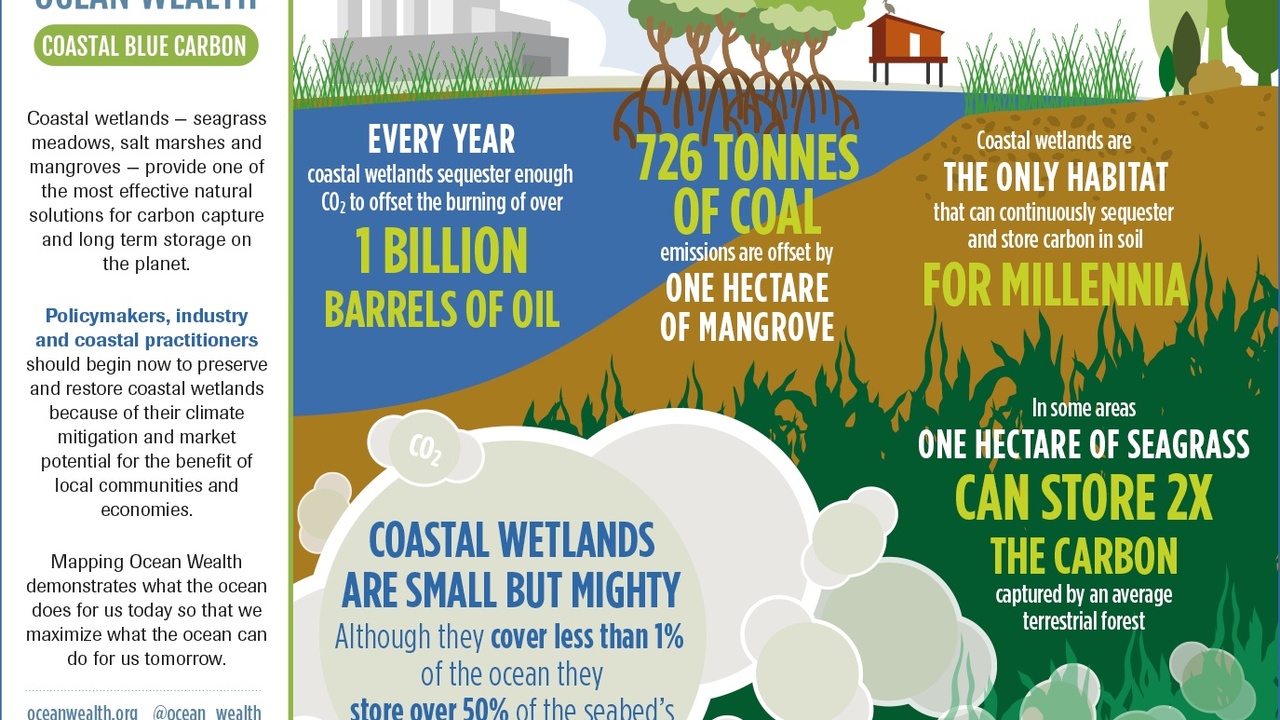
One of the facts about mangrove restoration is that these forests act as powerful blue carbon sinks and natural coastal defenses. They store carbon in trees and, crucially, in deep, anoxic soils; their root networks also reduce wave energy and stabilize shorelines. Combining restoration with sediment and tidal management makes these benefits durable.
4. Mangroves are exceptional blue carbon sinks
Mangroves store large amounts of carbon in both biomass and soils. In rich systems, combined tree and soil carbon can reach around 1,000 tonnes of carbon per hectare, while many sites commonly hold several hundred tonnes per hectare—numbers that often outpace upland forests on a per-area basis (IUCN and UNEP report guidance reflects these ranges).
Because of high per-area density, carbon accounting and blue carbon credits are emerging as ways to finance restoration at scale. Blue carbon pilots in Indonesia and Belize, supported by groups including the Global Mangrove Alliance, show how verified carbon finance can help cover long-term management costs.
5. Restored mangroves reduce wave energy and flood risk
Mangrove belts attenuate waves and lower storm-surge impacts; measured wave-height reductions range widely, from roughly 13% up to 66%, depending on forest width, species, and local bathymetry. Wider, denser forests deliver the strongest protection.
The Sundarbans provide a regional example: intact mangrove tracts buffer parts of coastal Bangladesh during cyclones and reduce damage inland. That protective effect is site-specific, so restoration intended for disaster risk reduction must be planned at landscape scale to be effective.
6. Root networks stabilize shorelines and trap sediment
Tangled roots slow water flow, trap suspended sediment and encourage accretion, which can help shorelines keep pace with moderate sea‑level rise when sediment supply is adequate. Successful restoration programs plan for sediment inputs and reconnect tidal flow where it has been blocked.
Mekong Delta projects and other delta-focused initiatives emphasize reestablishing sediment pathways; by contrast, many failed planting attempts ignored hydrology and saw saplings drown or be washed away. Restoring tidal exchange is often the single most important technical fix.
Economic, social and governance benefits
Mangrove recovery is also a socioeconomic activity: it creates restoration jobs, supports fisheries and nursery services, attracts ecotourism, and can unlock finance through blue carbon or payments for ecosystem services. Governance matters: community-led efforts with secure tenure and benefit-sharing outperform top-down schemes.
7. Restoration supports local livelihoods and fisheries
Restoration translates into jobs during planting and maintenance and, over time, into improved fisheries. Some monitored projects report catch increases in the order of 20–50% after mangroves recover their nursery functions, though results vary with context and time.
Community-based programs in Indonesia and the Philippines combined local nurseries, wage opportunities and training; secure tenure and clear benefit-sharing arrangements encouraged sustained investment by fishers and households.
8. Ecotourism and cultural value bring diversified revenue
Healthy mangrove areas attract birdwatchers, kayak tours and cultural visits. Regions such as Belize and parts of Florida earn steady tourism income from mangrove-fringed waterways, and restoring aesthetics and biodiversity supports that market.
Integrating cultural tours and education into restoration both raises local revenue and builds stewardship. Tourism must be managed—visitor limits, boardwalks and community rules prevent trampling and pollution that would undermine restoration gains.
9. Finance, policy, and the pitfalls to avoid
Blue carbon credits, grants and PES schemes are making large-scale restoration feasible, and pilots in Belize and Indonesia have attracted funding. Organizations such as the Global Mangrove Alliance, IUCN and Wetlands International provide technical guidance and standards for finance and monitoring.
Common pitfalls include planting monocultures, ignoring tidal flow, and restoring unsuitable land (e.g., former salt pans with altered hydrology). Best practice bundles science and community rights: diverse species mixes, hydrological reconnection, long-term monitoring, and local governance lead to durable results.
Summary
- Mangrove restoration delivers measurable ecological, climate and social benefits—from nursery services and biodiversity rebound to deep soil carbon (hundreds to ~1,000 t C/ha) and wave attenuation (roughly 13–66% in studied cases).
- Technical success hinges on hydrology, correct species choice and adequate sediment supply; many sites show meaningful recovery within 5–10 years when those elements are addressed.
- Community-led governance, secure tenure and fair benefit-sharing improve livelihoods and long-term stewardship; finance streams (blue carbon, PES) are expanding but require robust monitoring and safeguards (IUCN, Global Mangrove Alliance guidance).
- Support reputable organizations and local projects: donate or volunteer with groups such as IUCN, the Global Mangrove Alliance or Wetlands International, and look for community-led initiatives that combine planting with hydrological restoration.