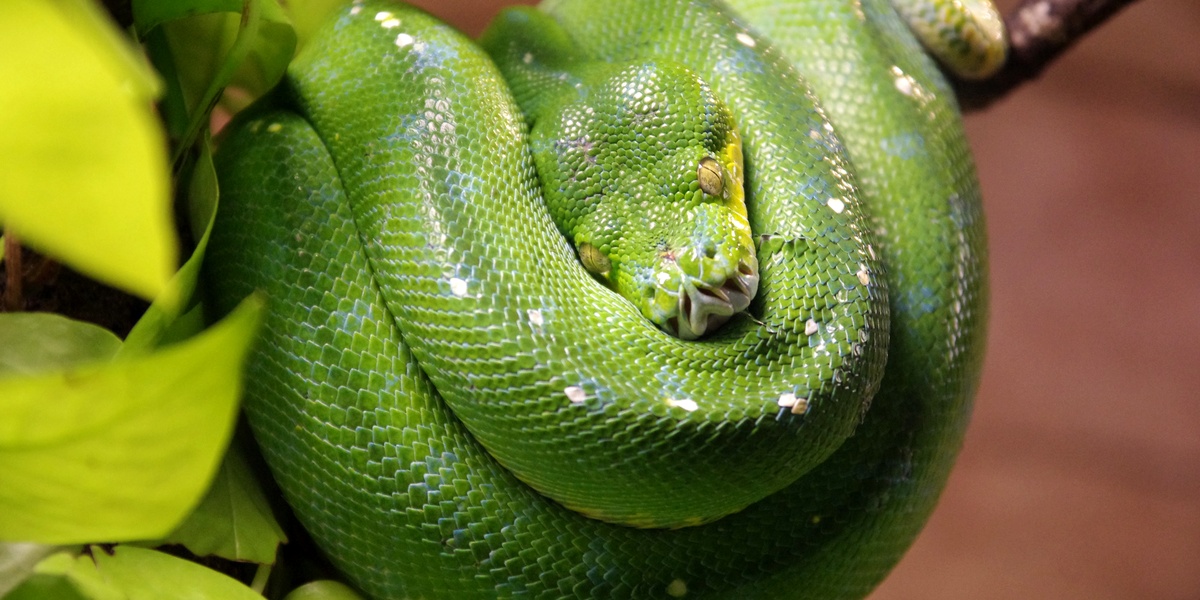
Walking under a closed canopy you notice the subtle signs of wildlife: a sun-warmed log, a sudden rustle, the flash of scales. Forest habitats hide a surprising diversity of reptiles adapted to leaf litter, water holes and low branches.
There are 29 forest reptiles, ranging from African dwarf crocodile to Wagler’s pit viper; for each species the data are organized as Scientific name,Range,Size (cm) — you’ll find below.
Which forest reptiles are dangerous to people?
Only a handful of forest reptiles pose significant risks: venomous snakes (like some vipers) and larger crocodilians can cause harm, while most lizards and small snakes are harmless. Learn the local species, avoid handling animals, give wildlife space, and know where to get medical help or antivenom in the region you’re visiting.
How can I identify forest reptiles in the field without disturbing them?
Observe habitat, behavior and key features from a distance—body shape, scale texture, color patterns and approximate size—and photograph specimens for later ID using field guides or online resources. Night surveys with a flashlight, careful note-taking of location, and consulting the Scientific name,Range,Size (cm) entries in the table below will improve accuracy without stressing the animals.
Forest Reptiles
| Name | Scientific name | Range | Size (cm) |
|---|---|---|---|
| Green tree python | Morelia viridis | New Guinea, NE Australia | 150 |
| Emerald tree boa | Corallus caninus | Amazon Basin, Colombia, Brazil, Venezuela | 150 |
| Eyelash viper | Bothriechis schlegelii | Central America, Colombia, Ecuador, Panama | 60 |
| King cobra | Ophiophagus hannah | India, Southeast Asia, Indonesia, Malaysia | 300 |
| Gaboon viper | Bitis gabonica | West and Central Africa (Nigeria, Gabon, DR Congo) | 120 |
| Boomslang | Dispholidus typus | Sub-Saharan Africa | 120 |
| Green iguana | Iguana iguana | Central and South America, Caribbean | 150 |
| Red-tailed boa | Boa constrictor | Central and South America | 200 |
| Wagler’s pit viper | Tropidolaemus wagleri | Thailand, Malaysia, Philippines, Indonesia | 75 |
| Asian vine snake | Ahaetulla nasuta | India, SE Asia | 120 |
| Brown tree snake | Boiga irregularis | New Guinea, Solomon Islands, Guam | 200 |
| Mangrove snake | Boiga dendrophila | SE Asia, Indonesia, Borneo, Philippines | 200 |
| Reticulated python | Malayopython reticulatus | Southeast Asia, Indonesia, Philippines | 300 |
| African dwarf crocodile | Osteolaemus tetraspis | West and Central Africa | 150 |
| Green tree monitor | Varanus prasinus | New Guinea, Indonesia | 80 |
| Tokay gecko | Gekko gecko | South and Southeast Asia | 30 |
| Crested gecko | Correlophus ciliatus | New Caledonia | 22 |
| Flying dragon | Draco volans | Southeast Asia | 25 |
| Panther chameleon | Furcifer pardalis | Madagascar | 50 |
| Parson’s chameleon | Calumma parsonii | Madagascar | 60 |
| Dwarf leaf chameleon | Brookesia superciliaris | Madagascar | 6 |
| Eastern box turtle | Terrapene carolina | Eastern United States | 15 |
| Black-breasted leaf turtle | Geoemyda spengleri | Vietnam, China, Laos | 18 |
| Hingeback tortoise | Kinixys erosa | West and Central Africa | 30 |
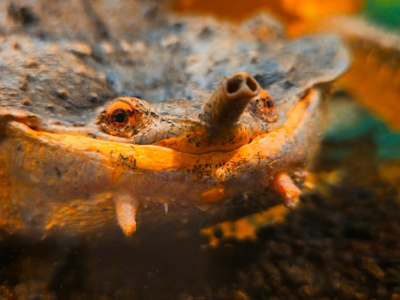
| Mata mata turtle | Chelus fimbriata | Amazon Basin, Brazil, Peru, Colombia | 45 |
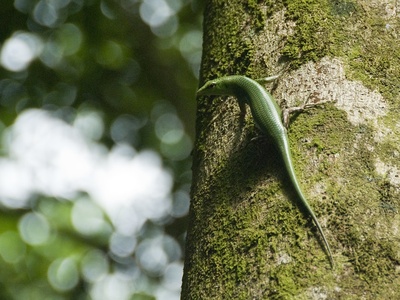
| Emerald tree skink | Lamprolepis smaragdina | SE Asia, Pacific Islands | 22 |
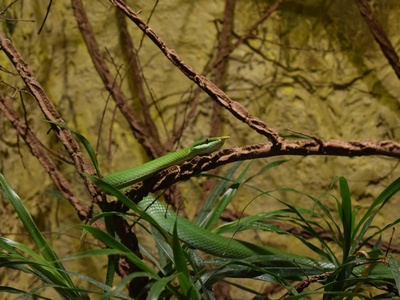
| Crested forest lizard | Gonocephalus chamaeleontinus | Borneo, Indonesia, Malaysia | 25 |
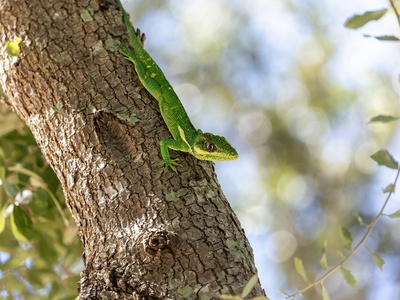
| Knight anole | Anolis equestris | Cuba, Caribbean | 50 |
| Green anaconda | Eunectes murinus | Amazon Basin, South America | 400 |
Images and Descriptions
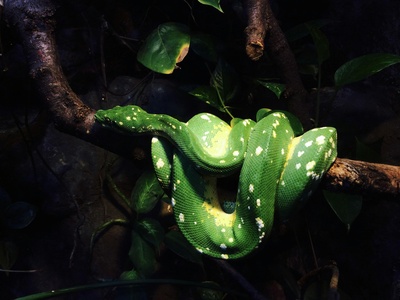
Green tree python
Arboreal rainforest python that coils on branches and vines; bright green with a prehensile tail and occasional white lateral markings. Nonvenomous constrictor, rarely aggressive to people. Sensitive to deforestation; local populations decline where forest is cleared.
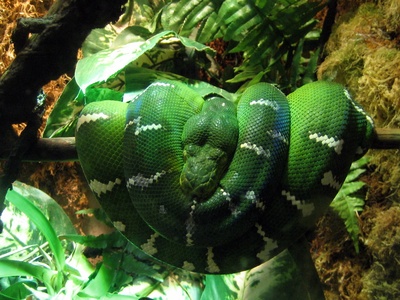
Emerald tree boa
Striking arboreal boa of Amazonian rainforests; emerald green with white saddle markings and a broad head. Nonvenomous constrictor often seen in canopy near waterways. Vulnerable to habitat loss and pet trade pressure in parts of its range.
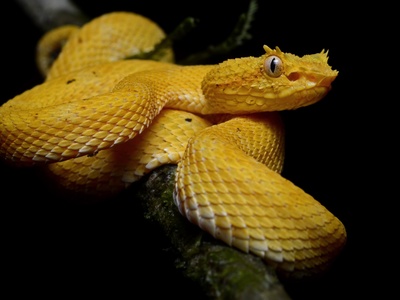
Eyelash viper
Small arboreal pit viper of humid lowland and montane forests, often on thin branches; variable colors and distinctive supraocular scales (“eyelashes”). Venomous and potentially dangerous. Habitat loss threatens some populations, though locally common.
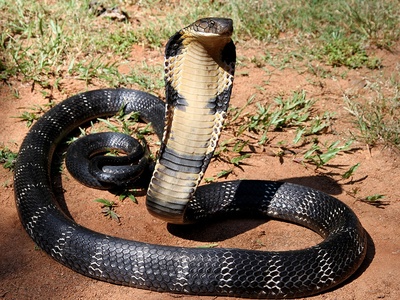
King cobra
Forest-specialist elapid often found in dense tropical and secondary forests; long, hooded snake with smooth scales and powerful size. Highly venomous, can be fatal. Faces persecution and habitat fragmentation across much of its range.
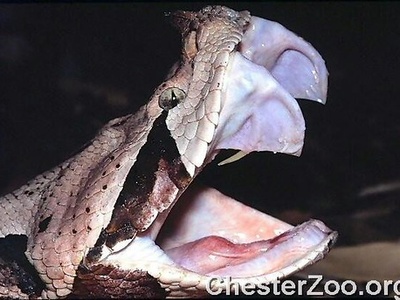
Gaboon viper
Large, heavy-bodied forest floor viper with complex leaf-like pattern and longest fangs among vipers. Ambush predator in rainforests and swampy forest floors. Extremely venomous but slow-moving; threatened by habitat loss and hunting.
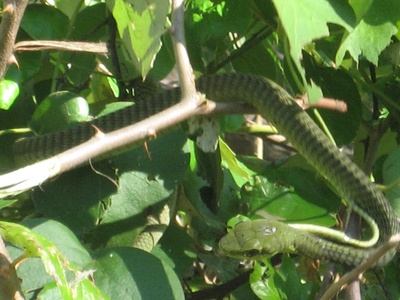
Boomslang
Arboreal, slender snake frequenting forest and woodland edges; males often green, females brown. Large eyes and rear-fanged venom delivery; bites can be serious. Generally avoids humans; forest clearance reduces suitable habitat locally.
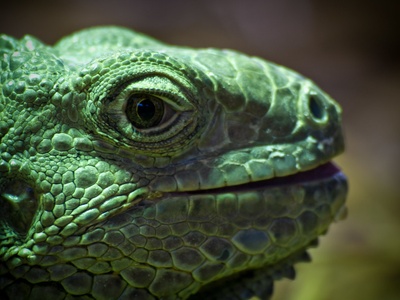
Green iguana
Large arboreal lizard found in tropical forests and riparian canopy; bright green when young, with long tail and dewlap. Nonvenomous herbivore that basks near water. Local declines from hunting and pet trade, but widespread overall.
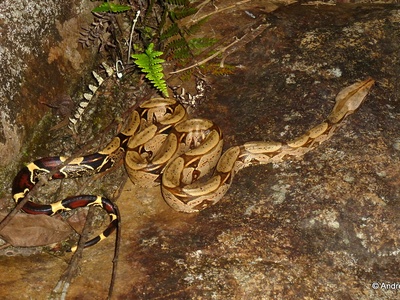
Red-tailed boa
Versatile forest-dwelling constrictor of primary and secondary rainforests; stout body with saddle markings and reddish tail. Nonvenomous, kills by constriction. Habitat loss and collection for trade impact local populations.
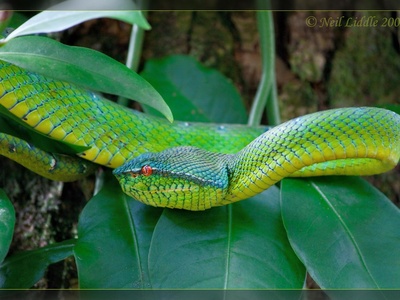
Wagler’s pit viper
Arboreal pit viper of lowland and mangrove forests; triangular head and bold banding in females. Venomous with painful bites. Often found near human-used forest edges; some local populations face habitat disturbance.
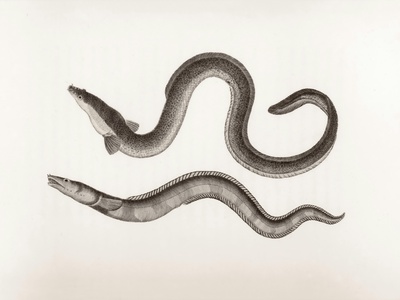
Asian vine snake
Slender, green arboreal snake blending with foliage in moist forests; long pointed snout and thin body. Mildly venomous rear-fanged species generally not life-threatening to humans. Forest clearing reduces its leafy hunting habitat.
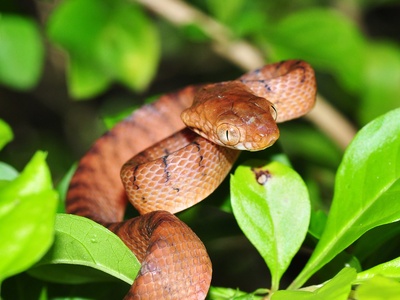
Brown tree snake
Nocturnal arboreal snake inhabiting tropical forests and disturbed woodlands; brown with darker markings and large eyes. Mildly venomous, rear-fanged; dangerous to small pets and birds. Invasive on Guam; native populations affected by habitat change.
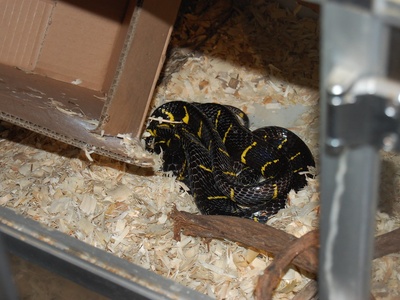
Mangrove snake
Glossy black-and-yellow arboreal snake of mangrove and lowland forests, often near water. Rear-fanged and mildly venomous, rarely deadly to people. Habitat loss from coastal development and logging threatens local groups.
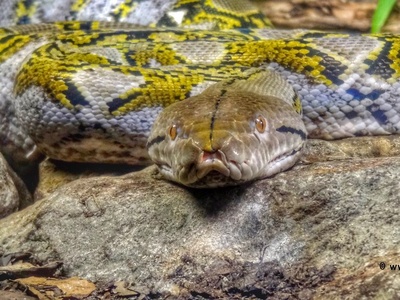
Reticulated python
Large forest and riverine python, often in dense rainforest and flooded forest. Complex net-like pattern, powerful constrictor that can reach great lengths. Nonvenomous but capable of killing large prey; vulnerable to habitat loss and hunting.
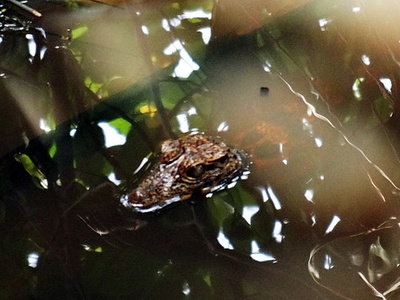
African dwarf crocodile
Small, secretive crocodile of forest streams, swamps and flooded forest. Stout, armored body and relatively small size compared with other crocodylians. Rarely aggressive to people but threatened by hunting and forest drainage.
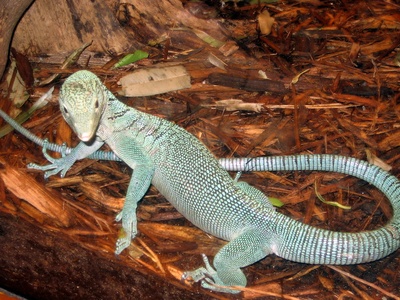
Green tree monitor
Slender arboreal monitor lizard with vivid green coloration living in rainforest canopy. Excellent climber and insectivore/small-prey hunter. Not dangerous to people but sensitive to pet trade and deforestation impacting canopy habitat.
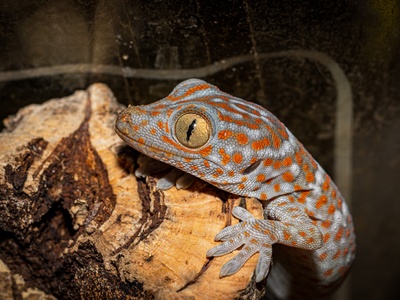
Tokay gecko
Nocturnal, vocal gecko found in humid forests and rocky forest edges; robust body with spotted pattern. Bites can be painful but not usually dangerous. Locally collected for pet trade, but widespread in intact forest areas.
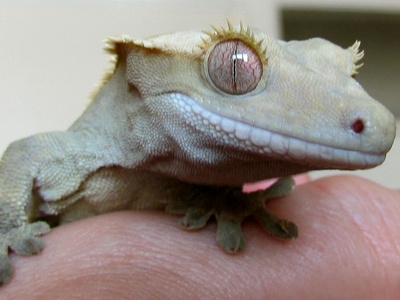
Crested gecko
Arboreal forest gecko that lives in humid montane and lowland forest; prehensile tail and fringed crest along the back. Harmless to people. Wild populations impacted by habitat loss and predation by introduced mammals.

Flying dragon
Small arboreal agamid specialized for gliding between trees in tropical forests; look for wing-like ribs with colorful patagia. Insectivorous and harmless to humans. Depends on continuous canopy; fragmentation limits movement and dispersal.
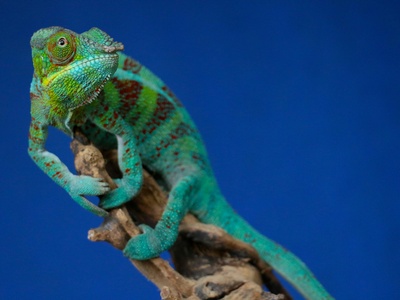
Panther chameleon
Colorful arboreal chameleon inhabiting humid lowland and gallery forests; males show vivid colors and lateral striping. Grasping feet and independently moving eyes are ID hints. Habitat loss and overcollection have impacted some island populations.
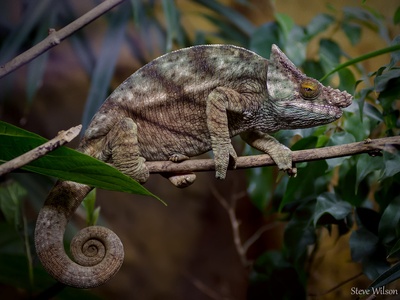
Parson’s chameleon
Large montane and lowland forest chameleon with robust body and casque on males. Arboreal ambush predator of insects. Not dangerous to people. Vulnerable to deforestation and local collection for trade.
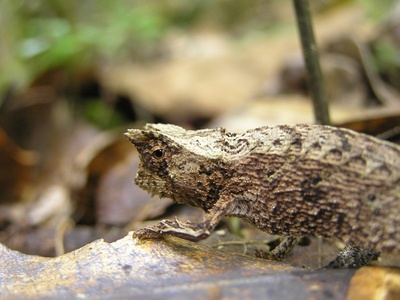
Dwarf leaf chameleon
Tiny leaf-litter chameleon living in primary rainforest floor and understory; cryptic brown coloring and short tail. Harmless and often overlooked. Highly dependent on intact forest and threatened by habitat loss.
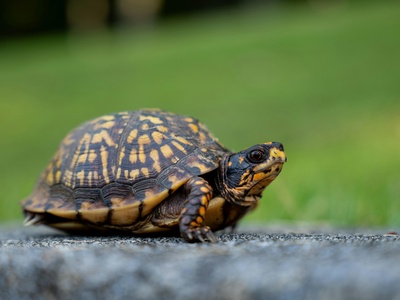
Eastern box turtle
Terrestrial, forest-associated turtle of deciduous woodlands and moist leaf litter; dome shell and hinged plastron for defense. Omnivorous and shy. Populations decline from habitat fragmentation, road mortality and collection.
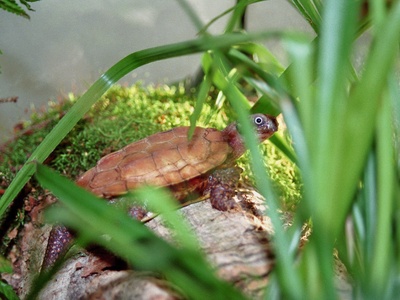
Black-breasted leaf turtle
Small, secretive forest floor turtle inhabiting moist evergreen forests and leaf litter; dark carapace with subtle patterns. Shy and nonaggressive. Critically affected by habitat loss and heavy collection for local trade.
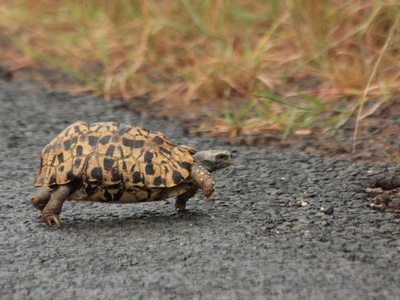
Hingeback tortoise
Forest and rainforest floor tortoise with hinged shell and flattened profile, often found in leaf litter. Herbivorous and slow-moving. Faces hunting pressure and habitat degradation in many forest regions.
Mata mata turtle
Highly camouflaged, suction-feeding turtle of slow-moving forest streams and flooded forest; flat, knobbled shell and leaf-like snout. Harmless to humans. Specialized habitat makes it vulnerable to water pollution and deforestation.
Emerald tree skink
Arboreal, glossy green skink common in tropical forests and disturbed wooded areas; slender body and smooth scales. Harmless insectivore. Locally common but vulnerable where forest canopy is removed.
Crested forest lizard
Robust, arboreal agamid of humid lowland and hill forests with a compressed body and crest. Often on trunks and branches, camouflaged against bark. Harmless; depends on intact forest structure and suffers from logging.
Knight anole
Large arboreal anole native to Cuban forests; stout body, large head and often green with dorsal patterning. Territorial but harmless to humans. Habitat loss and collection affect native pockets; widely introduced elsewhere.
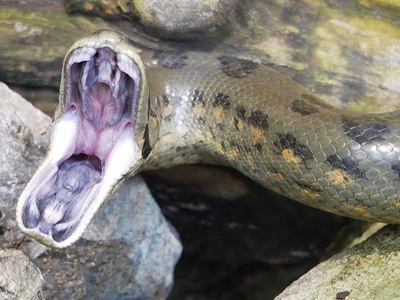
Green anaconda
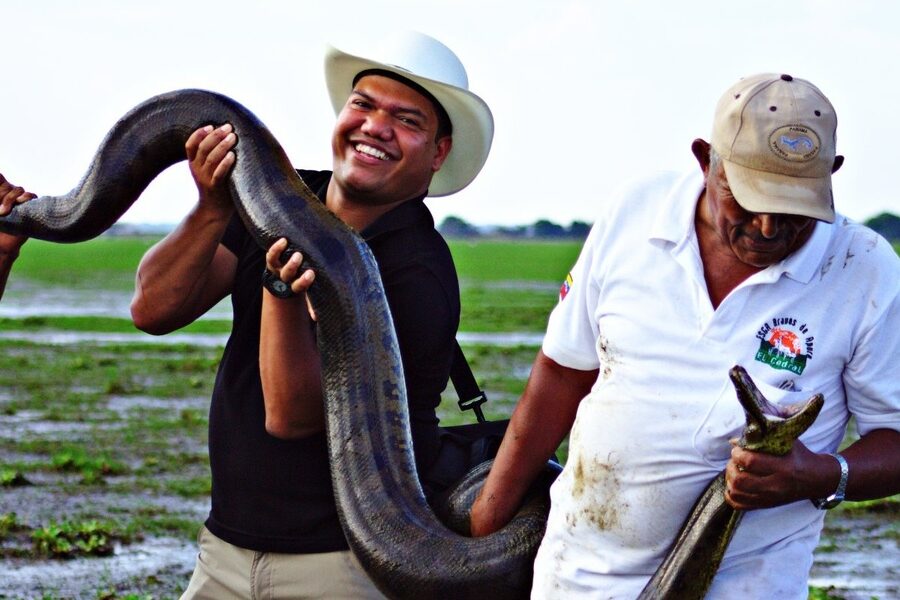
Massive semi-aquatic boa inhabiting flooded forests, swamps and slow rivers; olive-green with dark blotches and muscular body. Nonvenomous constrictor able to take large prey. Vulnerable to habitat change and hunting in some areas.