
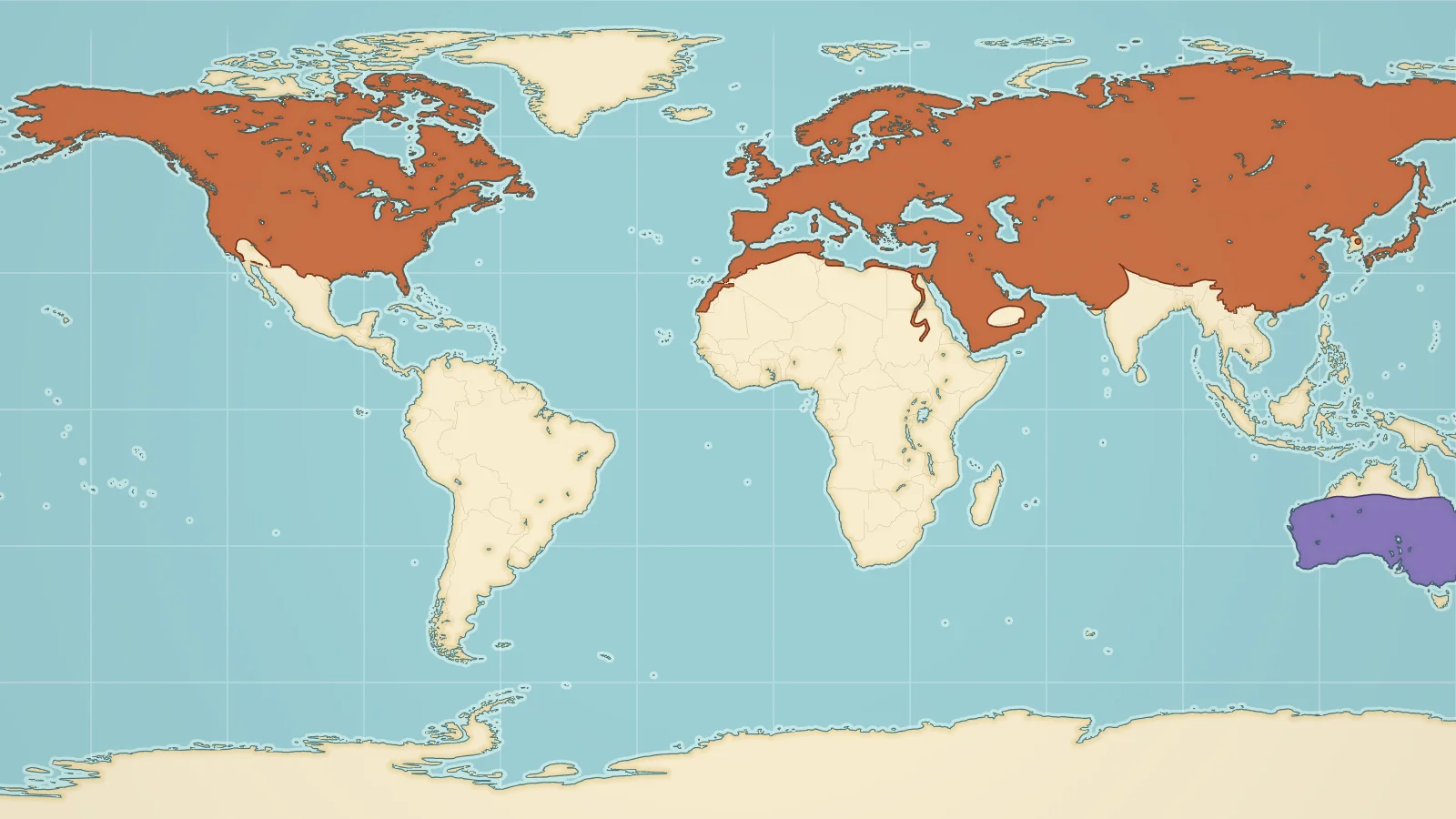

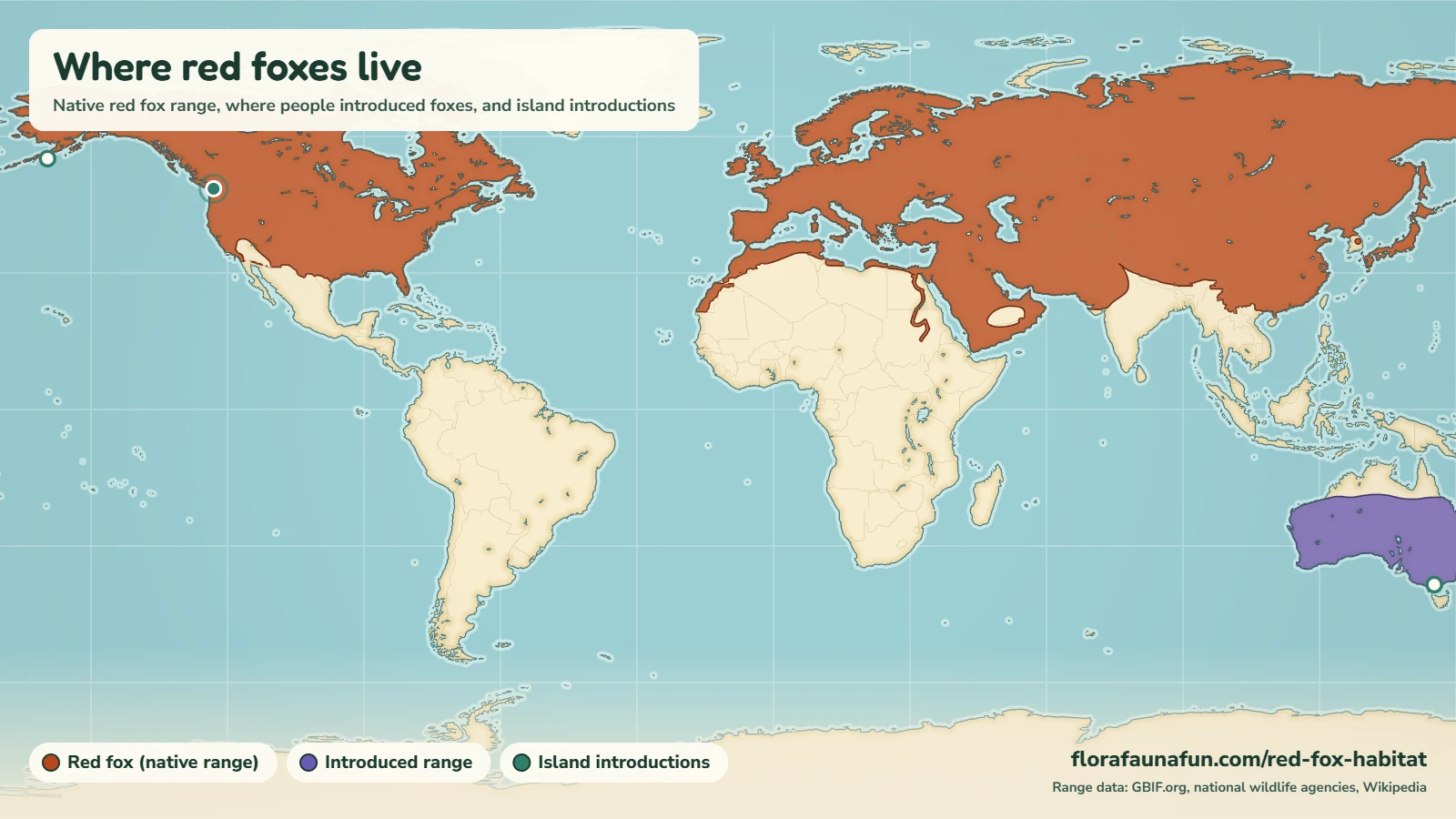
Red foxes (Vulpes vulpes) live across the Northern Hemisphere: in Canada and every US state except Hawaii, in Europe from Portugal and Ireland to Russia, across Asia to Japan and India, and along the coast of North Africa. People also released them in Australia, where foxes now cover about three quarters of the mainland. No other wild carnivore has a natural range as large, close to 70 million square kilometers. The map above shows the native range, the introduced range in Australia and the islands where foxes were released.
More maps of where animals live are on the animal habitat maps page.
Red fox habitat at a glance
| Region | Where red foxes live | Habitat | Native or introduced |
|---|---|---|---|
| North America | Canada, Alaska and every US state except Hawaii, north to the Arctic coast | Forest edge, farmland, tundra, mountains, suburbs | Native |
| Europe | Every mainland country, Britain and Ireland, Scandinavia to the Mediterranean | Woodland, farmland, mountains, towns and cities | Native |
| Russia, Central and East Asia | Siberia, Kazakhstan, Mongolia, China, Korea, Japan | Taiga, tundra, steppe, desert edge, mountains | Native |
| Middle East, South Asia and North Africa | Turkey, Iran, Arabia, Pakistan, northern India, Morocco to Egypt | Desert edge, scrub, high mountains | Native |
| Australia | Every mainland state and territory except the tropical north | Farmland, woodland, arid scrub, cities | Introduced around 1871 |
The IUCN lists the red fox as Least Concern with a stable population. Nobody has counted the world's red foxes. Britain alone was estimated at about 240,000 adults before the breeding season, and Australia at more than 7.2 million foxes in 2012.
Where red foxes live today
North America
Red foxes live in every Canadian province and territory and in every US state except Hawaii. In the Arctic they spread north over the tundra between the 1920s and the 1960s, and Bylot Island and Herschel Island now mark the northern edge. Some of the dry country of the central plains and the southwestern deserts has few or none.
For a long time people believed eastern red foxes descended from English foxes released for hunting in the mid-1700s. Genetic studies show otherwise. Foxes from the eastern and southern United States carry North American lineages and are closely related to the native foxes of eastern Canada. Red foxes were scarce in much of the East in colonial times and common by the mid-1800s, as forest was cleared for farms. The English foxes left a trace: some foxes in the mid-Atlantic states still carry European DNA.
A few populations in the West and South came from foxes that people moved. Texas got its red foxes from about 40 animals released near Waco between 1890 and 1895. Florida had no records before the 1950s. The lowland foxes of California and western Washington descend from fur-farm stock released from the 1960s, while the native western red foxes live high in the mountains. The Sacramento Valley has its own native subspecies, Vulpes vulpes patwin.
Scientists have found that North American red foxes are genetically distinct from Eurasian ones, and some argue they should be a separate species, Vulpes fulva. Most checklists, including the Mammal Diversity Database, still treat all red foxes as one species.
Europe
Red foxes are native to every mainland European country and to Britain and Ireland. They are absent from the Channel Islands, the Isles of Scilly and most Scottish islands. Foxes released on the Isle of Man in the 1980s never properly established. Iceland has only the arctic fox. Mallorca had no foxes in historical times until one was shot in December 2009.
Russia, Central Asia and East Asia
Foxes live across Russia, Kazakhstan, Mongolia and most of China. Mongolia lists the red fox as Near Threatened on its national red list because of heavy hunting for fur. Japan has two native subspecies, one on Hokkaido and one on the southern islands. South Korea lost its wild red foxes and has been bringing them back since 2012 in Sobaeksan National Park, where about 120 foxes lived in 2024. Taiwan has no foxes.
The Middle East, South Asia and North Africa
Red foxes live across Turkey, Iran, the Arabian Peninsula and Central Asia. In India the small desert fox lives in the Thar Desert of Rajasthan, Gujarat and Kutch, and Himalayan and Kashmir red foxes live in the northern mountains. In Africa the range is a narrow band along the north: northern Morocco, Algeria, Tunisia, eastern Libya, western Egypt and the Nile valley in Sudan. The open Sahara belongs to the fennec fox, the pale fox and Rüppell's fox.
Red fox habitat types
Red foxes live from sea level to about 4,500 m, in tundra, forest, farmland, steppe, desert edge and city centres. They avoid only the most extreme deserts, the high Arctic islands and dense tropical forest. Three things explain why so many habitats work:
- Mixed diet: voles, mice, rabbits and birds make up most of the diet, but foxes also eat insects, earthworms, fruit, carrion and food waste.
- Small territories: a family can live in a few square kilometers where food is plentiful, which lets foxes fit into farmland and suburbs.
- Den sites: foxes dig their own dens or take over badger setts and rabbit burrows, and in towns they den under sheds and in railway banks.
Forest and forest edge
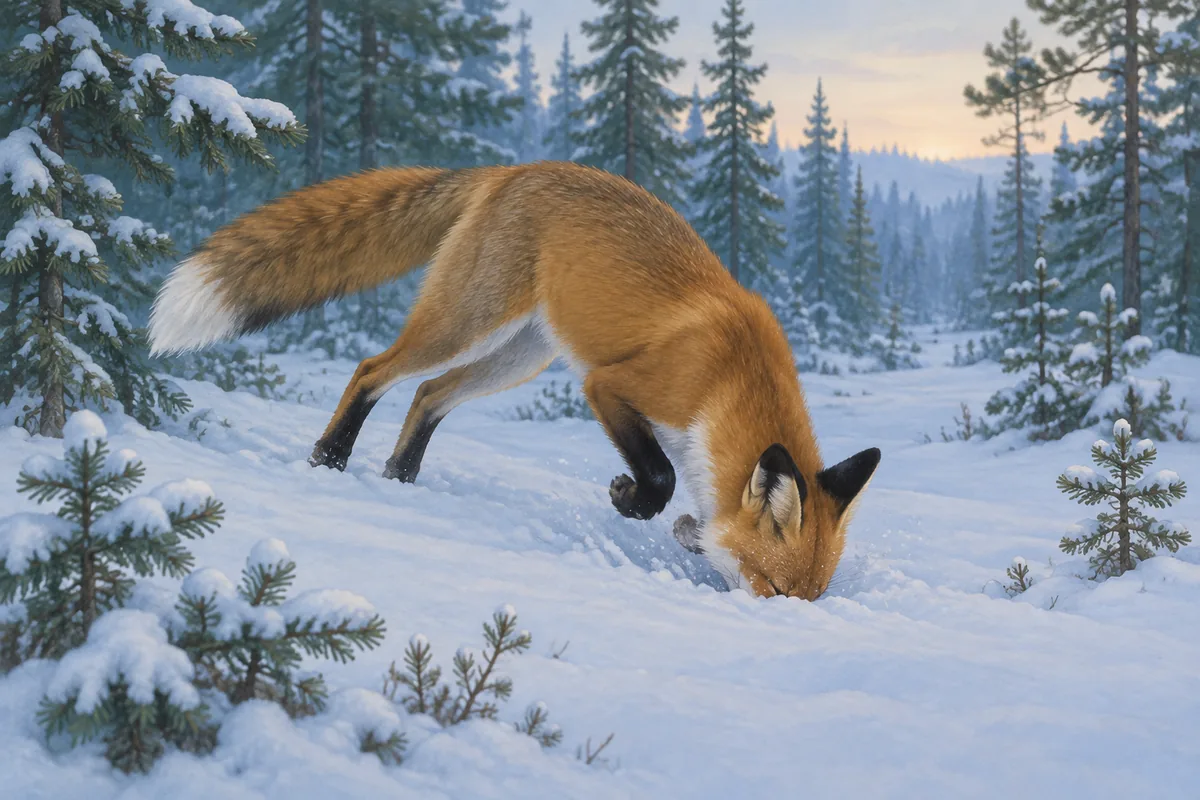
Red foxes prefer the edge of a forest to its middle. Edges, clearings and river banks hold the most voles and rabbits, and they give cover close to open ground. In the boreal forest of Canada, Scandinavia and Siberia foxes hunt rodents under the snow in winter.
Farmland and grassland
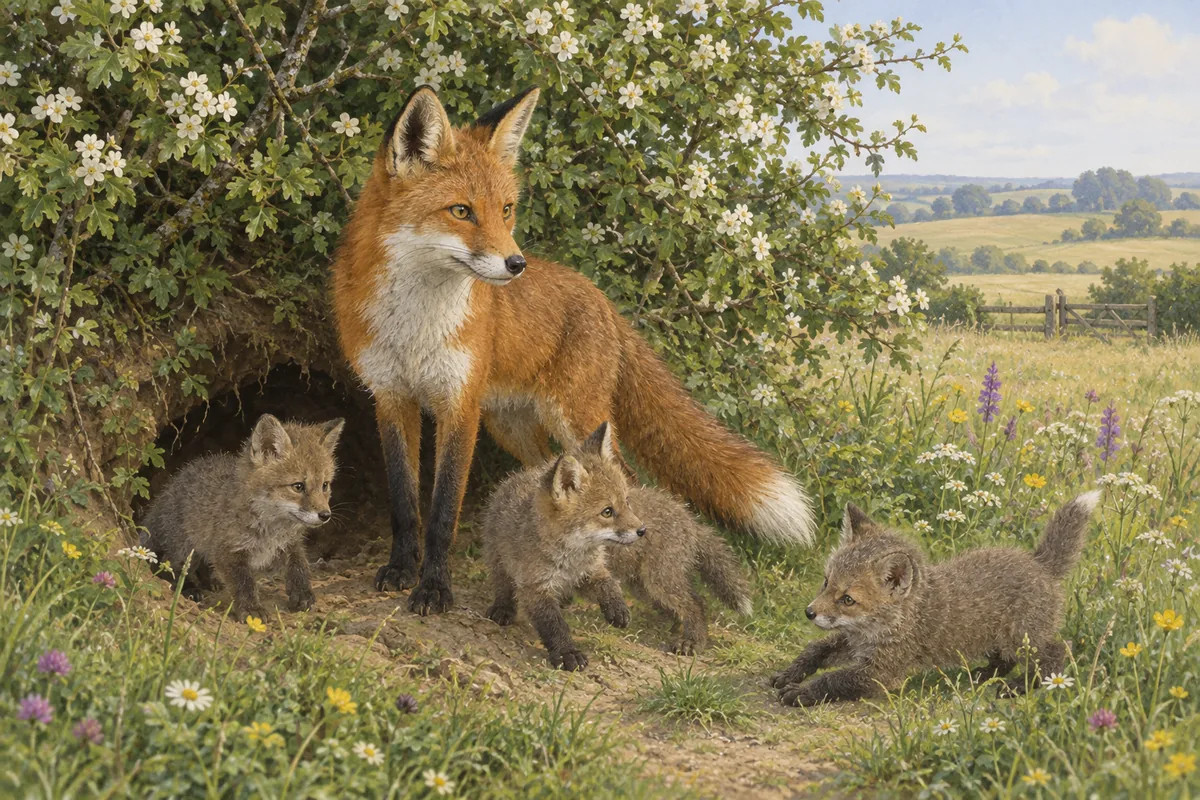
Mixed farmland is some of the best fox habitat anywhere. Hedgerows, woodlots and field margins provide dens, and fields are full of voles, rabbits and insects. On the open steppe of Kazakhstan and Mongolia red foxes live alongside the smaller corsac fox.
Tundra
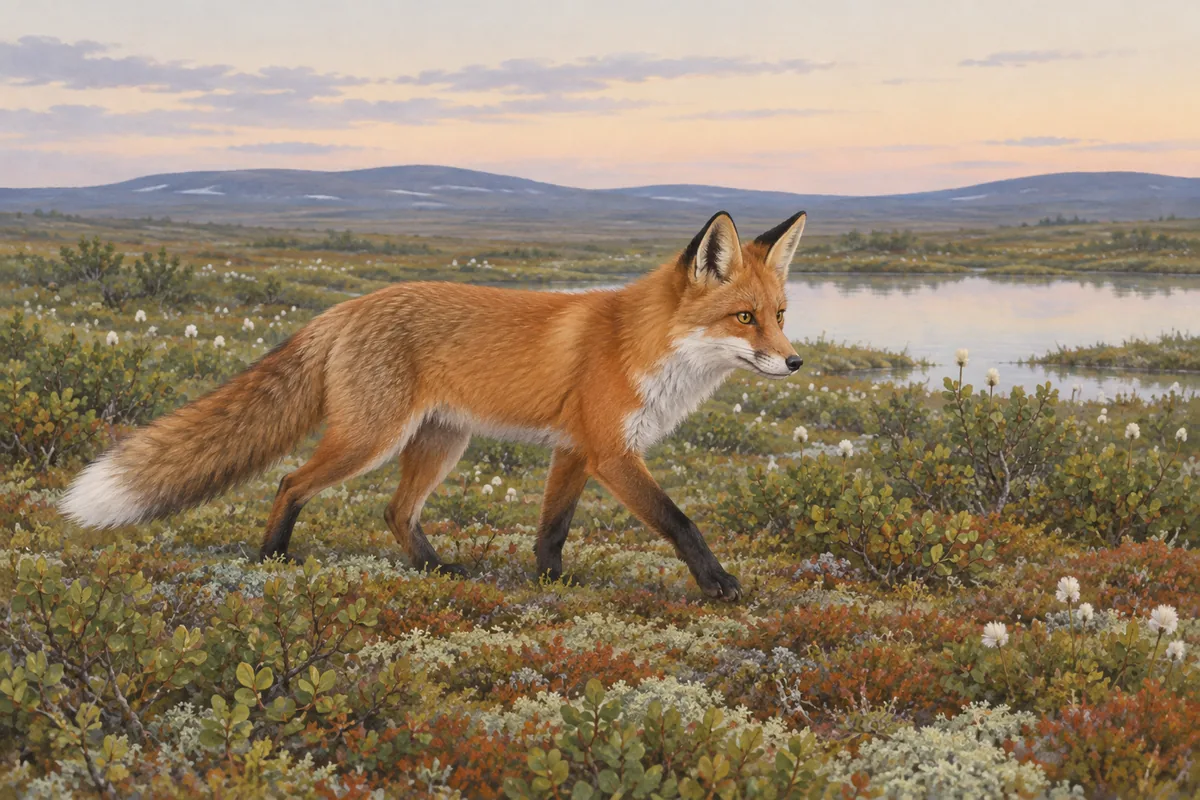
The tundra was arctic fox country, but red foxes have pushed north across Arctic Canada, Alaska, Scandinavia and Russia. The larger red fox can take over arctic fox dens and kill arctic foxes.
Towns and cities
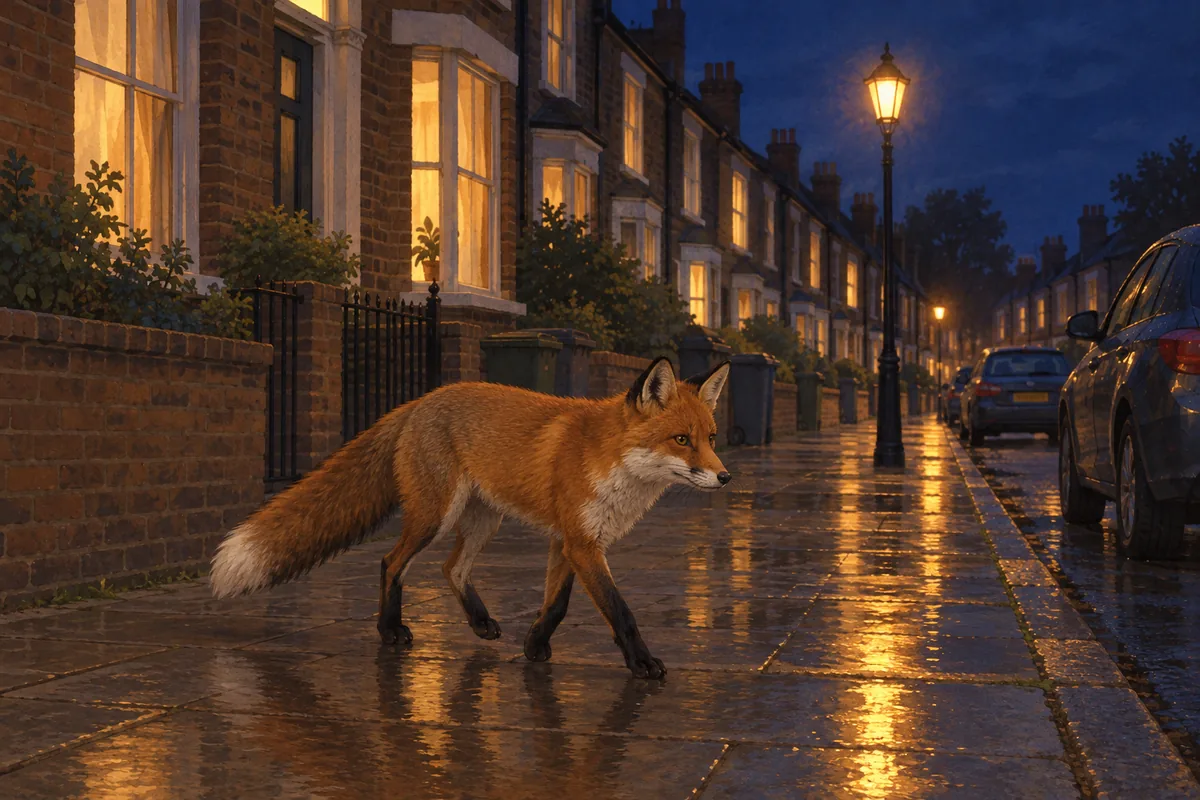
Red foxes live in city centres such as London, Paris and Stockholm, as well as in suburbs across Europe, North America, Japan and Australia. Gardens, parks, railway lines and cemeteries provide dens, and food waste, pet food and rodents provide meals.
Mountains and desert edge
In the Himalayas and on the Tibetan plateau red foxes live up to about 4,500 m. In the Middle East, North Africa and the Thar Desert smaller, paler desert subspecies live in semi-desert and scrub, close to oases and farmland.
Red foxes in Australia
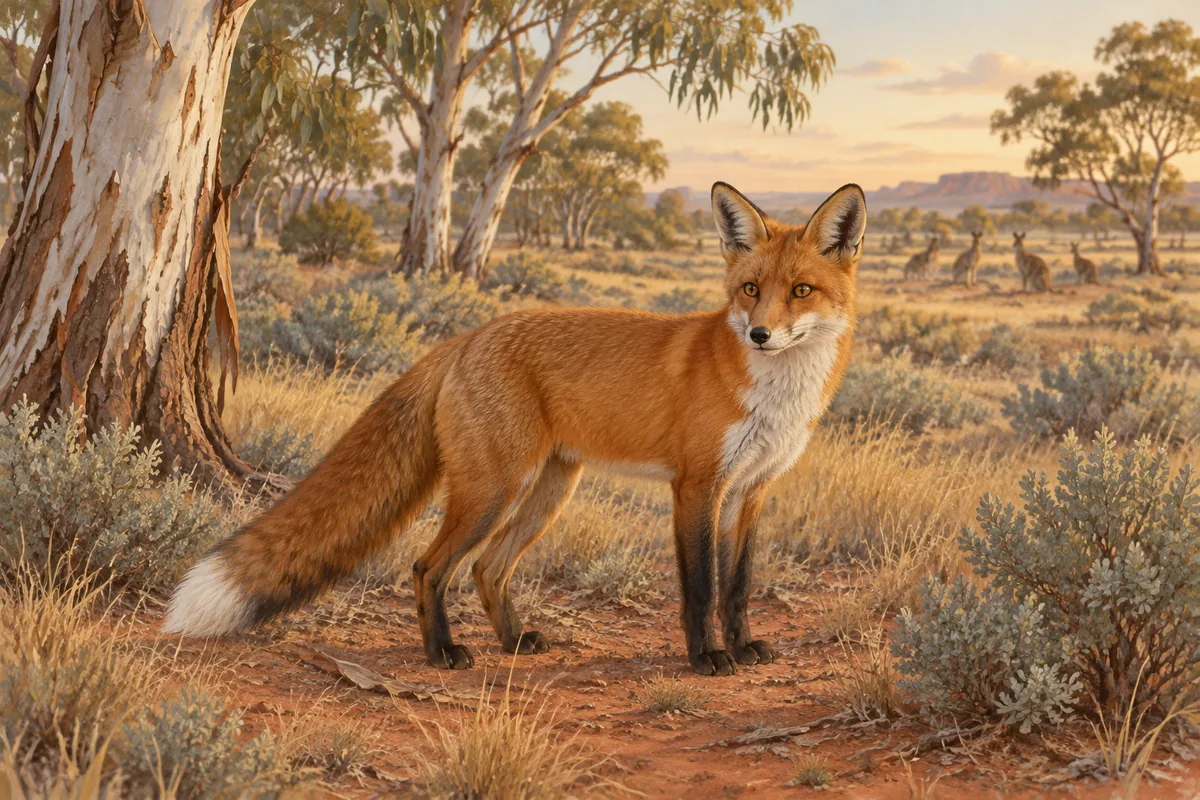
Settlers released red foxes for hunting, and the first lasting population came from releases around 1871 at Point Cook and Ballarat in Victoria. Foxes reached South Australia by 1888 and Kalgoorlie in Western Australia by 1917. Today they cover about 76 percent of the continent, with an estimated 7.2 million foxes in 2012. The tropical north, including the Kimberley, the Top End and far north Queensland, is too hot for them.
Foxes are managed as a pest across Australia. They prey on small native mammals, ground-nesting birds and turtle eggs, and they have contributed to the extinction and decline of many small marsupials. Fox baiting is a standard part of Australian wildlife conservation.
Tasmania and the fox-free islands
Tasmania has no established fox population. People tried to introduce foxes there between 1864 and 1972, and a fox escaped from a container ship at Burnie in 1998. Tasmania set up a Fox Free Taskforce in 2001 and a Fox Eradication Program in 2006. Between 1998 and 2012 the search turned up four fox carcasses and 61 scats with fox DNA, but no evidence that foxes were breeding. Kangaroo Island in South Australia is also fox-free.
Phillip Island in Victoria had foxes from 1907. They killed little penguins, and a knock-down program began in 2006. The last sign of a fox was found in August 2015 and the island was declared fox-free in 2017, the largest island cleared of red foxes.
Island introductions
Between 1741 and the 1930s fur traders released foxes on hundreds of Alaskan islands. Most of these were arctic foxes, but red foxes went to some islands where no land predators lived, and seabird colonies collapsed. Red foxes are native only to the extreme eastern Aleutians. On Big Koniuji Island in the Shumagins, 13 pairs of red foxes were released in 1916. Wildlife managers trapped 84 foxes in 1985 and 1986 and declared the island fox-free in 1987. San Juan Island in Washington is the opposite case: its foxes came from Alaskan fur-farm stock released around 1914, and they still live there.
New Zealand has never had wild foxes, and importing them is banned. The foxes of the Falkland Islands are Patagonian gray foxes, introduced around 1930, not red foxes.
Frequently asked questions
Where do red foxes live?
Red foxes live across the Northern Hemisphere: North America from the Arctic to the southern United States, all of Europe, most of Asia south to northern India and Japan, and the north coast of Africa. They were introduced to Australia, where they live on most of the mainland.
What is a red fox's habitat?
Red foxes prefer a mix of woodland and open ground, such as forest edges, farmland and meadows. They also live in tundra, steppe, mountains up to about 4,500 m, desert edges, suburbs and city centres. They avoid only extreme deserts and dense tropical forest.
Are there foxes in Australia?
Yes. Red foxes were introduced around 1871 in Victoria and spread across about 76 percent of the continent. They live in every mainland state and territory except the tropical north. They are an invasive pest that kills native mammals and birds.
Are there foxes in Tasmania?
No fox population is established in Tasmania. Foxes arrived several times between 1864 and 1998, and a 2001 to 2012 search found four carcasses and fox DNA in scats, but no breeding population. Tasmania treats any fox as a declared pest.
Where do red foxes live in the United States?
Red foxes live in every state except Hawaii, from Alaska to Florida. They are most common in the East, the Midwest and the northern states, and scarcer in the dry plains and southwestern deserts. Native western red foxes live high in the Rocky Mountains, the Cascades and the Sierra Nevada.
Are red foxes native to North America?
Yes. Genetic studies show that North American red foxes, including those in the eastern United States, descend from native lineages and not from English foxes released in colonial times. Some lowland foxes in California and western Washington came from fur farms.
Are there red foxes in Hawaii?
No. Hawaii has no wild red foxes, and the islands have no native land carnivores.
Are there red foxes in Florida?
Yes. Red foxes were not recorded in Florida before the 1950s. They moved into the Panhandle from neighboring states and reached the peninsula partly through releases by hunters. The gray fox is Florida's long-established native fox.
Are there foxes in Ireland?
Yes. The red fox is native to Ireland and lives across the whole island, from farmland and bogs to Dublin's suburbs. It is Ireland's only wild fox.
Are there foxes in New Zealand?
No. A pair of tame foxes once arrived but did not survive, and importing foxes is now banned. New Zealand has no wild foxes of any species.
Are there foxes in Iceland?
Not red foxes. Iceland's only native land mammal is the arctic fox, which lived there before people arrived.
Are other foxes red foxes?
No. The arctic fox, the fennec fox, Blanford's fox, the gray fox and the corsac fox are separate species. Silver and cross foxes are color forms of the red fox. For more on the species itself, see our characteristics of a red fox.