From city gardens and backyard ponds to alpine slopes and coastal tundra, pale animals often catch the eye and reveal interesting survival strategies. Spotting them is a good way to connect with local nature whether you’re walking a trail or scanning a pond.
There are 23 small white animals, ranging from Albino African Clawed Frog (lab/pet strain) to Willow Ptarmigan. For each entry I list Scientific name,Size (cm),Habitat / range; you’ll find these details below.
How can I identify a small white animal I see outdoors?
Look at size, shape, behavior, and the habitat where you found it—those clues often narrow options quickly. Take a clear photo from different angles, note any markings or eye/leg color, and check a regional field guide or an app like iNaturalist to compare sightings; avoid handling unknown wildlife.
Are any of these species commonly kept as pets or used in labs?
Yes—some appear in captivity or research, such as the Albino African Clawed Frog (lab/pet strain) and various white morphs of mice, hamsters, or rabbits. If you’re considering a pet, confirm legal status, care needs, and sourcing; for research, species and strains are usually specified by institutions.
Small White Animals
| Common name | Scientific name | Size (cm) | Habitat / range |
|---|---|---|---|
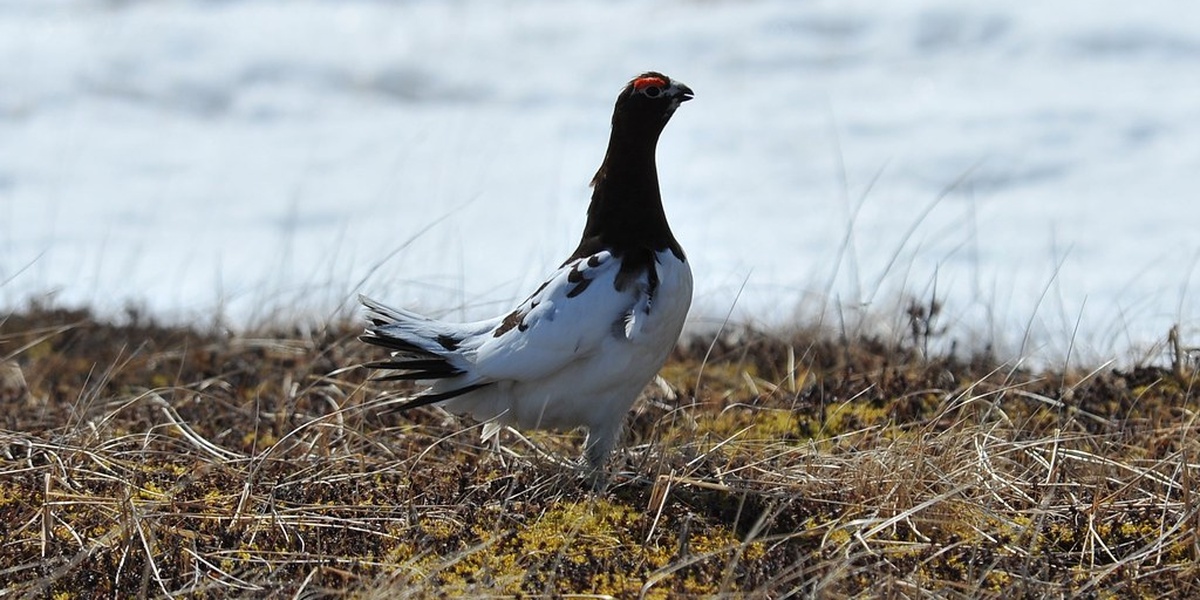
| Willow Ptarmigan | Lagopus lagopus | 34–39 cm | Arctic tundra, northern Eurasia and N. America |
| Rock Ptarmigan | Lagopus muta | 30–35 cm | Alpine and Arctic tundra, circumpolar mountains |
| White-tailed Ptarmigan | Lagopus leucura | 26–31 cm | Alpine zones, Rocky Mountains of N. America |
| Snow Bunting | Plectrophenax nivalis | 15–18 cm | Arctic tundra, northern coasts; winters in open fields |
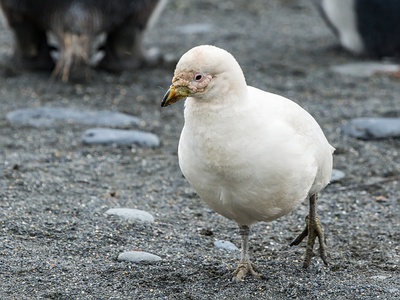
| Snowy Sheathbill | Chionis albus | 36–41 cm | Subantarctic islands and Antarctic coasts |
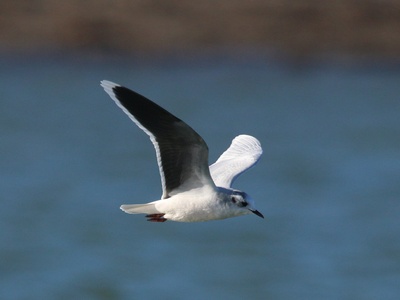
| Little Gull | Hydrocoloeus minutus | 23–28 cm | Coastal wetlands and inland lakes across Europe and Asia |
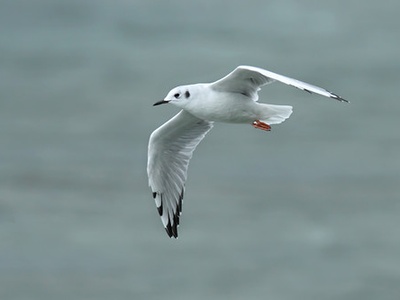
| Bonaparte’s Gull | Chroicocephalus philadelphia | 26–34 cm | North American coasts and inland lakes |
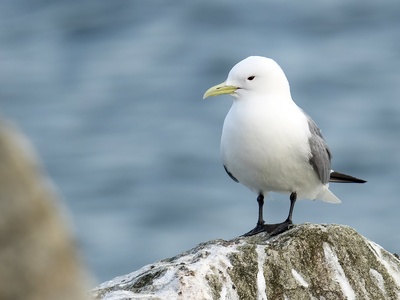
| Black-legged Kittiwake | Rissa tridactyla | 37–41 cm | Cliffs of North Atlantic and North Pacific oceans |
| Arctic Tern | Sterna paradisaea | 28–31 cm | Circumpolar oceans; migratory worldwide to Antarctic |
| White Wagtail | Motacilla alba | 16 cm | Open habitats across Europe, Asia and N. Africa |
| Stoat / Ermine | Mustela erminea | 17–33 cm | Forests, tundra and grasslands across Holarctic regions |
| Least Weasel | Mustela nivalis | 11–26 cm | Widespread across Eurasia and N. America in varied habitats |
| Small White (Cabbage White) | Pieris rapae | 2.00–2.50 cm | Worldwide temperate regions, gardens and farmland |
| Green-veined White | Pieris napi | 2.00–2.50 cm | Europe and temperate Asia; meadows and gardens |
| Large White | Pieris brassicae | 3.00–4.00 cm | Europe, Asia and N. Africa; farmland and gardens |
| Small Ermine Moth | Yponomeuta padella | 0.80–1.20 cm | Woodlands, hedgerows and gardens across Eurasia |
| Great Ermine Moth | Spilosoma lubricipeda | 1.50–2.50 cm | Europe and temperate Asia; varied habitats |
| Sea Angel | Clione limacina | 3.00–5.00 cm | Cold northern oceans; pelagic open water |
| Ghost Shrimp (Glass Shrimp) | Palaemonetes paludosus | 2.00–4.00 cm | Freshwater streams, ponds and aquaria in the Americas |
| Albino African Clawed Frog (lab/pet strain) | Xenopus laevis (albino) | 8.00–12.00 cm | Laboratory and captive populations worldwide |
| Eubranchus exiguus (white nudibranch) | Eubranchus exiguus | 0.20–0.80 cm | Temperate to cold seas on rocky shores and algae |
| Snow Flea (springtail) group | Hypogastrura spp. | 0.10–0.30 cm | Cold-temperate snow edges and leaf litter |
| White-tailed Ptarmigan (duplicate name avoided) | Lagopus leucura | 26–31 cm | Alpine North America, Rocky Mountains |
Images and Descriptions
Willow Ptarmigan
A chunky gamebird that molts to nearly all-white winter plumage for camouflage on snow; whiteness is seasonal (winter molt). Look in tundra and shrubby edges; length typically 34–39 cm, ground-dwelling and well-camouflaged.

Rock Ptarmigan
A hardy grouse that turns almost pure white in winter to blend with snow; whiteness is seasonal through molt. Found on rocky tundra and alpine slopes; small and compact at about 30–35 cm long.
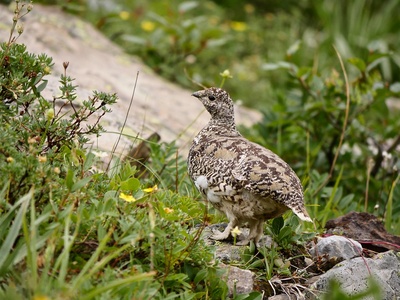
White-tailed Ptarmigan
The only North American ptarmigan restricted to high alpine areas; becomes all-white in winter by seasonal molt. Short, stocky and 26–31 cm long, it uses white plumage to hide on snowfields.
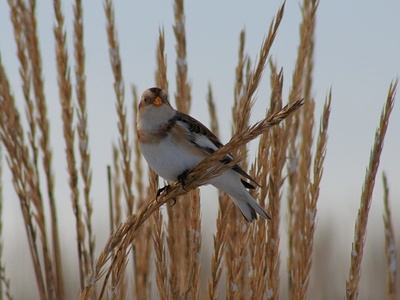
Snow Bunting
A small passerine that shows very white winter plumage with dark accents; whiteness is seasonal and habitual in wintering birds. Seen on tundra and open coasts, 15–18 cm long and ground-foraging.
Snowy Sheathbill
A wholly white, pigeon-sized shorebird found in Antarctic and subantarctic islands; whiteness is natural pigment, not seasonal. Scavenging around penguin colonies and rocky shores, typically 36–41 cm long and stocky.
Little Gull
A small, delicate gull with predominantly white plumage and pale gray wings; whiteness is natural species coloration. Watch coastal lagoons and lakes in migration, length about 23–28 cm.
Bonaparte’s Gull
A small gull with mostly white body and head, pale gray wings; white is primary natural plumage. Found on coasts and freshwater bodies, 26–34 cm long, often in winter flocks.
Black-legged Kittiwake
A sea gull with a clean white body and head, gray wings and black wingtips; whiteness is natural plumage. Nesting on coastal cliffs and feeding offshore; adults roughly 37–41 cm long.
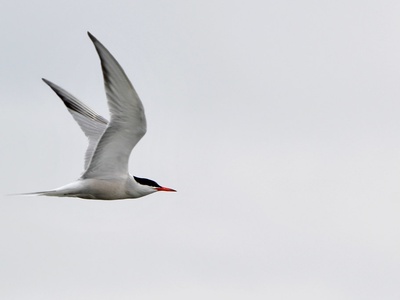
Arctic Tern
A slim, long-distance migratory tern with predominantly white plumage and pale underparts; whiteness is natural. Often seen over open water and coasts, small at 28–31 cm in length.
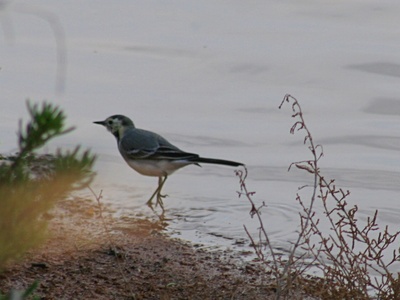
White Wagtail
A striking black-and-white songbird with dominant white underparts and face patches; whiteness is natural patterning. Common on rivers, roads and fields; small at about 16 cm long and actively foraging.
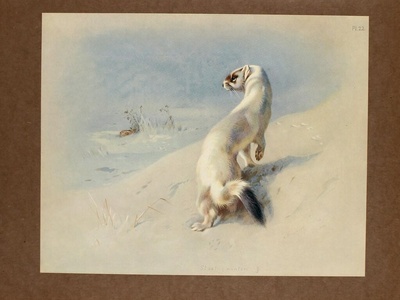
Stoat / Ermine
A small mustelid that in many northern populations molts to pure white winter fur called “ermine”; whiteness is seasonal for camouflage. Body length 17–33 cm, slender with a black tail tip.
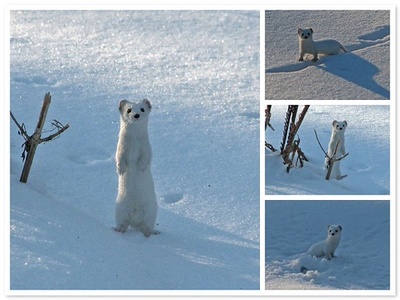
Least Weasel
The smallest weasel species; northern populations commonly turn white in winter (seasonal molt) for snow camouflage. Tiny and agile, typical adult length 11–26 cm depending on subspecies.
Small White (Cabbage White)
A common butterfly with mostly white wings marked by small dark spots; whiteness is natural wing pigmentation. Body length about 2.0–2.5 cm; frequently seen fluttering around brassicas and flowers.
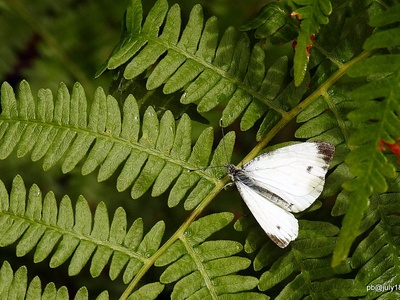
Green-veined White
A white butterfly with greenish veins on the wing undersides; white coloration is natural and seasonal appearance varies. Small, about 2.0–2.5 cm body length, common in damp meadows and hedgerows.
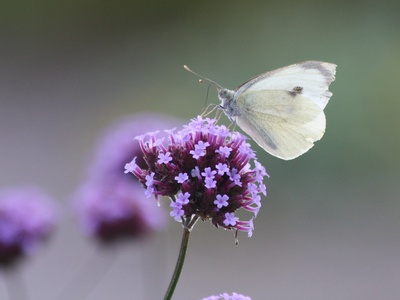
Large White
A fairly large white butterfly whose wings are primarily white by natural pigment; caterpillars feed on brassicas. Body length roughly 3.0–4.0 cm, often seen around cultivated fields and gardens.
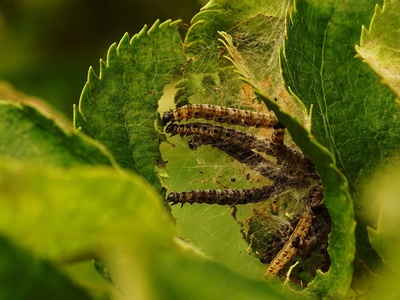
Small Ermine Moth
A tiny moth with predominantly white wings and scattered black spots; whiteness is natural scale coloration. Adults are small (0.8–1.2 cm body length) and caterpillars form conspicuous communal webs on shrubs.
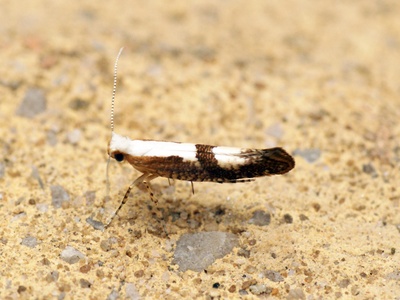
Great Ermine Moth
A white moth often with blackish speckles; wings are mainly white by natural scales. Medium-small body length around 1.5–2.5 cm, attracted to lights and found in meadows and gardens.
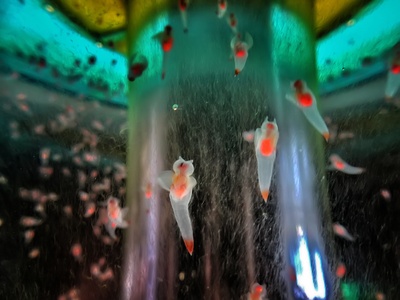
Sea Angel
A small, translucent to milky-white pelagic sea slug (pteropod) whose pale color is natural transparency and light pigmentation aiding open-water camouflage. Size typically 3–5 cm, floats in cold seas.
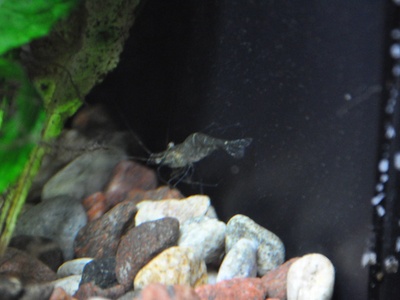
Ghost Shrimp (Glass Shrimp)
A small translucent or pale-white shrimp common in freshwater habitats and the aquarium trade; whiteness comes from translucency or reduced pigmentation. Body length about 2–4 cm, often transparent-looking.
Albino African Clawed Frog (lab/pet strain)
An albino morph of the African clawed frog widely kept in labs and as pets; whiteness is due to albinism (lack of melanin). Typical adult body length 8–12 cm in captivity; not common in wild populations.
Eubranchus exiguus (white nudibranch)
A tiny nudibranch often pale-white or translucent; whiteness is natural pigmentation or transparency linked to diet and camouflage. Adults are very small (0.2–0.8 cm) on algae and rocks.
Snow Flea (springtail) group
Tiny springtails sometimes seen on snow surfaces; many species are pale to white or translucent by natural pigmentation. Body length 0.1–0.3 cm; they hop across snowmelt and debris.
White-tailed Ptarmigan (duplicate name avoided)
A compact alpine grouse that molts to mostly white in winter for snow camouflage; whiteness is seasonal. Found at high elevations on rocky slopes, about 26–31 cm long and well-camouflaged.