In gardens, forests and city corners, tiny yellow animals often go unnoticed even though they contribute to pollination, decomposition and food webs. Spotting them takes close observation and sometimes a loupe, but they’re worth looking for if you’re curious about the smaller side of animal life.
There are 12 smallest yellow animals, ranging from Asian citrus psyllid to Yellow sac spider; for each, the entries are organized as Scientific name,Adult body length (mm),Range / habitat, which you’ll find below.
How small is “smallest” in this list?
Sizes are reported as adult body length in millimeters (see the Adult body length (mm) column); the list includes species measuring under a millimeter up to a few millimeters, so “smallest” refers to adult size rather than juvenile stages.
Can I expect to see these species where I live?
Distribution depends on the species—check the Range / habitat column for regional presence and typical environments (gardens, crops, leaf litter, buildings), and consult local field guides or citizen-science records for confirmation.
Smallest Yellow Animals
| Name | Scientific name | Adult body length (mm) | Range / habitat |
|---|---|---|---|
| Pharaoh ant | Monomorium pharaonis | 2.00 | Cosmopolitan; indoor nests in buildings and kitchens |
| Yellow meadow ant | Lasius flavus | 3.50 | Europe and western Asia; grasslands and lawns, subterranean nests |
| Yellow crazy ant | Anoplolepis gracilipes | 5.00 | Tropical Indo-Pacific; forests, urban areas, invasive on islands |
| Oleander aphid | Aphis nerii | 2.00 | Worldwide on oleander, milkweeds, and other ornamental plants |
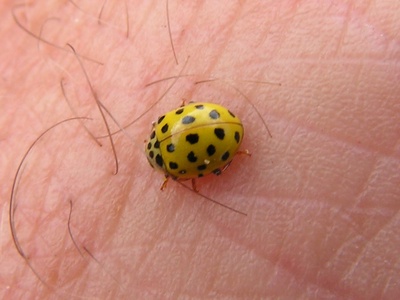
| Twenty-two-spot ladybird | Psyllobora vigintiduopunctata | 4.00 | Europe; meadows and gardens on mildew-covered plant surfaces |
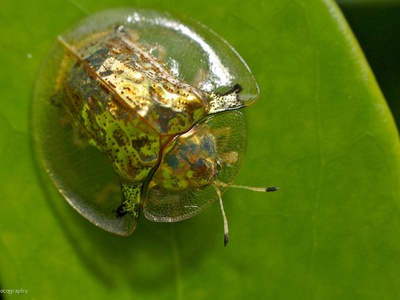
| Golden tortoise beetle | Charidotella sexpunctata | 6.00 | North & South America; morning glory and sweet potato leaves |
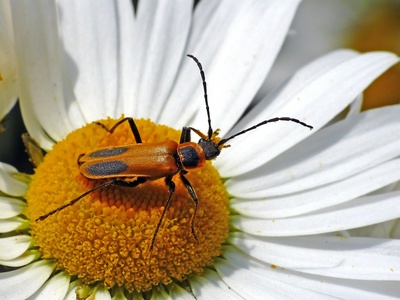
| Soldier beetle | Cantharis livida | 8.00 | Europe; flower-rich meadows and hedgerows, on blossoms |
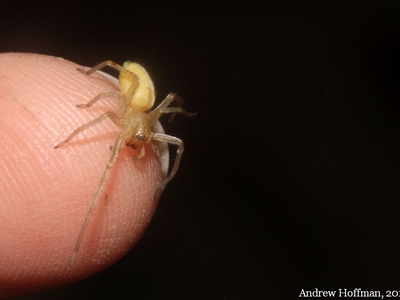
| Yellow sac spider | Cheiracanthium mildei | 8.00 | Europe, North America; houses, gardens and low vegetation |
| Yellow dung fly | Scathophaga stercoraria | 7.50 | Temperate regions; dung pats, meadows and wet pastures |
| Goldenrod crab spider | Misumena vatia | 7.00 | Holarctic; flowers like goldenrod and aster in meadows |
| Asian citrus psyllid | Diaphorina citri | 3.00 | Asia, Americas; citrus orchards and residential citrus trees |
| Thief ant | Solenopsis molesta | 2.00 | Cosmopolitan; nests in soil, buildings, around food sources |
Images and Descriptions
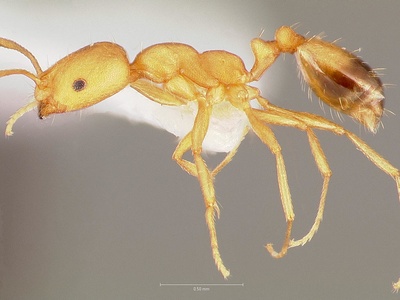
Pharaoh ant
Tiny, light-yellow household ant about 2 mm long that forms sprawling indoor colonies. Notable as a common pest in homes and hospitals, workers forage in trails for sweets and proteins. “Pharaoh” name reflects historic association, not origin.
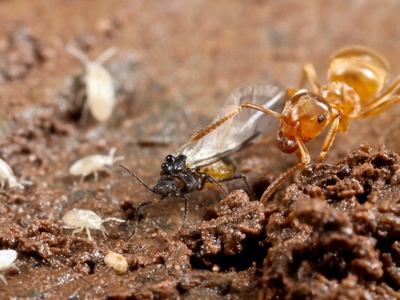
Yellow meadow ant
Small, pale-yellow meadow ant with workers around 3.5 mm. Lives in underground nests in lawns and pastures, tending root aphids for honeydew. Notable for creating hummocky soil mounds and being one of the common yellow ants on temperate grasslands.

Yellow crazy ant
Slender, bright-yellow ant about 5 mm long known for erratic “crazy” movements. Native to the Indo-Pacific, it forms massive supercolonies on invaded islands, causing severe ecological disruption and overwhelming native invertebrates and small vertebrates.
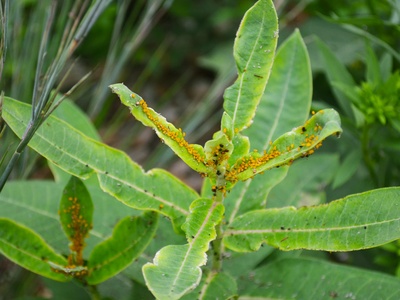
Oleander aphid
A vivid yellow sap-sucking aphid roughly 2 mm long that specializes on oleander and milkweeds. Notable for striking uniform color, rapid population growth on ornamentals, and small black cornicles that contrast with its bright yellow body.
Twenty-two-spot ladybird
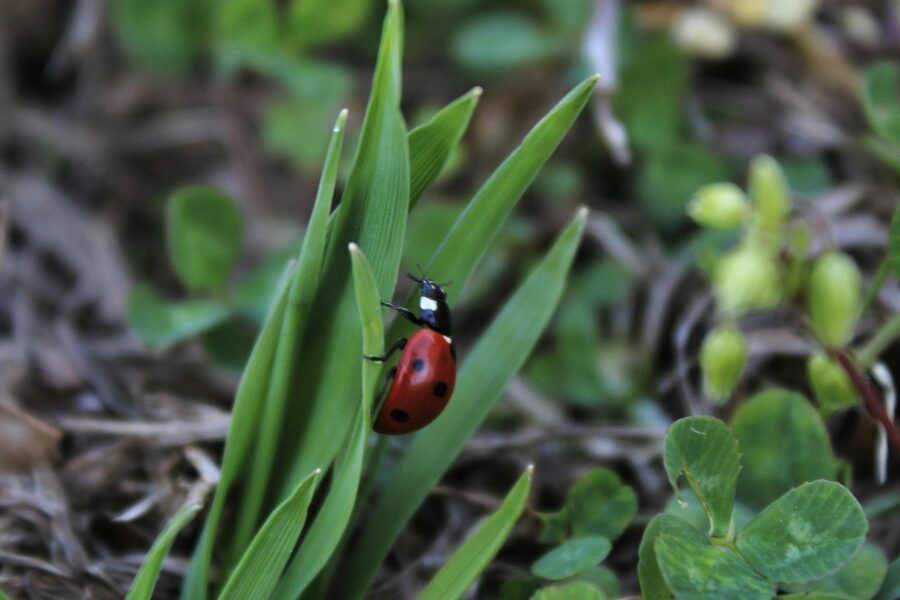
Small yellow ladybird about 4 mm long, usually covered in black spots. Unusual among ladybirds because it feeds on mildew rather than aphids. The common name refers to its typical spot number; a familiar little beetle on low vegetation and flowers.
Golden tortoise beetle
A shiny, domed tortoise beetle about 6 mm long with brilliant golden or yellow elytra. Feeds on morning glory and sweet potato leaves. Notable for its metallic sheen that can shift with humidity and its rounded, leaf-mimicking silhouette.
Soldier beetle
Yellow-orange soldier beetle roughly 8 mm long often seen on flowers in summer. Adults are active predators of soft-bodied insects and frequent pollinators. Easily spotted by their elongated, flexible bodies and bright yellow elytra in meadow habitats.
Yellow sac spider
A pale yellow sac spider about 8 mm long that lives on foliage and commonly enters houses. Builds silken daytime sacs under leaves or corners. Notable for its uniform yellow-green body, stealthy nocturnal hunting, and occasionally a mild bite to humans.
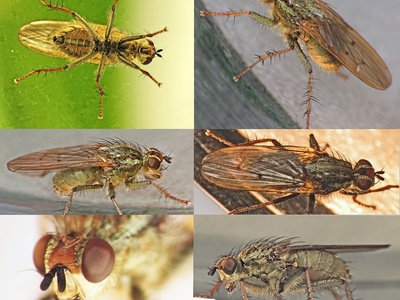
Yellow dung fly
The yellow dung fly is a golden-yellow fly about 7.5 mm long commonly found on dung and nearby grasses. Males are especially bright and territorial, swarming around livestock droppings. Notable for dense populations and prominent mating battles at droppings.
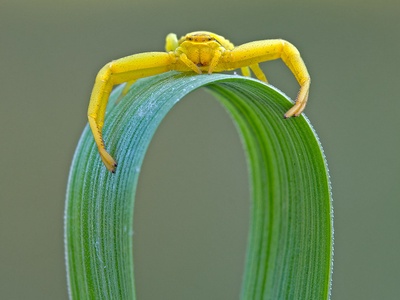
Goldenrod crab spider
Female goldenrod crab spiders reach about 7 mm and can be vivid yellow, hiding on flowers to ambush pollinators. Notable for excellent camouflage (they can also be white), sideways crab-like movement, and color change that aids in blending with local blossoms.
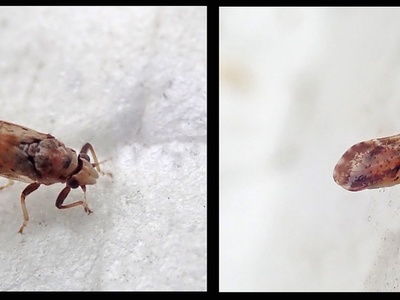
Asian citrus psyllid
A small orange-yellow psyllid about 3 mm long that feeds on citrus leaves and shoots. Highly notable as the vector of citrus greening (huanglongbing) disease, making it a major agricultural pest. Adults rest with wings folded roof-like over the body.
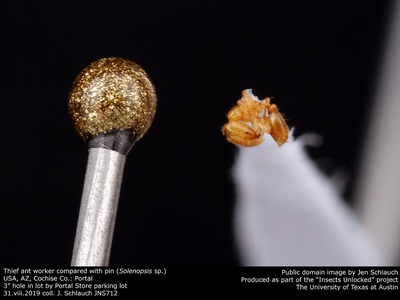
Thief ant
Minute, pale-yellow thief ant roughly 2 mm long commonly found in homes and outdoors. Named for its habit of stealing brood and food from other ant colonies, it forms tiny workers in multi-queen colonies and is a frequent, easily overlooked household pest.