Table of Contents
- Why Malaysia Is a Biodiversity Powerhouse
- Malayan Tiger
- Bornean Pygmy Elephant
- Proboscis Monkey
- Bornean Orangutan
- Sun Bear
- Malayan Tapir
- Flat-headed Cat
- Hose’s Palm Civet
- Matang Narrow-Mouthed Frog
- Kinabalu Black Shrew
- Chan’s Megastick
- Rajah Brooke’s Birdwing
- Bornean Bristlehead
- Where to See Malaysian Endemics
Why Malaysia Is a Biodiversity Powerhouse
Malaysia sits inside Sundaland, one of the world’s most species-rich biodiversity hotspots — a landmass that once connected the Malay Peninsula and Borneo to mainland Southeast Asia during the last glacial period. When sea levels rose, populations became isolated and evolved independently. That isolation is the reason Malaysia punches so far above its weight: it’s one of only 17 megadiverse nations on Earth, holding an estimated 20% of the world’s animal species in a country roughly the size of New Mexico.
A quick caveat before the list: “found in Malaysia” and “endemic to Malaysia” are not the same thing. A lot of lists lump in King Cobras, Saltwater Crocodiles, and Asian Elephants — all of which range across wide swaths of Southeast Asia. The animals below are genuine endemics or near-endemics, meaning Malaysia is either their only range or a defining part of a range shared with only one neighboring territory (typically Indonesian Borneo). Each entry includes conservation status and where you can actually see it.
Malayan Tiger
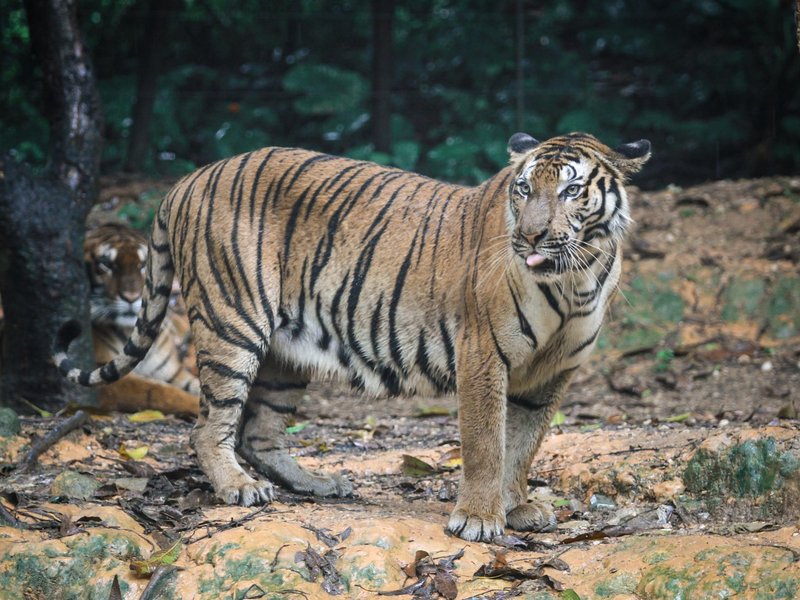
Conservation status: Critically Endangered (~150 individuals remaining) Where to see it: Taman Negara National Park, Belum-Temengor Forest Complex
Panthera tigris jacksoni was only formally recognized as a subspecies distinct from the Indochinese tiger in 2004. The genetic split matters: this is a Malaysian animal in every meaningful sense, adapted to the lowland and highland rainforests of the Peninsula and found nowhere else. It’s also disappearing fast. Fewer than 150 individuals are thought to survive in the wild, down from roughly 3,000 in the 1950s — a collapse driven by poaching and habitat fragmentation from palm oil expansion. Camera traps in Taman Negara still pick them up, but seeing one in the wild is genuinely rare. The tiger is a national symbol; the word harimau appears in poetry, idioms, and the national football team’s nickname.
Bornean Pygmy Elephant
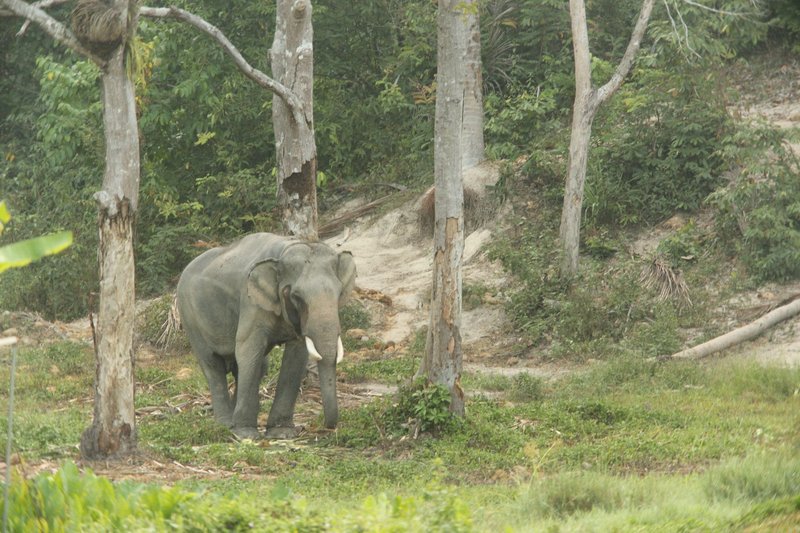
Conservation status: Endangered (~1,500 individuals remaining) Where to see it: Kinabatangan River Wildlife Sanctuary, Danum Valley, Tabin Wildlife Reserve
The smallest elephant in Asia, and among the most charming things in Malaysian wildlife. Bornean Pygmy Elephants (Elephas maximus borneensis) stand about a foot shorter than mainland Asian Elephants, with noticeably rounder faces, larger ears, and tails that drag on the ground. For decades, they were assumed to be feral domesticated stock brought over centuries ago. Genetic analysis published in the early 2000s confirmed they diverged from mainland elephants roughly 300,000 years ago — making them a genuinely distinct and ancient lineage. The Kinabatangan River is your best shot at seeing a herd from a boat at dusk.
Proboscis Monkey
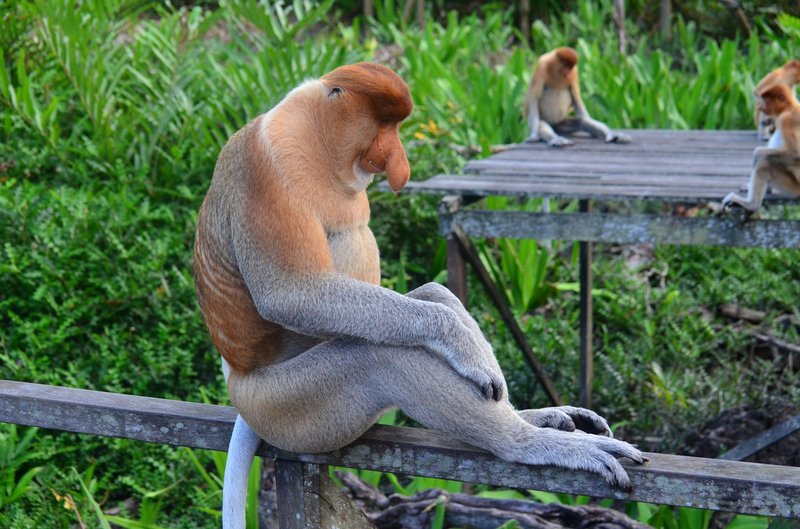
Conservation status: Endangered Where to see it: Bako National Park (Sarawak), Labuk Bay Proboscis Monkey Sanctuary, Kinabatangan River
Nasalis larvatus has one of the most distinctive faces in the primate world — the male’s pendulous, fleshy nose can exceed 7cm and droops over the mouth. It’s not just for show: the nose amplifies vocalizations and appears to play a role in sexual selection. Proboscis Monkeys are endemic to Borneo and live almost entirely in coastal and riverine forests, including mangroves, which puts them directly in the crosshairs of coastal development. They’re also highly specialized feeders — their multi-chambered stomachs, convergent with cow digestive anatomy, are designed for unripe leaves and seeds that would be toxic to most primates. Bako is the easiest spot to find them; the sanctuary at Labuk Bay is more reliable but more touristic.
Bornean Orangutan
Conservation status: Critically Endangered Where to see it: Sepilok Orangutan Rehabilitation Centre, Danum Valley, Kinabatangan
Pongo pygmaeus is Borneo’s great ape and one of humanity’s closest relatives — sharing roughly 97% of DNA with us. It’s been separated from its Sumatran cousin (Pongo abelii) by the sea for long enough that the two are now distinct species. The Bornean species is the larger of the two, with adult males developing pronounced cheek flanges called “flanges” that develop slowly and only in dominant males. Orangutans are the most arboreal of the great apes — they spend almost their entire lives in the canopy. According to IUCN data, the population has declined more than 50% over the past 60 years, primarily due to deforestation. Along with the Malayan Tiger and Proboscis Monkey, the orangutan is one of the species covered in depth in the 12 most famous animals of Malaysia — a useful companion read if you want broader context on Malaysia’s iconic wildlife.
Sun Bear
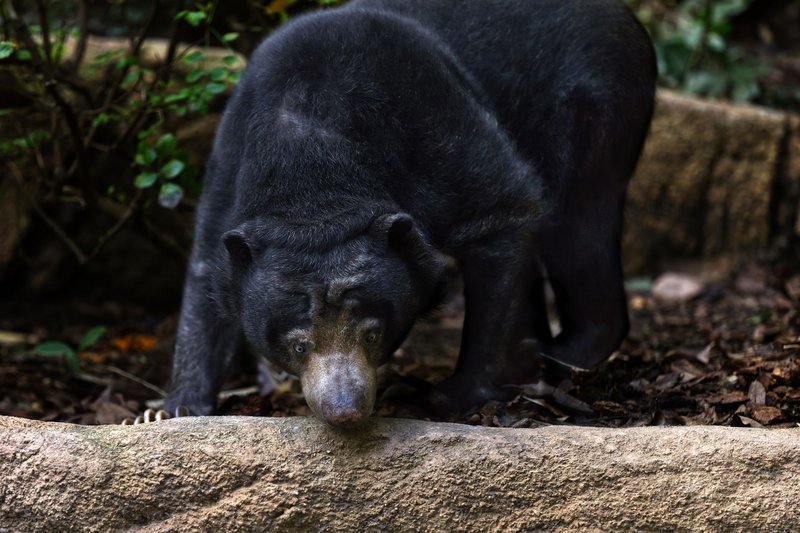
Conservation status: Vulnerable Where to see it: Bornean Sun Bear Conservation Centre (Sandakan), Danum Valley
The smallest bear in the world, Helarctos malayanus weighs in at 25–65 kg fully grown — less than most adult Labrador Retrievers. Their defining feature is the yellowish-orange crescent on the chest, which varies enough between individuals that researchers use it like a fingerprint for identification. Sun Bears have the longest tongue relative to body size of any bear species — up to 25cm — purpose-built for raiding beehives and termite mounds. They’re also the most arboreal bears, building daytime sleeping nests in the canopy. The Conservation Centre in Sandakan is a genuine rehabilitation program, not a zoo, and the semi-wild viewing platforms make it one of the better wildlife experiences in Malaysian Borneo.
Malayan Tapir
Conservation status: Endangered Where to see it: Taman Negara, Royal Belum State Park, Endau-Rompin
Tapirus indicus is the only tapir in the Old World — its three relatives are all in Central and South America, which tells you something about how ancient the lineage is. It looks like someone painted a black-and-white two-tone pattern across a stocky, horse-sized animal with a prehensile snout. The coloration is actually camouflage: in dappled moonlight, the white saddle breaks up the silhouette against the forest floor. They’re primarily nocturnal browsers, using that flexible nose to pluck leaves and fruit, and are important seed dispersers in the Peninsular Malaysian rainforest. Tapir populations have been hit hard by road mortality and habitat loss.
Flat-headed Cat
Conservation status: Endangered Where to see it: Kinabatangan River, lowland rivers in Sabah and Sarawak
Prionailurus planicephalus is one of the world’s least-known wild cats and one of Malaysia’s most obscure endemic predators. It’s roughly the size of a domestic cat, with a flattened skull, small rounded ears set low on the head, and partially webbed feet — all adaptations for catching fish along riverbanks. Almost everything known about this cat comes from camera trap footage and occasional sightings near rivers. Captive specimens have been documented washing food before eating it, a behavior not typically seen in wild felids. Its dependence on healthy riverine habitat means it shares its fate with other rare wetland animals that are quietly disappearing as rivers are degraded and riparian forests cleared.
Hose’s Palm Civet
Conservation status: Least Concern, but narrowly endemic Where to see it: Lowland forests of Borneo (Sarawak, Sabah)
Diplogale hosei was named after Charles Hose, a British colonial officer and amateur naturalist who collected extensively in Sarawak in the late 19th century. It’s a small, dark-furred civet restricted to the lowland dipterocarp forests of Borneo, distinguished from similar species by its longer snout and lack of a facial stripe pattern. It’s seldom photographed and poorly documented — most of what’s recorded comes from camera traps and historical museum specimens. As lowland forest in Borneo continues to be converted to oil palm plantations, this is the type of species that disappears without ever generating headlines.
Matang Narrow-Mouthed Frog
Conservation status: Vulnerable Where to see it: Matang Wildlife Centre and surrounding forest, Sarawak
Microhyla nepenthicola holds a specific distinction: until 2010, it was the world’s smallest known frog in Asia, measuring 10–12mm as an adult. It lives exclusively in and around pitcher plants (Nepenthes spp.), breeding in the fluid-filled pitchers rather than in standing water. The frogs’ tadpoles develop inside the pitchers, tolerating the digestive enzymes that would kill most organisms. This obligate relationship with a specific plant genus in a specific geographic range means the frog’s future is directly tied to the health of Sarawak’s peat swamp forests.
Kinabalu Black Shrew
Conservation status: Vulnerable Where to see it: Kinabalu Park (above 2,000m elevation)
Crocidura baluensis is a tiny insectivore restricted entirely to Mount Kinabalu and its immediate surroundings in Sabah — one of the most geographically constrained mammals in Malaysia. Shrews rarely make wildlife photography lists, but the Kinabalu Black Shrew is a good example of an animal whose entire global range fits within a single national park. It forages in leaf litter and mossy undergrowth at high elevations and is vulnerable to the kinds of habitat alteration (trail widening, visitor infrastructure, climate-driven vegetation shifts) that accumulate gradually in popular mountain parks.
Chan’s Megastick
Conservation status: Data Deficient, but rare Where to see it: Gunung Kinabalu, Sabah (specimens collected at mid-elevation forest)
Phobaeticus chani is the world’s longest insect by body length — females can reach 35.7cm, and with legs fully extended, over 56cm. It was formally described in 2008 from specimens collected on Kinabalu, and named after Chan Chew Lun, a Malaysian naturalist. Very few specimens exist in collections; the natural population density appears to be extremely low. It’s a stick insect in the truest sense: perfectly mimicking the texture and color of dead branches, spending its life in the forest canopy eating leaves. The Natural History Museum in London holds one of the few known specimens.
Rajah Brooke’s Birdwing
Conservation status: Protected under Malaysian law Where to see it: Taman Negara, Cameron Highlands, lowland forest rivers in Sabah and Sarawak
Trogonoptera brookiana is Malaysia’s national butterfly and one of the most striking insects in the world. Males are jet black with an electric green band of triangular markings along the forewings — a visual that looks designed rather than evolved. They congregate at mineral seeps and riverbanks, particularly along forest streams, where males drink sodium-rich water. Named after James Brooke, the first White Rajah of Sarawak, these birdwings are large enough (wingspan to 17cm) that early collectors sometimes shot them with rifles. Collection is now illegal, but habitat loss in Borneo’s lowland forests continues to pressure the population.
Bornean Bristlehead
Conservation status: Least Concern, but rare and poorly understood Where to see it: Lowland dipterocarp forests of Borneo (Sabah, Sarawak)
Pityriasis gymnocephala is an odd bird in every sense. The sole member of its family (Pityriasidae), it has no close relatives — a taxonomic orphan. Adult males have a bare red head with a yellow wattle, giving the bird a faintly reptilian look. It forages in the mid-canopy for large invertebrates, often in mixed-species flocks. Despite living in the forests of Malaysian and Indonesian Borneo, its ecology and behavior are poorly documented — it’s rarely photographed, poorly studied, and not particularly sought by casual birdwatchers who tend to gravitate toward hornbills and pittas. That makes it a target for serious birders coming specifically to Borneo.
Where to See Malaysian Endemics
A few parks give you the highest concentration of unique wildlife per visit:
- Taman Negara (Pahang) — The Malay Peninsula’s oldest national park, 4,343 km² of unbroken rainforest. Best for Malayan Tapir, Malayan Tiger (camera traps), primates, and birds.
- Kinabalu Park (Sabah) — A UNESCO World Heritage Site and the best location for highland endemics: Kinabalu Black Shrew, Chan’s Megastick, Rajah Brooke’s Birdwing at lower elevations.
- Kinabatangan River Wildlife Sanctuary (Sabah) — The single best spot in Malaysia for large mammal sightings from a boat: Bornean Pygmy Elephant, Proboscis Monkey, Orangutan, Flat-headed Cat (rare), and Estuarine Crocodile.
- Danum Valley Conservation Area (Sabah) — Primary dipterocarp forest, limited tourist numbers, excellent for Bornean Orangutan, Sun Bear, and Flat-headed Cat.
- Bako National Park (Sarawak) — Small but dense. Almost guaranteed Proboscis Monkey sightings, along with Bearded Pigs, Silver Langurs, and pitcher plants.
Most of these require some advance planning — Danum Valley in particular has limited accommodation and books out months ahead. The effort is worth it. Malaysia’s endemic wildlife is genuinely world-class and, for the most part, still accessible in the wild rather than only in captivity.