The Amazon alone holds an estimated 3,600 spider species, and most of them have no name in any language you speak. That’s the part the “5 scary spiders” listicles skip. They give you the same five celebrities — the giant tarantula, the venomous wanderer — and call it a day.
This is a longer guest list. You’ll still meet the heavyweights, because a Goliath birdeater the size of a dinner plate earns its spot. But you’ll also meet a spider that builds a fake spider out of debris, a hunter that doesn’t bother with a web, and an orb-weaver whose silk a human can lean into without breaking it. Tropical rainforest spiders run the full range from terrifying to genuinely clever, and almost none of them want anything to do with you.
Here’s who lives in the canopy, who patrols the leaf litter, and which ones actually deserve the warning label.
Table of Contents
- Quick answer: are rainforest spiders dangerous?
- 1. Goliath Birdeater
- 2. Brazilian Wandering Spider
- 3. Pink-Toed Tarantula
- 4. Giant Fishing Spider
- 5. Golden Silk Orb-Weaver
- 6. Decoy Spider
- 7. Bold Jumping Spiders
- 8. Wandering Wolf Spider
- 9. Goblin Spiders
- 10. Bullet Ant–Mimicking Spider
- 11. Net-Casting Spider
- Venom severity, ranked
- Why the rainforest needs its spiders
Quick answer: are rainforest spiders dangerous?
Almost none of them, almost never. Of the thousands of spider species in tropical rainforests, only a small handful carry venom strong enough to send a healthy adult to the hospital, and serious bites are rare even among people who work in the forest daily.
The real danger list is short: the Brazilian wandering spider (genus Phoneutria) is the one with venom that genuinely warrants antivenom. Most tarantulas, despite the size and the fangs, deliver a bite roughly comparable to a wasp sting — painful, not life-threatening. Many of the spiders on this list can’t break human skin at all.
So the honest framing isn’t “deadly jungle.” It’s a forest packed with hunters that have far more interesting jobs than biting you. With that out of the way, the lineup.
1. Goliath Birdeater
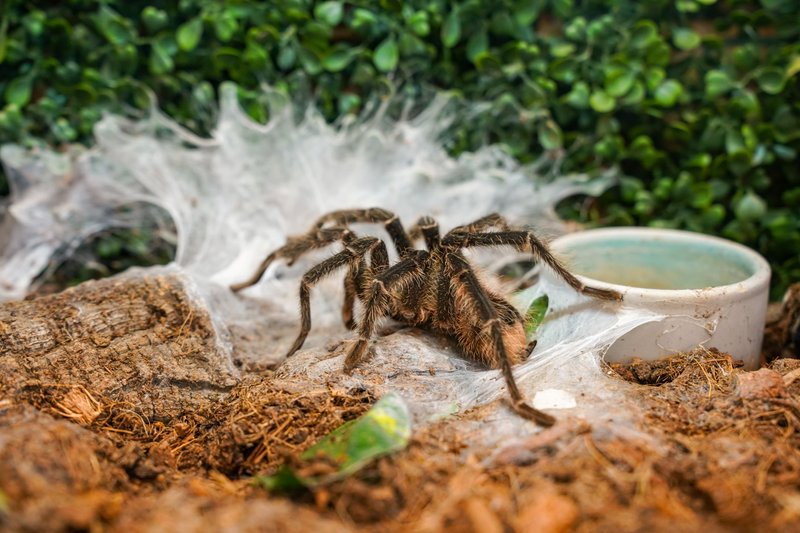
The heavyweight, and the one every list leads with for good reason. Theraphosa blondi is the largest spider on Earth by mass, with a leg span that reaches around 11 inches (28 cm) and a body that can weigh over 6 ounces — about the same as a young puppy.
- Size: Up to ~11 in (28 cm) leg span
- Venom level: Mild (wasp-sting equivalent)
- Diet: Earthworms, insects, frogs, small rodents — rarely birds
- Habitat layer: Forest floor, in burrows
- Lifespan: Females up to 15–25 years; males 3–6
The name oversells the menu. Despite “birdeater,” it almost never eats birds; the name traces back to an 18th-century engraving of one eating a hummingbird, and it stuck. Its real defense is theatrical: it rubs its hind legs against its abdomen to flick clouds of barbed urticating hairs at threats, which feel like fiberglass in your skin and eyes. It can also stridulate — a hissing rasp you can hear from several feet away. The bite itself? Manageable. The hairs are the part people actually regret.
2. Brazilian Wandering Spider
The genuinely dangerous one. Phoneutria species don’t build webs to catch food — they walk the forest floor at night hunting actively, which is exactly how people get bitten: a wandering spider tucked into a banana bunch, a woodpile, or a boot.
- Size: ~5–6 in (13–15 cm) leg span
- Venom level: High — medically significant
- Diet: Insects, other spiders, small lizards and mice
- Habitat layer: Forest floor and low vegetation; wanders at night
- Lifespan: 1–2 years
The venom is a neurotoxic cocktail; its potency is well documented in the toxicology literature, and the National Library of Medicine catalogs Phoneutria among the spiders of real medical concern in the Neotropics. Bites can cause intense pain, sweating, and elevated heart rate, and Brazil keeps an antivenom on hand for severe cases. The famous side effect gets the headlines, but the practical takeaway is simpler: this is the rainforest spider worth respecting, and the reason you shake out your boots.
That said, deaths are rare. Antivenom is effective, most bites are “dry” or mild, and the spider would rather flee than fight.
3. Pink-Toed Tarantula
The crowd favorite, and a reminder that tarantulas aren’t all ground-dwelling bruisers. Avicularia avicularia lives up in the trees, dark-bodied with bright pink tips on each foot, like it dipped its toes in paint.
- Size: ~5 in (13 cm) leg span
- Venom level: Mild
- Diet: Insects, occasionally small frogs or lizards
- Habitat layer: Canopy and understory; arboreal
- Lifespan: Females ~12 years; males 3–4
Being arboreal changes everything about how it behaves. Instead of throwing urticating hairs like its ground cousins, a pink-toe’s first move is to bolt — fast, often straight up — and its backup defense is genuinely strange: it fires a jet of fecal matter at whatever’s bothering it. It spins silken tube retreats in rolled leaves and bromeliads, which is why it shows up so often in the home-keeping hobby. Docile, beautiful, and an absolute escape artist.
4. Giant Fishing Spider
Spiders that hunt water are their own quiet category. Tropical fishing spiders (genus Ancylometes) are semi-aquatic — they hunt along streams and pond edges, run across the water’s surface, and dive under it to grab prey.
- Size: ~6 in (15 cm) leg span
- Venom level: Moderate (painful, not dangerous)
- Diet: Insects, tadpoles, small fish, frogs
- Habitat layer: Forest floor near water
- Lifespan: ~1–2 years
The trick is air. Fine water-repellent hairs trap a silvery film around the body so the spider can stay submerged for up to half an hour, breathing from its own bubble while it waits out a threat or ambushes a tadpole. They sense prey through ripples on the surface, the same way a web spider feels vibrations on silk — except the “web” here is the pond itself. Those same pond edges are crowded with the spider’s favorite prey, since the frogs and tadpoles of the rainforest breed in exactly the still water where these hunters patrol.
5. Golden Silk Orb-Weaver
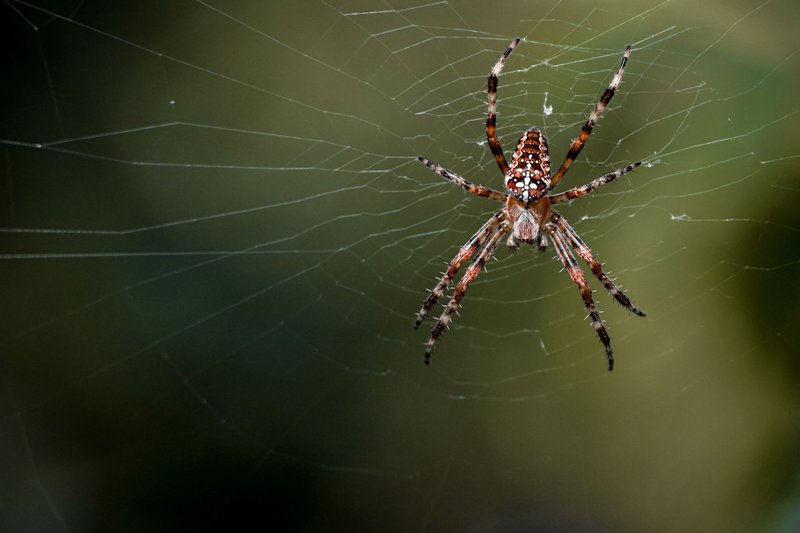
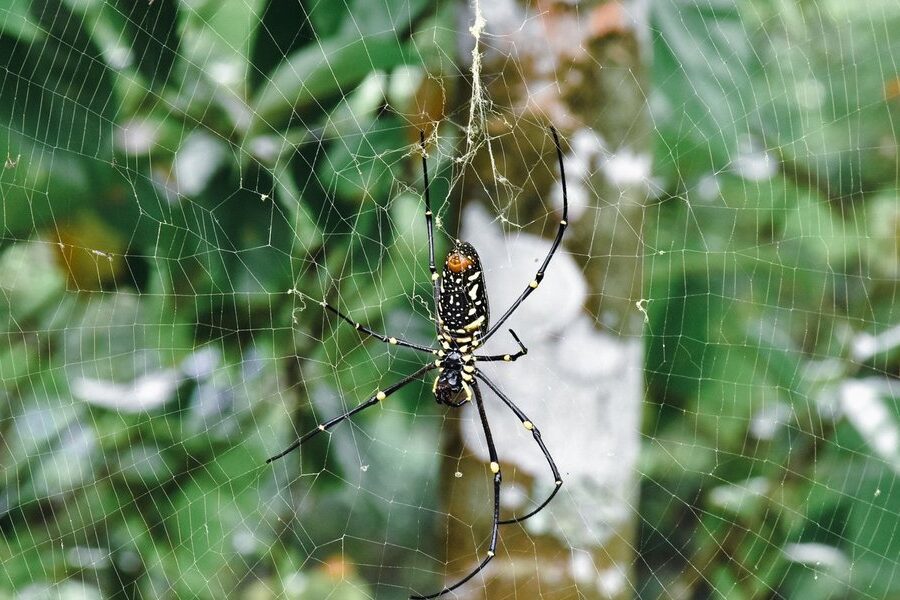
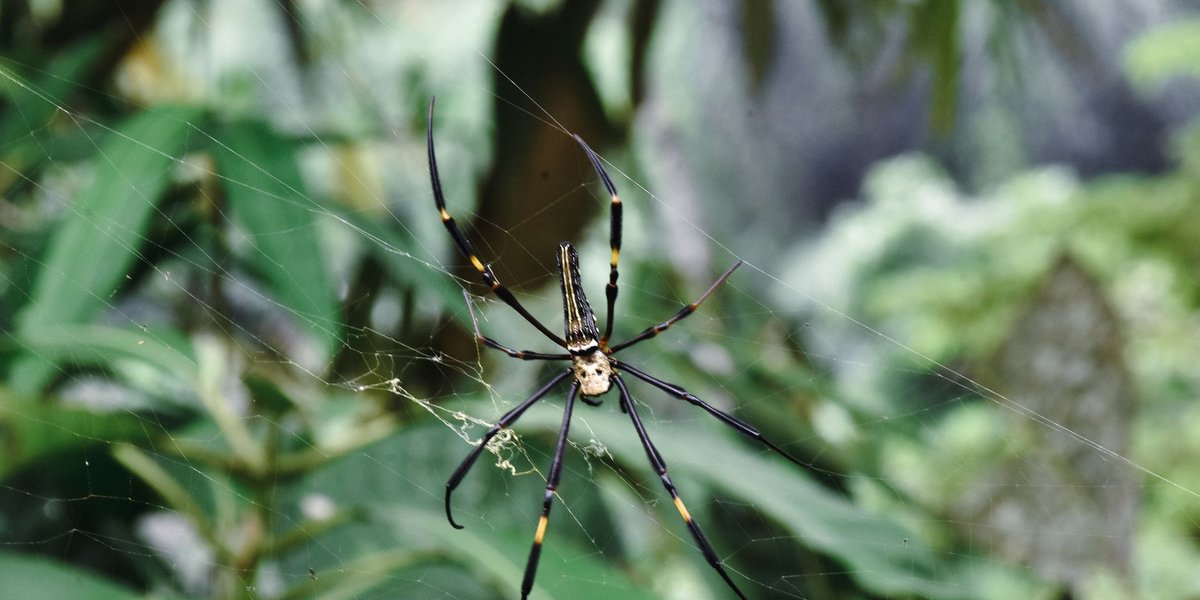
The architect. Trichonephila (formerly Nephila) builds the enormous golden-tinted webs you walk face-first into on a jungle trail — spans that can reach several feet across and anchor between trees.
- Size: Females up to ~2 in (5 cm) body, 6 in legs; males tiny
- Venom level: Mild
- Diet: Flying insects; occasionally small birds tangle in the web
- Habitat layer: Understory to mid-canopy
- Lifespan: ~1 year
The silk is the headline. It’s genuinely golden in color, and it’s among the toughest natural fibers known — strong enough that the web can briefly catch a small bird, and tough enough that researchers once spun it into a rare golden textile. The size gap between sexes is extreme: a female can be a hundred times the mass of the male sharing her web. She runs the operation. He mostly tries not to get eaten.
6. Decoy Spider
The one that sounds made up. A small Cyclosa species in the Amazon builds a fake, larger spider in the center of its web — a decoy assembled from leaf bits, dead insects, and debris, complete with radiating “legs.”
- Size: Tiny — the real spider is under 0.25 in (6 mm)
- Venom level: Harmless to humans
- Diet: Small flying insects
- Habitat layer: Understory
- Lifespan: Under 1 year
Then it makes the decoy move. By plucking the web strands, the real spider — hidden off to the side — sets its sculpture twitching, like a much bigger arachnid sitting in the open. Researchers only described this behavior in the Peruvian Amazon in 2012, which tells you how much of this forest’s spider life is still unwritten. A spider that builds a spider to fool predators. The rainforest doesn’t run out of ideas.
7. Bold Jumping Spiders
The charismatic ones. Tropical jumping spiders (family Salticidae) are the spiders even spider-haters tend to forgive — small, fuzzy, with two enormous forward-facing eyes that track you across a leaf.
- Size: ~0.2–0.8 in (5–20 mm)
- Venom level: Harmless to humans
- Diet: Insects, other spiders; one genus eats plant matter
- Habitat layer: All layers, sun-facing leaves
- Lifespan: ~1 year
No web for hunting — they stalk and pounce, using silk only as a safety dragline. Their eyesight is the sharpest of any spider and among the best of any animal their size, good enough to judge a leap and recognize prey by sight. The rainforest genus Bagheera is famous for the exception that proves the rule: it’s largely vegetarian, feeding on the protein-rich leaf tips of acacia plants. A spider that mostly eats salad.
8. Wandering Wolf Spider
The ground patrol. Tropical wolf spiders (family Lycosidae) are robust, fast, ground-hunting spiders that chase prey down across the leaf litter at night instead of waiting in a web.
- Size: ~1–2 in (3–5 cm) leg span
- Venom level: Mild
- Diet: Insects, other spiders
- Habitat layer: Forest floor
- Lifespan: ~1–3 years
What sets them apart is the parenting. A female wolf spider carries her egg sac attached to her spinnerets, hauling it everywhere she goes, then carries the dozens of newly hatched spiderlings on her back until they’re ready to disperse. Shine a headlamp across the forest floor at night and you’ll catch their eyeshine — hundreds of tiny green-white sparks reflecting back, which is the cheapest way to grasp just how many spiders share that ground with you. They’re hunting alongside the rest of the forest’s nocturnal rainforest animals, all working the same dark shift while the canopy sleeps.
9. Goblin Spiders
The invisible majority. Goblin spiders (family Oonopidae) are the spiders you’ll never notice — most are under 2 mm, a fleck of dust with legs, living down in the leaf litter and soil.
- Size: ~1–3 mm
- Venom level: Harmless to humans
- Diet: Springtails, mites, tiny invertebrates
- Habitat layer: Leaf litter, soil
- Lifespan: Under 1 year
They matter because of how many there are. Goblin spiders are one of the most species-rich and least-documented spider families on the planet, with new species described constantly from tropical leaf litter — the unglamorous engine behind that “3,600 species” figure that makes tropical spiders the most diverse group of hunters on Earth. Many have a hardened armored plate over the body, an odd bit of tank-building at a scale you’d need a hand lens to appreciate. They’re the reminder that most rainforest spiders are small, beige, and quietly running the basement economy of the forest.
10. Bullet Ant–Mimicking Spider
The impersonator. Several rainforest spiders — particularly some jumping spiders and corinnids — have evolved to look and move like ants, right down to walking on six legs and waving the front pair like antennae.
- Size: ~0.2–0.4 in (5–10 mm)
- Venom level: Harmless to humans
- Diet: Small insects
- Habitat layer: Understory, on and around ant trails
- Lifespan: ~1 year
The reason is strategic. Plenty of predators avoid ants, especially aggressive tropical species with serious bites and stings, so a spider dressed as one inherits that protection for free — a trick biologists call Batesian mimicry. Some take it further and mimic the specific ant they hunt, hiding in plain sight among their own prey. From a foot away you’d swear you were looking at an ant. The count of legs gives it away: eight, not six.
11. Net-Casting Spider
The closer, because it hunts in a way nothing else on this list does. Net-casting or “ogre-faced” spiders (genus Deinopis) hold a small, stretchy silk net between their front legs and throw it over passing prey like a gladiator with a weighted cast-net.
- Size: ~1 in (2.5 cm) body, longer with legs
- Venom level: Harmless to humans
- Diet: Insects walking or flying below
- Habitat layer: Understory, low vegetation
- Lifespan: ~1–2 years
The “ogre-faced” name comes from two massive central eyes — the largest simple eyes of any arthropod — that let it hunt in near-total darkness. Newer research found it also “hears” prey: it detects the flight sounds of insects passing behind it using sensors on its legs, then flings the net backward without ever seeing the target. A spider that nets its food out of the dark, partly by sound. The rainforest had to save one of its best tricks for last.
Venom severity, ranked
Size and danger barely correlate in the rainforest, which is the point worth taking home. Here’s how these stack up by actual risk to a human:
| Spider | Venom to humans | Real-world risk |
|---|---|---|
| Brazilian wandering spider | High, neurotoxic | The one that warrants antivenom |
| Giant fishing spider | Moderate | Painful bite, no lasting harm |
| Goliath birdeater | Mild | Hairs worse than the bite |
| Pink-toed tarantula | Mild | Rarely bites; runs first |
| Golden silk orb-weaver | Mild | Like a bee sting |
| Wolf spider | Mild | Minor local pain |
| Jumping / decoy / goblin / ant-mimic / net-casting | Negligible | Can’t meaningfully hurt you |
One spider on this list — the wandering spider — accounts for essentially all the genuine medical risk. The biggest spider on Earth doesn’t even crack the top of the list. The IUCN and field researchers consistently make the same point: the danger of rainforest spiders is wildly overstated relative to, say, mosquitoes.
Why the rainforest needs its spiders
Strip the spiders out of a tropical rainforest and the insects win. That’s the role almost every listicle skips while it’s busy ranking fangs.
Spiders are the forest’s primary insect control, and at the densities tropical forests support — estimates run to the hundreds of thousands of spiders per acre across all the layers — they collectively eat a staggering tonnage of insects every year. They work every level: net-casters and orb-weavers in the air, wolf and wandering spiders on the floor, goblin spiders in the litter, jumping spiders on sunlit leaves. Different layers, different tactics, no gaps left uncovered. National Geographic and global studies have put spiders among the most consequential invertebrate predators on Earth precisely because of this volume.
They’re also food. Birds, frogs, lizards, monkeys, and parasitic wasps all rely on spiders as a protein source, which makes them a load-bearing middle rung in the food web — remove them and the strain runs both up and down the chain.
So the next time a list tells you the rainforest is crawling with deadly monsters, remember the actual roster. Eleven spiders, exactly one of them worth genuine caution, and every single one doing a job the forest can’t run without. The tropical rainforest spiders worth fearing are few. The ones worth knowing are everywhere.