Walk into a tropical rainforest at night and the loudest thing isn’t a jaguar or a monkey. It’s frogs. Thousands of them, calling from leaves twenty meters off the ground, from puddles caught in bromeliad cups, from bark you’d swear was empty. Rainforests pack more amphibian species into a single hectare than entire temperate countries hold, and most of them never touch standing water as adults.
That’s the part people miss. We picture amphibians at the water’s edge, half in and half out. In the rainforest, the action moved up into the canopy a long time ago.
This is a tour of the amphibians that define tropical rainforests — six species and groups worth knowing, where they actually live in the forest, the adaptations that keep them alive, and the disease quietly erasing them.
Table of Contents
- Why rainforests are amphibian central
- The 6 amphibians to know
- 1. Poison dart frogs
- 2. Red-eyed tree frog
- 3. Glass frogs
- 4. Caecilians
- 5. Cane toad
- 6. Tree frogs of the canopy
- Quick comparison table
- Where they live in the forest layers
- The conservation problem
- FAQ
Why rainforests are amphibian central
Amphibians breathe partly through their skin, which has to stay moist to work. A dry frog is a suffocating frog. So a place that’s warm, wet, and humid year-round — no killing frost, no dry season that shuts everything down — is about as good as it gets for an animal that drinks and breathes through its surface.
Tropical rainforests deliver exactly that. Constant humidity means a frog can live its whole life in the trees, never descending to a pond. Bromeliads — those spiky air plants wedged into branches — collect rainwater in their leaf bases, creating hundreds of tiny private pools suspended in the canopy. A frog can lay eggs, raise tadpoles, hunt, and breed without ever leaving the trees. Whole reproductive strategies evolved around these aerial water tanks.
The result is staggering diversity. The Amazon basin alone hosts more than 200 species of amphibians, and frogs make up the overwhelming majority. New species still turn up regularly, often distinguished only by their calls.
The 6 amphibians to know
1. Poison dart frogs
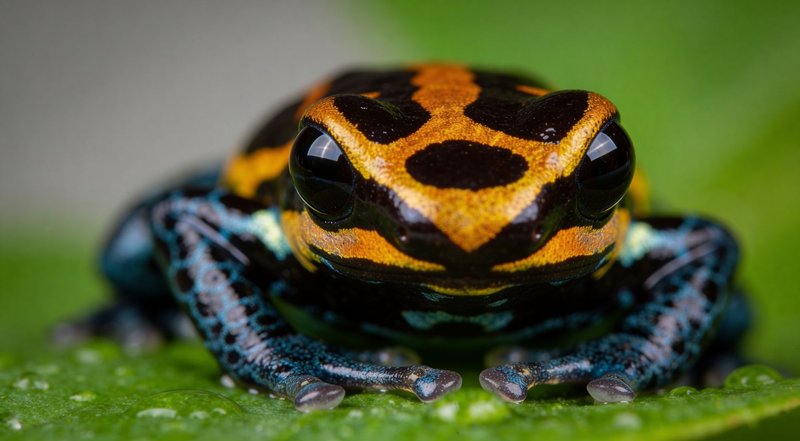
These are the ones you’ve seen on a magazine cover — thumbnail-sized frogs in electric blue, fire orange, or yellow-and-black like a tiny hazard sign. The family (Dendrobatidae) includes around 200 species, and the bright colors aren’t decoration. They’re a warning, a strategy biologists call aposematism: eat me and you’ll regret it.
Appearance: Brilliant, high-contrast colors — blues, reds, yellows, metallic greens. Size: Tiny. Most are 1.5 to 6 cm long; the golden poison frog tops out around 5 cm. Habitat layer: Forest floor and understory, near the damp leaf litter. Diet: Ants, mites, termites, and small insects. Wow adaptation: The golden poison frog (Phyllobates terribilis) carries enough batrachotoxin in its skin to kill several adult humans, making it one of the most poisonous animals alive. The toxins aren’t made by the frog — they come from the alkaloid-rich ants and mites it eats. Raise one in captivity on fruit flies and it grows up harmless.
That electric blue you see on some dart frogs is rarer than it looks in the animal kingdom — true blue pigment is almost unheard of, which is one reason these frogs join such an exclusive club of genuinely blue animals. Indigenous Emberá and Noanamá people in Colombia historically rubbed blowgun darts across the frog’s back to coat the tips, which is where the common name comes from.
2. Red-eyed tree frog
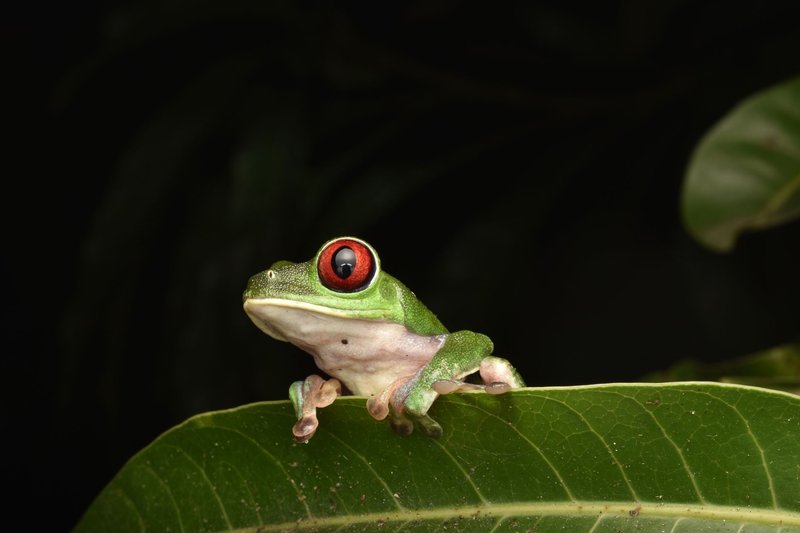
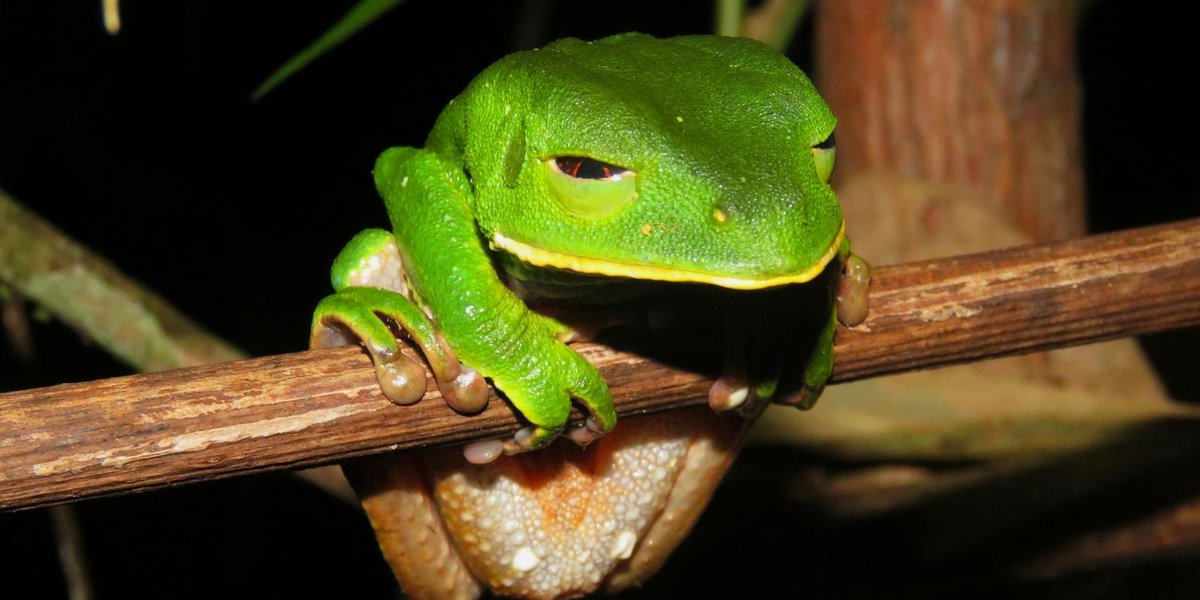
If poison dart frogs are the warning sign, the red-eyed tree frog (Agalychnis callidryas) is the magician. By day it’s nearly invisible — folded onto the underside of a leaf, eyes shut, legs tucked, just a green lump against green. Its famous colors only show when it moves.
Appearance: Neon-green body, blue-and-yellow striped flanks, bright orange feet, and those signature scarlet eyes. Size: Females reach about 7 cm; males are smaller, around 5 cm. Habitat layer: Canopy and understory leaves, in lowland Central American rainforests. Diet: Crickets, moths, flies, and other insects it ambushes at night. Wow adaptation: Startle coloration. When a predator nudges a sleeping frog, it flashes those red eyes and bright flanks in a sudden burst of color — a half-second of confusion that buys time to leap. Biologists call it deimatic display, a built-in jump scare.
The red-eyed tree frog is also one of the species people most want to keep at home, though it sits squarely in the demanding category of tropical rainforest pets that need carefully maintained humidity and live insect diets to thrive. Even the eggs are clever. Red-eyed tree frog embryos can sense the vibrations of an approaching snake and hatch early, dropping into the water below before they’re eaten — a documented case of an embryo making a survival decision.
3. Glass frogs
The glass frog looks like a manufacturing defect. Flip one over and you can see its heart beating, its intestines coiled, sometimes the green of its bones — all through translucent skin on its belly. There are over 150 species in the family Centrolenidae, scattered across Central and South American rainforests.
Appearance: Lime-green from above; transparent or translucent underneath, internal organs visible. Size: Small, generally 2 to 3 cm. Habitat layer: Vegetation overhanging forest streams. Diet: Small insects and spiders. Wow adaptation: The transparency is camouflage. Recent research showed that some glass frogs become even more see-through while sleeping by pulling red blood cells out of circulation and storing them in their liver — clearing the blood from their vessels so they’re harder to spot. They effectively hide their own blood.
Males guard the egg clutches, laid on leaves above streams so hatching tadpoles drop straight into the water.
4. Caecilians
Here’s the amphibian almost nobody pictures. Caecilians aren’t frogs, toads, or salamanders — they’re a separate group, and they look like a cross between an earthworm and a snake. Most spend their lives underground in the forest floor, which is why you can live near thousands and never see one.
Appearance: Limbless, segmented, ranging from a few centimeters to over a meter. Tiny or hidden eyes. Size: Highly variable; the largest tropical species exceed 1 meter. Habitat layer: Subterranean — burrowed into moist soil and leaf litter. Diet: Earthworms, termites, and other soil invertebrates. Wow adaptation: A pair of chemosensory tentacles between eye and nostril that they use to “taste” their way through the dark soil. Many species give live birth, and some young scrape and eat a special layer of their mother’s skin for nourishment — a behavior called maternal dermatophagy.
Caecilians are proof that “amphibian” is a much weirder category than the frog-shaped picture in your head.
5. Cane toad
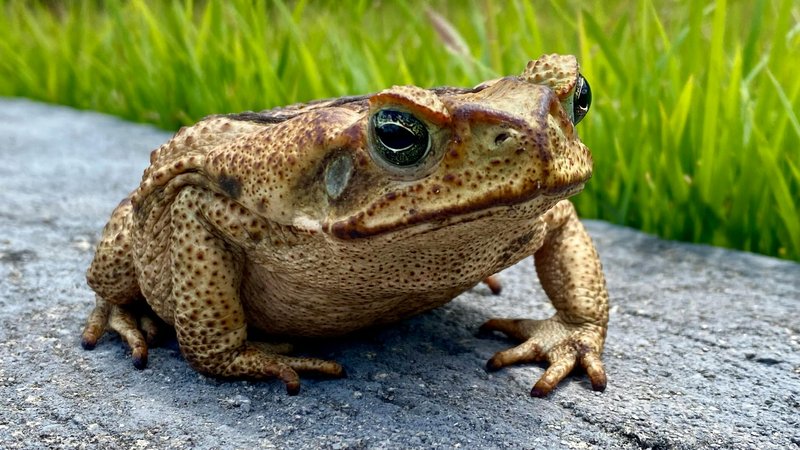
The cane toad (Rhinella marina) is the rainforest amphibian with a reputation problem. Native to South and Central America, it’s a big, warty, unfussy survivor — and when humans moved it around the world to control crop pests, it became one of the most infamous invasive species on Earth.
Appearance: Large, brown, heavily warted, with prominent paratoid glands behind the eyes. Size: Big. Commonly 10 to 15 cm; some exceed 20 cm and weigh over a kilogram. Habitat layer: Forest floor, but adaptable to almost any open or disturbed ground. Diet: Nearly anything it can swallow — insects, small reptiles, even pet food. Wow adaptation: The paratoid glands secrete bufotoxin, a poison potent enough to kill dogs and native predators that try to eat it. Combined with a willingness to eat anything and breed prolifically, that toxic defense is exactly why introducing it to Australia in 1935 backfired so badly.
In its native rainforest it’s just one toad among many, kept in check by predators that evolved alongside its toxins. Move it somewhere new and the balance collapses.
6. Tree frogs of the canopy
Beyond the red-eyed celebrity, the rainforest canopy holds a vast cast of tree frogs (family Hylidae) — the unsung majority that make the night so loud. Different species call at different pitches and times, partitioning the soundscape so each can be heard.
Appearance: Varied — greens, browns, mottled grays, often with toe pads. Size: Mostly small to medium, 2 to 8 cm depending on species. Habitat layer: Canopy and understory, breeding in bromeliad pools and tree holes. Diet: Insects and other small invertebrates. Wow adaptation: Toe pads. Tiny, structured surfaces on each toe generate enough wet adhesion to let a frog cling to a vertical leaf or a smooth wet branch in a downpour. It’s the engineering trick that let amphibians abandon the ground entirely and colonize the treetops.
Those leaf-matching greens are no accident — like most green animals, tree frogs get the color from pigments and structure that turn them invisible against foliage rather than from anything green in their diet. These are the frogs filling those suspended bromeliad pools with eggs, raising tadpoles in a few liters of rainwater caught between leaves.
Quick comparison table
| Species | Size | Forest layer | Standout adaptation |
|---|---|---|---|
| Poison dart frogs | 1.5–6 cm | Floor / understory | Diet-derived skin toxins + warning colors |
| Red-eyed tree frog | 5–7 cm | Canopy / understory | Startle coloration; vibration-cued early hatching |
| Glass frogs | 2–3 cm | Streamside leaves | Transparent belly; hides blood while sleeping |
| Caecilians | up to 1 m+ | Underground | Sensory tentacles; live birth, skin-feeding young |
| Cane toad | 10–20 cm | Floor | Potent bufotoxin glands; extreme adaptability |
| Canopy tree frogs | 2–8 cm | Canopy | Adhesive toe pads; bromeliad-pool breeding |
Where they live in the forest layers
The rainforest stacks life into horizontal bands, and amphibians sort themselves by humidity and water access:
- Forest floor and leaf litter: Poison dart frogs hunt the ants and mites that make them toxic; cane toads patrol open ground. Below the surface, caecilians burrow through the soil entirely out of sight.
- Understory: A transition zone of low vegetation and overhanging streamside leaves — glass frogs guard eggs here, and tree frogs rest within reach of breeding pools.
- Canopy: The high green ceiling, kept humid enough that frogs never need to come down. Bromeliad cups and tree holes become nurseries, and tree frogs spend entire lives among the leaves.
The pattern holds across continents: the wetter and more vertical the forest, the more amphibian life climbs off the ground.
The conservation problem
Here’s the hard part. Amphibians are the most threatened class of vertebrates on the planet. According to the IUCN Red List, roughly 41% of amphibian species are threatened with extinction — a higher share than birds or mammals. Rainforest species, despite living in some of the wildest places left, are far from safe.
Two forces drive it. The first is habitat loss: every cleared hectare of rainforest removes the humidity, the bromeliads, and the breeding pools that canopy amphibians depend on, and they can’t simply relocate.
The second is worse because it reaches even untouched forest. Batrachochytrium dendrobatidis — the chytrid fungus — infects amphibian skin and disrupts the animal’s ability to breathe and balance salts through it. A skin-breather with a skin infection is in serious trouble. Research published in Science linked chytrid to declines in over 500 amphibian species and the presumed extinction of around 90, calling it the most destructive wildlife disease ever recorded. It has swept through Central and South American rainforests, emptying streams that once rang with frog calls.
The animals that survive on diet-derived toxins, transparent bellies, and twenty-meter leaps turn out to have no defense against a fungus the size of a single cell. That’s the uncomfortable headline of rainforest amphibian conservation right now.
FAQ
What amphibians live in tropical rainforests? Mostly frogs and toads — poison dart frogs, tree frogs like the red-eyed tree frog, glass frogs, and large toads like the cane toad — plus the limbless, burrowing caecilians. Salamanders occur in some tropical regions too, but frogs vastly outnumber everything else.
Why do rainforests have so many amphibians? Constant warmth and humidity let amphibians thrive without freezing or drying out, and features like water-holding bromeliads create breeding sites high in the canopy. That combination supports far more species than cooler, drier habitats.
Are rainforest frogs poisonous? Many are. Poison dart frogs carry some of the most potent toxins in the animal kingdom, and cane toads produce dangerous bufotoxin. The toxicity is usually advertised by bright warning colors — though plenty of harmless rainforest frogs are camouflaged greens and browns.
Do poison dart frogs make their own poison? No. They acquire toxins from the ants, mites, and other small invertebrates they eat. Raised in captivity on a different diet, they’re non-toxic.
What is killing rainforest amphibians? Habitat destruction and the chytrid fungus, Batrachochytrium dendrobatidis, which attacks their skin. Chytrid alone has driven declines in hundreds of species and is considered the deadliest wildlife disease on record.