Here’s the thing almost nobody tells you about blue animals: the blue is usually a lie. Not a lie the animal is telling you, exactly, but a trick of physics. Crush a blue jay feather and the blue vanishes. Grind up a blue morpho wing and you get brown dust. The pigment isn’t there. The color is built, not painted.
That’s the real reason rare blue animals are rare. Making blue from a pigment is so biochemically difficult that across the entire animal kingdom, almost nothing pulls it off. The blue you see on a kingfisher or a mandarin fish is structural color – light bouncing off microscopic architecture in scales, feathers, or skin. And once you understand that, the next question writes itself: which animals manage to be blue and genuinely rare? Endangered, range-restricted, down to their last few hundred individuals?
This list answers both. First the science, fast. Then 22 rare blue animals grouped by category and ranked, at the end, by how close they are to gone.
Table of Contents
- Why blue is the rarest color in nature
- Pigment vs. structural color
- Rare blue mammals
- Rare blue birds
- Rare blue reptiles and amphibians
- Rare blue fish
- Rare blue insects
- Rare blue marine invertebrates
- Ranked: the rarest blue animals of all
- FAQ
Why blue is the rarest color in nature
Red, orange, yellow, brown, black – animals make these with pigments. Carotenoids from food, melanin from their own cells. Cheap, abundant, easy. A cardinal is red because it eats red-pigmented berries and parks those carotenoids in its feathers.
Blue doesn’t work that way. There is, with one strange exception, no true blue pigment in the animal world. Vertebrates can’t synthesize it. So an animal that wants to be blue has to cheat using structure: layers of keratin, chitin, or specialized cells arranged at the scale of light wavelengths, tuned so that they scatter and amplify blue light while canceling everything else.
Building that nanostructure costs more than dumping pigment into a feather. It evolves rarely, which is exactly why a blue animal stands out – to you, and to mates and rivals of its own species. Roughly one in ten plant species produces blue flowers, and in animals the share of true-blue species is far smaller still.
The one exception worth knowing: the obrina olivewing butterfly. It’s one of the only animals documented to use an actual blue pigment rather than structural color. Everything else on this list, the blue is engineered light.
Pigment vs. structural color
A quick reference, because this distinction is the whole story:
| Pigment color | Structural color | |
|---|---|---|
| How it works | Molecules absorb some wavelengths, reflect others | Nanostructures scatter and amplify specific wavelengths |
| Common in animals for | Red, yellow, orange, brown, black | Blue, iridescent greens, metallic sheens |
| Survives crushing? | Yes – color stays | No – color disappears |
| Changes with viewing angle? | No | Often yes (iridescence) |
| Example | Cardinal (red), flamingo (pink) | Blue morpho, blue jay, peacock |
The crush test is the giveaway. Mash a flamingo feather and it stays pink. Mash a blue jay feather and the blue is gone, because there was never blue in it – only structure that made blue from it. The same structural-versus-pigment split explains why so many big green animals look green without a drop of green pigment – color in nature is far more often built than painted.
Rare blue mammals
Blue fur basically doesn’t happen, which makes this the shortest section. Mammals went all-in on melanin. The “blue” mammals are blue-gray at best, and the genuinely blue-skinned ones are rare for a reason.
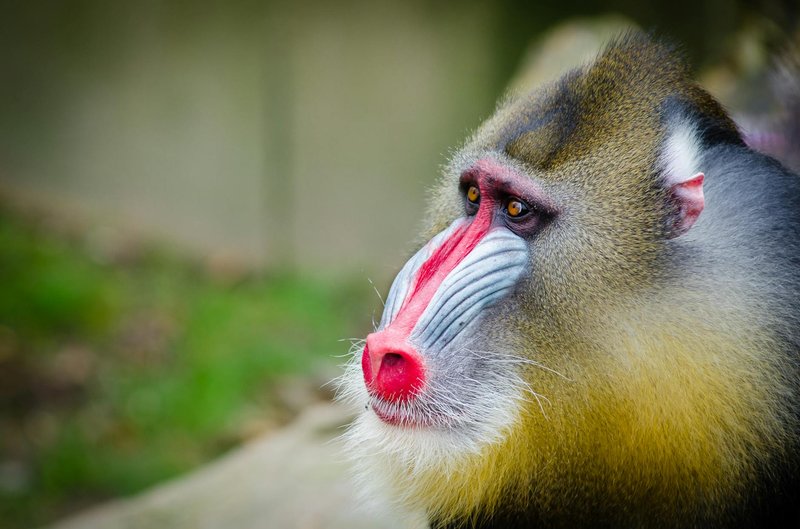
1. Mandrill. The bright blue ridges on a male mandrill’s face aren’t pigment – they’re structural color from layered collagen in the skin, the same trick a butterfly uses, running on a primate. Mandrills live in the rainforests of Gabon, Cameroon, and Congo, and the IUCN lists them as vulnerable to habitat loss and bushmeat hunting.
2. Blue monkey. Mostly a misnomer – the Cercopithecus mitis is more olive-gray with a bluish cast – but it earns a spot because the faint blue is, again, structural. Found across East and Central African forests, with several subspecies under pressure from logging.
3. Blue whale. Not truly blue, but the mottled blue-gray that gives the largest animal ever to exist its name. Worth including for the obvious reason: at an estimated 10,000 to 25,000 individuals, the blue whale remains endangered decades after commercial whaling stopped.
Rare blue birds
Birds are where structural blue gets spectacular – and where some of the rarest blue animals on Earth live. Feather barbs full of tiny air pockets scatter blue light; melanin underneath absorbs the rest.
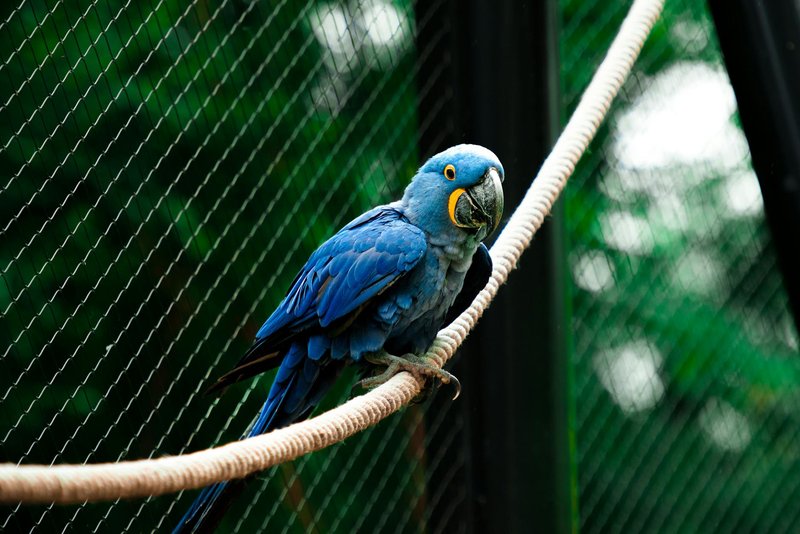
4. Spix’s macaw. The blue parrot from the animated film Rio, and one of the rarest birds alive. Declared extinct in the wild around 2000, the species survived only in captivity. A reintroduction program has since released birds back into Brazilian caatinga – meaning Spix’s macaw went from zero wild individuals to a fragile, slowly growing population. It’s the closest thing on this list to a resurrection.
5. Hyacinth macaw. The largest flying parrot, a deep cobalt nearly two feet head to tail. Native to central South America, it’s classed as vulnerable, hammered by the pet trade and habitat clearance for cattle.
6. Blue jay. Common in eastern North America, but it earns inclusion as the textbook case: every blue jay you’ve ever seen is brown. The pigment in the feather is melanin. The blue is pure structure, which is why a backlit jay feather looks gray.
7. Indigo bunting. A small songbird that looks electric blue in sunlight and nearly black in shade – because structural color depends on light hitting it the right way. Males are blue only in breeding season.
8. Blue-footed booby. The feet, not the bird. That cartoonish turquoise comes from carotenoid pigments in the diet, and brighter feet signal a healthier, better-fed male – females read foot color during courtship. A rare case of “blue” being honest pigment rather than structure.
9. Splendid fairywren. An Australian bird where breeding males turn almost entirely iridescent blue. Outside the breeding season they’re brown like the females, which tells you how metabolically expensive that blue is to maintain.
Rare blue reptiles and amphibians
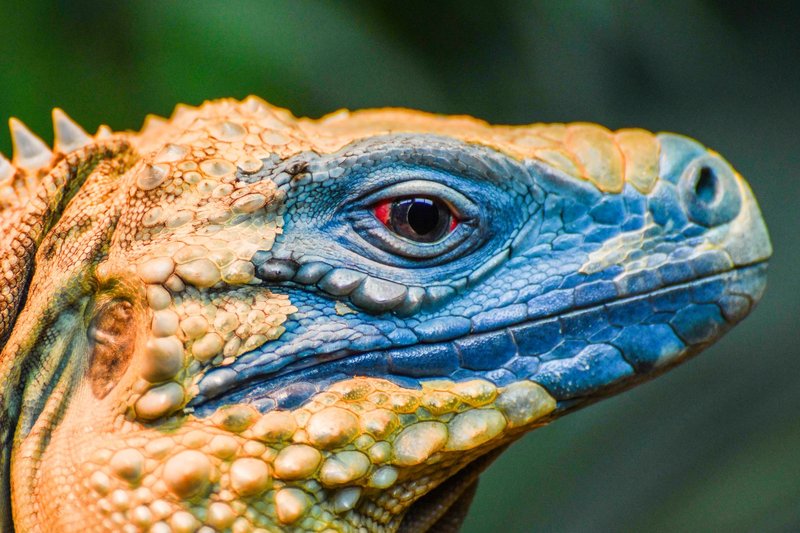
10. Grand Cayman blue iguana. One of conservation’s quiet success stories. By 2002 there were fewer than 25 left in the wild on Grand Cayman. A captive-breeding and release program pulled the species back from the edge – it’s still endangered, but it exists, which a decade ago looked unlikely. The adult blue is most intense in territorial males.
11. Blue poison dart frog. Dendrobates tinctorius “azureus,” a deep cobalt frog with black spots from a small area of southern Suriname. In the wild it lives in isolated forest “islands” surrounded by savanna, which makes its populations naturally fragmented and vulnerable.
12. Panther chameleon (blue morph). Certain locale forms from Madagascar – especially around Nosy Be – produce brilliant blue males. The color is structural, sitting in specialized skin cells called iridophores that chameleons can actively tune, which is why their color shifts with mood and temperature.
13. Blue-tongued skink. A cheat entry, but a famous one: the lizard itself is drab, but it flashes a startling cobalt-blue tongue to scare off predators. The blue is a defensive bluff, and it reflects UV light that predators can see even when humans barely register it.
Rare blue fish
Underwater, blue is everywhere and almost always structural, generated by iridophores in the skin.
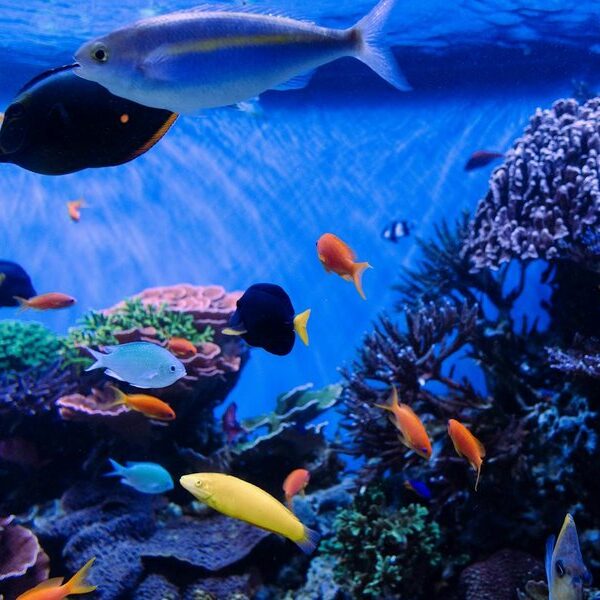
14. Mandarinfish. One of only two animal groups known to produce blue using a genuine cellular blue pigment rather than pure structure – a real biochemical oddity. This tiny Pacific reef fish is covered in psychedelic blue-and-orange swirls. Hard to keep, hard to breed, and heavily collected for aquariums.
15. Blue tang. The “Dory” fish. Royal blue with a black palette pattern, common across Indo-Pacific reefs – included because its blue is structural and its post-Finding Nemo popularity drove a wild-collection problem the species never had before.
16. Electric blue hap. A cichlid from Lake Malawi where dominant males turn neon blue. The same fish kept in stressful conditions fades, because structural blue intensity tracks the animal’s status and health in real time.
17. Blue lobster. Roughly one in two million lobsters is blue, caused by a genetic mutation that overproduces a protein binding to the usual shell pigment, twisting it blue. Not a species, just a rare individual – which is its own kind of rarity. Bright blue lobsters turn up in fishing hauls every few years and usually end up in aquariums rather than pots. The same structural-versus-pigment rules play out across the warm end of the spectrum too, which is why yellow fish almost never get their color the way you’d expect.
Rare blue insects
Insects do structural blue better than anyone, using layered chitin in wing scales.
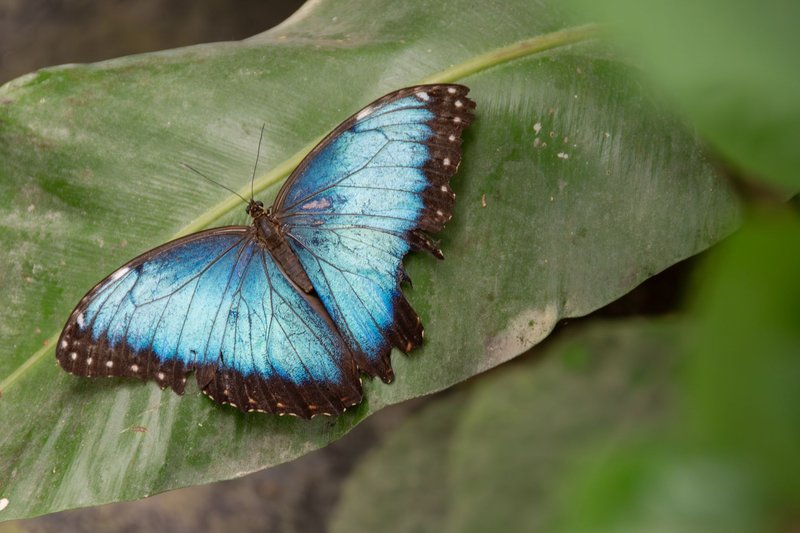
18. Blue morpho butterfly. The classic. Those huge metallic-blue wings have no blue pigment at all – the scales are stacked at nanometer spacing that reflects blue and cancels other colors, which is why the wings flash and shift as the butterfly flies. The underside is dull brown for camouflage.
19. Cobalt blue tarantula. Cyriopagopus lividus from Myanmar and Thailand, with legs an almost unreal metallic blue. The color is structural – the same nanostructure trick, on a spider – and researchers study it because every blue tarantula species arrived at the same blue through different physical structures, a case of convergent evolution. The forests it comes from are a biodiversity hotspot in their own right, full of Myanmar’s lesser-known native species.
20. Adonis blue butterfly. A small European butterfly whose males are a vivid sky blue. It depends on a single plant, horseshoe vetch, on chalk grassland – so as that habitat shrinks, so does the butterfly, making it a conservation indicator in the UK.
21. Blue-eyed cicada. Cicadas normally have red eyes. Every so often, a one-in-a-million mutation produces blue eyes – and during the big periodical cicada emergences, collectors hunt for them like four-leaf clovers. There’s no blue-eyed species; it’s a rare flicker in an otherwise red-eyed population.
Rare blue marine invertebrates
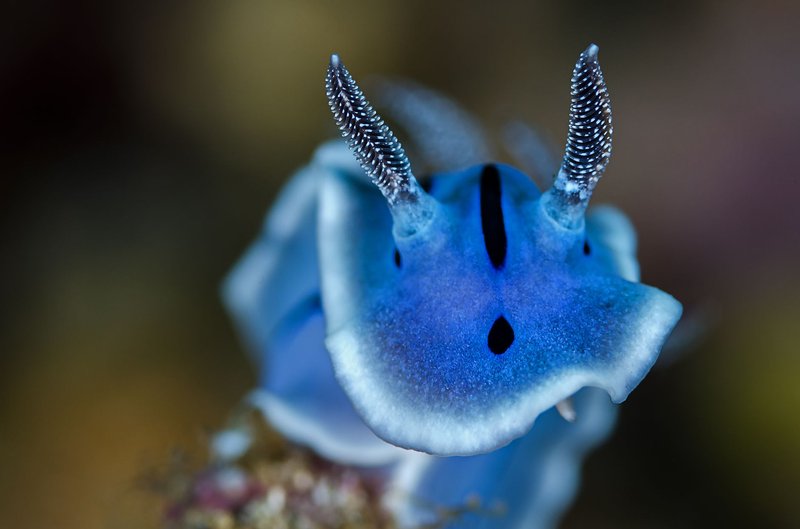
22. Blue dragon sea slug. Glaucus atlanticus, a thumbnail-sized nudibranch that floats upside down at the ocean surface, its blue belly facing the sky as camouflage against the water. It eats Portuguese man o’ war and stores their stinging cells, concentrating them – so a creature the size of a coin can deliver a worse sting than the jellyfish it ate. It washes up on beaches periodically, and you should not pick it up.
Ranked: the rarest blue animals of all
Most “blue animals” lists stop at pretty. Here’s what actually matters if rarity is the question – ranked from most precarious to merely uncommon:
- Spix’s macaw – functionally extinct in the wild for two decades; surviving only through captive breeding and a fragile reintroduction. The rarest blue animal on this list, full stop.
- Grand Cayman blue iguana – dropped below 25 wild individuals before a breeding program reversed the slide. Still endangered.
- Blue-eyed cicada – roughly one in a million within an emergence; not a species, a genetic lottery ticket.
- Blue lobster – about one in two million individuals.
- Hyacinth macaw – vulnerable, declining from the pet trade and habitat loss.
- Blue poison dart frog – naturally fragmented into isolated forest patches.
- Mandrill / blue whale – vulnerable and endangered respectively, though far more numerous than the top of this list.
The pattern is hard to miss. Blue is expensive to build, so it tends to show up in specialists – animals tied to one forest, one lake, one host plant. And specialists are exactly the animals that struggle when their habitat shrinks. The rarest blue animals are rare twice over: rare in color, and rare in number.
FAQ
Why are blue animals so rare? Because almost no animal can make a true blue pigment. Blue in nature is nearly always structural color – microscopic structures that scatter blue light – and evolving that nanostructure is harder and rarer than producing ordinary pigments like melanin or carotenoids.
What is the rarest blue animal in the world? Spix’s macaw. It was extinct in the wild for about 20 years and survives mainly through captive breeding, with only a small reintroduced population now in Brazil.
Are any blue animals actually blue from pigment? Very few. The obrina olivewing butterfly and the mandarinfish are among the only known animals that use a genuine blue pigment rather than structural color. For nearly everything else – blue jays, morphos, blue tarantulas – the blue is built from structure, not paint.
Why does a blue feather turn gray when you crush it? Because the blue was never a pigment. The color comes from the feather’s nanostructure scattering light. Crush it and you destroy the structure, so the blue disappears, leaving the melanin underneath – which is brown or gray.