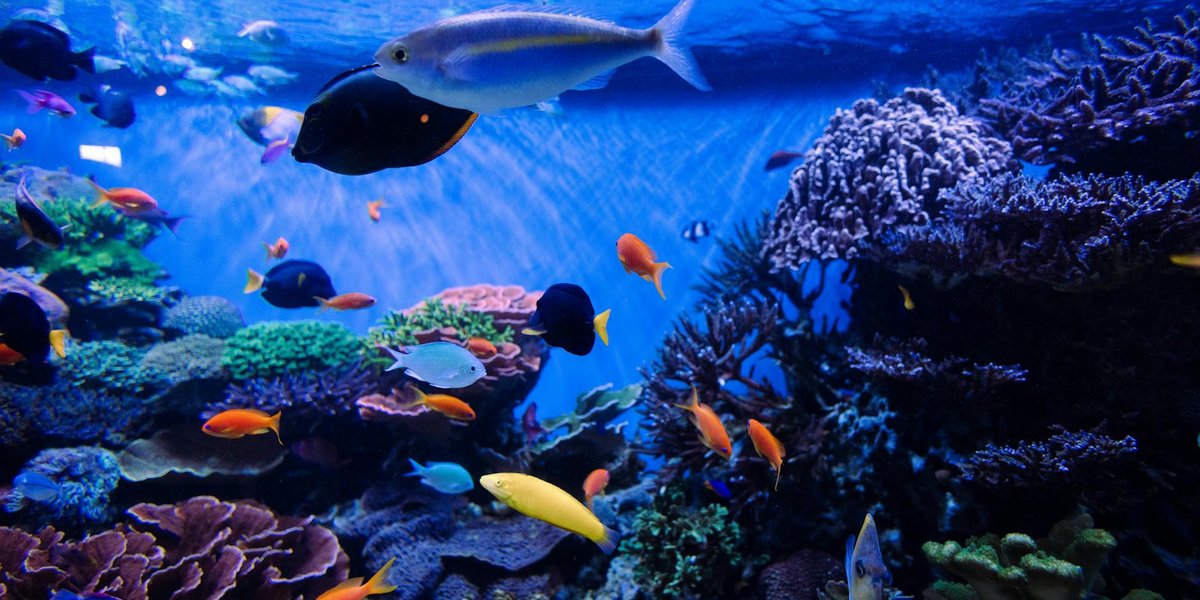
About 96 percent of all living fish are bony fish. So if you point at a random fish — a goldfish in a bowl, a tuna steak at the market, a clownfish in a reef tank — the odds are overwhelming that you’re looking at a member of Osteichthyes, the bony fish. The exceptions are the cartilaginous ones (sharks, rays, skates) and a tiny handful of jawless oddballs. Everything else has a real skeleton made of bone.
Test yourself with our fish identification quiz: 10 photos of live fish, four choices each, on Easy, Medium or Hard.
That’s the short version. Below is the longer one: 30 bony fish examples sorted by where you’d actually run into them, a clear breakdown of what separates a bony fish from a shark, and the single anatomical feature that ties the whole group together.
Table of Contents
- The quick answer: what counts as a bony fish
- The two branches: ray-finned vs. lobe-finned
- Common bony fish you already know
- Freshwater bony fish examples
- Saltwater bony fish examples
- Ornamental and aquarium bony fish
- Strange and rare bony fish
- Bony fish vs. cartilaginous vs. jawless: the comparison table
- The defining feature: bones, swim bladders, and that gill flap
- Frequently asked questions
The quick answer: what counts as a bony fish
A bony fish is any fish whose skeleton is made primarily of bone rather than cartilage. The scientific group is Osteichthyes, which literally means “bone fish” in Greek. There are more than 29,000 described species, which makes them not just the largest group of fish but the largest group of vertebrates on Earth — more than all the birds, mammals, reptiles, and amphibians combined.
A few traits show up in almost every bony fish:
- A bony skeleton instead of cartilage
- An operculum — the bony plate covering the gills (lift it on a fresh fish and you’ll see the red gills underneath)
- A swim bladder — a gas-filled organ that controls buoyancy
- Scales that lie flat, usually thin and overlapping
- Fins supported by bony rays rather than the fleshy fins of sharks
Sharks and rays miss every one of those. That’s the whole distinction, and we’ll come back to it in the table.
The two branches: ray-finned vs. lobe-finned
Bony fish split into two classes, and the difference comes down to fin structure.
Ray-finned fish (Actinopterygii) make up the overwhelming majority — somewhere north of 99 percent of all bony fish species. Their fins are thin webs of skin stretched over bony spines, the rays. Salmon, tuna, goldfish, bass — almost every fish on this list is ray-finned.
Lobe-finned fish (Sarcopterygii) have fleshy, muscular fins built on a central bone, more like stubby limbs than fans. There are only a handful left alive: the coelacanths and the lungfishes. They matter way out of proportion to their numbers, because the lobe-finned lineage is the one that crawled onto land roughly 375 million years ago and eventually produced every four-limbed animal — including you. Tetrapods are, technically, lobe-finned fish that kept going.
So when you sort bony fish, you’re really sorting a few thousand families of ray-finned fish plus a tiny, evolutionarily enormous club of lobe-fins.
Common bony fish you already know
Start with the fish you’ve eaten, kept, or caught. All six are ray-finned.
-
Salmon — Anadromous, meaning they hatch in freshwater, mature in the ocean, and fight their way back upstream to spawn. A sockeye’s flesh turns red from the krill and shrimp it eats. Pacific salmon famously die after a single spawning run.
-
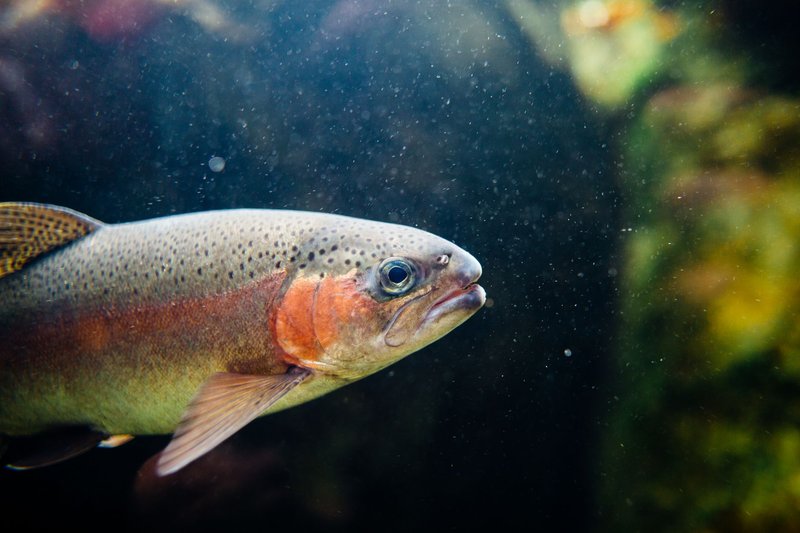
Rainbow trout — A salmon relative and a staple of stocked lakes and rivers. The pink lateral stripe gives it the name. Hatcheries raise them by the millions, which is why trout shows up in places it was never native to.
-
Goldfish — A domesticated carp, bred in China over a thousand years ago. The “bowl goldfish” myth aside, a healthy goldfish can live 10 to 20 years and grow well past a foot in a pond.
-
Largemouth bass — The most-targeted freshwater game fish in North America. The mouth extends back past the eye, which is the field mark that separates it from smallmouth bass.
-
Tuna — Built for speed. Bluefin tuna are partially warm-blooded, keeping their muscles hotter than the surrounding water so they can chase prey across whole oceans at bursts over 40 mph.
-
Catfish — Named for the whisker-like barbels around the mouth, which are packed with taste buds. Channel catfish can essentially taste their entire surroundings, useful in muddy water where eyesight fails.
Freshwater bony fish examples
Freshwater covers a sliver of the planet’s water but holds an outsized share of fish diversity.
-
Northern pike — Ambush predator with a duckbill snout and backward-slanting teeth. It waits motionless in weeds, then strikes.
-
Yellow perch — Schooling panfish with vertical dark bars, common across northern lakes and a favorite of ice anglers.
-
Common carp — Hardy, adaptable, and invasive across much of the world. Carp can survive low-oxygen water that would kill most fish.
-
Bluegill — A palm-sized sunfish with a black “ear” spot. Often the first fish a kid ever catches off a dock.
-
Tilapia — A group of African cichlids farmed worldwide for fast growth and bland, forgiving flesh. They breed so readily they’ve become invasive in warm waters.
-
Arapaima — One of the largest freshwater fish alive, reaching over eight feet in the Amazon basin. It gulps air at the surface using a modified swim bladder that works like a primitive lung.
Saltwater bony fish examples
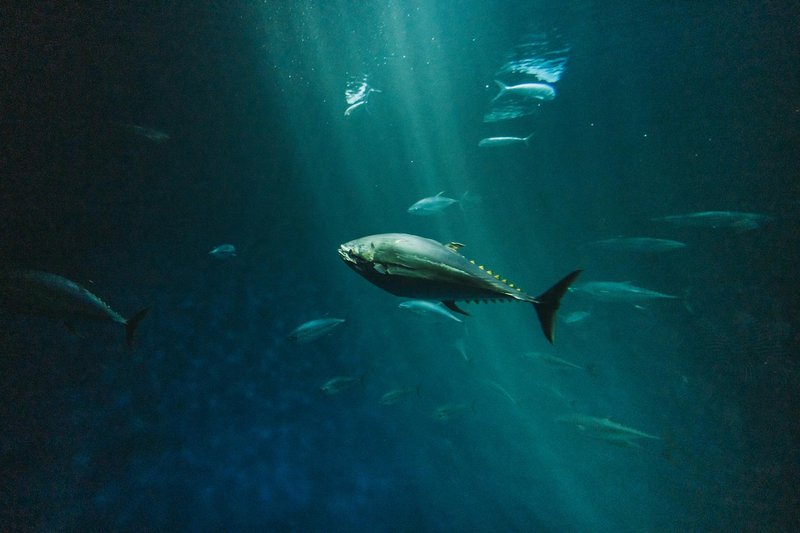
The ocean holds the largest range of bony fish, from coastal flats to the deep open water.
-
Atlantic cod — The fish that built economies. Centuries of overfishing collapsed the Grand Banks stocks in the 1990s, a textbook case of fisheries mismanagement.
-
Mackerel — Fast, oily, schooling fish with tiger-stripe backs. A key link in ocean food webs, eaten by tuna, seabirds, and dolphins alike.
-
Halibut — A flatfish that starts life upright, then has one eye migrate across its skull so both end up on the same side as it settles onto the seafloor.
-
Red snapper — A reef-associated fish with a sharp profile and a long lifespan; some live over 50 years, which puts them in the same league as a few of the longest-living animals on record.
-
Grouper — Heavy-bodied ambush predators that swallow prey whole by opening their mouths fast enough to create a vacuum.
-
Swordfish — Named for the flat, sword-like bill it uses to slash through schools of prey. Like tuna, it can warm its eyes and brain to hunt in cold, deep water.
Ornamental and aquarium bony fish
The pet trade runs almost entirely on bony fish. These are the species people actually keep.
-
Clownfish — Made famous by a certain animated movie. They live inside sea anemones, immune to the stings that would kill other fish — a partnership that doubles as one of the more elegant animal defense mechanisms in the reef. Every clownfish is born male, and the dominant one becomes female.
-
Koi — Ornamental carp bred in Japan for color patterns. A prized koi can sell for tens of thousands of dollars, and the fish can outlive their owners; some have reached over 50 years.
-
Angelfish — Tall, triangular freshwater cichlids from the Amazon. Their flattened bodies let them slip between vertical plant stems.
-
Betta — The “Siamese fighting fish.” Males flare and fight, but they also breathe air through a labyrinth organ, which is why they survive in tiny cups that would suffocate most fish.
-
Guppy — Small, fast-breeding livebearers. They give birth to live young instead of laying eggs, which is why a single pair can fill a tank.
-
Discus — Round, disc-shaped cichlids that feed their fry on a mucus secreted from their own skin. Demanding to keep, prized by hobbyists for exactly that reason.
Strange and rare bony fish
The far end of the bony fish family tree is where it gets weird.
-
Oarfish — The longest bony fish, reaching over 30 feet. It lives in the deep open ocean and is the likely source of countless “sea serpent” sightings.
-
Ocean sunfish (Mola mola) — The heaviest bony fish, topping 2,000 pounds. It looks like a swimming head with fins, having essentially no tail, and drifts near the surface eating jellyfish.
-
Seahorse — Yes, it’s a bony fish. It swims upright, anchors with a prehensile tail, and the male carries the eggs in a brood pouch and gives birth.
-
Lungfish — A lobe-finned fish that breathes air and can survive drought by burrowing into mud and going dormant for months inside a mucus cocoon.
-
Coelacanth — A lobe-finned fish thought extinct for 66 million years until one turned up in a South African fishing net in 1938. It’s a living window into the lineage that gave rise to land animals, and you can read the original discovery account from the Natural History Museum.
-
Anglerfish — The deep-sea hunter with a glowing lure dangling over its mouth. In many species the tiny male permanently fuses to the much larger female’s body, becoming little more than an attached source of sperm.
Bony fish vs. cartilaginous vs. jawless: the comparison table
The three living groups of fish are easy to mix up. Here’s the side-by-side.
| Feature | Bony fish (Osteichthyes) | Cartilaginous fish (Chondrichthyes) | Jawless fish (Agnatha) |
|---|---|---|---|
| Skeleton | Bone | Cartilage | Cartilage |
| Examples | Salmon, tuna, clownfish | Sharks, rays, skates | Lampreys, hagfish |
| Jaws | Yes | Yes | No |
| Gill covering | Operculum (bony flap) | Exposed gill slits | Gill pouches |
| Swim bladder | Usually present | Absent (relies on oily liver) | Absent |
| Scales | Thin, overlapping | Tooth-like denticles | None |
| Species count | ~29,000+ | ~1,200 | ~120 |
The fastest way to ID a bony fish in the field: look for the operculum, that single hard flap over the gills. Sharks and rays have a row of naked gill slits instead. If you see one smooth cover, it’s a bony fish. The rest of the characteristics of a shark — from the cartilage skeleton to the denticle-covered skin — line up as the mirror image of everything on the bony-fish side.
The defining feature: bones, swim bladders, and that gill flap
If you only remember one thing, make it the swim bladder. Most bony fish carry a gas-filled sac that they inflate or deflate to hover at a given depth without burning energy. A shark can’t do this — it has to keep swimming or sink, which is why sharks never truly rest the way a perch can hang motionless in the water column.
The swim bladder also explains a few oddities on this list. The arapaima and the lungfish both turned theirs into air-breathing organs, a backup for warm, stagnant water where oxygen runs out. That’s the same evolutionary trick, pushed in a different direction — and a small preview of how lobe-finned fish eventually managed to breathe on land.
The operculum is the second giveaway and the easiest to spot. It pumps water across the gills even when the fish is sitting still, another thing sharks can’t do. Add the bony skeleton and the ray-supported fins, and you’ve got the full definition of Osteichthyes without needing a microscope.
Frequently asked questions
Is a shark a bony fish? No. Sharks are cartilaginous fish (Chondrichthyes). Their skeletons are made of cartilage, the same flexible material in your nose and ears, not bone. They also lack an operculum and a swim bladder, which is why they have to keep moving to stay afloat.
How many bony fish species are there? More than 29,000 described species, and new ones get added every year. That makes Osteichthyes the largest group of vertebrates on the planet.
Is a seahorse really a bony fish? Yes. Despite the unusual shape and upright swimming, a seahorse has a bony skeleton (covered in bony plates rather than scales) and a swim bladder. It sits firmly inside the ray-finned group.
What’s the difference between ray-finned and lobe-finned fish? Ray-finned fish (Actinopterygii) have fins made of thin skin over bony rays — that’s nearly every fish you’ll ever see. Lobe-finned fish (Sarcopterygii) have fleshy, muscular fins on a central bone; only coelacanths and lungfishes survive, and they’re the ancestors of all land vertebrates.
Are eels bony fish? Yes. True eels are ray-finned bony fish — their skeletons just stretched out into that long, snake-like shape. (Electric eels, confusingly, aren’t true eels at all, but they’re still bony fish.)
Is a whale a fish? No. Whales are mammals — they breathe air with lungs, are warm-blooded, and nurse their young. They’re not part of any fish group, bony or otherwise.