Liberia’s wildlife lists are everywhere, and almost none of them tell you which animals can actually hurt you. They’ll rank species by how rare or photogenic they are, bury the buffalo somewhere between the antelopes, and never mention that it kills more people in West Africa than most of the cats combined. So here’s the version that matters if you’re hiking Sapo National Park, working near the coast, or just want to know what’s out there: the nine animals in Liberia worth taking seriously, ranked by real-world risk, with where they live and what to do about them.
Most encounters end fine. Liberia isn’t a place where animals hunt people. The danger comes from surprise, from getting between a mother and her young, from wading into the wrong river, or from stepping where you can’t see. Knowing which is which is the whole game.
Table of Contents
- Quick Danger Reference
- 1. African Forest Buffalo
- 2. Nile Crocodile
- 3. West African Gaboon Viper
- 4. Leopard
- 5. West African Forest Elephant
- 6. Black-Necked Spitting Cobra
- 7. West African Crocodile
- 8. Honey Badger
- 9. Bull Shark
- How to Stay Safe in Liberia
Quick Danger Reference
| Animal | Threat type | Where you’ll meet it | Danger level |
|---|---|---|---|
| African forest buffalo | Trampling, goring | Forest edges, Sapo NP | Very high |
| Nile crocodile | Ambush, drowning | Rivers, wetlands | Very high |
| West African Gaboon viper | Venom (cytotoxic) | Rainforest floor | High |
| Leopard | Bite, claws (rare) | Dense forest, Sapo NP | Medium |
| Forest elephant | Trampling | Deep forest, Sapo NP | High |
| Black-necked spitting cobra | Venom, eye spitting | Grassland, villages | High |
| West African crocodile | Bite, ambush | Coastal rivers, lagoons | Medium |
| Honey badger | Bite, claws (if cornered) | Savanna, forest edge | Medium |
| Bull shark | Bite | Coast, river mouths | Low–medium |
1. African Forest Buffalo
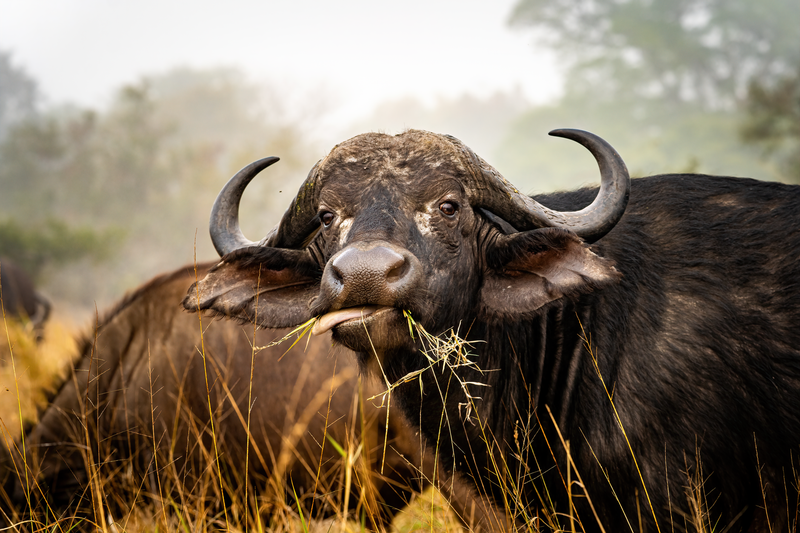
Syncerus caffer nanus
The forest buffalo is smaller and redder than the giant Cape buffalo of the savanna, and people underestimate it for exactly that reason. It’s still a 600-pound animal that does not back down. Buffalo across Africa are responsible for a large share of large-animal attacks on people, and the danger here is specific: they don’t bluff. A startled buffalo charges, and an injured one circles back to finish what spooked it.
In Liberia you’ll find them along the edges of dense forest and in the clearings of Sapo National Park, the country’s largest protected rainforest. They travel in small herds in the cover of the trees, which means you often hear or smell them before you see them, and by then you’re close. A solitary old bull is the worst case. They’ve been pushed out of the herd, they’re irritable, and they hold their ground.
If you’re on a guided trek and the guide stops dead and goes quiet, that’s why. Don’t make noise, don’t run, back away the way you came.
2. Nile Crocodile
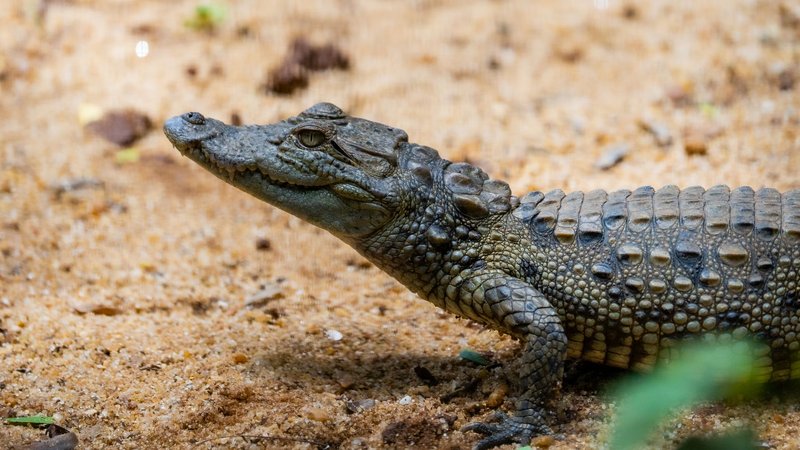
Crocodylus niloticus
This is the one that kills people. The Nile crocodile is the largest of Liberia’s three crocodile species, reaching over four meters, and it’s an ambush predator built around a single tactic: wait at the water’s edge, explode, and drag the prey under. It doesn’t need to be hungry often, and it doesn’t distinguish between an antelope drinking and a person fetching water.
Nile crocodiles live in Liberia’s larger rivers and wetlands, and the risk is highest exactly where human routine meets the water: washing points, fishing spots, river crossings, the shallow margins at dusk and dawn. Crocodile attacks across sub-Saharan Africa are badly underreported, but the National Geographic record on Nile crocodiles is consistent: they’re among the most dangerous large reptiles on Earth, and most attacks happen in water people use every day.
The rule is unglamorous and absolute. Assume any slow-moving river in Liberia has crocodiles. Don’t wade, don’t swim, don’t fish from the bank at the same spot every evening, and never let a child play at the waterline alone.
3. West African Gaboon Viper
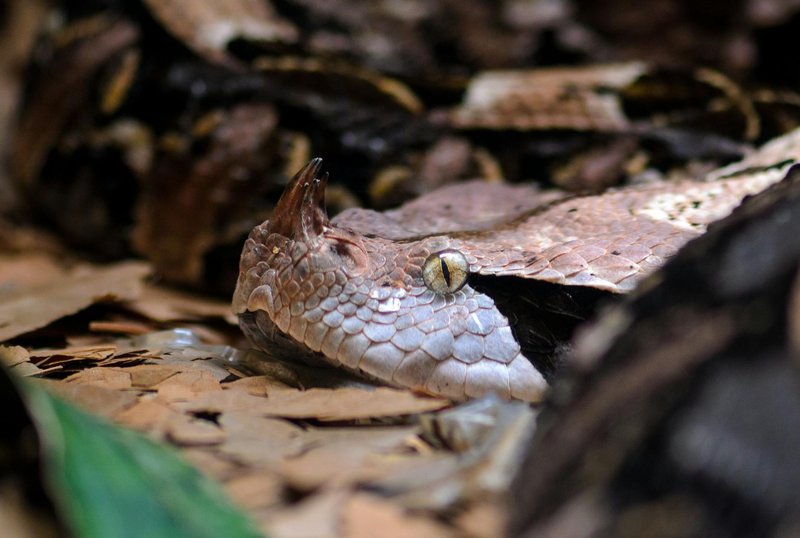
Bitis rhinoceros
The West African Gaboon viper is the snake the databases skip and the one you should actually fear. It has the longest fangs of any venomous snake, up to five centimeters, and it delivers a huge volume of cytotoxic venom in a single strike. The bite destroys tissue, drops blood pressure, and without antivenom it’s frequently fatal.
What makes it dangerous isn’t aggression. It’s the opposite. This viper is a master of camouflage, its leaf-pattern skin disappearing perfectly into the rainforest floor, and it doesn’t flee. It sits. People get bitten because they step on one they never saw, on a trail, near a village, at the edge of a cleared field. The strike is one of the fastest in the snake world.
Watch where you put your feet on forest paths, especially in leaf litter and especially after rain. Wear boots, not sandals. And carry a light at night, because that’s when these snakes move into the open.
4. Leopard
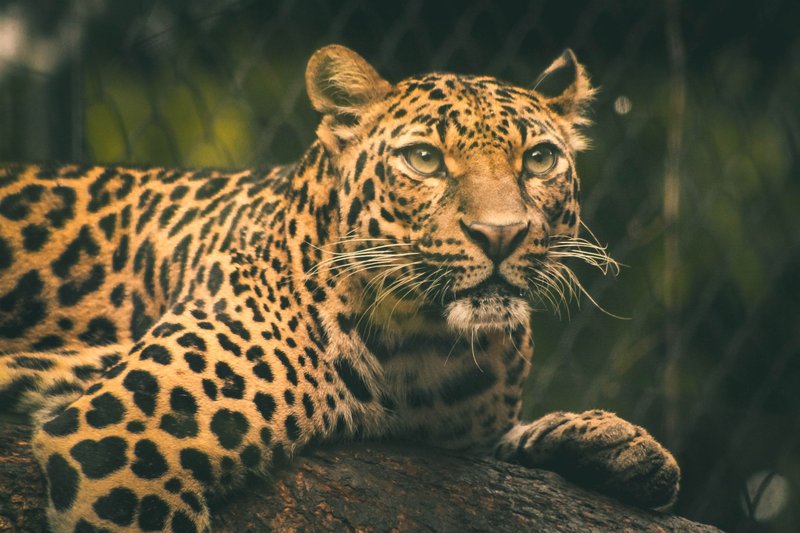
Panthera pardus
Liberia has no lions. The leopard is the apex predator, and it lives almost invisibly in the dense forests of the interior, including Sapo. Attacks on humans are rare, genuinely rare, and that’s the honest framing. A leopard’s instinct around people is to vanish, and most visitors who spend a week in the forest never glimpse one.
The risk sits in the narrow cases: a leopard that’s been wounded, cornered, or habituated by people feeding it scraps near a camp. A cornered leopard is extraordinarily fast and strong for its size, and it goes for the head and neck. There’s no outrunning one and no fighting one off cleanly.
The practical takeaway is small but real. Don’t store food in your tent, don’t follow tracks toward a kill, and if you somehow corner one, give it an exit. The leopard wants to leave more than you do.
5. West African Forest Elephant
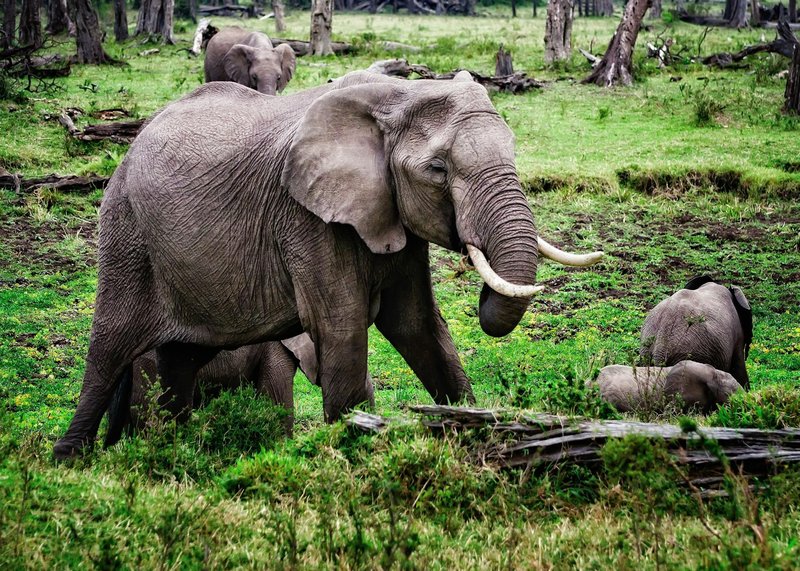
Loxodonta cyclotis
Forest elephants are smaller than their savanna cousins and far harder to see, which is precisely the problem. They move through thick vegetation in small family groups, and you can come around a bend and find yourself thirty feet from one with no warning. An elephant that feels its calves are threatened doesn’t hesitate, and a few tons moving fast through forest is unsurvivable on foot.
In Liberia they’re concentrated in the deep forest of Sapo and a handful of other reserves, where poaching has made them wary and short-tempered around humans. A wary elephant is a dangerous one. The warning signs are clear if you know them: ears flared, trunk up testing the air, a sharp trumpet, a mock charge that stops short.
If an elephant gives you those signals, it’s telling you to leave, and you leave immediately and quietly. Put trees between you and it. Never get between an adult and a calf, even by accident, even briefly.
6. Black-Necked Spitting Cobra
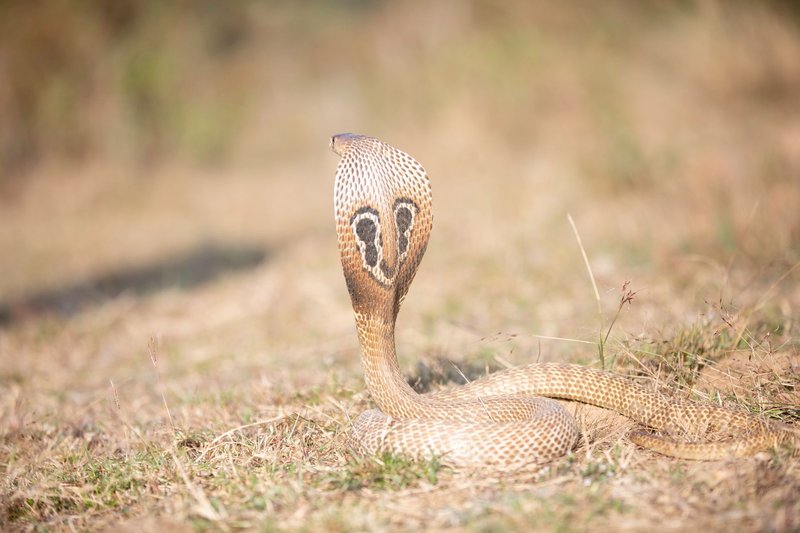
Naja nigricollis
Snakebite is the most underestimated wildlife threat in West Africa, and the spitting cobra adds a second hazard most people don’t expect. It can spray venom up to two meters, aiming for the eyes, causing intense pain and potential blindness if it isn’t rinsed out fast. The bite itself is cytotoxic and can be fatal. The World Health Organization classifies snakebite as a neglected tropical disease for a reason: across the region it kills and maims far more people than any large mammal.
Spitting cobras turn up in grassland, farmland, and the edges of villages, drawn by the rodents that live where people do. That overlap is what makes them dangerous. They’re encountered in gardens, near homes, around chicken coops, far more often than in untouched wilderness.
If one rears up and faces you, look away and back off, because it’s about to spit and your eyes are the target. If venom hits the eyes, flush with water or any clean fluid for fifteen minutes and get to a clinic.
7. West African Crocodile
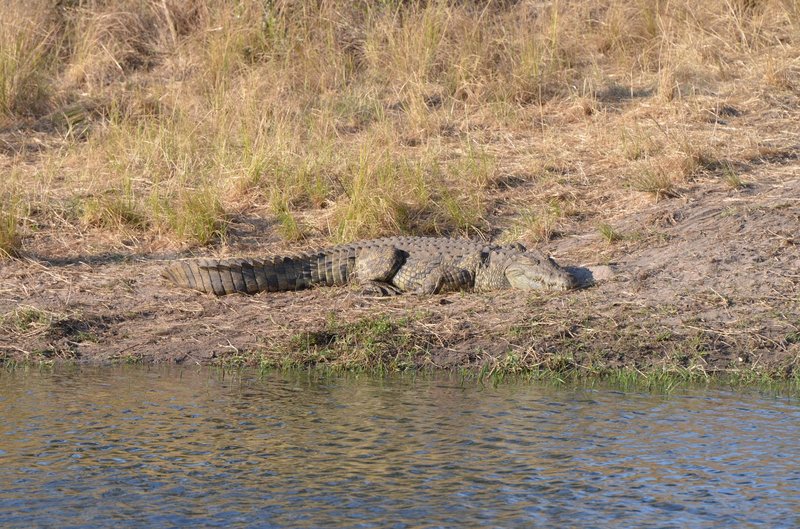
Crocodylus suchus
Often confused with the Nile crocodile and historically lumped in with it, the West African crocodile is a distinct, somewhat smaller and generally less aggressive species. It’s found in Liberia’s coastal rivers, lagoons, and brackish water. The danger is lower than its Nile cousin’s, but lower is not zero, and a large individual is fully capable of taking a person.
The reason it earns a spot is overlap with daily life. These crocodiles share exactly the calm coastal waterways where people fish, wash, and cross, so the encounter rate is high even if the per-encounter risk is moderate. Liberia also has the smaller dwarf crocodile in its forest streams, which is shy and rarely a threat to adults, but it’s a reminder that crocodiles inhabit far more of the country’s water than most visitors assume.
Treat coastal lagoons and slow rivers with the same caution as the big rivers. The species is harder to identify than the threat is to avoid.
8. Honey Badger
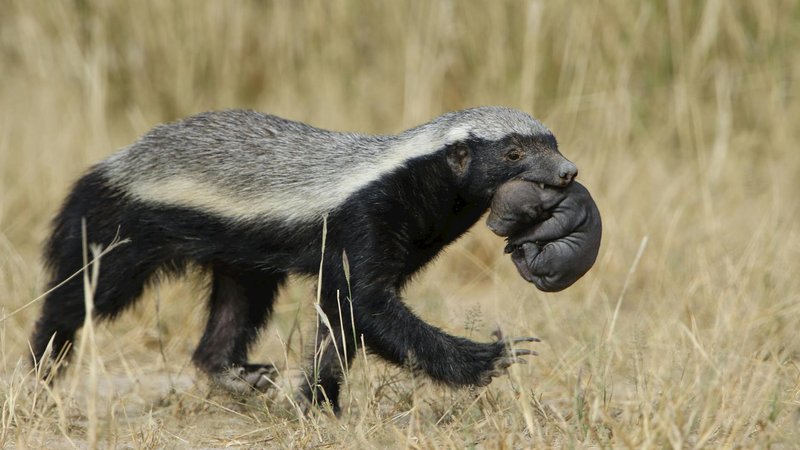
Mellivora capensis
The honey badger has a reputation, and unlike most internet legends, this one is earned. It’s small, maybe fifteen pounds, and it has no concept of backing down. Its loose, thick skin lets it twist around and bite even when something has it by the neck, and it’ll fight animals many times its size rather than retreat. It also has a degree of resistance to snake venom, which tells you what kind of life it leads. It’s the sort of improbable creature that earns a place on any roundup of the continent’s strangest wildlife, and in person it lives up to the billing.
It’s not a predator of humans and won’t seek you out. The danger is entirely defensive: a cornered or surprised honey badger, especially one protecting young, attacks with everything it has, going for the legs and lower body with claws and teeth that puncture deep.
In Liberia they roam savanna and forest edges, mostly at night, so you’re unlikely to meet one. If you do, the advice is the same as for everything else on this list. Give it room and don’t corner it. There is no upside to crowding a honey badger.
9. Bull Shark
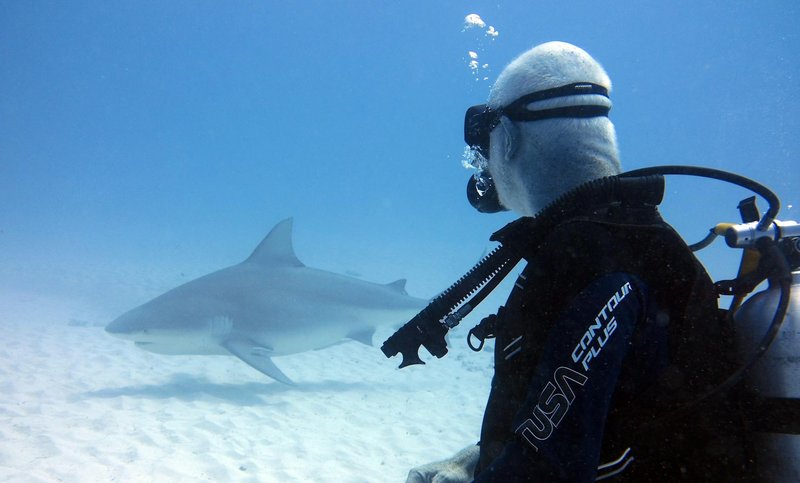
Carcharhinus leucas
Liberia’s Atlantic coast and river mouths put one more animal on the list, and it’s an unusual one. The bull shark tolerates fresh water, swimming up rivers far from the sea, which means the threat isn’t confined to the open ocean. It’s aggressive, it frequents the shallow, murky coastal water where people swim and fish, and it’s one of the few sharks regularly implicated in attacks on humans.
That said, shark attacks in Liberia are very rare, and the realistic risk to a careful visitor is low. The conditions that raise it are specific: swimming at dawn or dusk, swimming in murky water near a river mouth, or being in the water where fishing waste draws sharks in close.
Stay out of the water at low light, avoid swimming near active fishing or where rivers meet the sea, and don’t swim alone in murky surf. The coast is for most of the year a safe place to be.
How to Stay Safe in Liberia
The gap in every other Liberia wildlife list is the part that actually keeps you alive, so here it is. Almost none of these animals want anything to do with you. Nearly every attack traces back to surprise, to water, or to cornering an animal that just wanted to leave.
A few habits cover most of the risk:
- Hire a local guide for the forest. In Sapo and the interior, a guide reads buffalo, elephant, and snake sign you’ll walk straight past. This is the single biggest safety upgrade available.
- Respect the water. Assume rivers, wetlands, and lagoons hold crocodiles. Don’t wade, swim, or fish the same bankside spot at dusk, and keep children away from the waterline.
- Watch your feet, carry a light. Most snakebites come from a snake that was never seen. Wear boots on trails, scan leaf litter, and use a torch after dark.
- Never corner an animal or get between mother and young. Buffalo, elephant, leopard, and honey badger are dangerous mainly when trapped or defending offspring. Always leave them an exit.
- Know your snakebite plan before you need it. Antivenom isn’t available everywhere. Identify the nearest clinic that stocks it before you head into remote areas, keep the bitten limb still, and get there fast. For spat venom, flush the eyes immediately.
Treat the dangerous animals in Liberia as wildlife to read and respect rather than fear, and the country’s forests and coast open up. The buffalo and the crocodile demand real caution. The leopard and the shark you’ll likely never see. Go in informed, move with a guide, stay out of the wrong water, and the odds are firmly on your side.