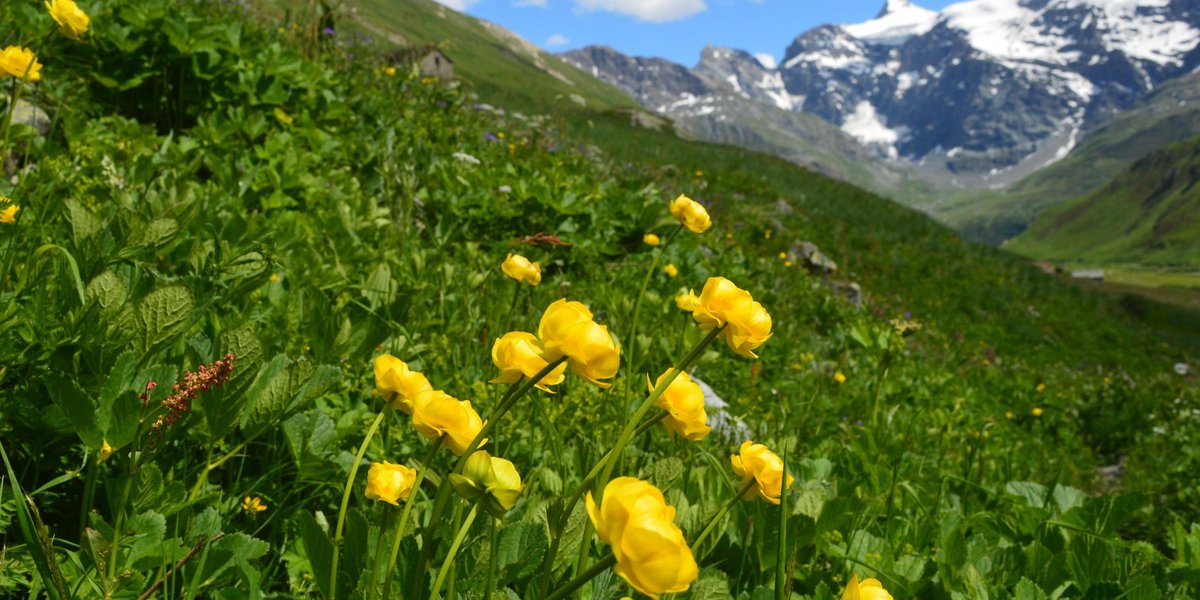
The grandalla is the plant most Andorrans will name first, and it sets the tone for everything else that grows here. It’s a wild narcissus — white petals, a small ringed center — and it appears on the national emblem, on hiking signage, on the labels of local honey. Narcissus poeticus is its botanical name, the poet’s narcissus, and it blooms across Andorra’s meadows roughly from late May into June, right at the seam where snowmelt meets spring.
What makes the plant a useful starting point isn’t the symbolism, though. It’s the geography. The grandalla flowers in the mid-altitude meadows, not in the valley floor and not on the high rock. Andorra is a country stacked vertically — barely 180 square miles, but ranging from around 840 meters at the Spanish border to nearly 3,000 at Coma Pedrosa, the highest peak. Plants here sort themselves by elevation more cleanly than almost anywhere else in the Pyrenees. Walk uphill for two hours and you pass through three distinct floras.
This guide is organized the way the mountains are: bottom to top.
Table of Contents
- How altitude shapes what grows
- The valley floor: oak, chestnut, and beech
- Mid-altitude conifer forests
- The alpine zone: gentians, edelweiss, and glacier buttercup
- The grandalla and the conservation question
- Quick-reference plant table
- What’s blooming when: a hiker’s calendar
How altitude shapes what grows
Andorra sits in the eastern Pyrenees, and its climate is split. The lower valleys catch a Mediterranean-leaning influence — warmer, drier summers. Climb a few hundred meters and that gives way to a cool, montane-Atlantic regime, then to genuinely alpine conditions near the peaks, where snow can linger into July and the growing season shrinks to a few frantic weeks.
Botanists usually carve this gradient into bands. For a hiker, three are enough to navigate by: the deciduous valley belt below roughly 1,600 meters, the conifer belt from there up to around 2,200–2,400 meters, and the alpine zone above the treeline. Each band has its signature species, and the transitions are visible — you’ll watch broadleaf trees thin out and pines take over, then watch the pines surrender to grass and bare rock.
The valley floor: oak, chestnut, and beech
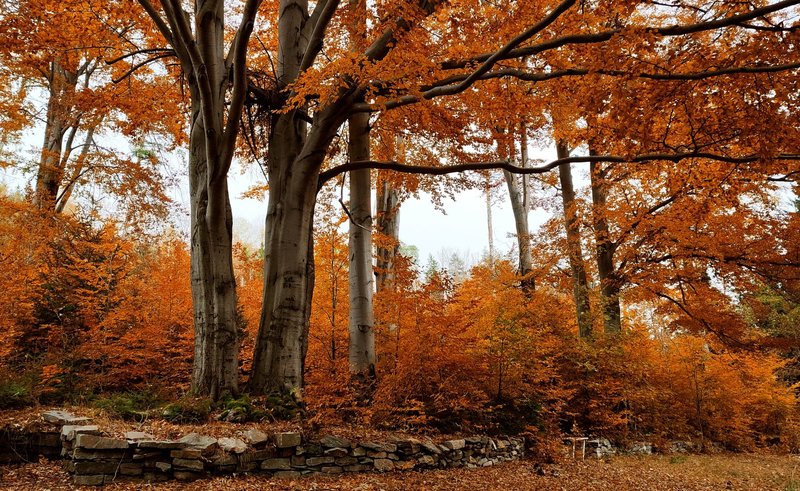
The lowest reaches of the Valira river valleys hold Andorra’s broadleaf forests, and they’re more varied than the alpine postcard suggests. Downy oak (Quercus pubescens) dominates the warmest, sunniest slopes — a scrubby, drought-tolerant oak that holds its dead leaves through winter. On cooler, north-facing ground you find European beech (Fagus sylvatica), the same smooth-barked, cathedral-canopy tree that carpets forests across temperate Europe. In autumn the beech stands turn copper, and the floor goes quiet under a deep litter of leaves that suppresses almost everything else.
Sweet chestnut (Castanea sativa) shows up too, often near old terraced ground — a reminder that these lower slopes were farmed and coppiced for centuries before tourism arrived. Its nuts are one of several edible crops that still grow on these slopes, alongside the other cultivated and wild fruits of Andorra that thrived on the old terraces. Hazel, ash, and silver birch fill in the gaps and the disturbed edges.
The understory is where the early color lives. Hellebores, primroses, and wild violets come up before the canopy closes in spring, grabbing light while the beeches are still bare. By midsummer the valley forest is shaded and green and relatively flowerless — the action has moved uphill.
Mid-altitude conifer forests
Cross roughly 1,500 meters and the conifers take over. This is the largest forest belt in Andorra by area, and two trees define it.
Scots pine (Pinus sylvestris) is the workhorse of the lower conifer zone — orange-barked in its upper trunk, tolerant of poor soil and exposure, the tree you’ll see colonizing slopes that were logged or burned. Higher up it cedes ground to mountain pine (Pinus uncinata), the hooked pine, which is the true subalpine specialist of the Pyrenees and pushes right up to the treeline. On shaded, humid slopes you’ll also find silver fir (Abies alba), tall and dark and straight, preferring the dampest pockets.
The conifer understory is a different palette from the valley. Bilberry (Vaccinium myrtillus) forms low mats that fruit in late summer — worth knowing if you’re hiking in August. Alpenrose, or rusty-leaved rhododendron (Rhododendron ferrugineum), grows in dense thickets near the upper edge of the forest and explodes into pink-red bloom in June and July. A slope of flowering alpenrose under mountain pine is one of the most reliably photogenic sights in the Andorran mid-mountains, and it’s a signal that you’re approaching the treeline.
The alpine zone: gentians, edelweiss, and glacier buttercup
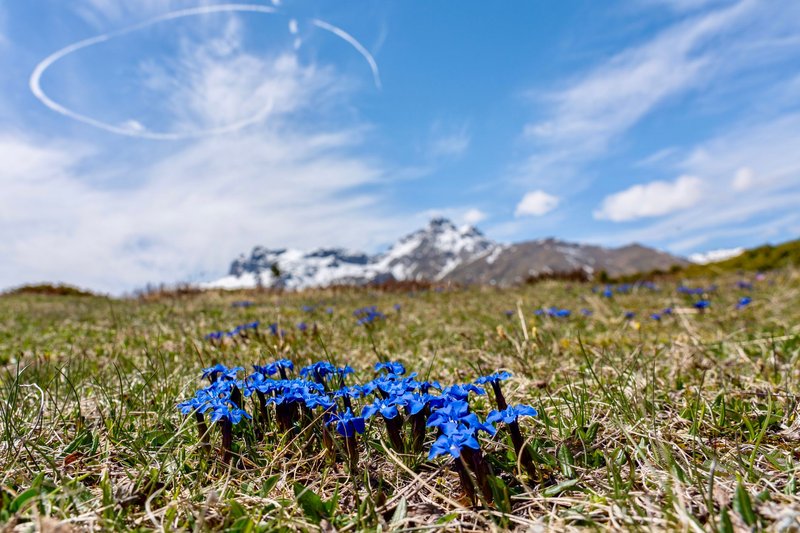
Above the trees, the plants get small, tough, and brilliantly colored — a survival strategy for a place with intense sun, hard frost, and a growing season measured in weeks.
The trumpet gentian (Gentiana acaulis) is the one people photograph: a stemless, deep-blue trumpet sitting almost flat against alpine turf, opening in early summer. It’s joined by spring gentian (Gentiana verna), smaller and an even more saturated blue. Edelweiss (Leontopodium alpinum) — the woolly white star of Alpine folklore — grows here too, though it’s less common and tends to favor limestone outcrops, so spotting one is a genuine find rather than a given.
Higher still, on the scree and the late-melting snow patches, comes the plant that defines the extreme edge of life in the Pyrenees: glacier buttercup (Ranunculus glacialis). It’s one of the highest-growing flowering plants in Europe, recorded above 4,000 meters in the Alps, and its white-to-pink flowers open within days of the snow retreating. In Andorra it clings to the highest ground around peaks like Coma Pedrosa.
Filling the spaces between are the alpine generalists — saxifrages wedged into rock cracks, mountain avens, alpine asters, and the cushion plants that hug the ground to escape the wind. The whole zone runs on speed: bloom fast, set seed faster, before the snow comes back.
The grandalla and the conservation question
Back to the national flower, because it’s where the story turns from catalog to something more current.
The grandalla (Narcissus poeticus) became Andorra’s official national flower and appears on the country’s coat of arms — a wild narcissus chosen, in part, because it grows naturally across the principality’s meadows rather than being imported or cultivated. It flowers in those mid-altitude grasslands in late spring, and for generations it was simply everywhere.
That’s changing. The plant’s bloom window is tied tightly to snowmelt and spring temperature, and the warming Pyrenees are scrambling that timing. Across the range, average temperatures have been climbing faster than the global mean, and species tied to specific elevation-and-season niches — exactly the grandalla’s situation — are the most exposed. As the climate warms, meadow species tend to get pushed upslope into a shrinking band of suitable habitat, and the alpine specialists above them have nowhere left to go. The pressure isn’t only from above, either: native meadow plants increasingly compete with invasive species recorded in Andorra that exploit the same warming, disturbed ground. The IUCN flags mountain and alpine flora among the ecosystems most vulnerable to this kind of upslope squeeze. For a country whose identity is literally stamped with a meadow flower, that’s not an abstract worry.
It also makes the practical question — when and where can you actually see these plants — more pointed. The window is real, and it’s moving.
Quick-reference plant table
| Species | Altitude zone | Bloom / interest season | Where to spot it |
|---|---|---|---|
| Grandalla (Narcissus poeticus) | Mid-altitude meadows | Late May–June | Open grasslands above the valleys |
| Downy oak (Quercus pubescens) | Lower valley | Foliage year-round; acorns autumn | Warm south-facing valley slopes |
| European beech (Fagus sylvatica) | Lower valley | Copper foliage in autumn | Cool, north-facing valley forest |
| Sweet chestnut (Castanea sativa) | Lower valley | Catkins June–July | Old terraced lower slopes |
| Scots pine (Pinus sylvestris) | Lower conifer belt | Year-round | Logged or exposed mid-slopes |
| Mountain pine (Pinus uncinata) | Upper conifer belt | Year-round | Up to the treeline |
| Alpenrose (Rhododendron ferrugineum) | Upper forest edge | June–July | Dense thickets near treeline |
| Bilberry (Vaccinium myrtillus) | Conifer belt | Fruit late summer | Forest floor mats |
| Trumpet gentian (Gentiana acaulis) | Alpine | Early summer | Alpine turf above treeline |
| Edelweiss (Leontopodium alpinum) | Alpine | Summer | Limestone outcrops, higher ground |
| Glacier buttercup (Ranunculus glacialis) | High alpine | Just after snowmelt | Scree near the highest peaks |
What’s blooming when: a hiker’s calendar
Andorra’s flowering season runs late and fast compared to the lowlands, and it climbs the mountain as the year warms. Use this as a rough planner — exact timing shifts a week or two each year with the snow.
April–early May. Action is still in the valleys. Look for hellebores, primroses, and violets on the forest floor before the beech canopy closes. The high country is still under snow.
Late May–June. The peak window for most visitors. The grandalla blooms across the mid-altitude meadows, and the best-known hiking season is opening up. Lower trails are clear and green; the alpenrose is starting near the treeline.
July. Alpenrose peaks in pink-red sheets along the upper forest edge. The treeline trails are the sweet spot. Gentians open in the alpine turf as the snow there finally retreats.
August. The alpine zone is at its fullest — gentians, asters, edelweiss on the right ground — and glacier buttercup flowers on the highest scree wherever snow has just cleared. Bilberries ripen in the conifer understory; bring a container. This is the month for the high routes.
September. Flowering fades, but the valley forests turn. Beech and chestnut go copper and gold, and the lower trails get their second visual act.
The simple rule: in spring, botanize low; in high summer, climb. The plants of Andorra don’t bloom all at once — they hand the season off, zone by zone, from the oak forests to the glacier buttercups, the same way the mountain itself rises.