TLDR
Burkina Faso holds more than 500 recorded bird species, from six vulture species teetering on the edge to a crane that struts around cattle like it owns them. Your best shots at seeing a real cross-section: W National Park, Arli National Park, Nazinga Game Ranch, and the Mare aux Hippopotames wetland, ideally between October and May when the dry season pulls birds toward remaining water.
Table of Contents
- Why Burkina Faso Punches Above Its Weight
- When and Where to Go
- 20 Birds of Burkina Faso
- The Vultures Worth Worrying About
- Getting the Most Out of a Trip
Why Burkina Faso Punches Above Its Weight
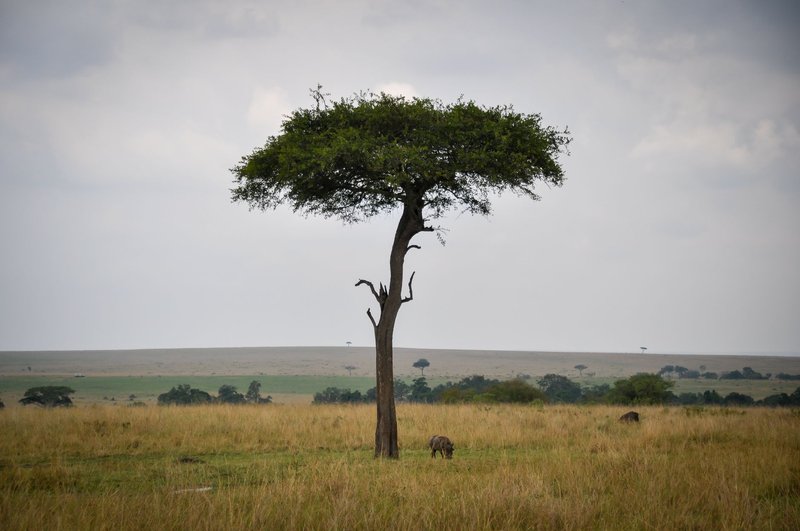
Burkina Faso sits squarely in the Sahel, a transition zone between Sahara scrubland to the north and the wetter Sudanian woodland to the south. That overlap is exactly why the country’s bird list runs past 500 species despite having none of the marquee rainforest or coastal habitat that draws birders to neighboring coastal West Africa. What it has instead is savanna raptors, wetland waders concentrated around a handful of permanent water sources, and a run of near-Sahelian specialists that get harder to find the farther south you go on the continent.
The African Bird Club puts the country’s total somewhere between 480 and 515 species, with ten officially recognized Important Bird Areas anchoring most of the diversity. Ten IBAs for a country roughly the size of Colorado is a dense concentration — it means the birding here isn’t spread thin across the whole map, it’s stacked into a short list of places worth actually driving to.
When and Where to Go
Timing matters more here than in most birding destinations because Burkina Faso’s water is seasonal, not permanent. During the dry months, birds funnel toward the rivers and pools that don’t evaporate, which makes them dramatically easier to find.
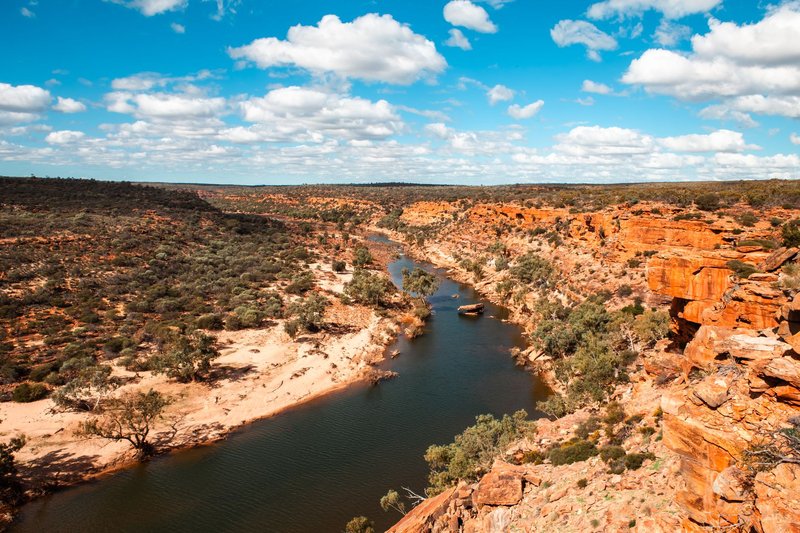
The two windows that consistently produce the best sightings are October through December and March through May — the shoulders of the dry season, when resident birds are concentrated but before the punishing heat of April sets in. November through March overlaps with the arrival of Palearctic migrants escaping the European winter, which is when you’ll pick up extra warblers, shrikes, and raptors passing through.
For actual sites, four names come up again and again:
- W National Park (shared with Niger and Benin) — the country’s flagship reserve and the most reliable spot for large raptors and hornbills.
- Arli National Park — smaller and less visited than W, with a reputation among local guides for dependable game-and-bird combo drives.
- Nazinga Game Ranch — a managed reserve near the Ghana border, known for its waterholes and comparatively easy road access.
- Mare aux Hippopotames — a wetland reserve near Bala that’s the single best bet for waterbirds and the country’s namesake hippos sharing the same pools.
20 Birds of Burkina Faso
This isn’t a taxonomic checklist — Wikipedia and Avibase already do that better than any blog post could. This is the set you’re actually likely to point binoculars at if you spend a few days in the parks above.
1. Abyssinian Ground Hornbill
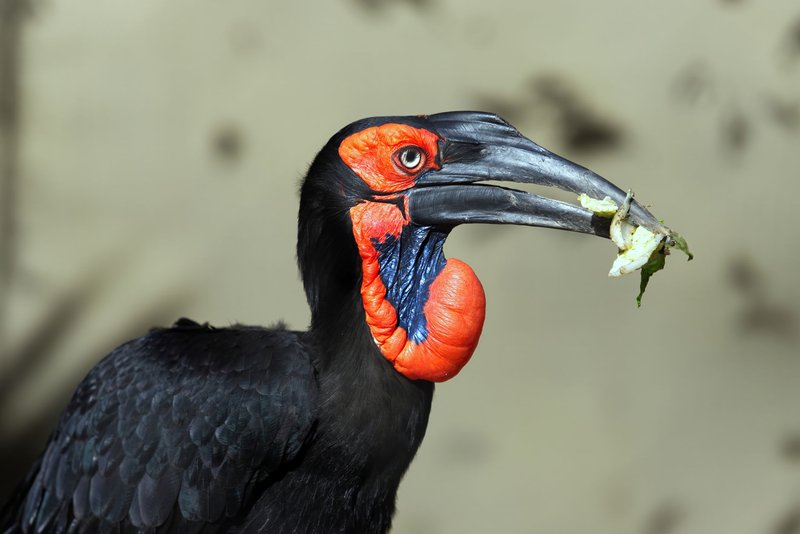
A turkey-sized bird that walks the savanna floor in small troops, hunting insects, snakes, and the occasional small mammal on foot rather than from a perch. Males have a bare red throat patch that inflates during territorial calls, which carry far enough at dawn that guides often hear them before seeing the bird.
2. Abdim’s Stork
Smaller and darker than the more famous Marabou, Abdim’s Stork arrives in Burkina Faso as a breeding migrant timed to the rains, following locust and grasshopper swarms across the Sahel. Local farmers in several West African countries traditionally welcome its arrival as a sign the rains have started.
3. Saddle-billed Stork
The tallest stork in Africa, with a bill split into red, black, and yellow bands and a bright yellow “saddle” shield at the base. Pairs hold large wetland territories and rarely tolerate other Saddle-billed Storks nearby, so seeing two together usually means you’ve found a breeding pair.
4. Marabou Stork
Ugly on purpose, functionally speaking — the bald head and neck are adaptations for a scavenger that spends time with its head inside carcasses. Marabous show up at Nazinga’s waterholes in loose groups, often alongside vultures working the same kill.
5. Black Crowned Crane
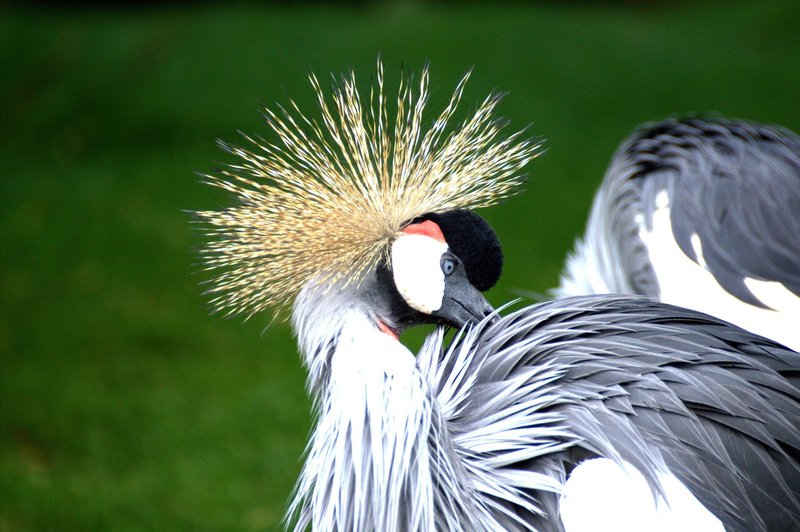
Burkina Faso’s most visually distinctive bird and a national symbol appearing on the country’s flag-adjacent emblem imagery. The stiff golden crest and red-and-white cheek patches make it unmistakable, and pairs often forage near cattle herds, picking up insects the livestock stir loose.
6. Denham’s Bustard
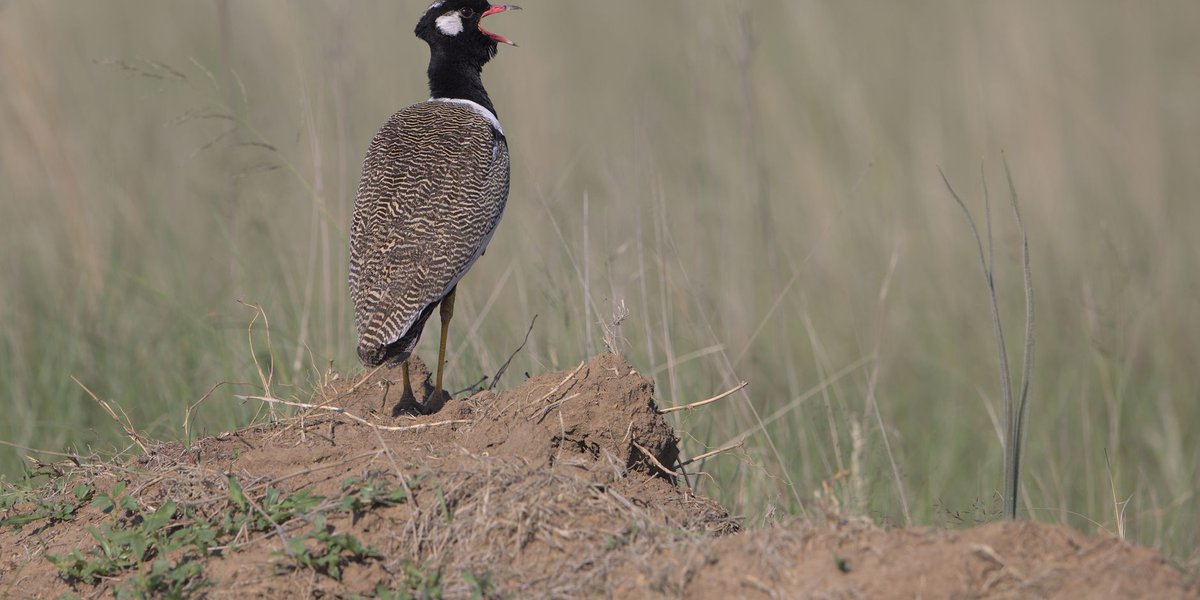
A large, ground-dwelling bird of open grassland that relies on camouflage over flight, freezing rather than bolting when approached. Males perform an inflated-neck display during breeding season that’s visible from several hundred meters across flat terrain.
7. Arabian Bustard
Slightly larger than Denham’s Bustard and found in the drier, more open parts of the country’s north. Both bustard species have declined across the Sahel as grazing pressure and hunting increase, making a confirmed sighting worth logging carefully.
8. Bateleur
A short-tailed eagle that’s easier to identify in flight than perched — the rocking, tilting wingbeat that gives the species its name (French for “tightrope walker”) is distinctive from a mile away. It patrols savanna at low altitude looking for carrion and small prey, and W National Park is one of the more reliable places to catch it soaring.
9. Bateleur’s cousin — the African Fish Eagle
Found wherever there’s permanent water, including the Mare aux Hippopotames. Its call — a high, ringing yelp — is often described as the sound of the African bush, and pairs will call in duet from riverside perches.
10. Egyptian Vulture
The smallest of the country’s vultures and one of the more range-restricted, with populations across Africa and Asia declining sharply enough that the IUCN lists it as Endangered. It’s also one of the few vulture species known to use tools, cracking ostrich eggs open with thrown stones.
11. White-backed Vulture
Once the most numerous vulture across sub-Saharan savanna, now Critically Endangered largely due to poisoning — both accidental, from pesticide-laced carcasses, and deliberate, from poachers targeting the birds that give away kill sites. Seeing a big kettle of them at a carcass in W National Park is a genuine wildlife spectacle that’s becoming rarer every year.
12. Rüppell’s Vulture
Holds the record for the highest confirmed flight altitude of any bird, having collided with an aircraft at over 37,000 feet. On the ground it’s a heavyweight scavenger with a scaly, pale-edged plumage pattern that separates it from White-backed Vulture at a glance once you know to look for it.
13. Hooded Vulture
Smaller, scrappier, and more comfortable around towns and roadsides than its larger relatives, often the first vulture species you’ll encounter simply because it tolerates human activity better. Its population crash across West Africa has been especially steep, driven by belief-based use in traditional medicine markets.
14. Violet Turaco
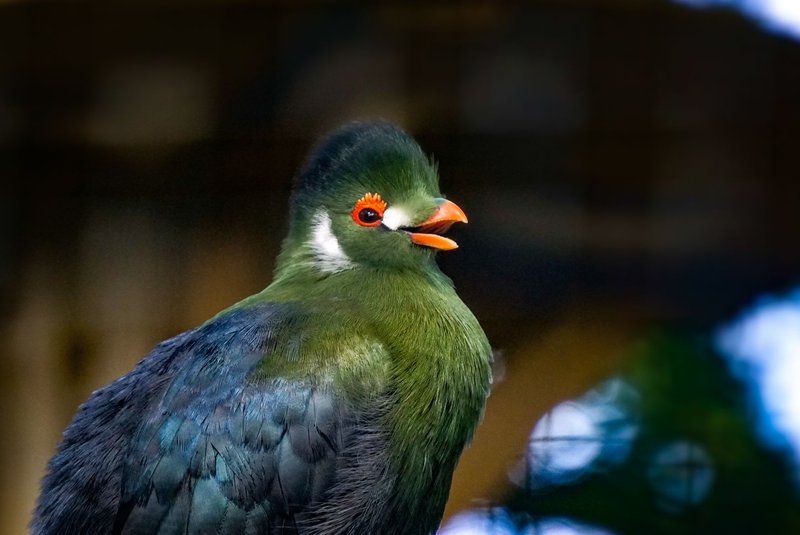
A large, iridescent purple-and-green fruit-eater found in gallery forest along the country’s rivers, including patches near Mare aux Hippopotames. Turacos get their vivid color from copper-based pigments unique to the family — not the light-refraction trick most iridescent birds use.
15. Senegal Parrot
A stocky, short-tailed parrot with an orange belly that travels in noisy flocks through open woodland, often heard well before it’s seen. It’s also one of the most heavily trapped West African parrots for the pet trade, which has pushed wild population estimates down in areas with easy road access.
16. Abyssinian Roller
Long, streaming tail feathers and a wash of turquoise and lilac make this one of the more photogenic perch-hunters in the region. It sits conspicuously on exposed branches or fence posts scanning for grasshoppers and lizards, which makes it an easy tick from a moving vehicle.
17. Red-billed Hornbill
Common and vocal across the drier woodland, identifiable by the slim red-and-black bill and a cackling call that carries through the bush at dawn. Hornbills in this genus have an unusual nesting habit — the female seals herself into a tree cavity with mud, leaving only a narrow slit for the male to pass food through until the chicks are nearly grown.
18. Pied Kingfisher
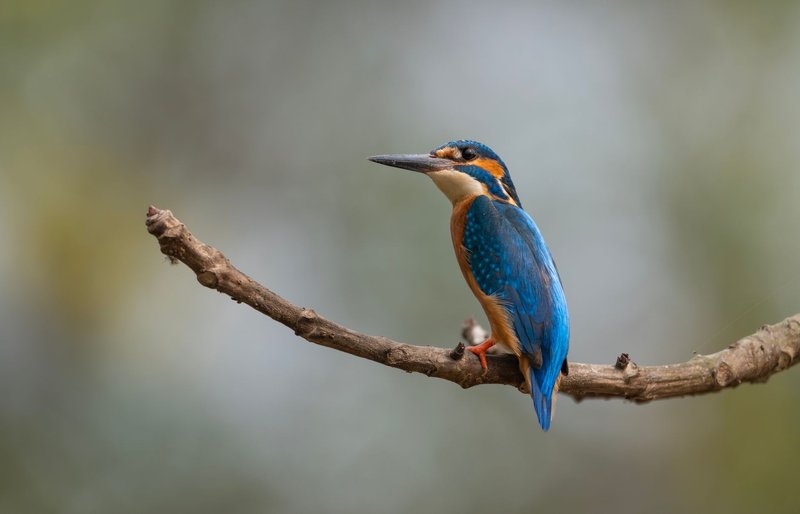
The most widespread kingfisher around the country’s water bodies, easily told apart by its black-and-white plumage and habit of hovering in place over water before diving — a hunting technique most kingfishers don’t use. Pairs at Mare aux Hippopotames sometimes hunt cooperatively, an unusual behavior for the family.
19. Village Weaver
Small, yellow-and-black, and impossible to miss once you spot a colony — dozens of woven grass nests hanging from a single tree, each built entirely by the male as part of his courtship display. Females inspect the construction quality before choosing a mate, so a messy nest gets abandoned.
20. Long-tailed Glossy Starling
A common, almost obnoxiously iridescent starling with a tail longer than its body, found around villages and lodges as readily as in the bush. The metallic green-and-purple sheen shifts dramatically depending on the angle of light, which makes it a deceptively hard bird to photograph well.
The Vultures Worth Worrying About
Burkina Faso’s vulture story deserves its own section because it’s not just a checklist item — it’s the clearest sign of how fast Sahel ecosystems are changing. The country hosts up to seven vulture species, and most are now on the IUCN Red List: Egyptian Vulture, White-backed Vulture, Rüppell’s Vulture, and Hooded Vulture among them.
The mechanism is almost always the same. Poisoned carcasses, whether set out to kill predators attacking livestock or deliberately laced by poachers trying to hide the location of an illegal kill, wipe out dozens of vultures in a single feeding event because the birds gather in numbers to strip a carcass fast. A functioning vulture population is also a public health asset — without them, carcasses linger longer and disease risk to livestock and people goes up. Regional conservation groups working with the IUCN have flagged West African vulture declines as one of the steepest of any raptor group on the continent.
Getting the Most Out of a Trip
A local guide is worth the cost here in a way it isn’t everywhere — much of Burkina Faso’s best birding land requires park permits and, in some areas, security clearance that’s easier to arrange through an established operator than independently. Arli and W National Park both run guided game drives that double as bird outings if you tell the guide upfront that’s your priority; without that heads-up, drives tend to optimize for large mammals and blow past raptors and waders.
Bring a scope if you have one. A surprising amount of Sahel birding happens across open, flat terrain where a bustard or crane is visible half a kilometer out but unidentifiable without magnification. And plan around water: in the dry season, parking near any of the country’s few permanent pools for an hour at dawn will usually out-produce driving around looking for birds — the birds are already coming to you.