Africa’s rainforests are alive with insect activity at every level of the canopy and forest floor, from pollinators visiting flowers to predators patrolling leaves. Walking a trail here means spotting a wide range of forms and behaviors that keep these ecosystems functioning.
There are 12 african rainforest insects, ranging from African flower chafer to Weaver ant. For each, you’ll find below the data organized as Scientific name,Range,Size (mm), and you’ll find below the compact details to help with identification and comparison.
How can I tell an African flower chafer apart from other beetles in the rainforest?
Look for a stout, often glossy beetle that visits flowers during the day; chafer species typically have clubbed antennae and a rounded body, and size and color patterns compared in the Scientific name,Range,Size (mm) fields will help distinguish similar species.
Are Weaver ants dangerous to people or useful in the forest?
Weaver ants can be aggressive if disturbed and deliver painful bites or sprays, but they play a major role as predators and biological control agents in the canopy, so they’re more ecologically beneficial than broadly harmful to people when left undisturbed.
African Rainforest Insects
| Common name | Scientific name | Range | Size (mm) |
|---|---|---|---|
| African giant swallowtail | Papilio antimachus | DR Congo, Cameroon, Gabon; Congo Basin | 80 |
| Goliath beetle | Goliathus goliatus | West and Central Africa; Congo Basin, Ghana, Nigeria | 60 |
| Giant flower beetle | Mecynorrhina torquata | West and Central Africa; Cameroon, Gabon, Ivory Coast | 80 |
| African leaf butterfly | Kallimoides rumia | West and Central Africa; Ghana to DR Congo rainforests | 35 |
| Forest charaxes | Charaxes etheocles | West and Central African rainforests; Congo Basin, Sierra Leone | 30 |
| Mocker swallowtail | Papilio dardanus | West and Central Africa; forest edges and lowland rainforests | 35 |
| Driver ant | Dorylus wilverthi | Central and West African rainforests; Congo Basin, Cameroon | 10 |
| Weaver ant | Oecophylla longinoda | West and Central African lowland rainforests; Ghana to Cameroon | 7 |
| Forest emperor moth | Imbrasia epimethea | West and Central African rainforests; Nigeria to Congo Basin | 40 |
| Large striped swallowtail | Graphium antheus | West and Central African rainforests; Congo Basin to Sierra Leone | 30 |
| Common Euphaedra | Euphaedra medon | West and Central African rainforests; Ghana to DR Congo | 28 |
| African flower chafer | Eudicella smithi | Central and West African rainforests; Cameroon, DR Congo | 30 |
Images and Descriptions
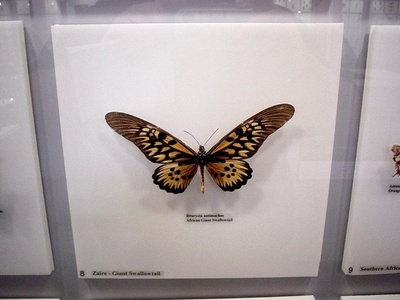
African giant swallowtail
Massive, broad-winged swallowtail usually seen high in the forest canopy of the Congo Basin. Flies slowly at dusk and rarely descends. One of the world’s largest butterflies, notable for enormous wings and secretive canopy habits.
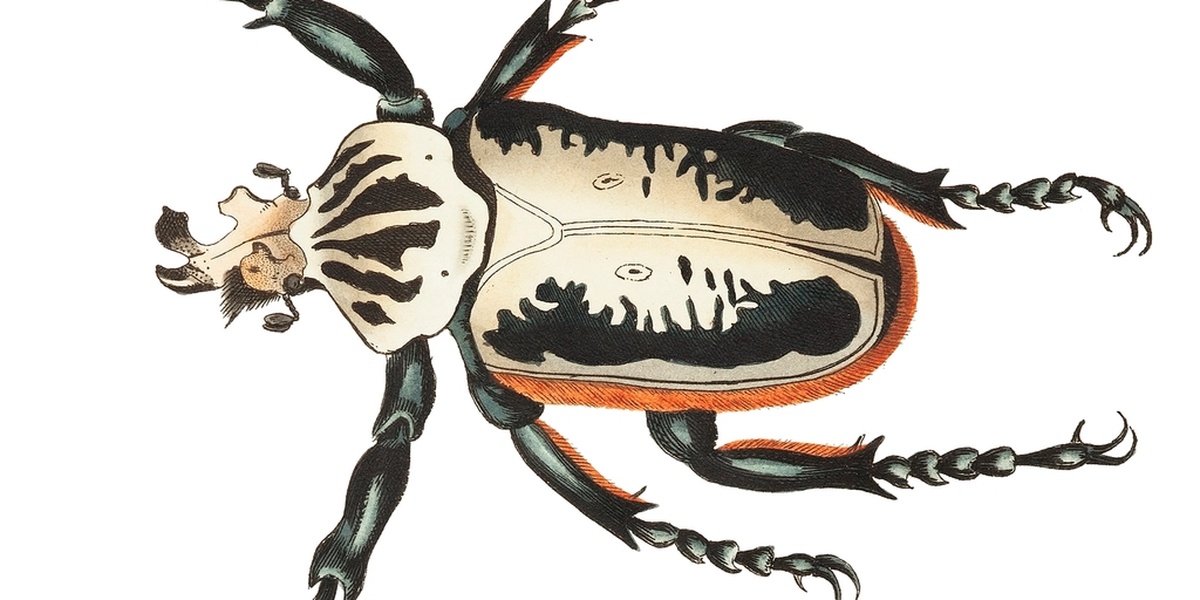
Goliath beetle
Bulky black-and-white adult beetle found on forest floors feeding on sap and fruit. Males have a short horn; larvae develop in decaying wood. Impressive for strength and size, often encountered in canopy gaps and forest-edge clearings.

Giant flower beetle
Shiny green-and-white flower chafer often visiting rainforest blossoms and sap flows. Males bear a Y-shaped horn used in contests; larvae develop in rotting logs. Active in canopy and clearings, attracted to ripe fruit and tree sap.
African leaf butterfly
Brown, leaf-mimicking butterfly that vanishes when wings are closed, showing precise vein-like markings. Common in shaded understory and forest edges, it feeds on fermenting fruit and relies on remarkable camouflage to avoid predators.
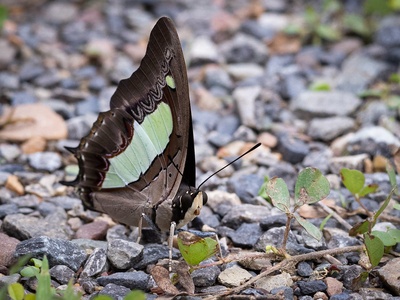
Forest charaxes
Powerful, fast-flying butterfly with strong tails and widely variable, often dark patterns. Inhabits canopy and sunlit gaps, frequently visits fruit baits and fallen fruit. Many localized forms make it a familiar sight in intact lowland forest.
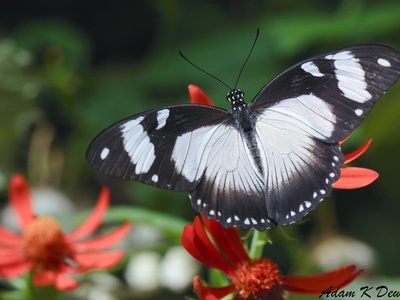
Mocker swallowtail
Famous polymorphic swallowtail where females mimic numerous distasteful species. Males are more uniform and tailless; females show diverse wing patterns. Found in forest clearings and edges, commonly attracted to sap, rotting fruit and flowers.
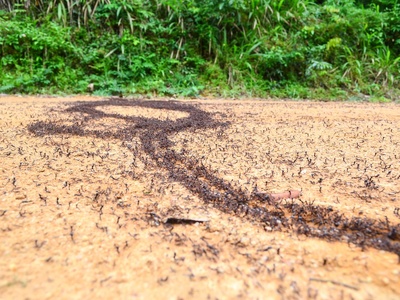
Driver ant
Large army-ant species forming massive, nomadic raiding columns that sweep the forest floor hunting invertebrates. Workers show strong size-polymorphism; colonies mount huge swarms and a single massive queen lives hidden in leaf litter or shallow nests.
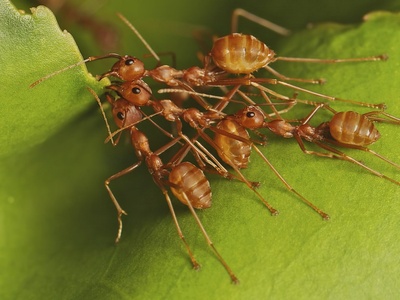
Weaver ant
Tree-dwelling social ant famous for weaving leaf nests using larval silk. Aggressive territorial defenders, they hunt insects across the canopy and build extensive colonies that bind trees together, often visible as bustling green zones in the canopy.
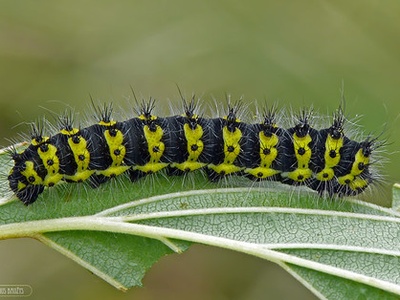
Forest emperor moth
Large saturniid moth with broad muted-brown or purplish wings, often attracted to lights and tree trunks at night. Caterpillars feed on many rainforest trees; adults do not feed and rely on stored energy to find mates and reproduce.
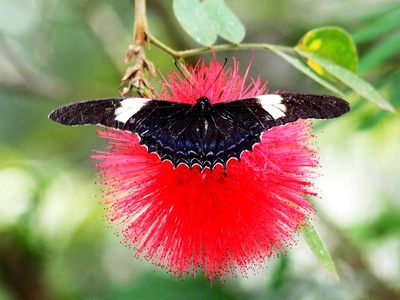
Large striped swallowtail
Graceful green-and-black striped swallowtail that frequents shaded forest trails and canopy gaps. Often seen feeding at sap runs and fallen fruit, it’s quick, territorial and a common indicator of healthy lowland rainforest.
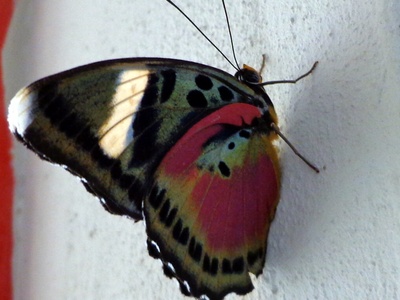
Common Euphaedra
Brightly colored, fruit-feeding butterfly favoring shaded understory and fallen fruit. Slow-flying and often found in groups around fermenting fruit and tree sap, it displays striking green, blue or orange markings depending on locality and subspecies.
African flower chafer
Metallic green-yellow flower chafer often seen on blossoms and ripe fruit in the rainforest understory and canopy. Males bear a small horn used in contests; larvae develop in decaying wood. Attracted to flowers, sap and overripe fruit.