Table of Contents
- The Basic Setup: Who Eats What
- Primary Consumers: The Plant-Eaters
- Secondary Consumers: The Middle Tier
- Tertiary Consumers and Apex Predators
- Two Real Amazon Food Chains
- Keystone Consumers: Pull One Out, Watch It Unravel
- Why the Consumer Chain Is Under Threat
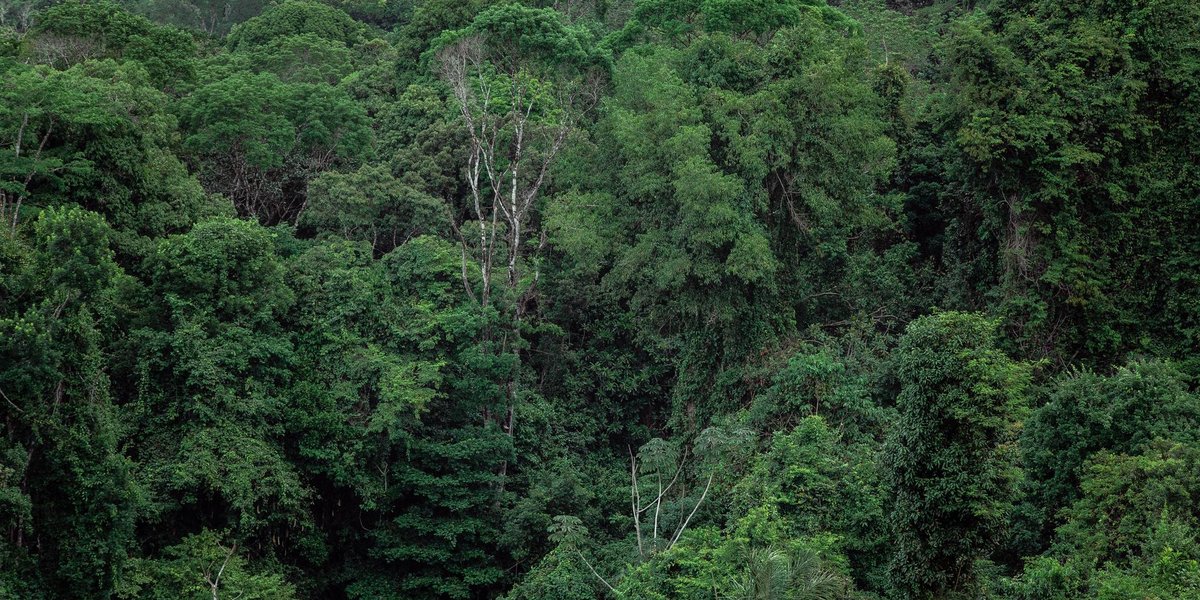
The Amazon isn’t just the world’s largest tropical rainforest — it’s one of the most complex feeding systems on the planet. Around 10% of all species on Earth live here, which means the food web isn’t a neat pyramid; it’s closer to a web you could spend a career trying to map. But the logic underneath it is the same as any ecosystem: energy flows from the sun to the plants, and from the plants through every animal that eats them, and the animals that eat those animals, and so on.
Here’s who those animals are, what they actually eat, and why losing any one of them matters more than most people realize.
The Basic Setup: Who Eats What
Ecologists divide consumers into trophic levels — essentially, how many steps away from the sun your calories are. Producers (plants, algae) sit at the bottom. Then:
| Trophic Level | Consumer Type | Energy Retained |
|---|---|---|
| Level 2 | Primary consumers (herbivores) | ~10% of producer energy |
| Level 3 | Secondary consumers (carnivores/omnivores) | ~10% of primary level |
| Level 4 | Tertiary consumers (apex predators) | ~10% of secondary level |
That 10% rule — the ecological efficiency principle — explains why apex predators are rare. You need a massive base of plants to support a single jaguar.
Primary Consumers: The Plant-Eaters
Primary consumers eat producers directly: leaves, seeds, fruit, nectar, bark. The Amazon has an enormous variety of them, and they represent just a slice of the diverse primary consumers found across the world’s rainforests.
Capybara (Hydrochoerus hydrochaeris) — the world’s largest rodent, weighing up to 65 kg, and a semi-aquatic grazer that works the riverbanks eating grasses, aquatic plants, and bark. Capybaras are extraordinarily social and move in groups, making them one of the most visible herbivores along Amazon tributaries.
Leafcutter ants — probably the Amazon’s most ecologically significant primary consumers. A single colony can strip a tree bare overnight, hauling leaf fragments back to underground chambers where the real work happens: they cultivate a fungus on the leaves, then eat the fungus. They’re not eating the plant directly, but they are consuming producers. According to Smithsonian Tropical Research Institute data, leafcutter ants are responsible for consuming roughly 15% of all leaf production in Neotropical forests.
Hoatzin (Opisthocomus hoazin) — a bird that digests leaves through fermentation, the same way cows do. It smells terrible because of it. The hoatzin’s gut microbiome breaks down cellulose that most animals can’t process, letting it exploit a food source other birds largely ignore.
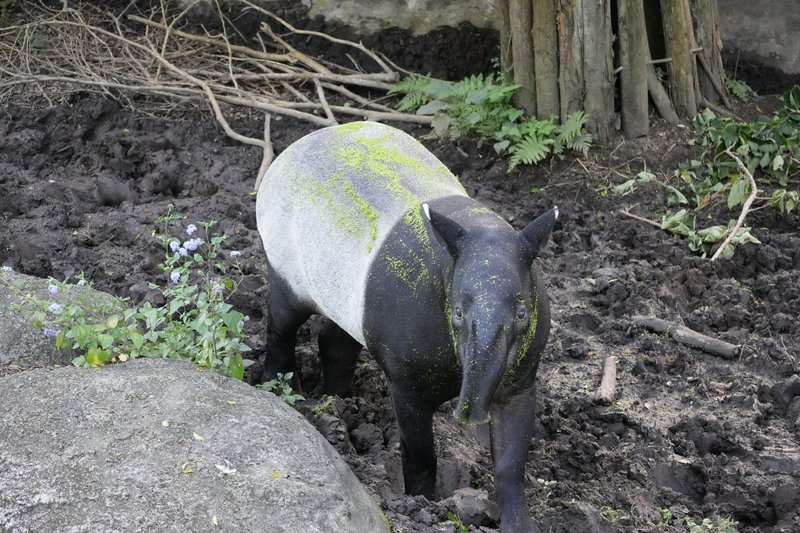
Tapir (Tapirus terrestris) — a 250 kg browser that wanders solitary trails through the understory eating fruits, seeds, and aquatic vegetation. Tapirs are critical seed dispersers: they eat large seeds that pass through their gut intact and get deposited in a pile of fertilizer somewhere else.
Three-toed sloth — eats mostly leaves, moving slowly enough that algae grows on its fur (a feature, not a bug — it provides camouflage). Sloths descend to the ground only once a week to defecate, which reduces their time exposed to predators.
Macaws and parrots — large-fruited trees depend heavily on macaws as seed dispersers. The hyacinth macaw, the largest flying parrot on Earth, specializes almost entirely on the nuts of two palm species: Attalea phalerata and Orbignya phalerata.
Secondary Consumers: The Middle Tier
Secondary consumers eat primary consumers. In the Amazon, this tier is where things get interesting — because many species here are opportunists that shift their diet seasonally.
Giant anteater (Myrmecophaga tridactyla) — eats leafcutter ants, termites, and other insects. A giant anteater can consume 35,000 insects per day, flicking its tongue up to 150 times per minute. It never stays at a single nest long enough to destroy the colony — it moves on when the stinging gets intense, lets the colony recover, and comes back.
Amazon river dolphin (boto) — pink, and able to rotate its head 90 degrees. The boto eats fish and small crustaceans, making it a secondary consumer in the aquatic portion of the Amazon food web. Its flexible neck lets it forage around submerged roots and vegetation during flood season when prey disperses into the flooded forest.
Poison dart frogs — tiny, vivid, and toxic. Most species eat mites, ants, and small insects. Their toxicity comes from their prey: captive-raised dart frogs that eat crickets instead of wild invertebrates lose their toxicity within months.
Ocelot (Leopardus pardalis) — a mid-sized spotted cat weighing 8–15 kg that hunts small mammals, birds, reptiles, and fish. Ocelots are nocturnal and solitary, with territories of up to 30 km² depending on prey density. They are among the many rainforest secondary consumers that occupy the critical middle tier of the food web.
Harpy eagle (Harpia harpyia) — while technically an apex predator (see below), juvenile harpy eagles eat smaller prey like lizards and medium birds before they’re large enough to take monkeys and sloths.
Tertiary Consumers and Apex Predators
These animals sit at the top of the Amazon’s food web. They have no natural predators in the ecosystem (apart from humans and, occasionally, other apex predators).
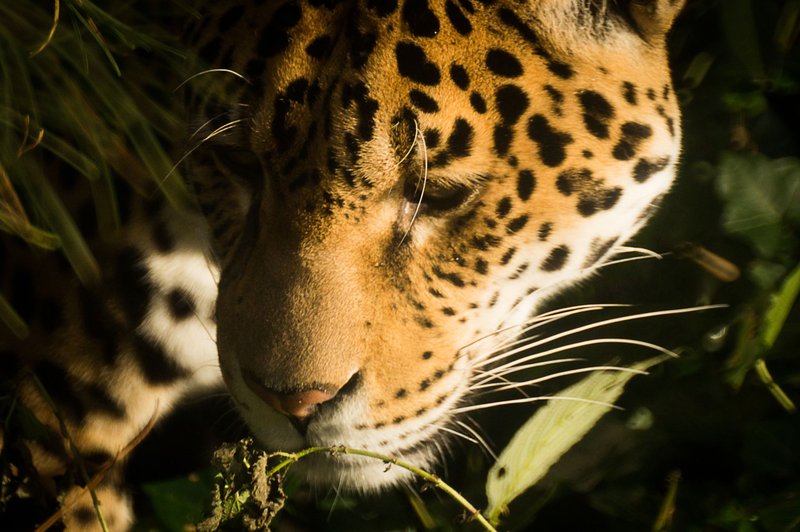
Jaguar (Panthera onca) — the Amazon’s largest cat and its primary apex terrestrial predator. Jaguars hunt capybara, peccaries, deer, caimans, turtles, and fish. Unlike most cats, jaguars don’t avoid water — they actively hunt caimans and fish at river’s edge. Their bite force is exceptional relative to body size; they kill by piercing the skull directly rather than suffocating prey through a throat bite.
Harpy eagle (adult) — hunts monkeys and sloths as its primary prey, using extraordinary grip strength (talons that exert up to 530 newtons of force) to pluck them from the canopy. A harpy eagle’s home range can cover hundreds of square kilometers, and a breeding pair needs a large intact forest patch to support themselves and a chick.
Black caiman (Melanosuchus niger) — the largest predator in the Amazon aquatic system, reaching 5–6 meters in length. Black caimans eat fish, turtles, capybaras, deer, and occasionally anacondas. They were hunted nearly to extinction in the 20th century for their skin; their comeback has been significant but fragile.
Green anaconda (Eunectes murinus) — the heaviest snake on Earth, capable of reaching 250 kg. Anacondas ambush prey in or near water, constricting capybaras, deer, caimans, and birds. They are sit-and-wait predators, sometimes not eating for weeks between large kills.
Two Real Amazon Food Chains
Abstract trophic levels are easier to understand when you can trace a specific path. Here are two complete chains through the Amazon:
Chain 1: Forest floor Rainforest leaves → Leafcutter ants (fungus garden → ant) → Giant anteater → Jaguar
Chain 2: Riverside Aquatic plants and fish larvae → Small fish (e.g., piranha prey species) → Piranha → Black caiman → (no predator — apex)
Each link in these chains is transferring only about 10% of the available energy forward. It takes roughly 1,000 kg of plant matter to support 100 kg of leafcutter ants, which supports 10 kg of anteater, which supports 1 kg of jaguar. That pyramid is why jaguars need enormous territories.
Keystone Consumers: Pull One Out, Watch It Unravel
A keystone species has a disproportionate effect on its ecosystem relative to its abundance. Removing one sends ripple effects through the food web — what ecologists call a trophic cascade.
Jaguars as keystone predators. When jaguar populations decline, caiman and capybara populations increase unchecked. More capybaras means more grazing pressure on riparian vegetation, which destabilizes riverbanks and reduces habitat for fish. Research published in the journal Oryx found that areas with functioning jaguar populations had measurably different prey community structures than areas where jaguars had been removed.
Tapirs as keystone seed dispersers. Tapirs eat large-seeded fruits that smaller animals can’t swallow. When tapir populations collapse in a forest patch, the large-seeded tree species those fruits belong to stop recruiting — their seeds don’t travel. Over decades, the forest composition shifts toward small-seeded, wind-dispersed species. The tapir’s absence rewrites what kind of forest grows there.
Leafcutter ants as ecosystem engineers. Their tunnels aerate soil, their waste heaps alter soil chemistry, and their harvesting shapes which plant species dominate in their territory. Remove them and you don’t just lose a link in the food chain — you lose infrastructure.
Why the Consumer Chain Is Under Threat
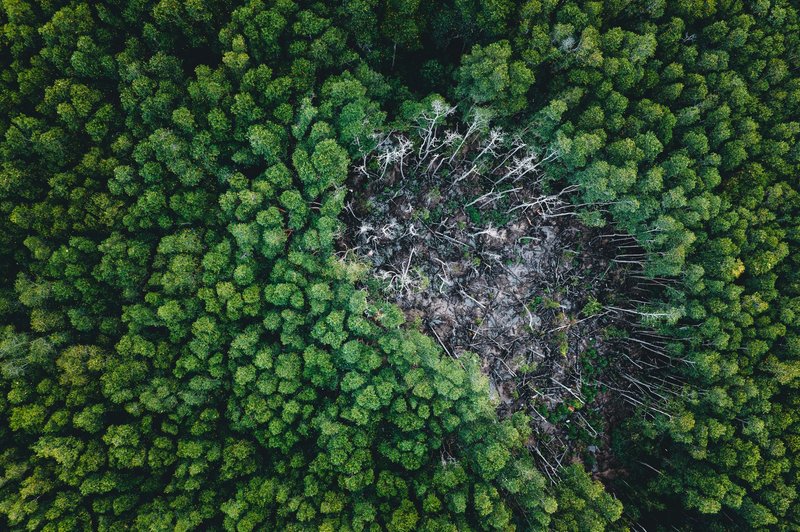
Deforestation is the most direct threat. The Amazon has lost roughly 17% of its original cover, according to Brazil’s National Institute for Space Research (INPE), and fragmented forest can’t support large consumers. A jaguar needs a continuous territory. A harpy eagle needs an old-growth tree large enough to support a nest. Fragments don’t provide either.
Overhunting targets the same species that anchor the food web. Black caimans, harpy eagles, giant river otters, and jaguars are all hunted or killed as threats to livestock — removing apex predators releases pressure on mid-level consumers and the cascade moves down the chain.
Freshwater pollution and mercury contamination (from illegal gold mining) accumulate up the food chain — biomagnification means apex predators like river dolphins and giant otters accumulate the highest concentrations of contaminants, impairing reproduction and immunity.
The Amazon’s consumer chain isn’t fragile in the way a single species going extinct is fragile. It’s resilient in pockets, with redundancy built in across millions of years. But push it hard enough — through habitat loss, hunting, and pollution simultaneously — and what breaks isn’t one link. It’s the logic of the whole thing.
Summary
The Amazon’s consumers span four trophic levels, from leafcutter ants stripping foliage to jaguars killing caimans at the water’s edge. What makes this ecosystem distinctive isn’t just the number of species — it’s how tightly they’re coupled. Capybaras control riparian vegetation; tapirs disperse tree species; anteaters regulate ant colonies that reshape the forest floor. Each consumer is doing multiple jobs, and several of them are doing jobs that hold the whole system together. That’s what makes deforestation and hunting so damaging here specifically — you’re not just losing an animal, you’re pulling out a structural piece.