
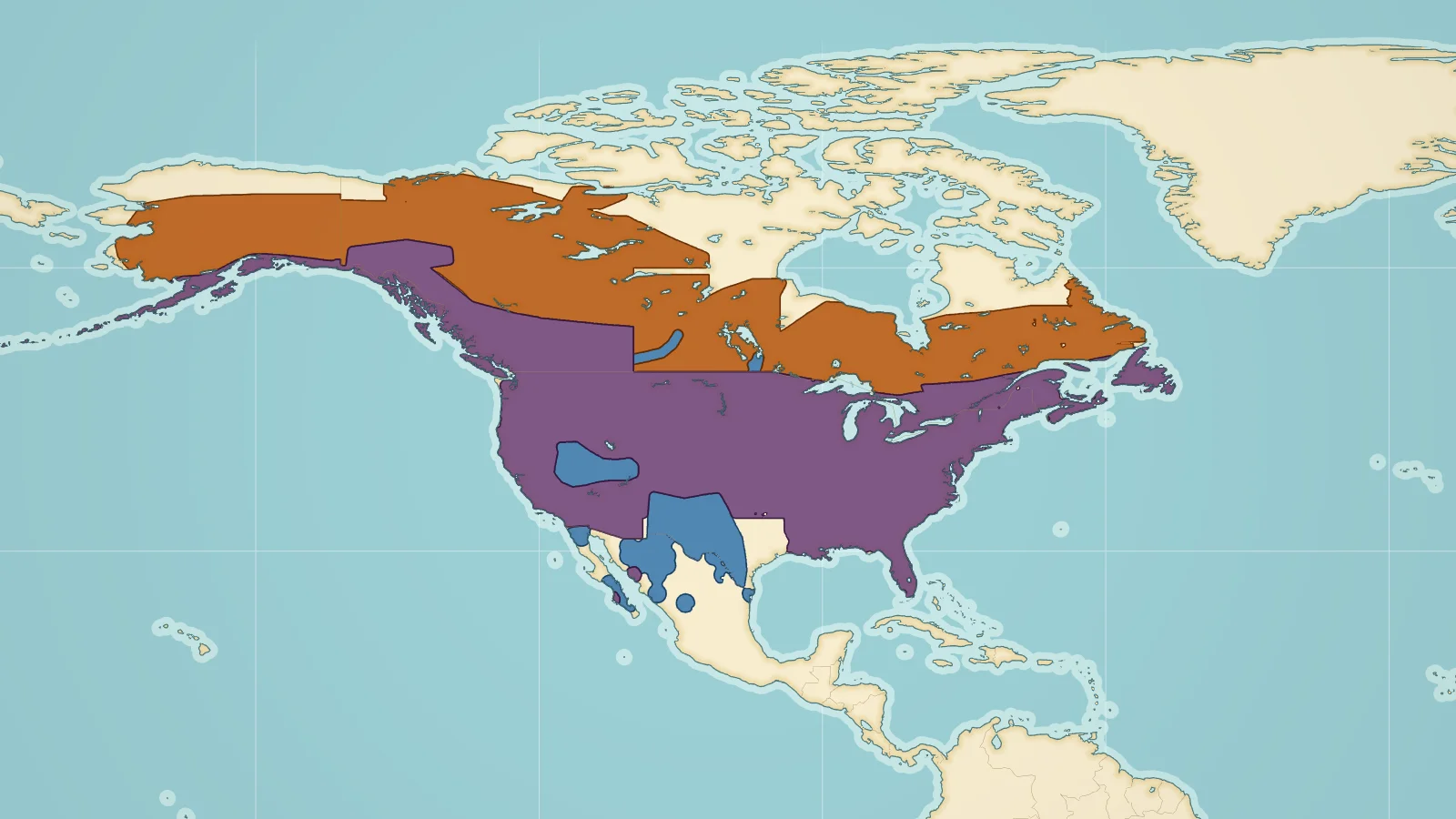

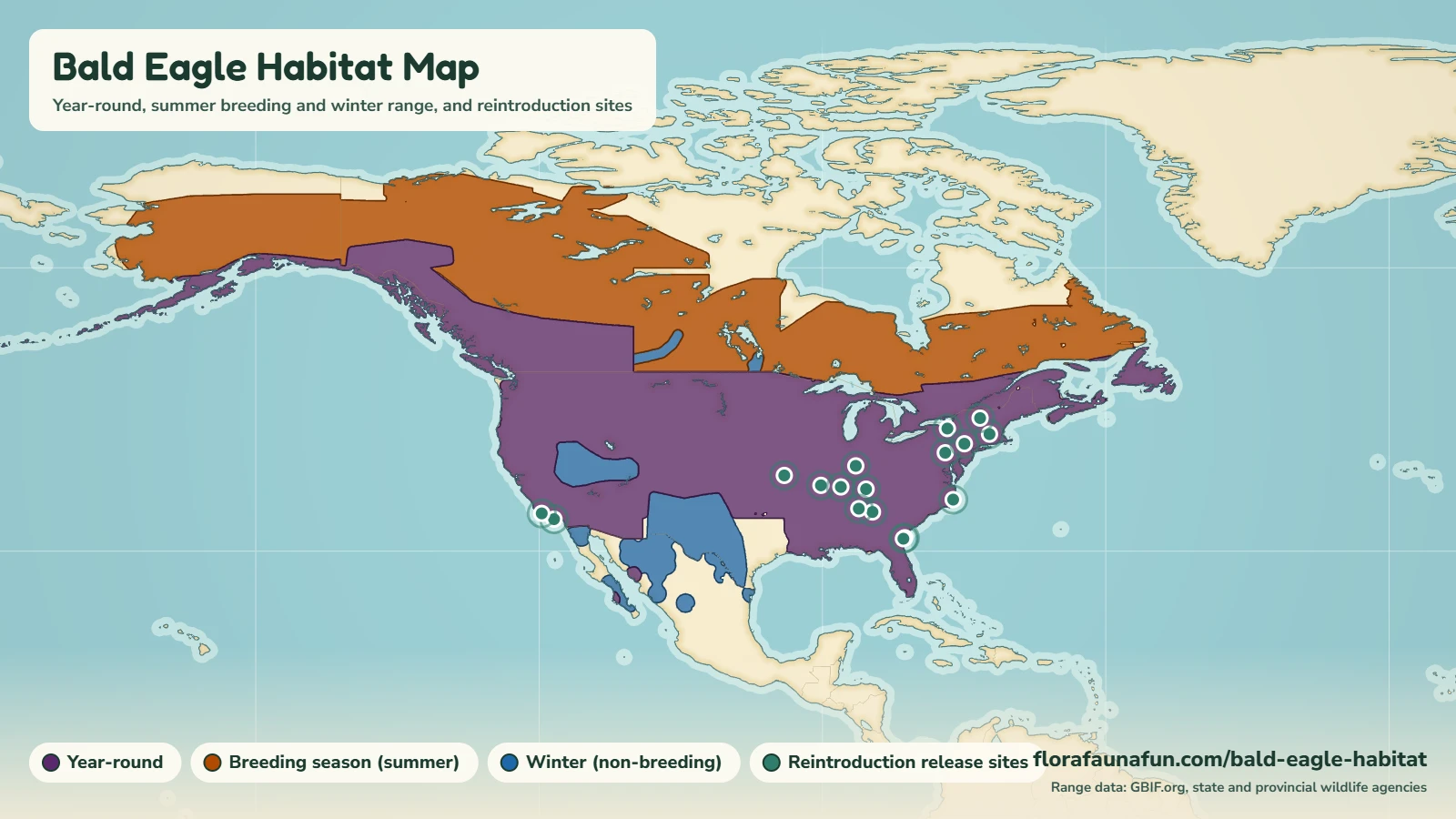
Bald eagle habitat is open water with tall trees nearby: coasts, large lakes, reservoirs and rivers across North America. The map above shows where bald eagles live in each season. Purple marks places where eagles stay all year, orange marks the summer breeding range that eagles leave in winter, and blue marks places they visit only in winter. Teal pins mark the sites where young eagles were released between 1976 and 2006 to bring back lost breeding populations. Type a state, province or country into the lookup to see whether bald eagles live there and when.
The ranges on this bald eagle habitat map are generalised from GBIF occurrence records split by month (May to July for summer, December to February for winter) and from wildlife agency range statements. More maps of where animals live are on the animal habitat maps page, including the red fox habitat map and the gray wolf habitat map.
Bald eagle habitat facts at a glance
| Fact | Bald eagle (Haliaeetus leucocephalus) |
|---|---|
| Range | Alaska, every Canadian province and territory, every US state except Hawaii, and northern Mexico |
| Habitat | Seacoasts, estuaries, large lakes, reservoirs, rivers and marshes with plenty of fish |
| Nest site | A tall tree near water with a clear view; on dry ground nests sit 16 to 38 m up |
| Distance to water | Most nests are within 200 m of open water |
| Nest size | Usually 1.5 to 2 m across; the record nest was 2.9 m wide and 6 m deep |
| Diet | Mostly fish, plus waterfowl, small mammals and carrion |
| Population | About 316,700 eagles and 71,467 occupied nests in the lower 48 states (2018 to 2019 surveys); about 58,000 adults on the Pacific coast from southern British Columbia to the Alaska Peninsula |
| Conservation status | Least Concern (IUCN), increasing. Removed from the US endangered species list in 2007. Listed as endangered in Mexico |
Where do bald eagles live?
Bald eagles live only in North America. They nest from the Aleutian Islands and the Mackenzie Delta south to Florida, the Gulf Coast and two states in northwest Mexico. Most eagles stay near the same water all year. Those that nest where lakes and rivers freeze move south or to the coast in winter, and they gather wherever water stays open. That gives the map its three colours, and it means a bald eagle's location changes with the season in the far north but hardly at all in the south.
Alaska and the Pacific Northwest
An estimated 58,000 adult bald eagles live on the Pacific coast between southern British Columbia and the Alaska Peninsula, a coast of fjords, islands and salmon rivers. In Alaska, eagles live all year on the coast from the southeast panhandle to the Aleutians. Interior Alaska has 525 to 725 nesting pairs, and the eagles that nest north of the Alaska Range leave for the winter, so the interior is orange on the map.
In Washington, bald eagles nest mainly along marine shorelines and the major rivers of the west and northeast, including Puget Sound and the San Juan Islands. Few nest in the dry Columbia Basin, but wintering eagles can be common there. Oregon's eagles nest along the coast and its large rivers and lakes.
Canada
Bald eagles live in every Canadian province and territory. Most of them live on the British Columbia coast, and large populations nest in the forests of Alberta, Saskatchewan, Manitoba and Ontario. Between one and two thousand eagles spend the winter around Squamish, British Columbia, where they feed on spawned-out salmon.
The northern forests are summer range. Eagles nest in Saskatchewan, Manitoba, the Northwest Territories and the northern parts of Alberta, Ontario, Quebec and Labrador, then leave when the water freezes. In Nunavut, nesting is known only on the mainland near Kugluktuk. In Quebec eagles nest south of the 55th parallel, and a growing number stay through the winter near ice-free water. In the Annapolis Valley of Nova Scotia, more than 500 eagles have been counted at Sheffield Mills in January, where poultry farmers have put out dead chickens since the 1970s. The French islands of Saint Pierre and Miquelon, off Newfoundland, have eagle records in every month of the year.
The Great Lakes and the North
The lake country of Minnesota, Wisconsin and Michigan has some of the highest nest densities in North America. Wisconsin found 1,590 occupied nests in 2017, in 69 of its 72 counties, and Vilas and Oneida counties in the northern lake district had the most. Some northern nesters move south when the lakes freeze, while others stay near open rivers, so the region shows as year-round.
In winter, eagles from Canada and the northern states move to the Mississippi and Illinois rivers. More than 3,000 bald eagles spend the winter in Illinois, which the Illinois Department of Natural Resources calls the largest wintering population in the continental United States.
The East Coast, Chesapeake Bay and Florida
Bald eagles live all year along the Atlantic coast, from Maine to Florida. The Chesapeake Bay is one of the best places to see them. Virginia's part of the bay had only 20 pairs in 1970 and a record 1,070 pairs in 2016. New York, Pennsylvania, Massachusetts, North Carolina and Georgia all rebuilt their populations with released eagles, and several of those release sites are pinned on the map.
Florida's eagles nest in the cool season. Nest building starts in October, eggs appear by December or early January, and the season ends around May or June.
The West and the Southwest
Bald eagles nest in every western state, mostly along rivers, reservoirs and mountain lakes. In the dry Southwest, nesting is thin and winter visitors outnumber residents. Texas eagles nest mainly in the eastern half of the state and on the coast from Rockport to Houston, with 160 active nests in 2005, while the Panhandle and central Texas see them mainly in winter. Nevada had about 10 nesting pairs in 2019, mostly in the Lake Tahoe Basin, and far more eagles in winter. Utah and New Mexico have a few nesting pairs and many more winter visitors, so all four states have blue winter-only areas on the map.
Off the California coast, the last known Channel Islands nest before the recovery was on Anacapa in 1949. Released eagles have since brought them back. Hawaii is the only US state with no bald eagles, and the Hawaiian bird checklist has no record of the species.
Mexico
Bald eagles nest in Mexico only in Baja California Sur and Sonora. A study of Magdalena Bay in Baja California Sur from 1983 to 1993 found no more than three nesting pairs, the remnant of a population that once nested on both coasts of the peninsula. In Sonora, a few pairs nest along the lower Rio Yaqui. Elsewhere in northern Mexico, eagles are rare winter visitors, recorded in Baja California, Chihuahua, Coahuila, Durango, Sinaloa and Tamaulipas. Mexico lists the bald eagle as endangered.
Rare visitors outside North America
Bald eagles sometimes stray far from home. The island of Ireland has two accepted records: a bird shot in County Fermanagh, Northern Ireland, in 1973 and an exhausted young eagle caught in County Kerry in 1987. A few eagles wintered at Kurilskoye Lake in Kamchatka, Russia, between 2014 and 2016. Japan, South Korea, Greenland, Iceland, Bermuda, the Bahamas, Cuba and Puerto Rico also have rare records. The lookup marks these places as rare visitors, not as part of the range.
Bald eagle habitat types
The bald eagle's natural habitat is almost any large body of open water with plenty of fish: seacoasts, rivers, large lakes and marshes. The water supplies food, and the trees along the shore supply nest sites and perches.
Coasts and estuaries
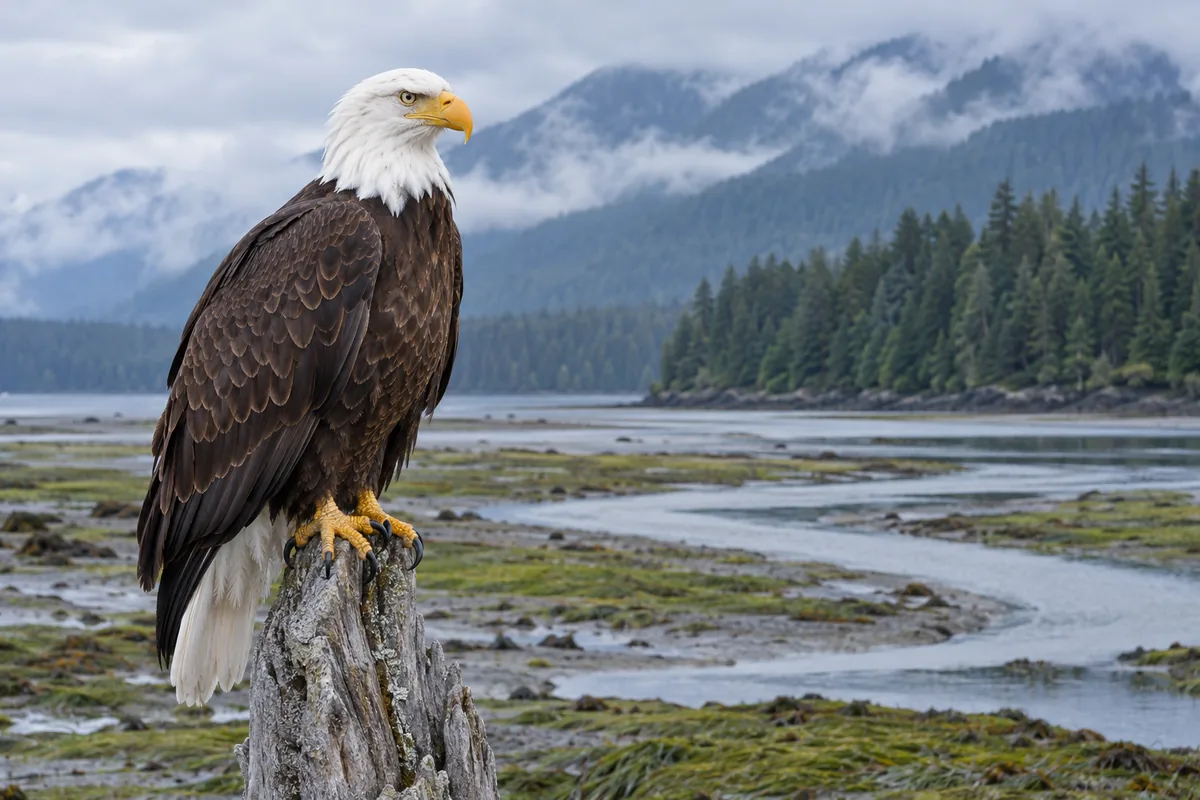
Seacoasts give eagles salmon, herring and other fish, as well as seabirds and carrion washed up on the shore. The Pacific coast from British Columbia to Alaska, the Chesapeake Bay and the Florida coast are the core of the bald eagle's range. Estuaries, where rivers meet the sea, are especially rich because fish gather there to spawn.
Lakes and reservoirs
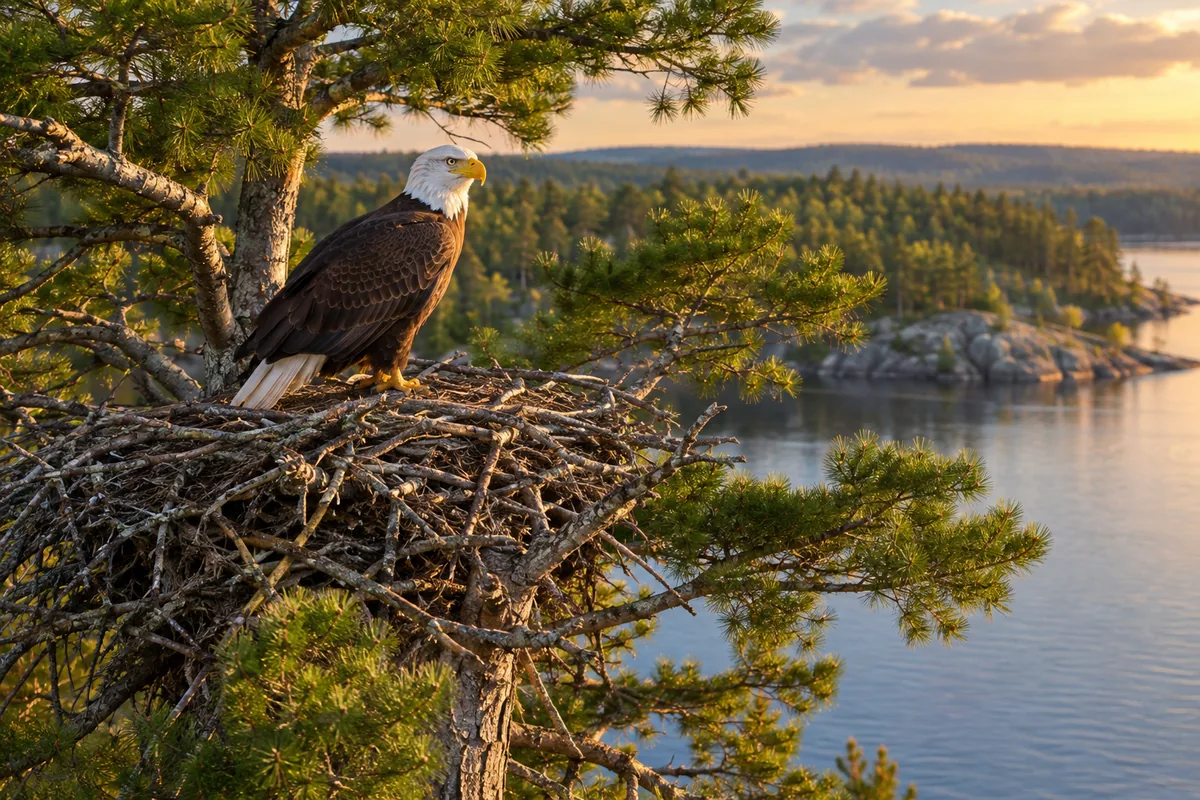
Large lakes support eagles across Canada and the northern states, and Wisconsin's northern lake district has one of the highest nest densities in North America. Reservoirs have added habitat where natural lakes are scarce. Many of the release sites on the map are reservoirs, including Quabbin Reservoir in Massachusetts, Monroe Lake in Indiana, Dale Hollow Lake on the Tennessee and Kentucky border and Lake Guntersville in Alabama.
Rivers
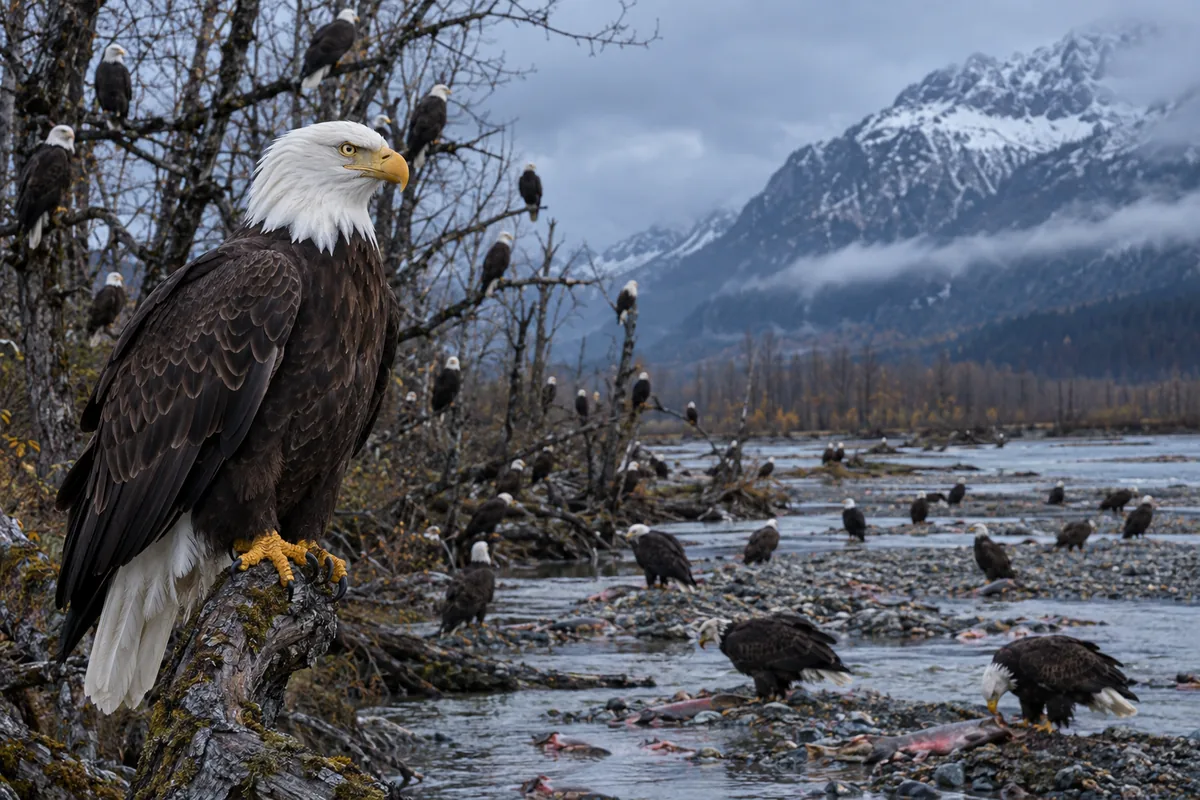
Rivers give eagles fish all year, and in the north they follow the salmon runs. When the salmon spawn and die, eagles gather on the gravel bars to feed, as they do at Squamish in British Columbia. Large rivers such as the Mississippi, the Susquehanna and the Yellowstone carry nesting pairs along much of their length.
Forests for nesting
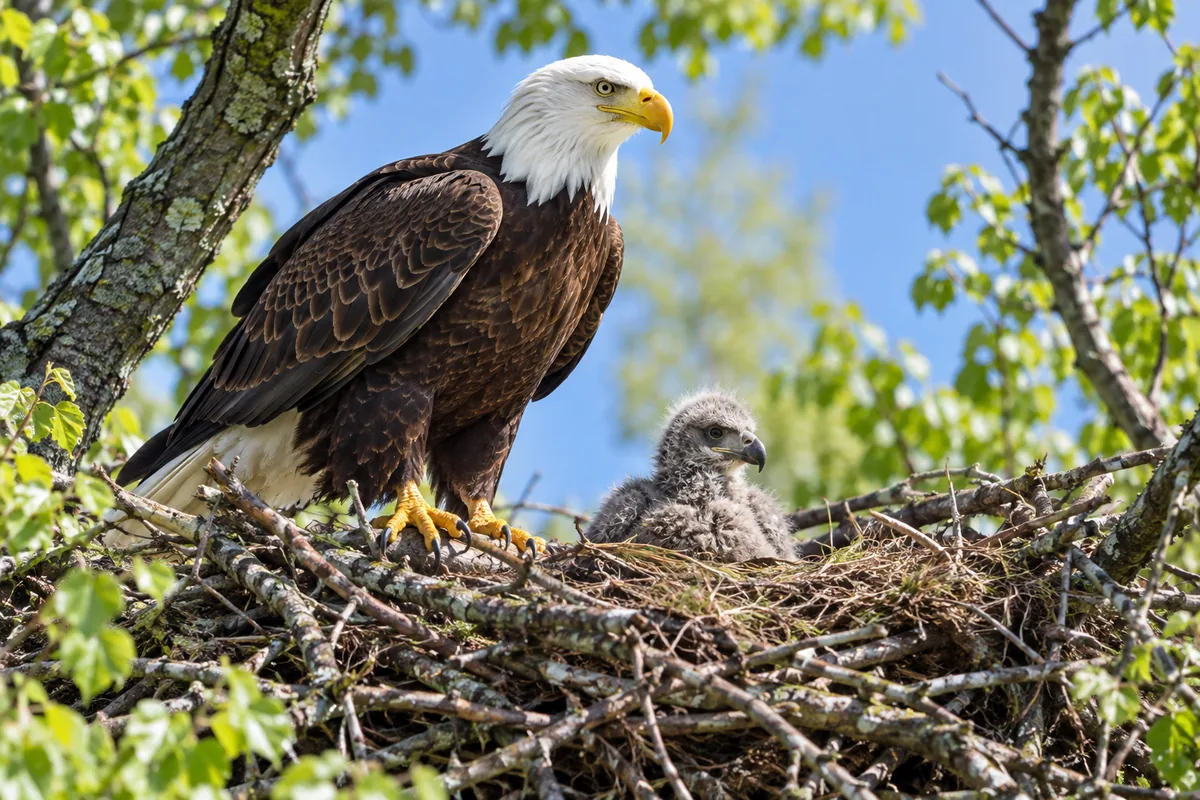
Bald eagles need trees as much as water. They build their nests in tall, sturdy trees, often pines or cottonwoods, that stand above the canopy and give a clear view of the water. Old trees with thick branches near the top can hold a nest that grows heavier every year.
Winter roosts and open water below dams
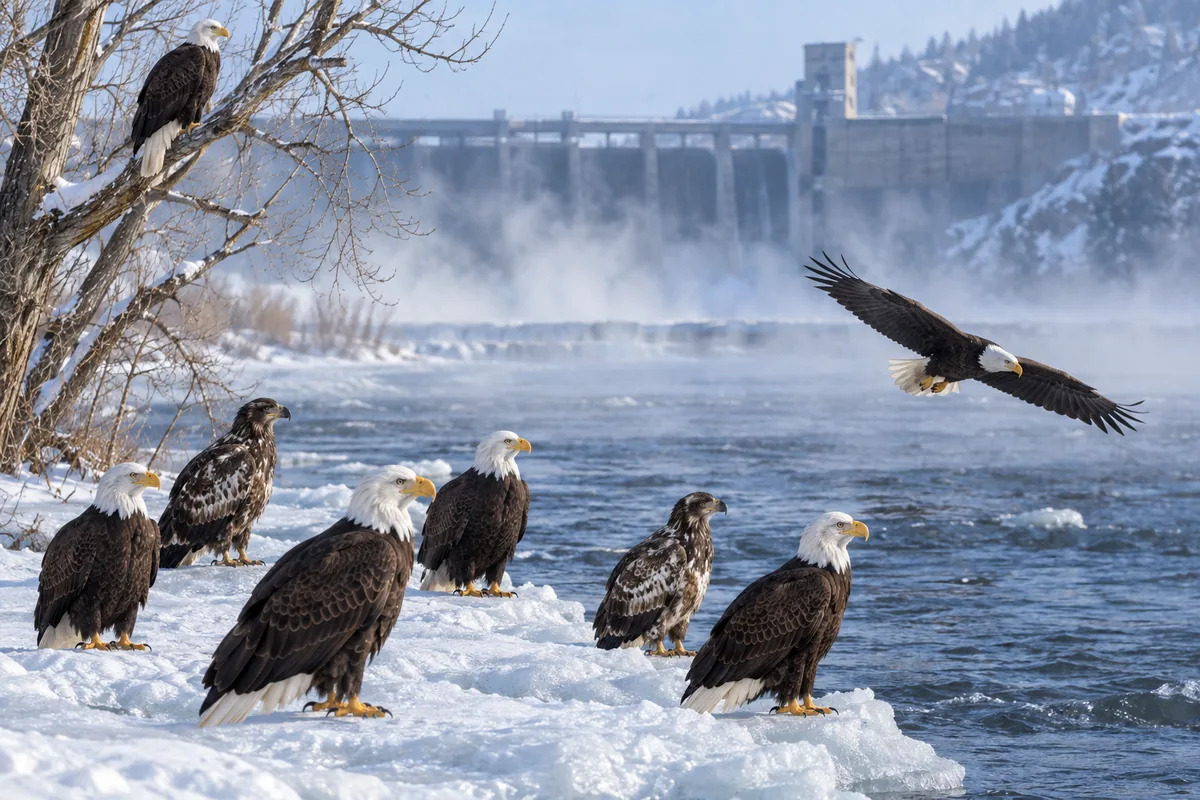
In winter, eagles need open water more than anything else. The fast water below dams and locks rarely freezes, and fish that pass through the dams come out stunned and easy to catch, so eagles gather below dams on the Mississippi and Illinois rivers. At night, they share communal roosts in sheltered groups of trees out of the wind, sometimes several kilometers from where they feed.
What makes good bald eagle habitat
Good bald eagle habitat has four things:
- Food: fish such as salmon, herring, catfish and carp make up most of the diet. Eagles also take ducks and other waterfowl, small mammals and carrion, and they often steal fish from ospreys.
- Tall trees: nests sit in the tallest trees near water. On dry ground, nests are usually 16 to 38 m above the ground.
- Open water: most nests are within 200 m of open water. In winter, eagles leave any area where the water freezes over.
- Low disturbance: eagles may abandon nests when people work or build too close. In the United States, the Bald and Golden Eagle Protection Act protects nests, nest trees and the habitat around them.
A pair uses the same nest year after year and adds sticks every season. A typical nest is 1.5 to 2 m across. The largest bird nest on record belonged to bald eagles near St. Petersburg, Florida: it was 2.9 m wide, 6 m deep and estimated at more than two tonnes when it was examined in 1963. The female usually lays two eggs, and the parents incubate them for about 34 to 36 days. Young eagles are brown and get their white head and tail at 4 to 5 years of age. Wild bald eagles can live about 30 years. The oldest known wild eagle was at least 38 years old: it was banded in Minnesota in 1977 and died in New York in 2015.
How bald eagles came back
Bald eagles were once common across North America, but shooting, habitat loss and poisoning cut their numbers. Congress gave them federal protection in 1940. The worst damage came after World War II from the pesticide DDT. Eagles absorbed it from the fish they ate, and it made their eggshells so thin that they broke during incubation. By 1963 only 417 nesting pairs were known in the lower 48 states.
The bald eagle was listed as endangered south of the 40th parallel in 1967. The Environmental Protection Agency cancelled DDT for most uses in 1972, and in 1978 the eagle was listed as endangered in 43 of the lower 48 states and threatened in Michigan, Minnesota, Wisconsin, Oregon and Washington.
Banning DDT stopped the decline, but many states had no eagles left to recover. Wildlife agencies used a method called hacking: they took eaglets from healthy populations in Alaska, Canada and the Great Lakes, raised them in towers over good habitat and released them when they could fly. Many of them came back to nest in the region as adults. The first hacking tower was built at Montezuma National Wildlife Refuge in New York in 1976, and New York released 198 young eagles over its program. The teal pins on the map mark these release sites. Pennsylvania released 88 eagles from Saskatchewan at Haldeman Island and Shohola Lake between 1983 and 1989. Indiana released 73 eaglets at Monroe Lake from 1985 to 1989. On Santa Catalina Island in California, the released eagles laid eggs too thin to hatch because DDE, a breakdown product of DDT, was still in the local food chain. Santa Cruz Island in the Channel Islands received about 60 young eagles between 2002 and 2006, and Vermont's program at Dead Creek ended the same year.
The eagle was reclassified from endangered to threatened in 1995. With about 9,789 breeding pairs counted, it was removed from the federal list of endangered and threatened species on August 8, 2007. In its 2020 update, published in March 2021, the US Fish and Wildlife Service estimated 316,700 bald eagles and 71,467 occupied nests in the lower 48 states from surveys in 2018 and 2019. In December 2024, a new law made the bald eagle the official national bird of the United States.
Frequently asked questions
Where do bald eagles live?
Bald eagles live across North America, from Alaska and northern Canada to Florida and northwest Mexico. They live near coasts, large lakes, reservoirs and rivers, and they nest in every US state except Hawaii and in every Canadian province and territory.
What is a bald eagle's natural habitat?
A bald eagle's natural habitat is open water with plenty of fish and tall trees nearby for nesting and perching. Seacoasts, estuaries, large lakes, reservoirs, rivers and marshes all qualify. Most nests are within 200 m of open water.
Do bald eagles live in all 50 states?
Bald eagles live in 49 states. Hawaii is the only state with no bald eagles, and the Hawaiian bird checklist has no record of the species.
Where do bald eagles live in winter?
In winter, bald eagles gather wherever water stays open: coasts, large rivers and the water below dams. More than 3,000 winter in Illinois along the Mississippi and Illinois rivers, and the coasts of British Columbia and Alaska hold large numbers all year.
Do bald eagles migrate?
Some do. Eagles that nest in interior Alaska, northern Canada and other places where the water freezes move south or to the coast for the winter. Eagles on the coasts and in the southern states usually stay near their nests all year.
Where do most bald eagles live?
The Pacific coast between southern British Columbia and the Alaska Peninsula has an estimated 58,000 adults, and most of Canada's eagles live on the British Columbia coast. The lower 48 states had about 316,700 eagles in 2018 and 2019, with large nesting populations around the Great Lakes, the Chesapeake Bay and Florida.
Do bald eagles live in Mexico?
Yes, but only a few. A small number nest in Baja California Sur and Sonora, and rare winter visitors reach other northern states such as Chihuahua and Tamaulipas. Mexico lists the bald eagle as endangered.
Do bald eagles live in Canada?
Yes. Bald eagles live in every province and territory, and most Canadian eagles live on the British Columbia coast. In Saskatchewan, Manitoba, the Northwest Territories and Nunavut, they are mainly summer visitors that nest and then leave when the water freezes.
Have bald eagles been seen in Europe or Asia?
Only as rare strays. Ireland has two records, from 1973 and 1987, and a few eagles wintered in Kamchatka, Russia, between 2014 and 2016. Japan, South Korea, Greenland and Iceland also have rare records.
Where do bald eagles build their nests?
Bald eagles build their nests in tall trees near water, usually 16 to 38 m above the ground, with a clear view over a lake, river or coast. A typical nest is 1.5 to 2 m across, and the record nest in Florida was 2.9 m wide and 6 m deep.
How did bald eagles come back after DDT?
Only 417 nesting pairs were known in the lower 48 states in 1963. The 1972 DDT ban, legal protection and the release of young eagles at hacking sites from 1976 brought the species back, and it was removed from the endangered species list in 2007.
How many bald eagles are there?
The US Fish and Wildlife Service estimated 316,700 bald eagles, with 71,467 occupied nests, in the lower 48 states from surveys in 2018 and 2019. Tens of thousands more live in Alaska and Canada. The IUCN lists the species as Least Concern with an increasing population.