10 Characteristics of a Scallop
Some scallops have nearly 200 tiny eyes lining their mantle, an unexpected sight for a bivalve and a hint at how specialized these animals are. That quirky fact matters because scallops play clear ecological roles, support coastal fisheries, and have inspired engineers studying simple optical systems.
This piece groups ten specific traits into three categories—Anatomy & Physiology, Behavior & Ecology, and Human Uses & Conservation—so you can quickly see what makes these shellfish both fascinating and valuable. Expect concrete examples (bay vs sea scallops, hotate sashimi, NOAA-managed fisheries) and a few numbers along the way.
Anatomy & Physiology
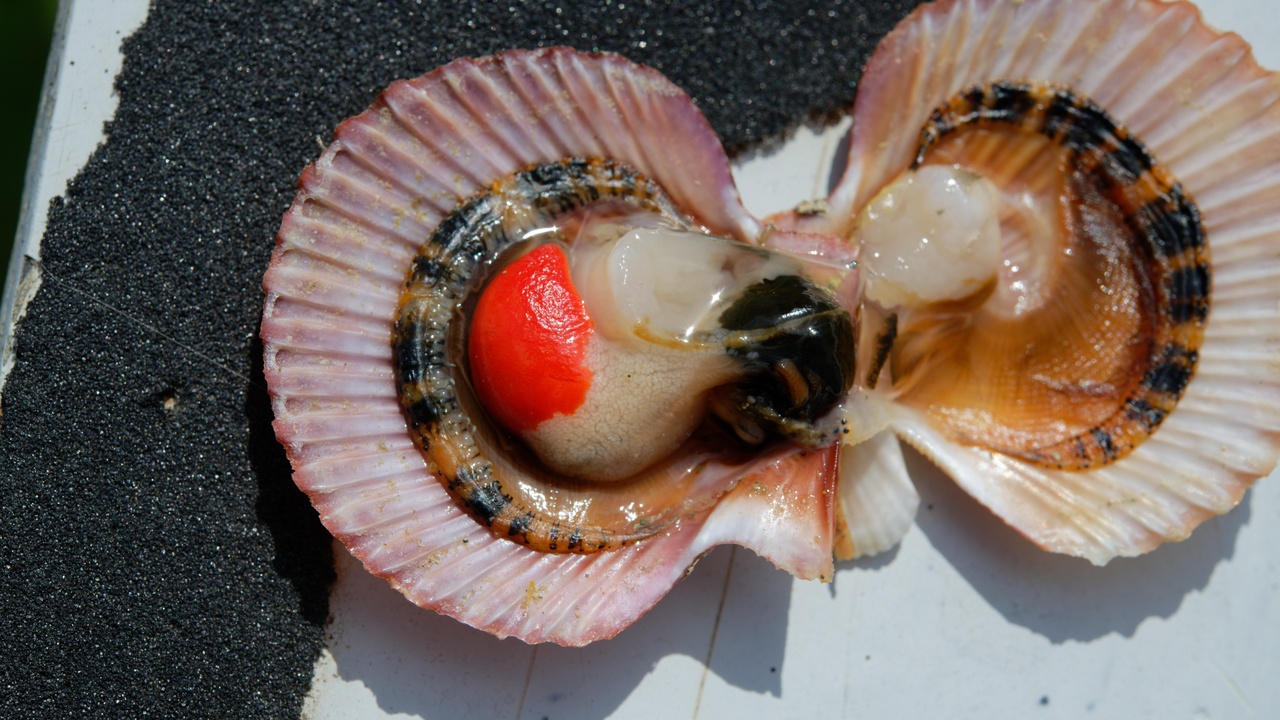
Scallops are bivalves with some physical properties that set them apart from clams and oysters: a distinctive fan-shaped shell, a stout adductor muscle, dozens to hundreds of eyes, and a fringe of sensory tentacles. Those features shape how scallops move, sense danger, feed, and why chefs prize them.
1. Distinct Shell Shape and Radiating Ribs
Most scallop shells are roughly fan-shaped with radiating ribs that give each valve a scalloped appearance. Size varies: bay scallops such as Argopecten irradians are often only a few centimetres across, while the commercially harvested sea scallop Placopecten magellanicus can reach about 15 cm in diameter.
The ribs and coloration help scallops blend with sandy or gravel seabeds, offering camouflage from visual predators. There are around 300 living species in the family Pectinidae, and shell thickness, rib prominence, and color patterns reflect habitat differences and species-specific life histories.
2. Powerful Adductor Muscle (the edible ‘meat’)
The adductor muscle is the scallop’s striking internal feature and the part eaten as “scallop meat.” It’s a dense muscle, made largely of white muscle fibers, built for forceful, quick contractions that snap the shell shut.
Those contractions also power short bursts of swimming, a rare capability among bivalves. Culinary traditions prize the muscle for its sweet flavor and firm-but-tender texture: think hotate in Japanese sashimi or seared New England sea scallops in butter. Fisheries target larger sea scallops in part because of their sizable adductor muscles.
3. Hundreds of Tiny Eyes Along the Mantle
Many scallops sport dozens to up to 200 simple eyes arrayed around the mantle edge. These eyes are not for detailed vision; they sense changes in light intensity, motion, and looming shadows.
That visual sensitivity helps scallops detect approaching predators such as starfish or crabs and triggers escape responses. Engineers have taken interest in the scallop’s eye array as a model for simple, distributed optical sensors in robotics and biomimetic devices.
4. Sensory Tentacles and Mantle Tissue
The mantle edge bears numerous short tentacles and sensory cells that respond to touch and dissolved chemicals. Those receptors let a scallop sample the water for food particles, irritants, or the brush of a predator’s limb.
When suspended sediment rises, scallops may withdraw their mantles or reduce feeding; similarly, a light touch from a predator will prompt tentacle retraction and often a clapping escape. These small, flexible tissues coordinate feeding and protective behaviors in near-real time.
Behavior & Ecology

Scallops are suspension feeders that filter plankton from the water, but unlike many bivalves they can also swim. They occur in a variety of habitats and play roles in nutrient cycling, water clarity, and food webs as prey for fish, crabs, and starfish.
5. Filter-Feeding Diet
Scallops feed by drawing water over gills where cilia trap plankton and organic particles. Ciliary currents channel food to the mouth, while wastes are expelled in a separate outflow.
Large scallop beds can measurably reduce plankton concentrations in shallow bays during feeding, improving water clarity and linking primary producers to higher trophic levels. During phytoplankton blooms, scallops opportunistically consume abundant phytoplankton, which can boost growth but also expose them to bloom-related stressors.
6. Mobility: Swimming to Escape Predators
Scallops produce jet pulses by rapidly clapping their valves, forcing water out of the mantle cavity and propelling them several body lengths in short bursts. This jet-propelled escape is unusually mobile for a bivalve.
Typical triggers are a shadow overhead or the tactile approach of a predator like a starfish. Swimming helps scallops relocate away from benthic threats, but it’s energetically costly so they rarely travel long distances this way.
7. Habitat Range and Distribution
Scallops occur worldwide in temperate and tropical seas, from shallow seagrass beds to continental shelves and several hundred meters deep. Different species pick different homes—some prefer seagrass meadows, others sandy bottoms or rocky substrate.
There are around 300 species of scallops, and habitat influences traits such as shell thickness, coloration, and even behavior. For example, bay scallops associate closely with seagrass in shallow bays, while deep-water sea scallops live on sandy or gravelly floors farther offshore.
Human Uses, Fisheries & Conservation

Scallops are both an economic staple in many coastal communities and a focus of conservation and aquaculture efforts. Their high value per kilogram drives fisheries, while managers and growers work to reduce environmental impacts and sustain stocks.
8. Economic Importance: Fisheries and Aquaculture
Scallops are commercially harvested worldwide and generate millions of dollars for regional economies. Major producing areas include the U.S. Northeast, Japan, and parts of Europe, with harvest methods ranging from dredging to diver-tended collection and aquaculture.
Aquaculture and reseeding programs supplement wild harvests, especially for bay scallops on a smaller scale. The tradeoff is clear: high market value supports livelihoods, but intense effort can stress stocks and damage seabed habitat if poorly managed.
9. Culinary Characteristics: Taste, Texture, and Processing
The adductor muscle gives scallops a sweet, delicate flavor and a firm yet tender texture that works raw, seared, or cooked. Market categories such as sea versus bay scallops reflect size and culinary use: sea scallops are larger and often seared, while bay scallops are smaller and suited to quick-cook recipes.
Processing affects quality: “dry-packed” scallops retain natural flavor and sear better, while “wet-packed” scallops (soaked in phosphates) can weigh more but may soften when cooked. Cultural examples include hotate served raw in Japan and butter-seared New England scallops on Western menus.
10. Conservation Concerns and Management
Some scallop fisheries are well-managed, but others face threats from overfishing, habitat loss, dredge-related damage, and bycatch. Managers use tools such as quotas, closed areas, gear restrictions, and rotational harvests to protect stocks and habitats.
Monitoring and restoration—like reseeding beds and supporting aquaculture—help rebuild local populations. In the U.S., NOAA participates in science-based management of sea scallop fisheries; similar regional agencies oversee fisheries elsewhere. The challenge is balancing harvest with long-term ecosystem health.
Summary
- Scallops combine surprising sensory tools (dozens to up to 200 simple eyes) with a powerful adductor muscle that serves for movement and is the culinary prize.
- They filter plankton, affect water clarity, and can swim short distances to evade predators, occurring across a wide range of habitats and about 300 species worldwide.
- Scallops support valuable fisheries and growing aquaculture, but sustainable management—quotas, closures, gear limits, and reseeding—is key to avoiding overexploitation.
- Remember the characteristics of a scallop when you buy seafood: choose well-managed sources or certified products to help protect both fisheries and the habitats they rely on.