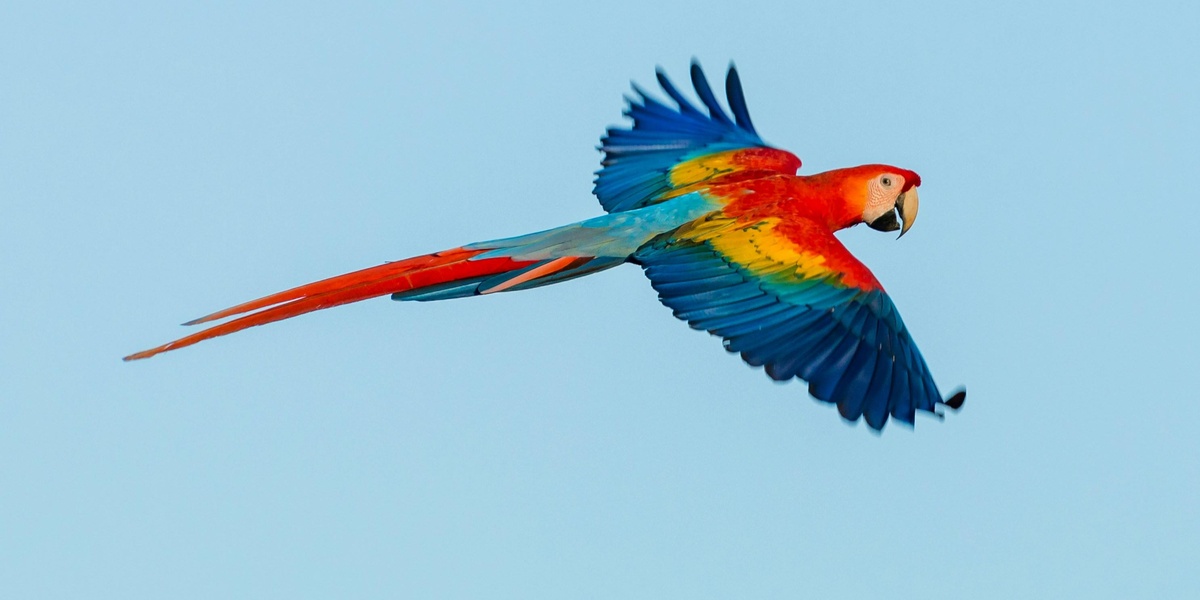
Across habitats from humid rainforests to suburban parks, flashes of bright plumage catch the eye and make birding rewarding in any season. Noting where and when these species appear helps you connect field observations with broader patterns of migration and habitat use.
There are 48 colorful birds, ranging from African Pitta to Yellow Warbler, showing a wide spread of forms and distributions. For each species, you’ll find below Scientific name,Primary colors,Range (regions/countries) to help with ID and regional context — you’ll find below.
How can I tell similar-looking colorful birds apart in the field?
Focus on a few consistent traits: overall color pattern, primary colors on the head and wings, song or call, behavior (e.g., foraging height), and habitat. Use the Scientific name and Primary colors columns to narrow candidates, then confirm with range data and vocalizations.
Which regions are best to see the greatest variety of colorful birds?
Tropical and subtropical regions usually offer the highest diversity, but many temperate zones host seasonal migrants. Check the Range (regions/countries) column in the list for hotspots and time-of-year tips to plan sightings.
Colorful Birds
| Common name | Scientific name | Primary colors | Range (regions/countries) |
|---|---|---|---|
| Scarlet Macaw | Ara macao | red, yellow, blue | Central & South America: Mexico to Peru, Brazil |
| Blue-and-yellow Macaw | Ara ararauna | blue, yellow, green accents | Central & South America: Panama to Brazil, Bolivia |
| Hyacinth Macaw | Anodorhynchus hyacinthinus | deep blue, yellow eye-ring | South America: Brazil, Bolivia, Paraguay |
| Rainbow Lorikeet | Trichoglossus moluccanus | blue head, green wings, red chest, yellow | Australia, Indonesia, Papua New Guinea |
| Resplendent Quetzal | Pharomachrus mocinno | emerald green, crimson belly, iridescent | Central America: Mexico to Panama |
| Mandarin Duck | Aix galericulata | orange, purple, green, white | East Asia; introduced UK, USA |
| Northern Cardinal | Cardinalis cardinalis | bright red (male), brown with red (female) | North America: USA, Mexico, Canada |
| Painted Bunting | Passerina ciris | bright blue head, red breast, green back | USA Gulf and Atlantic coasts, Mexico, Central America |
| Gouldian Finch | Erythrura gouldiae | red, green, yellow, purple | Northern Australia |
| Lilac-breasted Roller | Coracias caudatus | lilac, turquoise, blue, green | Sub-Saharan Africa: savannas, southern Africa |
| Toco Toucan | Ramphastos toco | black, white, huge orange bill | South America: Amazon basin, Argentina |
| Keel-billed Toucan | Ramphastos sulfuratus | green bill, black body, yellow face, red | Central America: Mexico to Panama |
| Wilson’s Bird-of-paradise | Cicinnurus respublica | red, blue, black, green crown | Indonesia: Raja Ampat (New Guinea) |
| Superb Starling | Lamprotornis superbus | metallic blue, orange breast | East Africa: Kenya, Tanzania, Ethiopia |
| African Pitta | Pitta angolensis | green, blue, black, red | Sub-Saharan Africa, seasonal movements |
| Common Kingfisher | Alcedo atthis | bright blue, orange, white | Europe, Asia, North Africa |
| Malachite Kingfisher | Corythornis cristatus | bright blue, orange, red bill | Sub-Saharan Africa |
| Atlantic Puffin | Fratercula arctica | black, white, orange bill and feet | North Atlantic: Iceland, UK, N. America |
| Eastern Bluebird | Sialia sialis | bright blue, orange, white | North America: USA, Canada, Mexico |
| Scarlet Tanager | Piranga olivacea | brilliant red male, black wings | North and Central America: eastern USA, Mexico |
| Common Pheasant | Phasianus colchicus | iridescent green/bronze, red face, white neck ring | Native Asia; introduced worldwide |
| Eurasian Hoopoe | Upupa epops | orange, black, white, crest | Europe, Asia, Africa |
| European Bee-eater | Merops apiaster | green, yellow, blue, chestnut | Europe, N. Africa, W. Asia, sub-Saharan wintering |
| King Vulture | Sarcoramphus papa | white, black, orange, yellow, red | Central & South America: Mexico to Argentina |
| Nicobar Pigeon | Caloenas nicobarica | iridescent green, purple, copper, white neck hackles | Nicobar Islands, SE Asia, Pacific islands |
| Indian Peafowl | Pavo cristatus | iridescent blue, green, eye-spots | Indian subcontinent |
| Eclectus Parrot | Eclectus roratus | male green, female red and purple | New Guinea, Solomon Islands, NE Australia |
| Sun Conure | Aratinga solstitialis | bright orange, yellow, green | Northeast South America: Brazil, Guyana |
| Turquoise-browed Motmot | Eumomota superciliosa | turquoise, green, blue, chestnut | Central America: Guatemala to Nicaragua |
| Superb Fairywren | Malurus cyaneus | iridescent blue (male breeding), brown (female) | Australia |
| Purple Gallinule | Porphyrio martinicus | iridescent purple-blue, green, yellow bill, red frontal shield | Southeastern USA to South America, Caribbean |
| Rainbow Bee-eater | Merops ornatus | green, blue, chestnut, yellow throat | Australia, Indonesia, Solomon Islands |
| Scarlet Ibis | Eudocimus ruber | bright red | Northern South America, Caribbean |
| American Flamingo | Phoenicopterus ruber | pink, orange | Caribbean, Florida, Galápagos, coastal Americas |
| Baltimore Oriole | Icterus galbula | orange, black | Eastern North America, Central America wintering |
| Green Jay | Cyanocorax yncas | bright green, blue, yellow, black face | Central & South America: Mexico to Argentina |
| Steller’s Jay | Cyanocitta stelleri | deep blue, black crest, gray | Western North America |
| Indigo Bunting | Passerina cyanea | indigo blue (male breeding), brown (female) | North America: USA, Mexico, Central America wintering |
| Greater Bird-of-paradise | Paradisaea apoda | orange, yellow, green, brown | New Guinea lowlands |
| Green-winged Macaw | Ara chloropterus | red, green, blue | South America: Amazon basin |
| Andean Cock-of-the-rock | Rupicola peruvianus | bright orange, black | Andean cloud forests: Colombia to Bolivia |
| Purple Honeycreeper | Cyanerpes caeruleus | iridescent purple-blue, black mask | Neotropics: Amazon basin, Central America |
| Blue-footed Booby | Sula nebouxii | white, brown, bright blue feet | Eastern Pacific: Galápagos, Peru |
| Red-headed Woodpecker | Melanerpes erythrocephalus | red head, black, white body | North America: USA, Canada |
| Red-billed Tropicbird | Phaethon aethereus | white, black wing markings, red bill, long tail streamers | Tropical Atlantic, Caribbean |
| Yellow Warbler | Setophaga petechia | bright yellow | Americas, widespread |
| Blue-throated Macaw | Ara glaucogularis | blue, yellow, green | Bolivia (Beni savanna) |
| Western Tanager | Piranga ludoviciana | yellow, red-orange head (male), black wings | North America: western USA, Canada |
Images and Descriptions
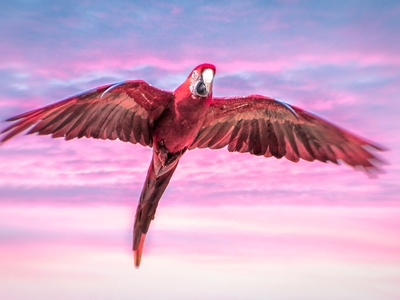
Scarlet Macaw
Large parrot with vivid red, yellow and blue plumage, found in humid lowland forests and edges. Social, often seen in noisy flocks and vulnerable to habitat loss and illegal trade; conservation depends on protected habitats and captive-breeding releases.
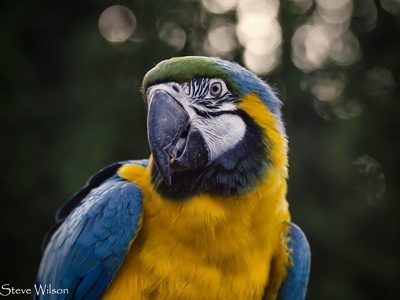
Blue-and-yellow Macaw
Striking large parrot with bright blue upperparts and golden-yellow underparts, prefers riverine forests and palm groves. Highly social and long-lived; threatened locally by trapping and deforestation, often seen rehabilitated or in ecotourism sites.
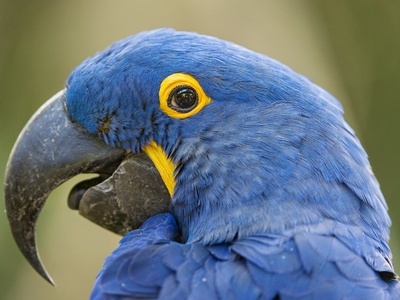
Hyacinth Macaw
World’s largest parrot, cobalt-blue with striking yellow facial rings, inhabiting palm-rich savannas and gallery forests. Reliant on specific palm seeds; endangered due to habitat loss and pet trade, with targeted nest protection improving some populations.
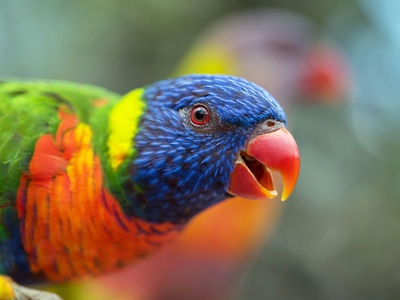
Rainbow Lorikeet
Small, fast parrot with iridescent blue head, green back and multicolored breast; feeds on nectar and fruit in coastal forests, gardens and woodlands. Highly gregarious and vocal; can become locally abundant and is an effective pollinator.
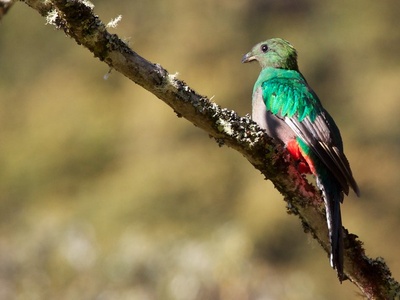
Resplendent Quetzal
Iconic cloud-forest resident with shimmering green plumage, long tail streamers and bright red belly. Eats fruits and insects, nests in tree cavities. Culturally significant; sensitive to deforestation so requires mature montane cloud forest for survival.
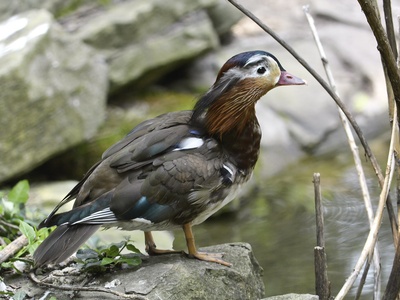
Mandarin Duck
Spectacular perching duck with ornate multicolored male plumage, crested head and patterned flanks. Breeds in wooded ponds and nests in tree cavities; prized by birdwatchers and often established in small introduced populations.
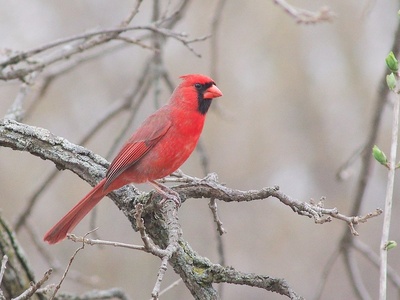
Northern Cardinal
Familiar backyard songbird with brilliant red males and warm brown females with red highlights. Inhabits shrubs, woodlands and gardens; territorial year-round and easy to identify by crest, strong conk-conk call and seed-loving diet.
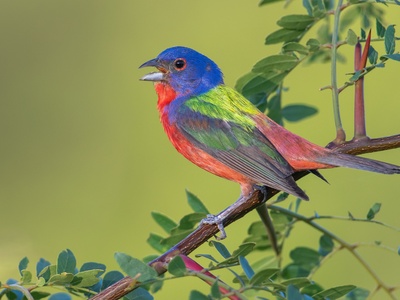
Painted Bunting
Vivid small songbird—males sporting a kaleidoscope of blue, red and green—found in brushy habitats and edges. Secretive during breeding but visible at feeders in winter; habitat loss and cagebird trade have impacted some populations.
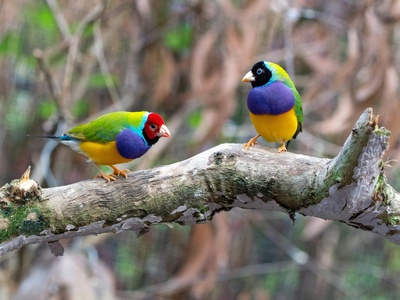
Gouldian Finch
Small, brilliantly colored finch with multiple head color morphs in males and bright green back. Prefers tropical savanna grasslands and feeds on seeds; endangered in wild due to habitat change and sporadic disease outbreaks.
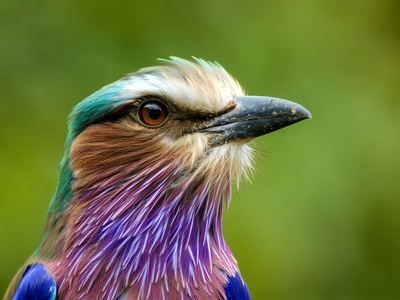
Lilac-breasted Roller
Striking perching bird with lilac throat, turquoise belly and blue wings, often seen hawking insects from roadside perches. Common in open woodland and savanna; popular with safari-goers for dazzling aerial displays.
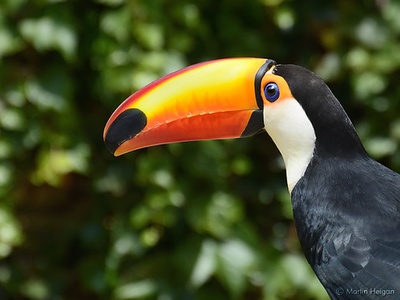
Toco Toucan
Large black toucan with a white throat and oversized bright orange bill used for feeding and thermoregulation. Occupies forest edges and riverine woodlands; conspicuous and important seed disperser but vulnerable to habitat fragmentation.
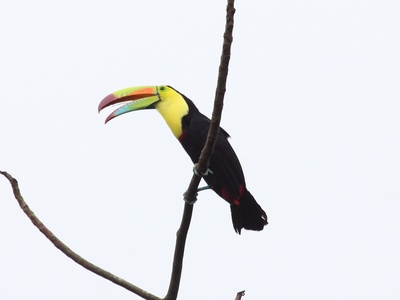
Keel-billed Toucan
Colorful medium-sized toucan with multicolored bill and contrasting black and yellow plumage, found in lowland rainforests and forest edges. Social and noisy, it forages on fruits and helps disperse seeds across the canopy.
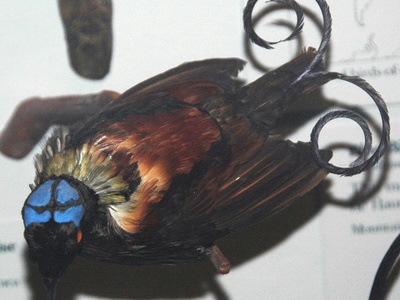
Wilson’s Bird-of-paradise
Small, spectacular male with red body, electric blue back and ornate head plumes, found in lowland forests of Raja Ampat. Elaborate courtship displays on cleared display courts; restricted range makes it vulnerable to habitat change.
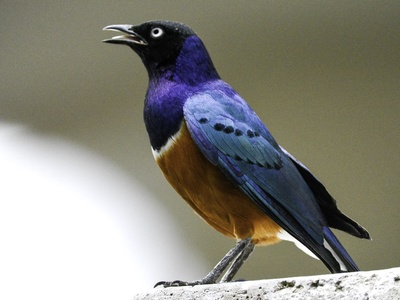
Superb Starling
Glossy-backed starling with metallic blue head and upperparts and bright orange belly, common in savannas and human-altered landscapes. Highly social in flocks, opportunistic feeder, and often seen perched conspicuously on bushes.
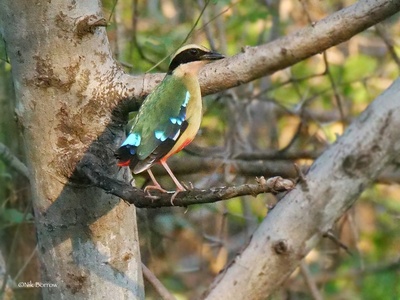
African Pitta
Secretive forest floor bird with bold green and blue upperparts, black face and red belly, favoring dense lowland or secondary forests. Often heard more than seen; migratory or dispersive habits in some regions make it unpredictable.
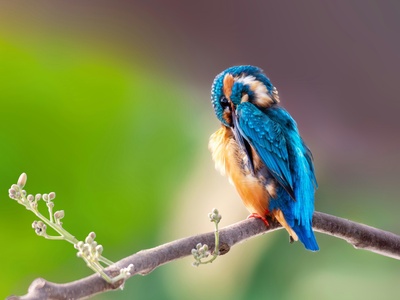
Common Kingfisher
Small, vivid kingfisher with electric blue back and orange underparts, perching near streams and ponds. Dives for fish with rapid stoops; sensitive to water quality and habitat alteration but readily seen where clear water persists.
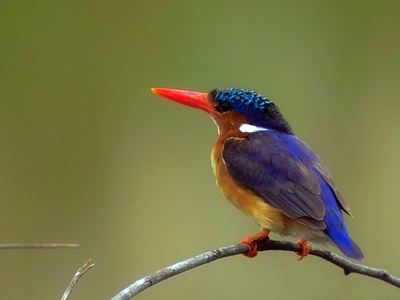
Malachite Kingfisher
Tiny riverine kingfisher with shimmering turquoise upperparts, orange underparts and a red bill, hunting small fish from low perches. Prefers slow-moving waters with vegetation and is a common, colorful sight in African wetlands.
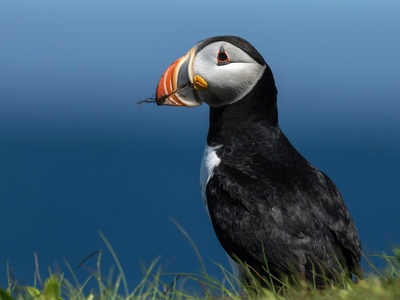
Atlantic Puffin
Chunky seabird with striking orange bill and feet and black-and-white plumage, nests in cliff colonies and dives for fish. Iconic coastal species vulnerable to overfishing and climate-driven prey shifts that reduce breeding success.
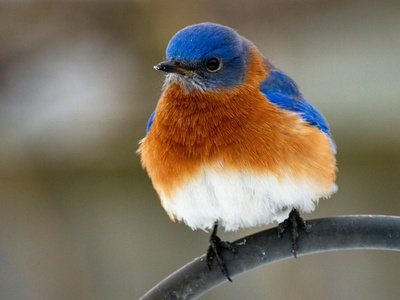
Eastern Bluebird
Small thrush with vivid azure upperparts and warm orange breast, frequenting open fields, orchards and nest boxes. Insectivorous and a favorite of backyard birders; populations recovered in many areas through nest-box programs.
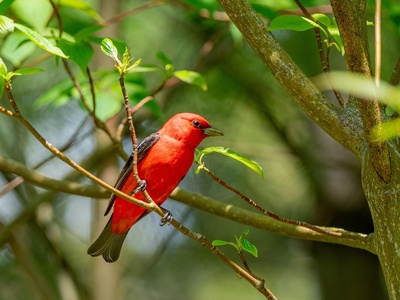
Scarlet Tanager
Forest canopy songbird: breeding males blaze red with contrasting black wings, females are yellowish-olive. Feeds on insects and fruit; migratory, dependent on mature deciduous forests and vulnerable to habitat loss on breeding grounds.
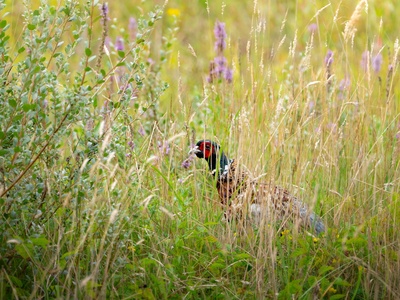
Common Pheasant
Showy gamebird with iridescent bronze-green body, red facial wattles and distinctive white neck ring in males. Found in farmlands and wetlands where introduced; prized by hunters and widely introduced, sometimes impacting native ecosystems.
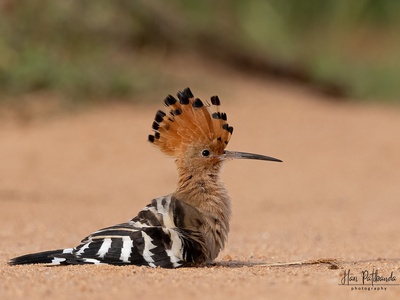
Eurasian Hoopoe
Distinctive crested bird with cinnamon-orange body, bold black-and-white wing pattern and a fanlike crest. Feeds on insects by probing soil in open landscapes and gardens; culturally significant and easily recognized in many regions.
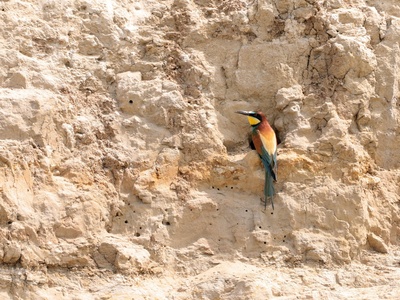
European Bee-eater
Slim, colorful aerial insectivore with green back, yellow throat, blue belly and chestnut nape, often perching on wires and mining banks to nest. Performs spectacular acrobatic flights to catch bees and is colonial during breeding.
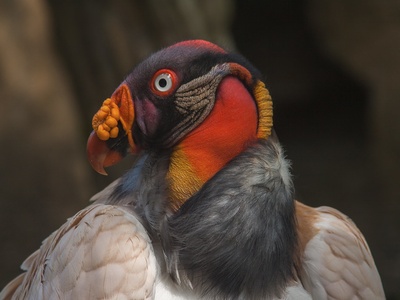
King Vulture
Large Neotropical vulture with mostly white body, contrasting black wings and a vividly colored head and neck in orange, yellow and red. Scavenger of tropical forests and important carcass recycler; sensitive to habitat loss and human persecution.
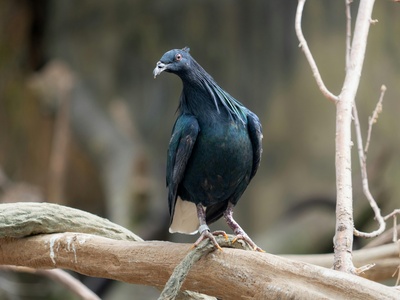
Nicobar Pigeon
Chunky pigeon with glossy iridescent green, purple and copper feathers and a distinct white neck patch. Coastal forest and island specialist; hunted historically and declining due to habitat loss and introduced predators, important seed disperser on islands.
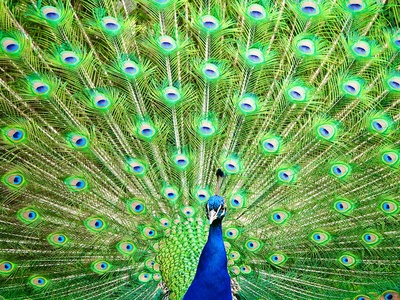
Indian Peafowl
Male peafowl displays an enormous iridescent train adorned with eye-spots during courtship, while females are more muted. Common in open forests and agricultural landscapes; culturally revered but declining in some areas due to habitat and hunting pressure.
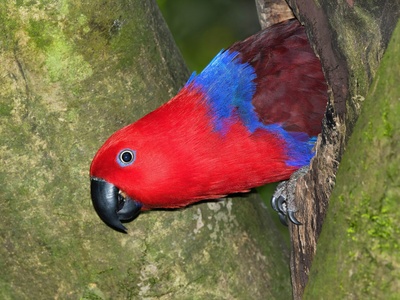
Eclectus Parrot
Sexually dimorphic parrot: males vivid green with orange beak, females striking red and purple. Lives in lowland rainforest and edges, feeds on fruits and blossoms; vulnerable to trapping but shows strong presence in protected forests.
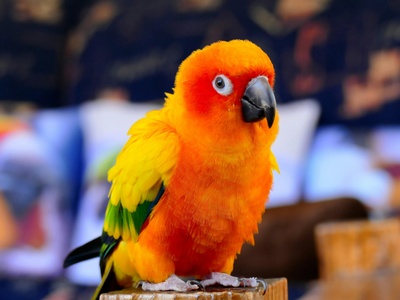
Sun Conure
Vibrant small parrot with blazing orange and yellow plumage and green wing tips, found in tropical savanna and woodland edges. Highly gregarious; wild populations declined from trapping and habitat loss, though often seen in aviaries.
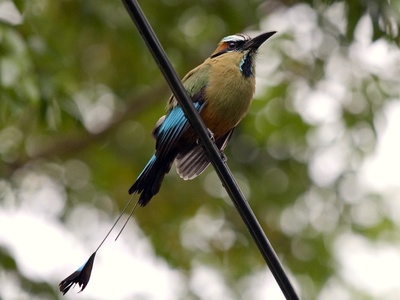
Turquoise-browed Motmot
Striking motmot with turquoise brow, green body and racketed tail tips, inhabiting tropical dry and humid forests and edges. Sits motionless to sally for insects and small prey; culturally important and a popular focal species in parks.
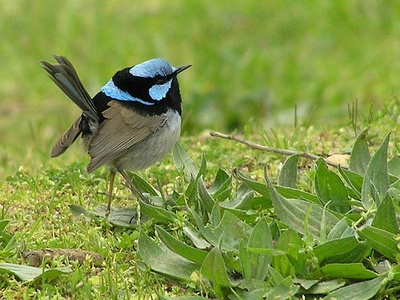
Superb Fairywren
Small insectivorous passerine with males showing brilliant electric blue breeding plumage and complex social behavior, living in scrub and gardens. Cooperative breeders, often in family groups; males moult to duller plumage outside breeding season.
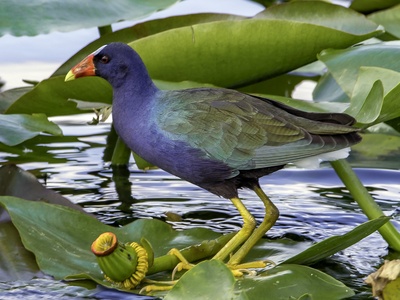
Purple Gallinule
Vibrant marsh bird with glossy purple-blue and green feathers, long toes for walking on floating vegetation and a colorful bill and frontal shield. Prefers freshwater wetlands and is often conspicuous, though habitat loss can reduce local numbers.
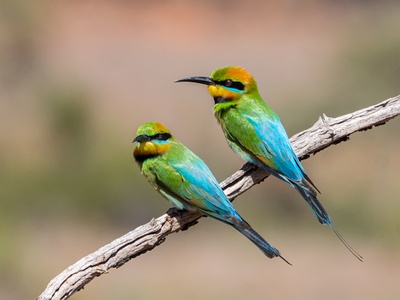
Rainbow Bee-eater
Sleek, colorful aerial insectivore with green body, blue cheeks and chestnut nape, known for catching bees in flight and removing stings. Prefers open woodlands and coastal dunes; migratory across Australia and nearby islands.
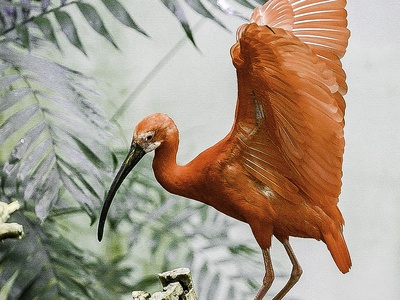
Scarlet Ibis
Striking wading bird drenched in bright scarlet plumage, inhabiting mangroves, mudflats and wetlands where it probes for crustaceans that give its color. Often colonial; local populations affected by habitat change and pollution.
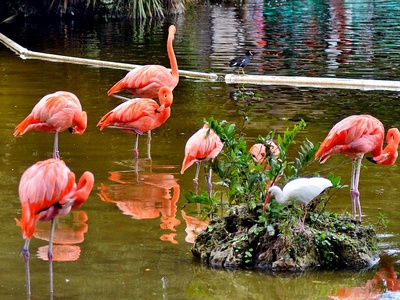
American Flamingo
Large wading bird with vibrant pink-orange plumage formed by diet, feeding by filter-feeding on brine shrimp and algae. Breeds in salt flats and lagoons in colonies; threatened locally by habitat disturbance and pollution.

Baltimore Oriole
Bright orange and black passerine common in open woodlands and urban parks, feeding on fruit, nectar and caterpillars. Noted for hanging woven pouch nests and voice; populations affected by nest parasitism and habitat conversion.
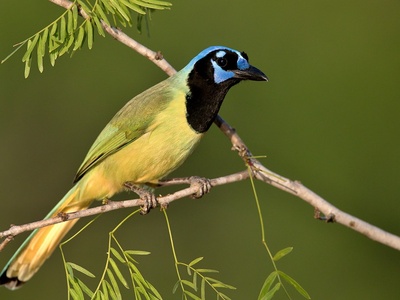
Green Jay
Colorful jay with bright green body, blue crown and yellow throat contrasted by a black facial mask, inhabiting forests, woodlands and edges. Bold and noisy, it forages on the ground and in trees for insects and fruits.
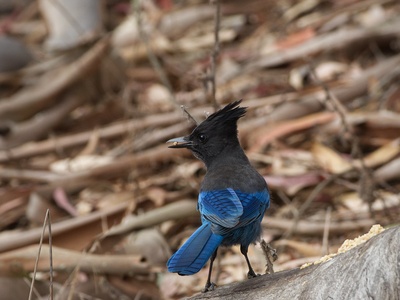
Steller’s Jay
Striking crest-topped corvid with glossy deep blue body and black head, common in coniferous forests and campgrounds. Omnivorous and bold around humans, its loud calls and curious behavior make it a memorable bird.
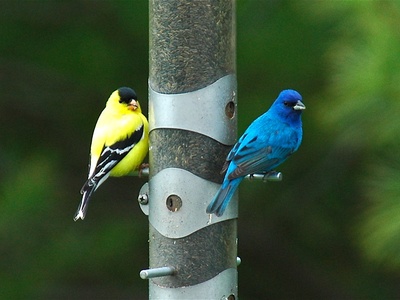
Indigo Bunting
Small songbird with males intensely indigo-blue in summer, shifting to brownish in winter. Occupies brushy fields and forest edges, singing from exposed perches; migratory and popular with backyard birders. Conservation generally stable but dependent on habitat.
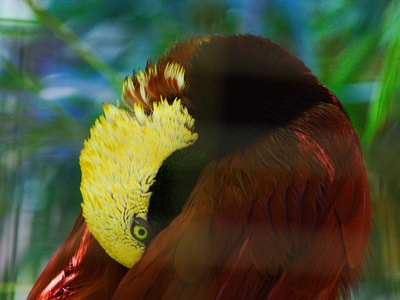
Greater Bird-of-paradise
Male displays flamboyant yellow and orange plumes and long flank feathers in elaborate courtship spectacles in rainforest canopy. Ground and tree nesting species; localized habitat loss threatens some populations though species remains culturally iconic.
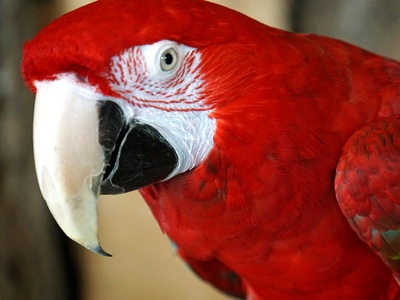
Green-winged Macaw
Large parrot with mostly red plumage, green wing coverts and blue flight feathers; inhabits humid tropical forests and river edges. Social and loud, threatened by habitat loss and capture for the pet trade.
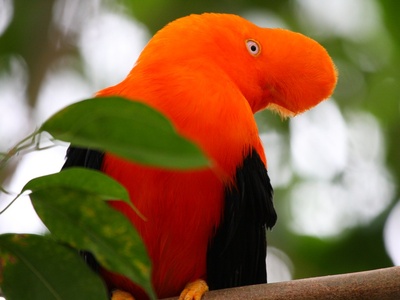
Andean Cock-of-the-rock
Striking orange lekking bird with fan-shaped crest seen at display arenas in Andean cloud forests. Males perform noisy group displays to attract females; restricted to forested foothills and vulnerable to habitat fragmentation.
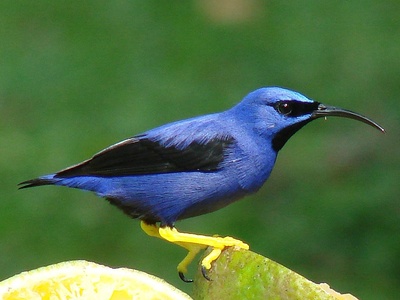
Purple Honeycreeper
Tiny tanager-like passerine with glossy purple-blue males and a slender bill for sipping nectar and taking insects in forest canopies. Prefers humid forests and edges; overlooked because of small size but striking in good light.
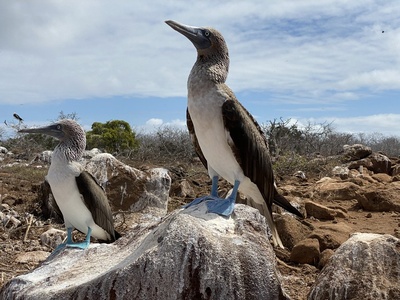
Blue-footed Booby
Seabird with white body, brown wings and famously vivid blue feet used in courtship displays on rocky islands. Dives for fish and breeds in dense colonies; foot color reflects health and diet, attracting mates.
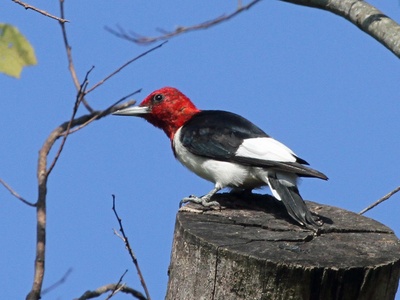
Red-headed Woodpecker
Bold woodpecker with bright red head, black back and white patches that flash in flight, favoring open woodlands and orchards. Catches insects and stores food; populations have declined with old-tree loss and habitat change.
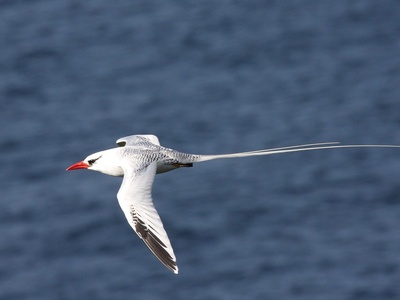
Red-billed Tropicbird
Elegant seabird with white plumage, distinctive red bill and long tail streamers used in aerial courtship. Nests on isolated islands and cliffs, pelagic outside breeding season; vulnerable to introduced predators at nesting sites.
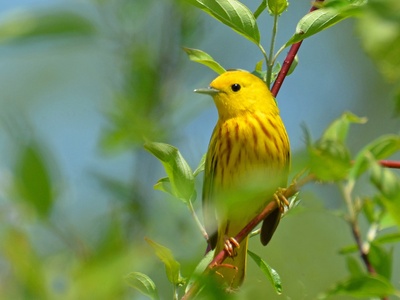
Yellow Warbler
Small, entirely bright yellow songbird with subtle streaking on the breast in some subspecies, inhabiting wetlands, thickets and gardens. Energetic insectivore during breeding; vulnerable in parts of range to habitat loss and brood parasitism.
Blue-throated Macaw
Rare parrot with vivid blue plumage and bright yellow underparts, restricted to remnant palms and gallery forests in Bolivia. Critically endangered with intensive conservation programs for nest protection and reintroduction.
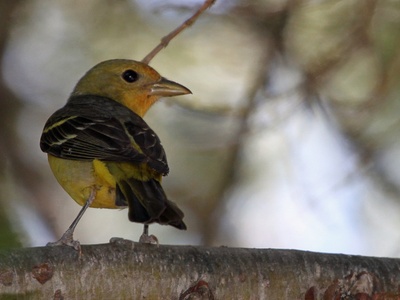
Western Tanager
Distinctive summer visitor with bright yellow body and males bearing red-orange hood and dark wings, found in open coniferous forests and mixed woodlands. Eats insects and fruit; migratory and often shows up at campgrounds.