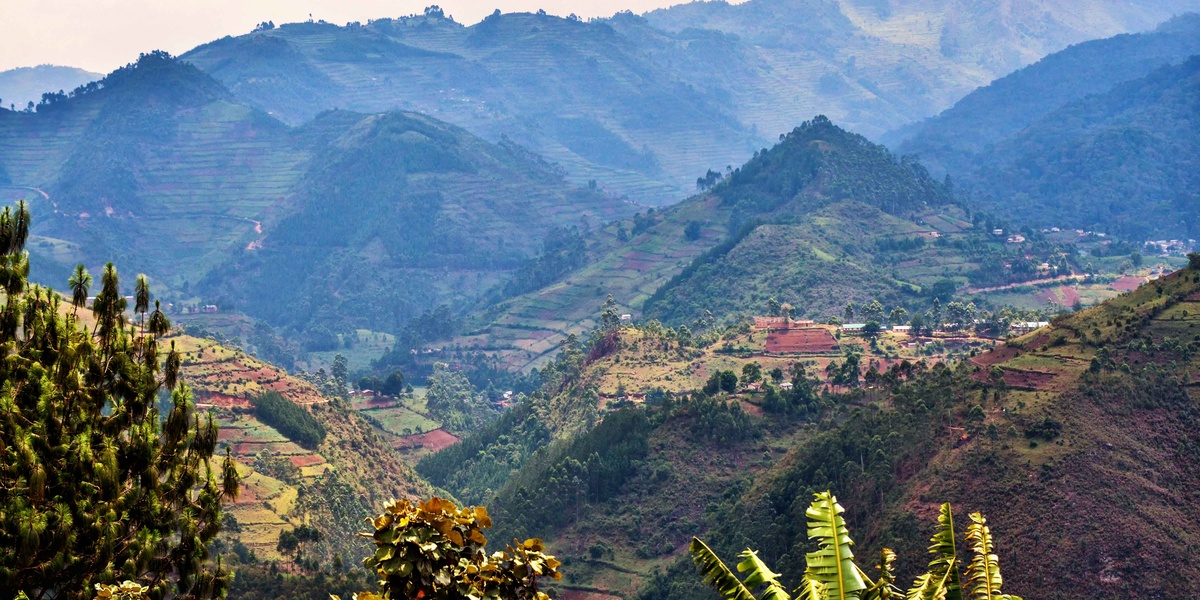
Uganda packs remarkable plant diversity into a country roughly 241,038 km² in size — the island of habitats from lowland rainforests to the Rwenzori alpine zone (Rwenzori peaks reach 5,109 m).
This diversity matters because plants deliver the services people rely on: they store carbon, regulate water and erosion, underpin local medicines, and support livelihoods from smallholder farms to timber mills.
Below are 12 notable examples that illustrate how the flora supports ecosystems, culture, medicine and economies. The profiles are grouped into four themes: canopy and iconic trees, medicinal and ethnobotanical species, economically important and agroforestry plants, and rare or conservation-priority species. Together they show why the Flora of Uganda is both valuable and vulnerable.
Canopy and Iconic Trees
Large canopy trees define much of Uganda’s tropical forest structure. Their crowns, often rising 30–40 m or more in lowland and montane forests, store substantial carbon and create the layered habitats that support countless birds, primates and epiphytes.
Beyond ecology, many canopy species supply timber and non-timber products that local communities rely on — poles, fuelwood, fruit and medicine. But selective logging and conversion to agriculture have altered canopy continuity in important forest blocks such as Mabira and Budongo.
The three species below are easy to spot on forest walks or in rural landscapes and illustrate the multiple roles of large trees: carbon sinks, wildlife resources and sources of income for small sawmills and artisans.
1. African mahogany (Khaya spp.) — towering timber species
African mahogany is one of Uganda’s most recognizable canopy trees and a valued source of hardwood. Mature trees commonly reach about 30–45 m, producing straight boles prized for cabinetry, flooring and boatbuilding.
High international demand has driven heavy harvests; several Khaya taxa are subject to trade controls and conservation concern (see CITES listings for mahogany-group species). Selective logging changes canopy structure and can open forests to further conversion.
On the ground, mahogany stands in Mabira Forest supply local sawmills and support livelihoods through timber processing and carpentry. Community forestry initiatives increasingly promote planted mahogany and mixed-species management to reduce pressure on remnant groves.
2. Fig species (Ficus spp.) — keystone trees that feed forests
Figs act as ecological keystones in Ugandan forests because many species fruit year-round or asynchronously, offering reliable food when other fruits are scarce.
By sustaining frugivores — bats, birds and primates — figs support seed dispersal and forest regeneration. In places like Kibale and Budongo, fig trees are central to the food web and to wildlife viewing that underpins ecotourism.
Visitors tracking chimpanzees or birding often depend on fig fruiting patterns; protecting these trees helps both biodiversity and tourism-dependent incomes in national parks and forest reserves.
3. Markhamia lutea (Nile trumpet) — a common roadside and cultural tree
Markhamia lutea is widespread along roads, in towns and on smallholder farms. Fast-growing and typically 8–15 m tall, it’s planted for shade, ornament and quick timber for local use.
Its clusters of trumpet-shaped flowers attract pollinators and add seasonal color to streetscapes. In Kampala and many rural communities it’s a go-to choice for school compounds, avenues and agroforestry boundaries.
Smallholders also use Markhamia wood locally, while its rapid growth makes it a practical component of mixed plantings that supply both shade and biomass.
Medicinal and Ethnobotanical Species

Uganda’s traditional knowledge about plants remains a living resource: communities use leaves, bark and roots to treat common ailments, and researchers have long turned to these remedies for leads in pharmacology.
That intersection of culture and science creates opportunity — and pressure. Bark- or root-harvesting can kill trees, driving the need for sustainable methods and cultivation of high-demand species.
The three profiles below highlight species with notable medicinal use and conservation attention, including international trade history and local efforts to reduce wild-harvest impacts.
4. Prunus africana (African cherry) — medicinal bark with international demand
Prunus africana bark has been harvested for decades for traditional remedies and commercial extracts linked to prostate health. Demand once reached high export levels, prompting conservation concern.
Because bark stripping can kill individuals, Prunus africana has been the subject of international trade controls and sustainability initiatives (see IUCN and CITES guidance). Sustainable harvest and cultivation help reduce pressure on wild populations.
In Uganda, community nursery programs and small-scale plantings aim to supply bark and finished extracts while giving local people a stake in conserving forest trees rather than overharvesting them.
5. Warburgia ugandensis (greenheart) — traditional antimicrobial and respiratory remedy
Warburgia ugandensis is prized in many communities for treating infections and respiratory problems; healers use leaves, bark and steam inhalations made from the tree.
Phytochemical studies have identified compounds with antimicrobial properties, which explains part of its continued use and the research interest in its extracts. At the same time, bark harvesting poses risks to long-lived trees.
Communities around Lake Victoria wetlands and forest edges often prefer leaf-based remedies or cultivated specimens to spare wild trees, and small conservation projects promote propagation rather than destructive harvest.
6. Aloe spp. — multipurpose succulents used locally and commercially
Aloe species grow in drier parts of Uganda and are widely used for skin care, minor burns and digestive remedies. Their gel is a household remedy and a base for small cosmetic lines.
Because Aloes are drought tolerant and easy to propagate, farmers cultivate them around homesteads. Small enterprises process gel into lotions and soaps, creating a climate-resilient income stream.
Village entrepreneurs in eastern districts commonly sell Aloe products at local markets and to neighboring towns, turning a common garden plant into a modest livelihood source.
Economically Important and Agroforestry Plants

Many tropical plants are central to Ugandan livelihoods: coffee and bananas feed households and foreign-exchange accounts, while agroforestry trees provide fuel, shade and soil benefits that raise farm resilience.
Coffee continues to be a cornerstone of rural income in many districts. According to the Uganda Coffee Development Authority, coffee contributes significantly to export earnings and supports hundreds of thousands of smallholders.
The following profiles show how cash crops, staples and purpose-grown trees combine on small farms to supply food, energy and marketable goods.
7. Coffee (Coffea canephora and C. arabica) — Uganda’s cash and shade crop
Robusta (Coffea canephora) dominates Uganda’s coffee landscape and underpins rural incomes across many regions. Arabica is grown in higher-altitude zones such as Mount Elgon and the Rwenzori foothills.
According to the Uganda Coffee Development Authority, coffee is a leading agricultural export and connects smallholders to global value chains through cooperatives and processing centers. Many smallholder plots are under 1–3 hectares, with families combining coffee with food crops for resilience.
Shade trees in coffee plots improve microclimate and biodiversity; cooperatives in Bugisu and Mount Elgon process cherries into parchment and dried beans for domestic and international buyers.
8. East African highland bananas (Matoke) — staple and agro-ecological mainstay
Matoke cooking bananas form a dietary staple across much of Uganda and supply regular income at roadside and town markets. Farmers plant them in bunches that provide continuous harvests for household consumption and sale.
Banana-based systems also protect soils on slopes, reduce erosion and create humid microclimates beneficial to intercrops. In eastern regions around Mbale and the Mount Elgon slopes, banana-coffee intercropping is a common strategy.
Local markets sell Matoke by the bunch, and household reliance on bananas for both food and cash makes them central to food security strategies on small farms.
9. Grevillea, Calliandra and other multipurpose agroforestry trees
Fast-growing trees such as Grevillea and Calliandra are mainstays on many smallholdings. They supply fuelwood, fodder and green manure while stabilizing boundaries as live fences or hedgerows.
Calliandra hedges provide palatable fodder and nitrogen-rich prunings, while Grevillea can be thinned for firewood or poles typically within 2–5 years under good management. Those short rotations supply household energy without clearing native forests.
Farmers commonly use alley-cropping and hedgerows to increase yields, conserve moisture and diversify on-farm income streams — practical adaptations as weather becomes less predictable.
Rare, Endemic and Conservation-Priority Species

Western Uganda sits in the Albertine Rift, and the Rwenzori massif rises to 5,109 m — together these places host many species found nowhere else. That endemism makes the region a global conservation priority.
Unfortunately, narrow ranges raise vulnerability: agricultural expansion, logging, invasive weeds and climate shifts threaten habitats. Protecting these species preserves unique genetic resources and the ecological functions they support.
The three profiles below illustrate alpine specialists, Albertine Rift forest endemics and the small understory plants whose loss would be easy to miss but hard to recover from.
10. Rwenzori alpine plants — specialists above the forest line
The Rwenzori Mountains host plants adapted to cold, wet, high-altitude conditions. Iconic forms include giant lobelias and Senecio species that create a surreal alpine landscape above the tree line.
Those giant rosette plants draw scientists and trekkers alike; alpine flora are a key reason visitors travel the Rwenzori trekking routes. Yet glacial retreat and changing rainfall patterns are shrinking suitable habitat for these specialists.
Conservation measures tied to mountain tourism — park fees, guided treks and research permits — help fund protection, but long-term resilience will depend on broader climate action and habitat connectivity.
11. Albertine Rift endemics — forest specialists with limited ranges
The Albertine Rift is recognized as a biodiversity hotspot because it contains a high number of endemic plant taxa, many with ranges confined to single forest blocks or mountain slopes.
Narrow ranges make species vulnerable to even modest habitat loss. Protecting forests such as Semuliki, Echuya and the western forest patches helps preserve plants that support pollinators, local medicines and future research.
Researchers and park managers use targeted surveys and community reserves to identify and safeguard named endemics; these on-the-ground actions are essential if rare taxa are to survive agricultural and demographic pressures.
12. Rare orchids and understory specialists — small plants with outsized roles
Orchids and other understory specialists are often range-restricted and highly sensitive to disturbance. Their roots and pollination networks tie them to intact forest microclimates.
Because orchids contribute to pollinator diversity and botanical knowledge, their presence is a sign of forest health. Montane forest patches and valley bottoms commonly harbor species recorded only in a few sites.
Botanical surveys in protected areas and adjacent community lands continue to document rare species; supporting those surveys and protecting small forest fragments helps preserve the full tapestry of Uganda’s plant life.
Summary
- Uganda’s plant diversity ranges from towering canopy trees and keystone figs to small endemic orchids, and each group provides distinct ecological and economic services.
- Many species underpin livelihoods: coffee and Matoke sustain rural incomes and food security, while medicinal trees supply traditional health care and commercial interest.
- Conservation urgency is highest for Albertine Rift and Rwenzori specialists; climate change and habitat conversion present immediate risks to species with tiny ranges.
- Sustainable solutions — community propagation, agroforestry, protected areas and responsible sourcing — can balance use and protection for the Flora of Uganda.
- Readers who want to learn more can consult IUCN, the Uganda Wildlife Authority and the Uganda Coffee Development Authority for current conservation status and sustainable-use guidance.