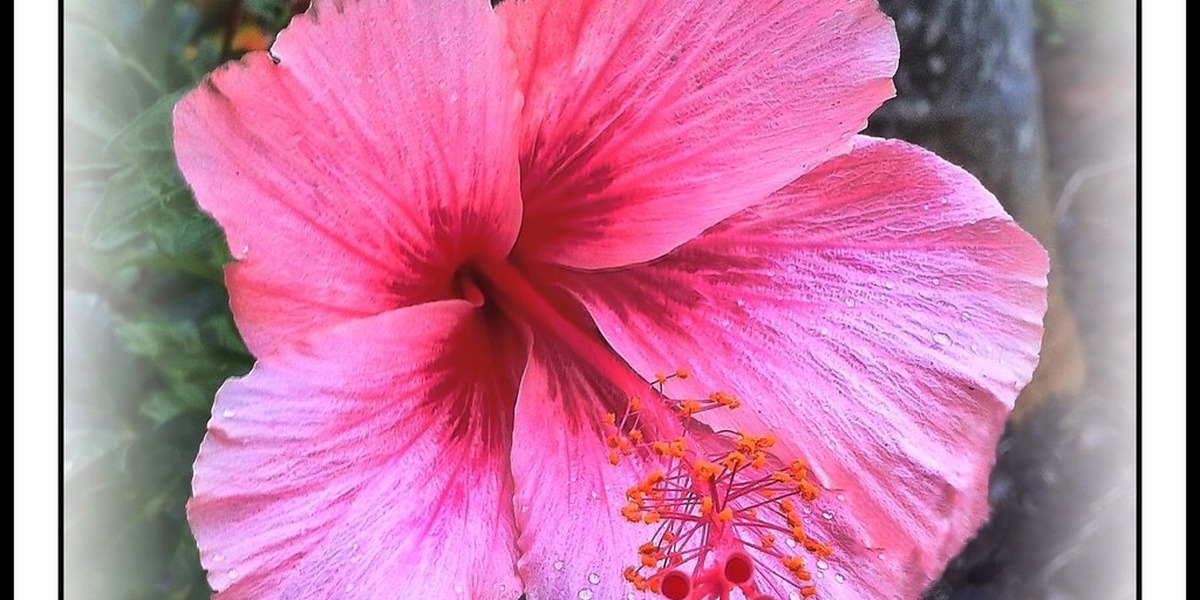
Guinea-Bissau’s coast, savannas and riverine forests host a surprising variety of flowering plants that mark the seasons and support local wildlife and livelihoods. Many blooms are best noticed during the rainy season, when colors pop across sandy plains and mangrove edges.
There are 25 Flowers of Guinea-Bissau, ranging from African rosewood to Wild passionflower; for each entry you’ll find Scientific name,Habitat,Bloom season (months) below.
When is the best time to visit to see most species in bloom?
The rainy season (roughly June–October) brings the greatest diversity of flowers, though some species bloom in the dry season or in short, unpredictable bursts; check the Bloom season (months) column to plan visits to specific habitats like savanna, forest edge or mangroves.
How can I use this list for field identification or conservation work?
Use the Scientific name,Habitat,Bloom season (months) fields together: the scientific name avoids local-name confusion, habitat narrows where to look, and bloom months tell you when to survey—combine with photos or local guides for accurate ID and to prioritize conservation efforts.
Flowers of Guinea-Bissau
| Name | Scientific name | Habitat | Bloom season (months) |
|---|---|---|---|
| Baobab | Adansonia digitata | dry savanna, villages, rocky outcrops | Dec–Feb |
| Red kapok | Bombax costatum | dry savanna, rocky hills, gallery edges | Feb–Apr |
| Sausage tree | Kigelia africana | riverbanks, gallery forest, open woodland | Mar–Jun |
| Kapok/Ceiba | Ceiba pentandra | gallery forest, secondary forest, village groves | Mar–May |
| African rosewood | Pterocarpus erinaceus | dry woodland, wooded savanna, termite mounds | Feb–Apr |
| Umbrella thorn acacia | Vachellia tortilis | open savanna, sandy flats, rocky soils | Nov–Mar |
| Gum arabic tree | Senegalia senegal | dry savanna, sandy plains, open scrub | Dec–Apr |
| Beach morning-glory | Ipomoea pes-caprae | sandy beaches, coastal dunes | Year-round |
| Black mangrove | Avicennia germinans | lower intertidal mangrove zones, estuaries | Year-round |
| Red mangrove | Rhizophora racemosa | fringing mangrove, lower tidal zones | Year-round |
| White mangrove | Laguncularia racemosa | upper mangrove fringe, lagoons, salt pans | Year-round |
| Portia tree | Thespesia populnea | coastal scrub, beach fronts, towns | Year-round |
| Tropical almond | Terminalia catappa | coastal groves, riverbanks, towns | Jun–Sep |
| Mango | Mangifera indica | cultivated, villages, secondary growth | Mar–May |
| Roselle | Hibiscus sabdariffa | fields, roadside, hedgerows, fallow land | Aug–Oct |
| Lantana | Lantana camara | roadsides, degraded ground, bushland | Year-round |
| Wild passionflower | Passiflora foetida | coastal scrub, disturbed ground, fences | Jul–Nov |
| Grey nicker | Caesalpinia bonduc | beaches, coastal scrub, thickets | Year-round |
| African tulip | Spathodea campanulata | forest edges, towns, riverine areas | Apr–Aug |
| Sea hibiscus | Hibiscus tiliaceus | mangrove margins, beaches, coastal woodland | Year-round |
| Candle bush | Senna alata | forest edges, disturbed ground, village hedges | Sep–Nov |
| Bushwillow | Combretum glutinosum | savanna, woodland, rocky slopes | Jan–Apr |
| Rosary pea | Abrus precatorius | coastal thickets, hedges, disturbed forest | Jun–Sep |
| Mexican sunflower | Tithonia diversifolia | roadsides, fallow fields, disturbed ground | Oct–Dec |
| Common wireweed | Sida rhombifolia | disturbed ground, fallow fields, hedges | Year-round |
Images and Descriptions
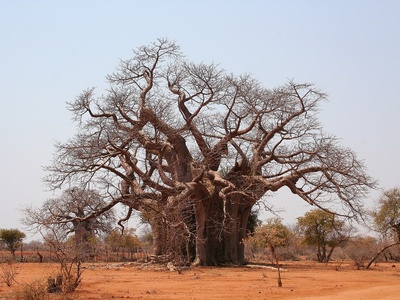
Baobab
Iconic broad-trunked tree with huge white nocturnal flowers; petals and long stamens cluster in funnel-shape. Look for flowers on bare branches in the dry season near villages and waterholes; fruit is large and pulpy, used locally.
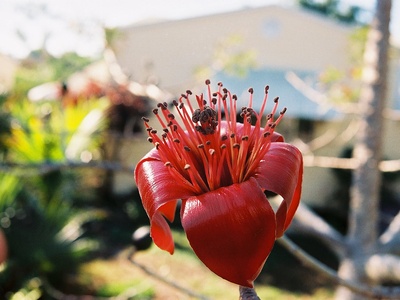
Red kapok
Striking red bowl-shaped flowers appear before or with leaves atop tall, bare trunks. Flowers attract sunbirds; easy to ID by swollen base and spiny seed pods. Common in Sudanian-savanna zones and roadside clearings.
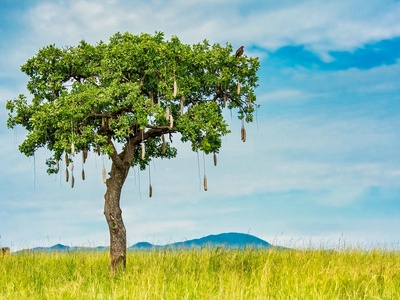
Sausage tree
Massive hanging sausage-like fruits and large maroon tubular flowers; blooms on branches and trunk. Found along rivers and in villages; flowers open in evening and draw bats and bats and nocturnal pollinators.

Kapok/Ceiba
Tall emergent with pale pink to white flowers and spiny trunk; flowers are showy and visited by bats and bees. Look for cottony seed floss after fruiting; common around riverine forests and old settlements.
African rosewood
Small yellow-orange papilionaceous flowers in dense clusters; bark reddish and valuable timber. Leaves pinnate; often found on well-drained savanna soils and along tracks where trees are scattered.
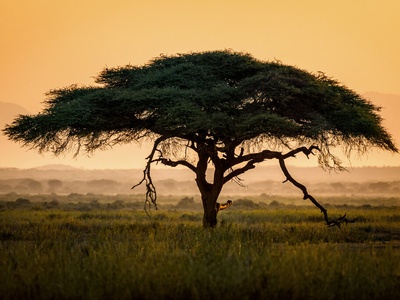
Umbrella thorn acacia
Flattened canopy with small cream globular flowerheads in late dry season. Look for pairs of thorns and pinnate leaves; common dry-savanna species forming distinctive umbrella shapes.
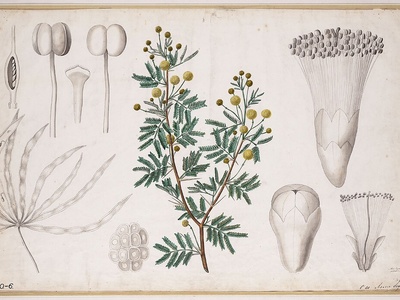
Gum arabic tree
Small creamy-yellow puffball flowers on thorny branches produce translucent gum. Compact, drought-tolerant tree often on poorer soils; easy ID by its stringy gum and bipinnate leaves.
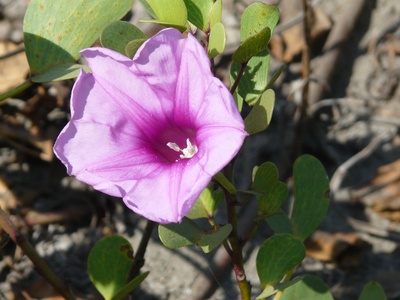
Beach morning-glory
Low creeping vine with large purple or pink funnel flowers; common on foredunes. Leaves deeply lobed and salt-tolerant; blooms nearly year-round with peak after rains, stabilizing sand.
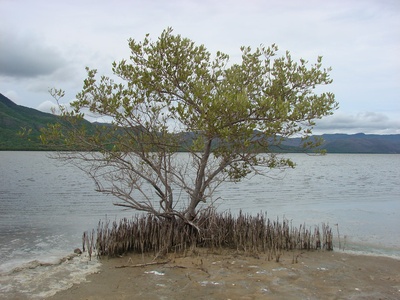
Black mangrove
Small, yellowish flowers in dense spikes among pneumatophores. Look for dark bark, leathery leaves and salt-excreting glands; dominant in many West African mangrove stands and estuaries.
Red mangrove
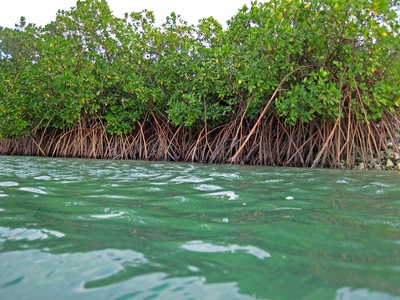
Distinctive prop roots and small bell-shaped flowers; propagules (seedlings) hang from branches. Forms dense stands along creeks and mudflats; flowers are subtle but fruits/propagules are obvious ID features.
White mangrove
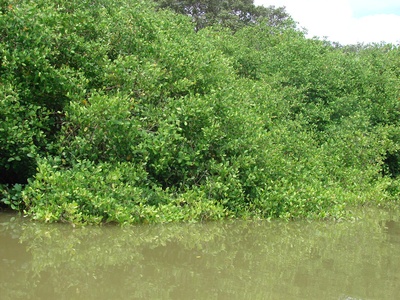
Small creamy-yellow cluster flowers and paired glands at leaf base; occurs at higher, less flooded mangrove zones. Look at leaves and nearby mangrove species to distinguish zones.
Portia tree
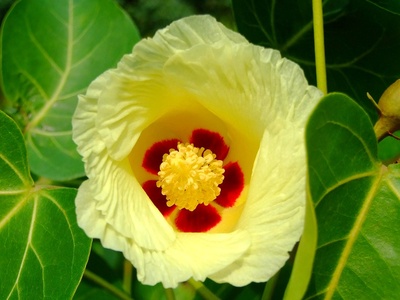
Small hibiscus-like yellow flowers with darker center; heart-shaped leaves and corky fruit. Common on sheltered beaches and near villages, salt-tolerant and often used as windbreak.
Tropical almond
Horizontal branching with large reddish-yellow flowers; fruit almond-like and edible. Leaves turn red before falling; common ornamental and naturalized on coasts and riverine strips.
Mango
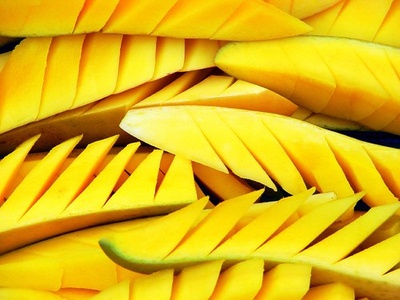
Large panicles of fragrant white to pink flowers precede fruiting. Widely cultivated orchards and homesteads; naturalized seedlings can be found in fallow fields and forest edges.
Roselle
Bright red calyces and hibiscus-like flowers used for tea (bissap). Bushy annual/shrub with lobed leaves; common in fields and homesteads where it’s cultivated and occasionally naturalized.
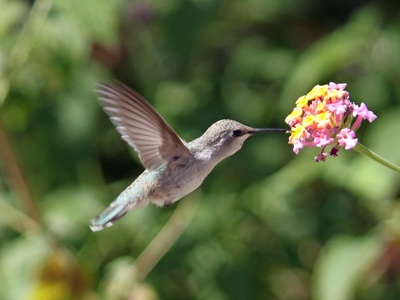
Lantana
Upright shrub with dense, multicolored flower clusters (orange, red, yellow). Highly invasive and common along disturbed tracks; aromatic leaves and rough stems help ID.
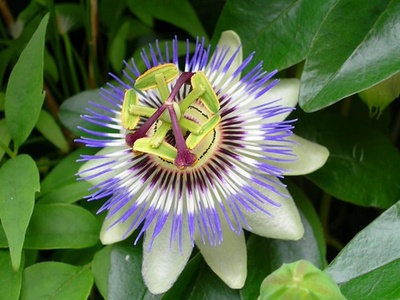
Wild passionflower
Delicate fragrant white-and-purple corona flowers and sticky hairy fruits. Vine often found climbing shrubs near coasts and paths; distinctive fringed corona makes ID straightforward.
Grey nicker
Tough spiny shrub with yellow pea-like flowers and round grey seed pods. Seeds wash up on shores; common in coastal scrub and used traditionally in local medicine.
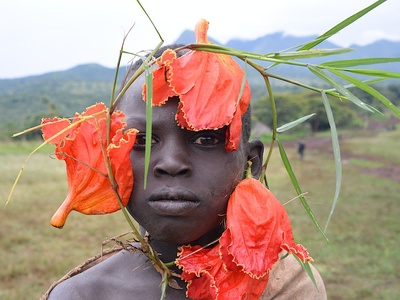
African tulip
Showy orange-red urn-shaped clusters; planted as ornamental but also naturalized in wetter sites. Young glossy leaves and explosive seed capsules; attracts sunbirds and bees.
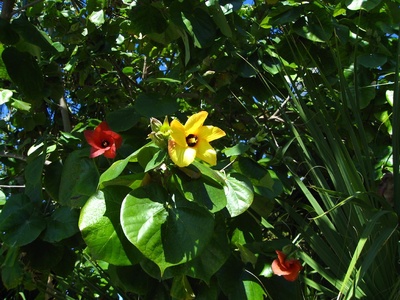
Sea hibiscus
Large heart-shaped leaves and yellow hibiscus flowers often with dark center. Tolerant of salt spray and common along coastlines and estuary fringes where it forms clumps.
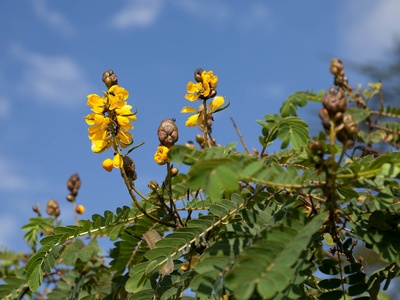
Candle bush
Large pinnate leaves and tall spikes of bright yellow buttercup-like flowers; commonly grows in waste places and along roadsides. Recognizable by tall flowering racemes and large leaflets.
Bushwillow
Clusters of small creamy to yellowish flowers followed by winged fruits. Shrub or small tree with sticky buds; common in drier savanna and used for fuelwood and fencing.
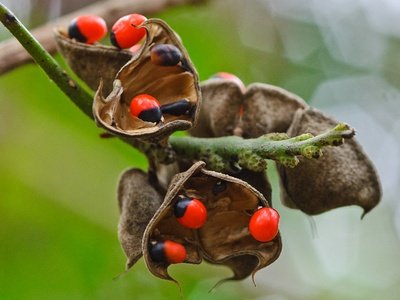
Rosary pea
Climbing vine with pea-like pink-and-white flowers and glossy red-black seeds (toxic). Often found twining through coastal scrub and disturbed woodland; seeds used as beads (handle with care).
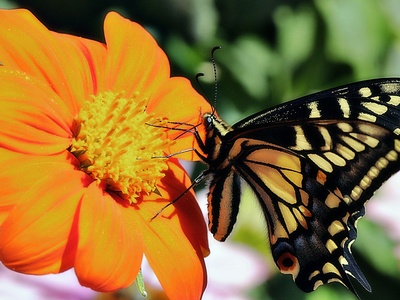
Mexican sunflower
Tall annual with bright orange daisy-like flowers; widely naturalized and colonizes degraded soils. Easily spotted along roads and abandoned plots by its profuse late-season blooms.
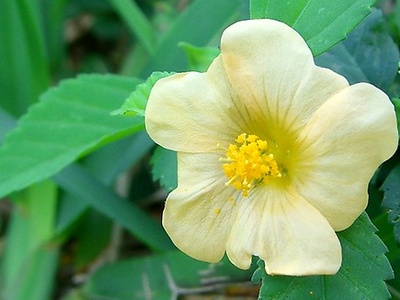
Common wireweed
Small erect shrub with pale yellow 5-petaled flowers and lanceolate leaves. Very common weed in villages and fields; flowers are modest but abundant, often used as a field identification staple.