Rainforests are a tangle of life where moisture, shade and constant turnover create perfect conditions for fungal diversity. From the forest floor to the canopy, fungi break down wood and leaf litter, form partnerships with plants, and sometimes act as parasites or predators in surprising ways.
There are 22 rainforest fungi, ranging from Bioluminescent Mycena to Zombie-ant fungus. For each species the list shows the columns Scientific name,Size (cm),Range so you can compare size and distribution at a glance — you’ll find these details below.
How do rainforest fungi affect the forest ecosystem?
Fungi are primary decomposers and nutrient recyclers, breaking down complex organic material into forms plants and other organisms can use; many also form mycorrhizal partnerships that improve plant nutrient uptake, while others control insect and plant populations, so their presence shapes community structure and soil fertility.
Could any of these fungi be dangerous to people or pets?
Some rainforest fungi produce toxins or can cause allergic or opportunistic infections, but most are harmless if left alone; avoid handling unidentified mushrooms, follow local guidance when foraging, and seek medical help if you suspect poisoning or infection.
Rainforest Fungi
| Name | Scientific name | Size (cm) | Range |
|---|---|---|---|
| Termitomyces titanicus | Termitomyces titanicus | 30-80 cm | West & Central African rainforests |
| Veiled stinkhorn | Phallus indusiatus | 6-15 cm | Pantropical (Amazon, SE Asia, Africa) |
| Zombie-ant fungus | Ophiocordyceps unilateralis | 2-6 cm (stroma) | Tropical forests worldwide (Amazon, SE Asia, Africa) |
| Bioluminescent Mycena | Mycena chlorophos | 1-4 cm | Subtropical/tropical Asia, some Pacific islands |
| Brazilian glowing Mycena | Mycena luxaeterna | 1-2 cm | Atlantic Forest, Brazil |
| Glowing Jack-o’-lantern | Neonothopanus gardneri | 3-9 cm | Atlantic Forest, Brazil |
| Pink cup fungus | Cookeina tricholoma | 1-8 cm | Neotropical rainforests (Central & South America) |
| Wood ear | Auricularia polytricha | 3-10 cm | Tropical Asia; pantropical in humid forests |
| Tropical reishi | Ganoderma australe | 5-30 cm | Pantropical rainforests |
| White root rot fungus | Rigidoporus microporus | 5-60 cm | Tropical America, Asia, Africa |
| Pineapple bolete | Boletellus ananas | 5-12 cm | Neotropical & Paleotropical rainforests |
| Split-gill fungus | Schizophyllum commune | 0.5-3 cm | Worldwide including tropical rainforests |
| Tropical turkey-tail | Trametes lactinea | 2-10 cm | Tropical Asia, Africa, Americas |
| Snow fungus | Tremella fuciformis | 2-10 cm | Tropical/subtropical Asia (wild rainforest records) |
| Large tropical porcini | Phlebopus portentosus | 20-60 cm | Southeast Asian rainforests |
| Stinkhorn (column) | Pseudocolus fusiformis | 3-8 cm | Pantropical rainforests |
| Bird’s nest fungus | Cyathus striatus | 0.5-2 cm | Worldwide including tropical rainforests |
| Tropical Xylaria | Xylaria cubensis | 1-6 cm | Neotropical rainforests |
| Pink oyster mushroom | Pleurotus djamor | 3-12 cm | Pantropical rainforests |
| Wild Lentinus | Lentinus squarrosulus | 3-12 cm | Tropical Africa, Asia, Americas |
| Small bioluminescent Mycena group | Mycena sp. | 1-3 cm | Tropical & subtropical rainforests worldwide |
| Termite mushroom (Indian) | Termitomyces heimii | 5-20 cm | South & Southeast Asian rainforests |
Images and Descriptions
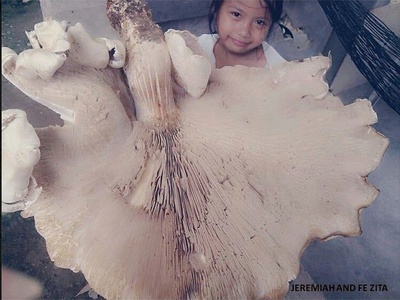
Termitomyces titanicus
Huge termite-associated mushroom with massive caps; obligate symbiont of fungus-growing termites, decomposes plant matter inside nests. Highly prized edible species, appears after rains in forest clearings and termite mounds.
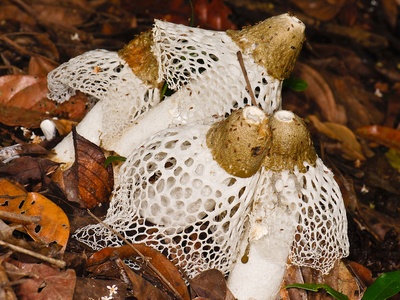
Veiled stinkhorn
Distinctive white, netted “skirt” beneath a bell-shaped cap; saprotrophic in leaf litter and wood chips. Emits a foul odor to attract flies; eaten in some Asian cuisines when young.
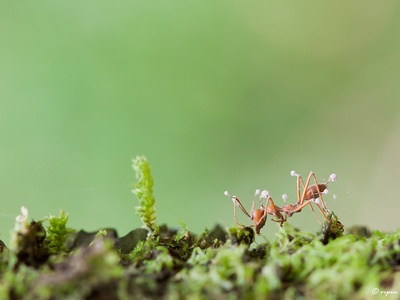
Zombie-ant fungus
Iconic entomopathogenic fungus that infects carpenter ants, altering behavior to die on vegetation where fungal stalks emerge. Important tropical ecological actor and model for host–parasite studies.
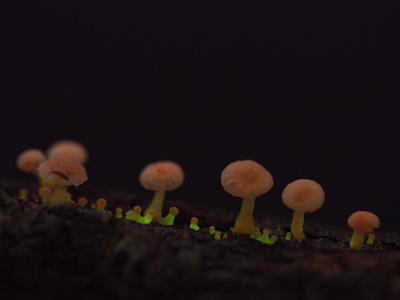
Bioluminescent Mycena
Small wood-rotting mushroom notable for greenish bioluminescence at night. Grows on fallen twigs in humid rainforest understory; non-toxic but not generally eaten.

Brazilian glowing Mycena
Tiny, strikingly bioluminescent mushroom found on decaying wood in humid Atlantic rainforest. Saprotrophic and rare, prized by photographers and naturalists for its ethereal glow.

Glowing Jack-o’-lantern
Bright orange bioluminescent mushroom growing on palm and woody debris in Brazilian rainforest. Saprotrophic, medium-sized cap, notable for clustered growth and night-time light displays.
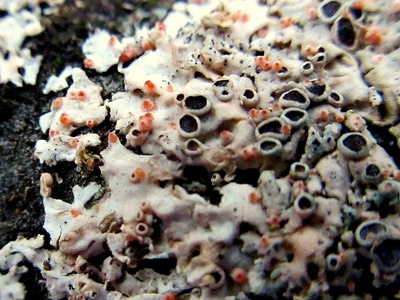
Pink cup fungus
Colorful, shallow-cup fungus on decaying twigs in wet forest; vivid pink to orange cups up to several centimeters. Easy to spot on fallen wood and non-toxic but mainly of interest to photographers.
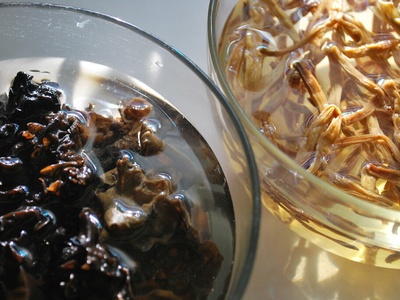
Wood ear
Gelatinous, ear-shaped bracket on decaying wood; common in tropical rainforests. Edible and cultivated in Asia, used in soups; functions as a saprotroph recycling dead wood.
Tropical reishi
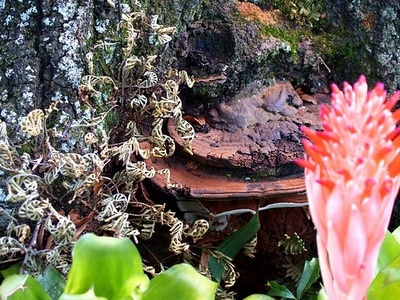
Large shelf polypore on living or dead trunks; brown varnished cap with white margin. Wood-decay fungus with medicinal use in some traditions; key decomposer of rainforest trees.
White root rot fungus
Parasitic polypore causing white root rot on many tropical trees, including rubber and cacao. Produces large brackets on trunks; ecologically important as a disease agent and timber pest.
Pineapple bolete
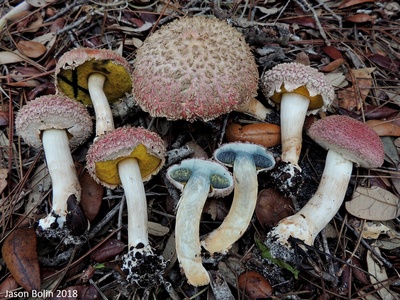
Boletaceous mushroom with scaly, pineapple-like cap surface; often mycorrhizal with tropical hardwoods. Edibility variable, important as a forest mycorrhizal partner aiding tree nutrition.
Split-gill fungus
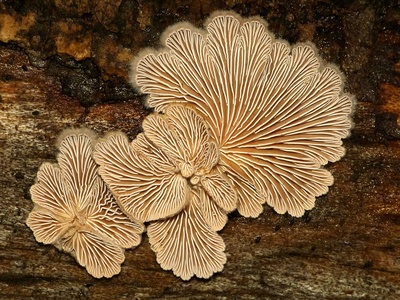
Small, fan-shaped wood-decay fungus growing on dead branches; gills split lengthwise when dry. Extremely widespread saprotroph, used in research and occasionally in folk medicines.
Tropical turkey-tail
Thin, zoned bracket polypore on dead wood in rainforests; whitish to cream-colored underside. White-rot decomposer that recycles lignin and cellulose on fallen logs.
Snow fungus
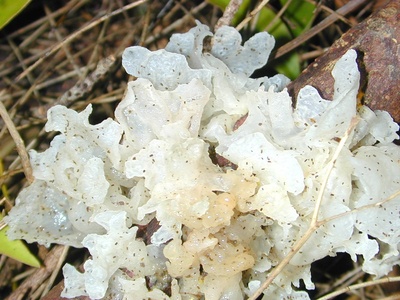
White, jelly-like parasitic fungus that grows on other wood-rot fungi in humid forests. Cultivated widely for food and medicine but also occurs naturally on dead wood in rainforests.
Large tropical porcini
Very large, bolete-like mushroom forming ectomycorrhizal associations with tropical trees; edible and foraged locally. Impressive cap size makes it conspicuous in forest litter near host trees.
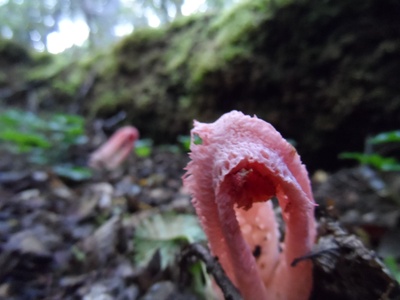
Stinkhorn (column)
Striking red-orange stinkhorn that emits a fetid odor to attract flies; saprotrophic on rich forest litter. Short-lived but conspicuous and common in disturbed rainforest patches and trails.
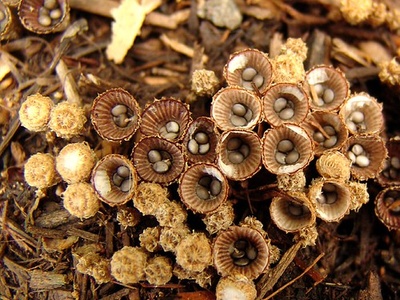
Bird’s nest fungus
Tiny “bird’s nest” fruiting bodies on decaying wood and woody debris. Splash-cup spore dispersal adapted to humid forest floors; interesting micro-fungi for photographers and ecologists.
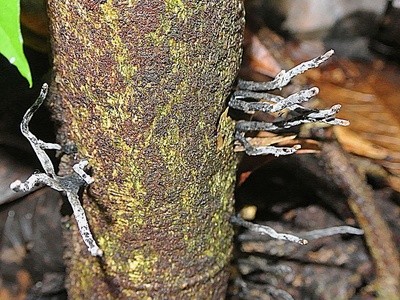
Tropical Xylaria
Black, finger-like stromata on decaying wood and palm debris; common xylariaceous decomposer. Produces long-lasting fruiting bodies and is typical of humid tropical forest wood decay communities.
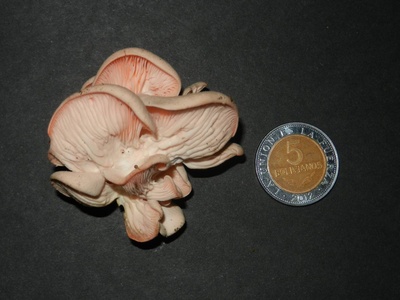
Pink oyster mushroom
Bright pink gilled mushroom growing on dead wood in warm, humid forests. Saprotrophic and widely eaten where found; fast-growing and occasionally foraged by local communities.
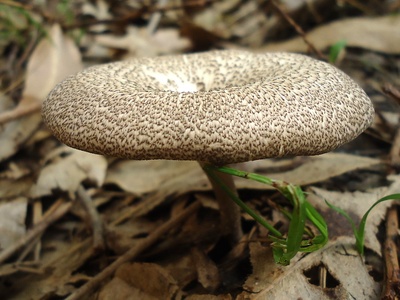
Wild Lentinus
Saprotrophic, leathery-gilled mushroom on dead trunks and fallen logs in humid forests. Locally collected as an edible in parts of Africa and Asia; effective wood decomposer.
Small bioluminescent Mycena group
Various small Mycena species produce bioluminescence on decaying wood in rainforest understories. Saprotrophic, tiny caps best seen by night photography; many species remain undescribed.
Termite mushroom (Indian)
Edible, termite-associated mushroom forming large, umbrella-like caps emerging from termite mounds or litter in wet tropical forests. Valued as food; part of termite–fungus mutualism that recycles plant material.