Desert landscapes often look empty, but a closer look reveals a lively community of insects perfectly fitted to heat, sand and sparse vegetation. Many are small, well-camouflaged or active at night, making them easy to miss unless you know where to look and when to search.
There are 16 Desert Insects, ranging from Antlion to Tarantula hawk. For each species, you’ll find below the Scientific name, Size (mm), Range to help with identification and quick comparisons—you’ll find below.
How can I safely observe these species without harming them?
Look for activity at cooler times (dawn, dusk, or night with a red-filtered light), watch from a short distance, and avoid lifting rocks or digging. Use photos and notes instead of handling; a small hand lens helps with ID. If you must move something, replace it exactly as found to preserve microhabitats.
What common adaptations let desert insects survive with so little water?
Many avoid daytime heat by being nocturnal or burrowing, have waxy cuticles to reduce water loss, and rely on metabolic water from food. Some enter dormant states during extreme drought and time reproduction to short wet periods, all strategies that conserve water and energy.
Desert Insects
| Name | Scientific name | Size (mm) | Range |
|---|---|---|---|
| Blue death-feigning beetle | Asbolus verrucosus | 10-20 | Sonoran and Mojave deserts (SW USA, Baja California) |
| Namib fog-basking beetle | Stenocara gracilipes | 8-12 | Namib Desert coastal dunes and fog zone |
| Pinacate beetle | Eleodes armata | 20-35 | SW USA and northern Mexico deserts |
| Sahara silver ant | Cataglyphis bombycina | 6-12 | Sahara Desert and North African arid plains |
| Red harvester ant | Pogonomyrmex barbatus | 6-9 | Chihuahuan, Sonoran deserts and nearby grasslands |
| Desert locust | Schistocerca gregaria | 40-80 | North Africa, Middle East, arid Africa and Asia |
| Tarantula hawk | Pepsis grossa | 25-40 | Deserts of SW USA to Central America |
| Panda ant (velvet ant) | Dasymutilla gloriosa | 10-20 | Southwestern US deserts (Sonoran, Chihuahuan) |
| Jerusalem cricket | Stenopelmatus fuscus | 30-70 | Arid western US and Mexican deserts and foothills |
| Mormon cricket | Anabrus simplex | 30-60 | Intermountain and Great Basin arid shrublands |
| Cactus moth | Cactoblastis cactorum | 10-15 | Arid Americas and invaded dry regions with prickly pear |
| Desert cicada | Diceroprocta apache | 20-35 | Sonoran and Chihuahuan deserts (SW USA, Mexico) |
| Cicada killer wasp | Sphecius speciosus | 25-35 | Open sandy soils across North American arid and semi-arid areas |
| Antlion | Euroleon nostras | 15-25 | Mediterranean and arid sandy habitats in Europe and N Africa |
| Sand wasp | Bembix americana | 12-20 | Sandy soils in North American arid scrub and dunes |
| Namib dune beetle | Onymacris unguicularis | 15-20 | Namib Desert coastal fog belt dunes |
Images and Descriptions
Blue death-feigning beetle
Chunky dark-blue darkling beetle of Sonoran and Mojave deserts; scavenges plant detritus and seeds. Known for “death-feigning” behavior and rough, warty elytra that reduce water loss; common under rocks and at night, tolerant of heat and drought.

Namib fog-basking beetle
Small dark tenebrionid that harvests fog by facing into wind and tilting abdomen to collect droplets. Feeds on detritus and microbial films; superb adaptation to hyper-arid coastal deserts, active in mornings when fog rolls inland.
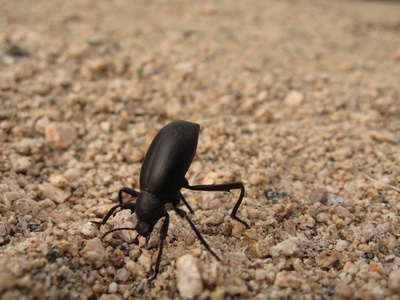
Pinacate beetle
Large black darkling beetle often called pinacate or stink beetle; feeds on decaying plant material and seeds. Raises abdomen to release defensive odor when threatened, common across sandy flats and scrub where it forages at night.
Sahara silver ant
Fast-moving ant adapted to extreme heat; forages at midday when surface temperatures soar. Silvery hairs reflect sunlight and reduce heat gain; uses remarkable navigation to find scattered food and return to distant nests in hot, barren terrain.
Red harvester ant
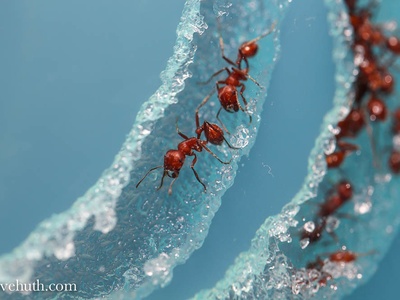
Seed-eating ground ant that harvests and stores seeds, shaping desert plant communities. Colonies build conspicuous mounds and clear foraging trails; workers collect and dry seeds, timing activity to avoid extreme heat.
Desert locust
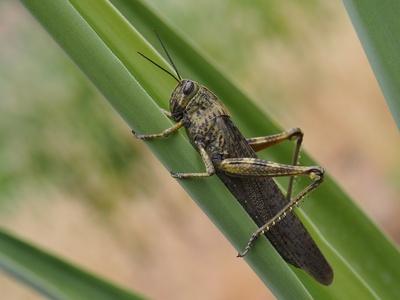
Famous migratory grasshopper that forms massive swarms after episodic rainfall in arid regions. Feeds on live vegetation and crops; solitary and gregarious phases show behavioral and color changes, making it one of the most destructive desert pests.
Tarantula hawk
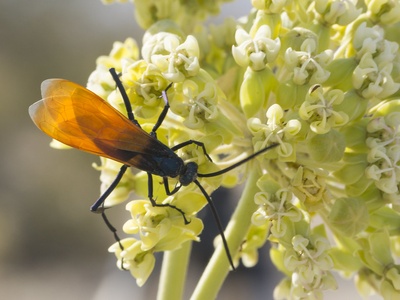
Large metallic wasp that hunts tarantulas to provision its larval nest. Adults feed on nectar but females sting and paralyze spiders, dragging them to burrows. Noted for a very painful sting; common near desert flowers and sandy soils.
Panda ant (velvet ant)
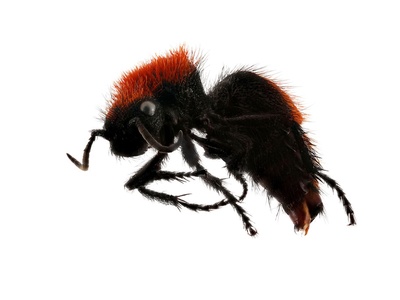
Brightly patterned wingless female wasp with dense hairs; mimics ants. Females roam sandy desert flats seeking bee nests to parasitize; sting is extremely painful. Males are winged but rarely seen; a striking, unmistakable desert insect.
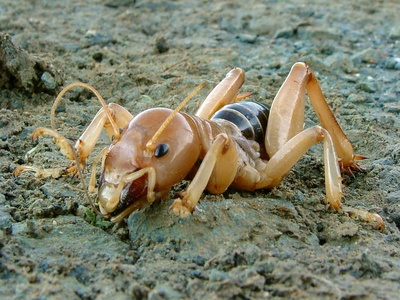
Jerusalem cricket
Large, flightless nocturnal insect that feeds on tubers and detritus in burrows. Big head and powerful jaws give it a distinctive look; often encountered under rocks and logs, harmless but startling to people.
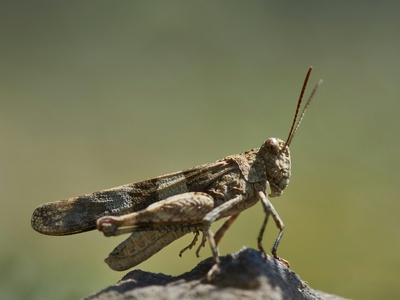
Mormon cricket
Large wingless katydid-like hopper that forms dense migratory bands after wet years, stripping vegetation. Omnivorous and gregarious, it can damage rangelands in mass outbreaks; otherwise a common herbivore on sagebrush and desert grasses.
Cactus moth
Small moth whose larvae feed on prickly pear cacti, burrowing through pads and causing dieback. Native to South America, introduced as a biological control in arid Australia; now an invasive threat in some desert ecosystems.
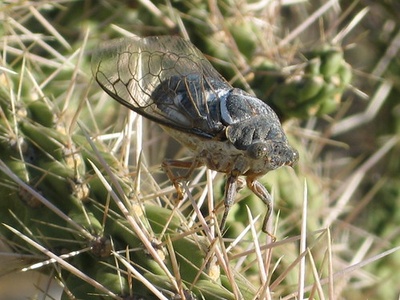
Desert cicada
Loud summer singer perched on desert shrubs and cacti; adults feed on plant xylem. Short-lived above ground, with a long subterranean nymph stage; well tuned to hot, dry seasons and often heard during midday heat.
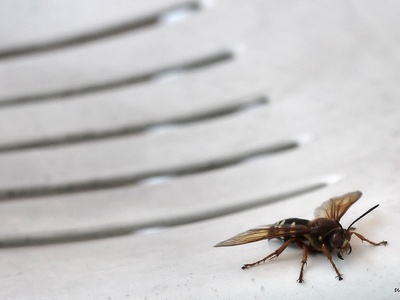
Cicada killer wasp
Solitary wasp that paralyzes cicadas to provision underground burrows for its larvae. Large and impressive but non-aggressive toward people; common on sunny, bare patches and along desert washes where cicadas live.
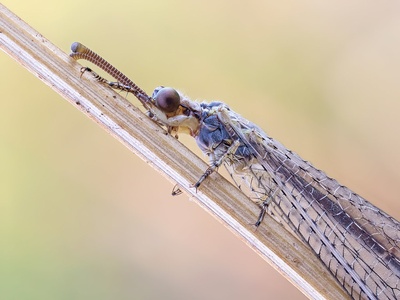
Antlion
Adult lacewing-like insect whose larvae (“doodlebugs”) dig conical sand pits to trap ants and small insects. Larvae lie buried waiting for prey; adults are nocturnal, fragile, and resemble damselflies when seen near desert sand.
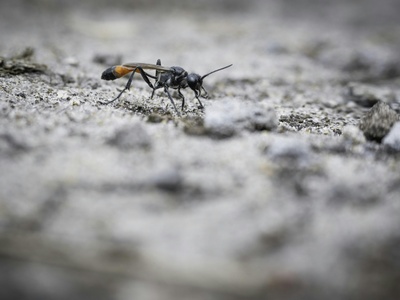
Sand wasp
Fast-flying solitary wasp that digs burrows in sandy desert soils and provisions them with paralyzed flies. Often seen hovering near ground, nesting in large aggregations on bare sand, important predators of flying insects.
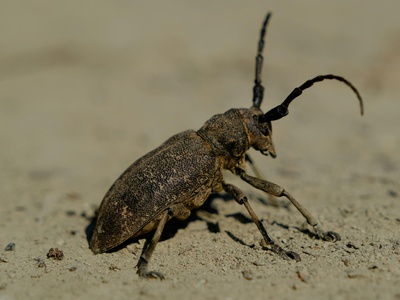
Namib dune beetle
Shiny dark tenebrionid famed for fog-collection behavior: stands on dunes to condense moisture on elytra. Feeds on detritus and seeds, active at night and dawn, extremely water-efficient and emblematic of Namib adaptations.