That flash of yellow at your feeder is almost certainly one of a dozen birds, not a hundred. North America has a manageable shortlist of yellow species that show up in yards, and most beginner confusion comes down to two or three lookalikes plus the fact that the females are usually drabber than the males.
The American Goldfinch is one of 120 birds in our bird quiz, which has 40 photos on each of three levels. See how many backyard birds you can name.
This guide sorts them out. Each entry gives you the one field mark that settles the ID, the size, when and where you’ll see the bird, and a note on the female if she looks different enough to trip you up. There’s a quick comparison table for the three birds people mix up most, a short explainer on why these birds are yellow in the first place, and a feeder-and-plant section for getting more of them into your yard.
Table of Contents
- Quick ID table: the three lookalikes
- The 12 yellow birds
- American Goldfinch
- Yellow Warbler
- Western Tanager
- Lesser Goldfinch
- Common Yellowthroat
- Wilson’s Warbler
- Yellow-rumped Warbler
- Prothonotary Warbler
- Evening Grosbeak
- Hooded Oriole
- Western Meadowlark
- Yellow-breasted Chat
- Why are some birds yellow?
- How to attract yellow birds to your yard
Quick ID table: the three lookalikes
Most “what’s this yellow bird” questions are really one of these three. Here’s the fast version before the full profiles.
| Bird | Wings | Bill | Where you see it | Tell |
|---|---|---|---|---|
| American Goldfinch | Black with white bars | Short, conical (seed-eater) | At the feeder, on thistle | Black cap on the male; bouncy, undulating flight |
| Yellow Warbler | Plain yellow, no bars | Thin, pointed (insect-eater) | In shrubs and willows, not feeders | Reddish streaks down the breast; almost no contrast |
| Western Tanager | Black with yellow bars | Stout, pale | High in conifers, west of the Rockies | Orange-red head on the male |
The bill is your shortcut. Cone-shaped and thick means a seed-eater that’ll visit feeders. Thin and pointed means a warbler that’s after insects and won’t.
The 12 yellow birds
1. American Goldfinch
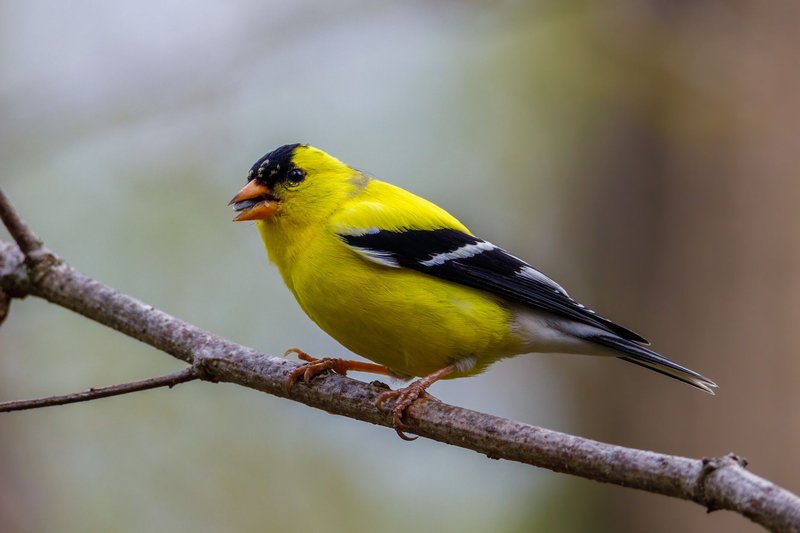
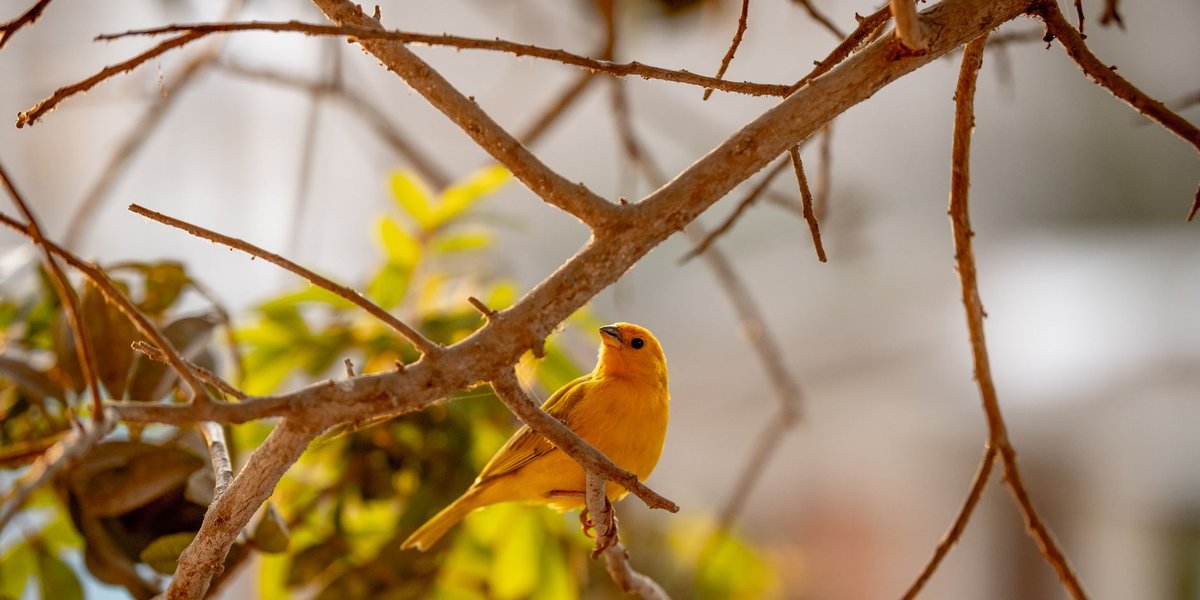
The default answer to “small yellow bird at my feeder.” Breeding males in summer are almost neon — bright lemon body, jet-black wings with white bars, and a tidy black cap right above the bill. Roughly 5 inches, sparrow-sized but slimmer.
Females and winter birds are the trap. The female is a dull olive-yellow year-round with no black cap, and in winter the male molts down to nearly the same drab buff, keeping only the black-and-white wings as a clue. So a “boring brown” finch in January and a screaming-yellow one in July can be the same bird.
Found across most of the U.S. and southern Canada. They love nyjer (thistle) seed and travel in loose, chattering flocks. The giveaway in flight is the deep, roller-coaster bounce paired with a flight call that sounds like po-ta-to-chip.
2. Yellow Warbler
The yellowest bird most people will ever see — it’s yellow on top of yellow. Unlike the goldfinch, the wings aren’t black; they’re yellow too, so the whole bird looks like a single warm color with very little contrast. Males have fine chestnut-red streaks running down the breast. About 5 inches, with a thin insect-eating bill.
It won’t come to your seed feeder. Look instead in willows, wet thickets, and shrubby edges near water, where it gleans caterpillars. The female is plainer and lacks the breast streaks, but she’s still unmistakably yellow all over. The song is a bright, hurried sweet-sweet-sweet-I’m-so-sweet. The Cornell Lab of Ornithology notes it breeds across nearly all of North America, so almost everyone has them passing through in spring.
3. Western Tanager
The showpiece of the western yellow birds. The male has a yellow body, black wings marked with yellow and white bars, and a flaming orange-red face that looks almost painted on. Around 7 inches, noticeably chunkier than a finch.
That red head comes from the bird’s diet rather than its own pigments — more on that below. Females skip the red entirely and wear a softer yellow-green, which makes them easy to overlook in the conifer canopy where this bird spends most of its time. Found in western mountain forests in summer, mainly from the Rockies to the Pacific. You’re more likely to hear its hoarse, robin-like song than spot it.
4. Lesser Goldfinch
The American Goldfinch’s smaller southwestern cousin, and a regular feeder visitor across California, the Southwest, and Texas. Males come in two flavors: a black-backed form and a green-backed form, both with a bright yellow underside and a dark cap. Just under 4.5 inches, so a touch tinier than the American.
The quickest separation from its bigger relative is the underside of the tail — Lesser Goldfinches show white patches there in flight. They’re also far more vocal, with a wheezy, mimicking song that strings together bits of other birds’ calls. They’ll mob a nyjer feeder in the same flocks as their cousins, so check tail and back if you’re in range of both.
5. Common Yellowthroat
Picture a small yellow bird wearing a black bandit mask, and you’ve got the male yellowthroat. The mask is bordered above by a thin white line, the throat and breast are bright yellow, and the back is olive. About 5 inches, often with the tail cocked up.
It’s a warbler, so think wetlands and dense low cover rather than feeders — cattail marshes, brushy fields, ditches. The female has no mask and is a plainer olive-and-yellow, which makes her one of the harder warblers for beginners. The male’s song is an easy one to learn: a rolling witchety-witchety-witchety.
6. Wilson’s Warbler
A tiny, hyperactive ball of yellow with a neat black beanie. The male’s solid black cap on an otherwise plain yellow head is the entire ID — nothing else looks quite like it. Around 4.5 inches and constantly flicking its tail.
Females and immatures may show only a faint smudge of a cap or none at all, leaving a plain yellow warbler that you separate from the Yellow Warbler by the lack of breast streaks and the longer, more active tail. It breeds in willow thickets across Canada, Alaska, and the western mountains, and passes through much of the country on migration, foraging low in shrubs where you can actually see it. That twice-a-year long-haul is impressive but hardly unique among songbirds — it’s the same instinct that drives the planet’s most famous long-distance migratory animals to cross continents on schedule.
7. Yellow-rumped Warbler
Not a fully yellow bird, but it earns a spot because it’s the yellow warbler you’re most likely to see in fall and winter, when the truly yellow ones have left. Mostly gray and white with bright yellow patches on the rump, sides, and (in the “Myrtle” and “Audubon’s” forms) the crown and throat. About 5.5 inches.
The flash of yellow on the rump as it flies away is so reliable that birders nickname it the “butter-butt.” It’s unusually hardy for a warbler because it can digest the wax in bayberries and wax myrtle, which lets it winter much farther north than its relatives. So a yellow-flashing bird in a cold-weather yard is almost always this one.
8. Prothonotary Warbler
The golden ghost of southeastern swamps. The whole head and underparts glow a deep, saturated orange-yellow, set against blue-gray wings — a richer, almost metallic yellow compared to the lemon of a goldfinch. Roughly 5.5 inches, with a noticeably long, heavy bill for a warbler.
It’s one of the few warblers that nests in tree cavities, so it sticks to flooded forests, cypress swamps, and wooded riverbanks in the Southeast. Females are a slightly muted version of the male but still strikingly golden. If you see a brilliant yellow bird working low over standing water in Louisiana or the Carolinas, this is your bird.
9. Evening Grosbeak
A bruiser of a yellow bird, built like a finch that hit the gym. The male is yellow and brown with a bold yellow eyebrow stripe, big white wing patches, and a massive pale greenish bill made for cracking heavy seeds. About 7 inches and stocky.
Females trade the yellow for soft gray with hints of yellow on the neck. This one is famous for being unpredictable — some winters big flocks “irrupt” far south of their northern range, mobbing platform feeders with sunflower seed, and other winters they’re nowhere to be found. Populations have declined sharply over recent decades, so a visit is more of an event than it used to be.
10. Hooded Oriole
A slim, elegant yellow-to-orange oriole of the Southwest, strongly tied to palms. The male has a yellow-orange body, black throat and back, and a long tail, and he often builds his hanging nest stitched to the underside of a palm frond. Around 8 inches, longer and more slender than the grosbeaks and tanagers.
Females and young males are a plainer olive-yellow without the black throat. Found in California, Arizona, Texas, and south, especially in suburbs with ornamental palms. Orioles have a sweet tooth — they’ll come to nectar feeders, orange halves, and grape jelly, which makes this one of the easier yellow birds to lure in if you live in range.
11. Western Meadowlark
A chunky grassland bird with a brilliant yellow breast crossed by a bold black V, like a badge. The back is streaky brown for camouflage in dry grass, so the yellow only blazes out when the bird turns to face you or sings from a fence post. About 9.5 inches, the largest bird on this list.
You won’t find it at a feeder — it’s a ground forager of open prairies, pastures, and fields across the western and central U.S. The reason to know it is the song: a rich, flute-like, tumbling melody that’s one of the signature sounds of the American West, and the official state bird of six states. Same yellow-and-black-V pattern shows up on the nearly identical Eastern Meadowlark; voice is the cleanest way to tell them apart.
12. Yellow-breasted Chat
The oddball that closes the list. Long classified as a giant warbler, the chat has a bright yellow throat and breast, olive back, and white “spectacles” around the eyes. At about 7.5 inches it dwarfs every real warbler, and its bill is heavier too. Audubon’s field guide describes its bizarre vocal range, which is the real reason to seek it out.
It’s a skulker that hides in dense, brushy thickets and shrubby old fields, more often heard than seen. The voice is unlike any other songbird: a disjointed mix of whistles, cackles, chuckles, and harsh chatter, sometimes delivered at night. Found across much of the U.S. in summer in overgrown, scrubby habitat.
Why are some birds yellow?
The yellow comes from carotenoids — the same family of pigments that makes carrots orange and egg yolks yellow. Birds can’t manufacture carotenoids on their own. They get them from food: seeds, fruits, and the insects that ate carotenoid-rich plants.
That diet link explains a lot of what you see in the field. A goldfinch on a good diet molts in brighter, more saturated feathers, and studies have found that the intensity of a male’s color signals his health and foraging skill to females. It also explains the Western Tanager’s orange face: that red tint comes from rhodoxanthin, a rare pigment the bird gets through its diet rather than producing itself, which is why the shade can vary from bird to bird.
It’s worth separating this from how blue and green are made. Blue in birds is structural — created by the way feather microstructure scatters light, not by a pigment. The same pigment-versus-structure distinction trips people up across the animal kingdom; plenty of big green animals only look green because of scales, lighting, or algae rather than any true green pigment. Yellow, by contrast, is almost always pigment you can trace back to the menu. So when a bird looks washed out, it’s often a clue about diet or the time of year rather than a different species. The USGS covers the broader why-birds-are-colored question if you want the deeper version.
It’s also worth remembering that the yellow you see isn’t necessarily the yellow the birds see. Many birds perceive ultraviolet light, so feathers that look like a flat lemon to us can carry hidden UV signals that matter for choosing a mate.
How to attract yellow birds to your yard
Two of the yellow birds above are realistic feeder targets for most people — the goldfinches — plus orioles if you’re in the right region. The warblers and tanagers are insect and fruit eaters, so you attract those with habitat, not seed.
For goldfinches: put out nyjer (thistle) seed in a tube feeder with small ports or a mesh “finch sock.” Goldfinches cling and feed upside down happily, and the tiny seed keeps larger birds out. Hulled sunflower chips work too. Keep the feeder stocked through winter — goldfinches don’t leave, they just go drab, and a reliable feeder holds the flock.
For orioles (Hooded, and the more orange Baltimore and Bullock’s): offer orange halves, grape jelly in a shallow dish, or a nectar feeder with larger ports than a hummingbird feeder. Put these out in early spring; orioles scout for food right when they arrive and a feeder that’s already up gets found first.
Plant for the insect-eaters: native flowering and seed-bearing plants do double duty. Coneflowers, sunflowers, asters, and cosmos left to go to seed feed goldfinches straight off the plant — they’ll often skip the feeder for a fresh seedhead. Native shrubs and trees host caterpillars, which is what actually pulls warblers like the Yellow Warbler and Common Yellowthroat into a yard. A brushy, un-manicured corner near water is warbler magnet territory.
Skip the pesticides. Spraying the yard removes the caterpillars and insects that warblers, chats, and tanagers depend on. A slightly buggier garden is a yellower one.
Match the strategy to the bird and your region, and the flash of yellow at the window stops being a mystery — you’ll know its name before it lands.