Fin whales eat krill, small schooling fish, and squid — and they pack away up to two tons of it on a good feeding day. That’s the short answer. The longer answer is more interesting, because what a fin whale eats depends heavily on which ocean it’s swimming in, and the way it eats is one of the most violent, athletic feeding strategies in the animal kingdom.
This is the second-largest animal that has ever lived, after the blue whale. To haul around 80 tons of body weight, it doesn’t chase down big prey. It does the opposite: it targets some of the smallest animals in the sea and eats staggering quantities of them at once.
Table of Contents
- What fin whales eat
- How fin whales feed: lunge feeding explained
- How much do fin whales eat per day?
- Northern vs. Southern Hemisphere diets
- Fin whale diet vs. blue whale diet
- Does prey decline threaten fin whales?
What fin whales eat {#what-fin-whales-eat}
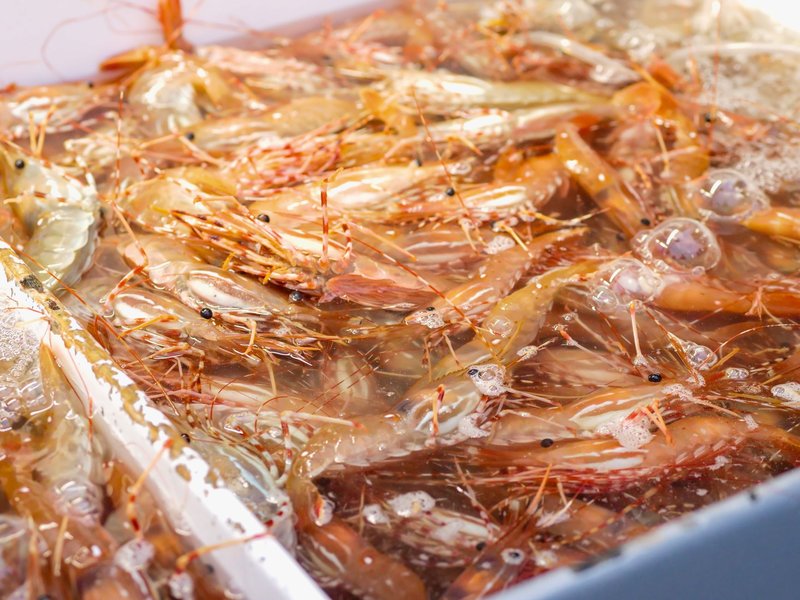
The fin whale’s menu is short but enormous in volume. The core of it:
- Krill — small shrimp-like crustaceans, the dietary backbone everywhere fin whales feed
- Copepods — tiny planktonic crustaceans, often swept up alongside krill
- Small schooling fish — herring, capelin, mackerel, sand lance, and sand eels
- Squid — a smaller, opportunistic part of the diet
What unites all of this is density, not size. Fin whales are filter feeders. They have no teeth. Instead, they go after prey that clumps together in thick, predictable swarms — a krill bloom, a bait ball of herring — because the whole strategy only works if there’s a lot of food in one mouthful. The squid in their diet is a minor, opportunistic catch, nothing like the deep-diving squid hunts of toothed specialists such as Cuvier’s beaked whales.
That’s also why fin whales aren’t picky in the way a predator with a narrow specialty would be. According to NOAA Fisheries, they take whatever schooling prey is abundant locally. In one region that’s krill; in another it’s herring. The fin whale follows the biomass.
How fin whales feed: lunge feeding explained {#how-fin-whales-feed}
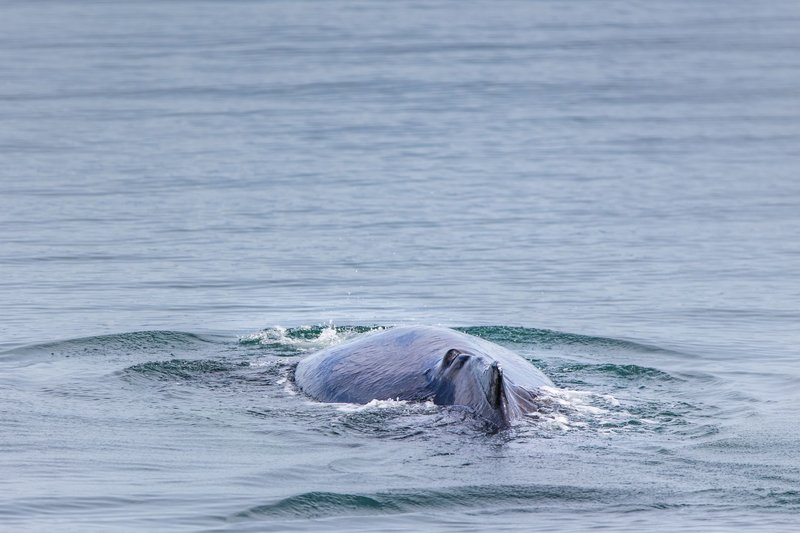
Here’s where it gets dramatic. Fin whales are lunge feeders, and lunge feeding is essentially a controlled collision with a swarm of prey.
The whale accelerates toward a dense patch of krill or fish, sometimes from below, and opens its mouth to nearly 90 degrees. As it does, the grooved skin of its throat — the ventral pleats — unfolds like an accordion. Fin whales have roughly 50 to 100 of these pleats running from the chin to the navel. The throat balloons into a massive pouch, engulfing a volume of water that can rival the whale’s own body weight in a single gulp.
Then the mouth closes. The whale pushes the water back out through its baleen — 260 to 480 fringed plates hanging from the upper jaw, made of keratin, the same protein as your fingernails. Water streams out the sides; krill and fish stay trapped on the inside of the baleen mat. The whale swallows the catch and resets.
A single lunge is metabolically expensive. The drag from that open mouth and inflated throat is brutal, which is exactly why fin whales only bother when prey is concentrated enough to make the effort pay off. They’ve also been documented rolling onto their right side while feeding — a quirk possibly linked to the whale’s asymmetrical coloring, where the lower right jaw is white and the left is dark, which may help herd fish.
How much do fin whales eat per day? {#how-much-do-fin-whales-eat}
During peak feeding season, a fin whale can eat up to around two tons (roughly 1,800 kg) of food per day. To put that in perspective, that’s the weight of a small car, consumed daily, in krill and fish.
But that number comes with a huge asterisk: it isn’t year-round. Fin whales run on a feast-and-fast cycle tied to migration.
In summer, they gorge in cold, productive feeding grounds at higher latitudes, building up thick blubber reserves. In winter, many populations migrate toward warmer breeding waters where food is scarce — and they eat little to nothing, living off the fat they banked. So the “two tons a day” figure describes a fin whale in feeding mode, not its annual average. Across the year, the intake is far more uneven than the headline number suggests, a seasonal rhythm the Whale and Dolphin Conservation group describes across baleen whale species.
This boom-and-bust pattern is why feeding-ground productivity matters so much. A bad krill year doesn’t just mean a hungry summer — it means a thinner fat reserve to survive the fasting months and fuel migration.
Northern vs. Southern Hemisphere diets {#hemisphere-differences}
This is the part most articles skip, and it’s the most interesting thing about the fin whale’s diet. What a fin whale eats depends on where it lives, and the split between hemispheres is stark.
| Region | Primary diet | Notes |
|---|---|---|
| Northern Hemisphere | Mixed: krill and small schooling fish (herring, capelin, mackerel, sand lance) plus squid | More varied, fish-heavy in many areas |
| Southern Hemisphere | Almost exclusively krill (especially Antarctic krill) | Far less fish; krill swarms dominate the food web |
Why the difference? It comes down to what’s available. Southern Ocean ecosystems around Antarctica are built on a foundation of krill — vast, dense swarms of Euphausia superba that feed nearly everything from whales to penguins to seals, the keystone resource underpinning so much polar fauna adapted to Earth’s extremes. There simply isn’t the same abundance of schooling baitfish, so Southern Hemisphere fin whales become near-specialist krill eaters.
In the Northern Hemisphere — the North Atlantic and North Pacific — the picture is more cluttered. Krill is still important, but cold-water fish like herring and capelin form dense, reliable schools too. A fin whale in the Gulf of Maine or off Norway can switch between krill and fish depending on what’s swarming that week. The diet is opportunistic and flexible in a way its southern cousins’ isn’t.
So “what do fin whales eat” genuinely has two correct answers, and the right one depends on the hemisphere.
Fin whale diet vs. blue whale diet {#fin-vs-blue}
People often lump the two largest whales together, but their diets diverge in a telling way.
Blue whales are krill specialists, full stop. They eat krill almost exclusively, in enormous quantities, and structure their entire migration around krill swarms. Fish barely register — krill dependence is one of the defining characteristics of a blue whale.
Fin whales are the generalists by comparison. They eat plenty of krill — and in the Southern Hemisphere, almost only krill — but in the Northern Hemisphere they readily add herring, capelin, mackerel, and squid to the mix. That dietary flexibility is one reason fin whales occupy a wider range of habitats than blue whales. Where a blue whale needs krill, a fin whale can make do with whatever dense prey the local waters offer.
The feeding mechanics are similar — both are lunge-feeding rorquals with pleated throats and baleen — but the menu is broader for the fin whale.
Does prey decline threaten fin whales? {#prey-decline}
Fin whales were hunted to the brink during the 20th century and are still listed as Vulnerable by the IUCN Red List, with populations recovering since the commercial whaling moratorium. But their recovery is tied directly to the small animals at the base of this article.
Krill is the pressure point. Antarctic krill populations face two compounding threats: a commercial krill fishery (krill is harvested for aquaculture feed and omega-3 supplements) and climate change, which is warming the Southern Ocean and shrinking the sea ice that krill larvae depend on. As krill distribution shifts poleward and thins out, the Southern Hemisphere fin whales that rely almost entirely on it have the least dietary flexibility to adapt.
Northern populations have more options — switch to fish when krill is scarce — but they’re not immune. Warming oceans are reshuffling where herring and capelin spawn, and a feeding ground that’s productive today may not be in twenty years.
The fin whale’s diet, in other words, isn’t just trivia. It’s the thread that connects a near-extinct giant to the health of the smallest creatures in the sea. Protect the krill swarms and the bait balls, and you protect the whale. Lose them, and two tons a day becomes a number the ocean can no longer supply.