Table of Contents
- TLDR: What Diana Monkeys Eat
- The Diet Breakdown
- Fruit Is the Backbone, Not the Whole Story
- Why the Diet Shifts With the Seasons
- How Much Time They Spend Eating
- Eating in Mixed-Species Groups Changes the Menu
- Diana Monkeys as Seed Dispersers
- What Diana Monkeys Eat in Zoos
TLDR: What Diana Monkeys Eat
Diana monkeys (Cercopithecus diana) are fruit-first foragers who fill in the gaps with whatever the forest canopy is offering that week. The rough split:
- Fruit — roughly a third of total intake, and the single biggest category
- Insects and other invertebrates — a major protein source, caught mid-branch
- Flowers — seasonally important, sometimes a primary food when fruit is scarce
- Leaves — a fallback, eaten more in lean months than good ones
- Seeds and the occasional small vertebrate or bird egg — opportunistic extras
None of that is fixed. A Diana monkey’s plate in March looks different from its plate in September, and that seasonal flexibility is the actual story — not the ingredient list.
The Diet Breakdown
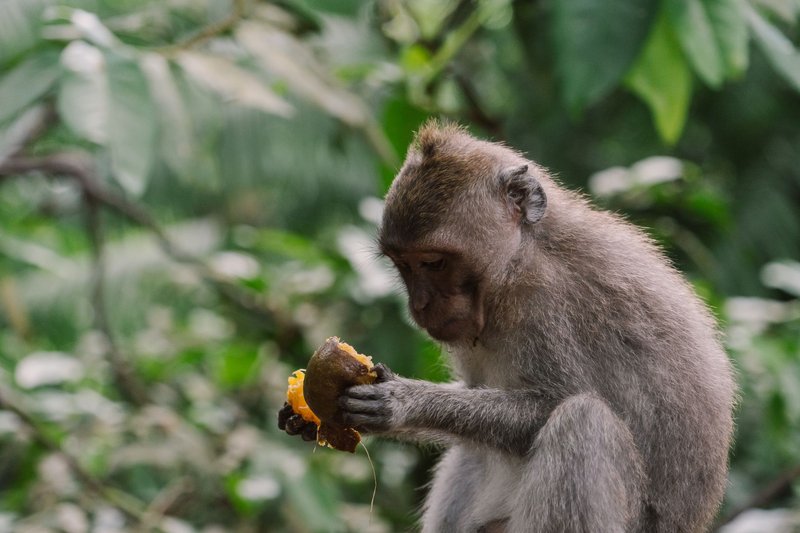
Here’s how the numbers generally shake out, based on field studies of wild populations in West Africa’s Upper Guinean forest belt:
| Food Type | Approx. % of Diet | Seasonality |
|---|---|---|
| Fruit | ~33–40% | Peaks in fruiting season (varies by forest, often mid-to-late year) |
| Insects/invertebrates | ~20–25% | Fairly constant, rises when fruit is scarce |
| Flowers | ~15–20% | Spikes during flowering season, can briefly outrank fruit |
| Leaves | ~10–15% | Rises in lean months as a fallback |
| Seeds, fungi, small prey | ~5–10% | Opportunistic, no clear season |
These aren’t lab-precise figures — wild primate diets get measured through direct observation and fecal analysis, and results vary between study sites and years. But every field study on this species lands on the same shape: fruit dominant, insects close behind, flowers and leaves filling the rest depending on what the canopy is doing.
Fruit Is the Backbone, Not the Whole Story
Diana monkeys aren’t picking at whatever fruit happens to be nearby. Researchers have documented them favoring specific species repeatedly across sites — Boleko Nut, African Nutmeg, Raphia palm fruit, and wild persimmons show up again and again in feeding records. These aren’t rare finds; they’re staples the monkeys track and revisit as different trees come into fruit across the year.
That tracking behavior matters. A troop doesn’t wander randomly hoping to bump into food — it moves through a mental map of which trees are fruiting where, adjusting its route as the canopy changes week to week. This is a level of dietary planning that a “Key Facts: Flowers, Fruit, Insects, Leaves” box on a zoo sign doesn’t capture, and it’s the difference between knowing what they eat and understanding how they eat.
Why the Diet Shifts With the Seasons
Rainforest fruiting isn’t constant — it comes in pulses tied to rainfall and tree phenology, and Diana monkeys built their whole feeding strategy around riding those pulses. When fruit is abundant, it can make up more than half of daily intake. When it isn’t, the troop pivots hard toward flowers and young leaves, and insect foraging picks up the slack for protein.
This isn’t a sign of stress or scarcity in the dramatic sense — it’s the normal rhythm of forest life. A Diana monkey’s digestive system and foraging behavior are built for this switching, unlike some more specialized primates that struggle when their preferred food dips. The flexibility is part of what’s let the species persist across a range of West African forest types, from Senegal down through Côte d’Ivoire and into parts of Ghana, even as fruiting patterns differ from one forest to the next.
How Much Time They Spend Eating
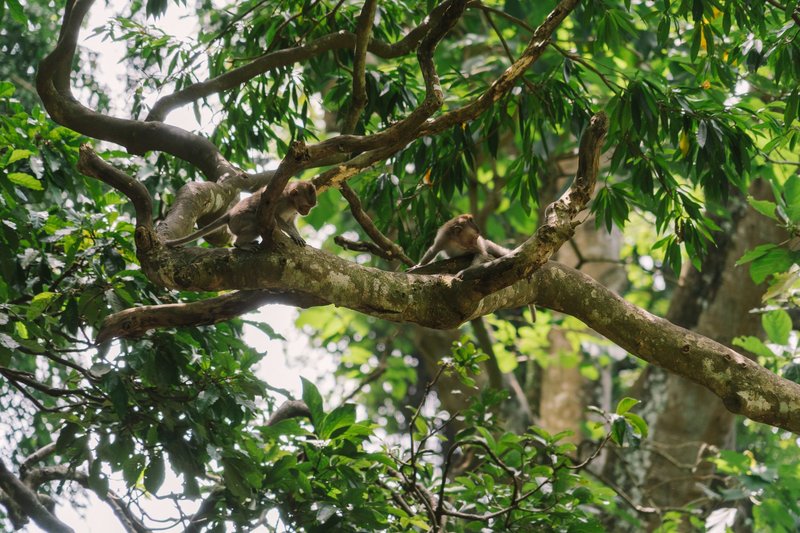
According to research compiled by Animal Diversity Web, a project of the University of Michigan’s Museum of Zoology, Diana monkeys spend roughly 40–45% of their active daylight hours foraging or feeding. That’s not incidental grazing between naps — it’s close to half their waking day spent working the canopy for food, which tracks with how energy-dense fruit and insects need to be gathered piece by piece rather than in one big meal.
The rest of the day splits between traveling between fruiting trees, resting, and social behavior — but feeding consistently ranks as one of the two or three largest activity categories in time-budget studies of this species.
Eating in Mixed-Species Groups Changes the Menu
Diana monkeys are famous among primatologists for something most people never hear about: they routinely form polyspecific associations, traveling and foraging alongside other guenon species like the Campbell’s monkey. A study on these mixed groups, published via PubMed, found that food choice and foraging behavior shift when Diana monkeys are traveling with other species compared to when they’re alone.
The practical effect is competition and coordination at the same time. Multiple species pulling from the same fruiting trees means Diana monkeys sometimes shift toward food types the other species use less, reducing direct overlap. It also means more eyes watching for predators, which lets individual monkeys spend more time actually feeding and less time on vigilance — a trade worth making even if it means occasionally sharing a tree.
Diana Monkeys as Seed Dispersers
Eating that much fruit has a side effect the monkeys aren’t trying for: they move seeds. Diana monkeys typically swallow small seeds whole and pass them intact, often well away from the parent tree, which makes them meaningful dispersers for the fruiting species they favor most, including Raphia palm and various fig species common in their range.
Forest ecologists treat this as more than a footnote. Primate seed dispersal shapes where the next generation of canopy trees actually grows, and losing a fruit-eating species from a forest can measurably change regeneration patterns over time. A Diana monkey troop moving through the canopy isn’t just feeding itself — it’s quietly replanting the forest as it goes.
What Diana Monkeys Eat in Zoos
Captive diets look nothing like the wild version, and that’s by design, not neglect. Zoos typically feed a base of commercial primate biscuit (formulated for balanced nutrition) supplemented with chopped vegetables, leafy greens, and a controlled portion of fruit — controlled because wild Diana monkeys get most of their sugar from fibrous, low-sugar wild fruit, while cultivated fruit like grapes and bananas is far sweeter and can cause dental and metabolic problems if overfed.
Insects or insect-based protein sometimes get added to mimic the wild invertebrate intake, and keepers frequently scatter or hide food to encourage the same kind of active foraging behavior the species evolved for — because a monkey that spends 40% of its day working for food in the wild doesn’t do well psychologically when that food just appears in a bowl.
The result is a diet that hits similar nutritional targets to the wild one without trying to replicate it ingredient-for-ingredient — proof that understanding why Diana monkeys eat what they eat matters more than just knowing the list.