North Macedonia is small enough to drive across in a day, but it sits at a crossroads of Mediterranean scrub, alpine limestone, and continental lowland — which is exactly why a country the size of Vermont holds more reptile diversity than most of its neighbors. Roughly thirty species call it home: tortoises basking on dry hillsides, whipsnakes that can outrun a jogger, and a viper you genuinely need to know how to identify.
This isn’t the Wikipedia rundown or the taxonomic checklist built for herpetologists. It’s a guide for the person standing on a Macedonian trail wondering what just rustled into the rocks.
Table of Contents
- Why North Macedonia Has So Many Reptiles
- Tortoises and Terrapins
- Lizards
- Snakes
- The One Snake to Actually Worry About
- Where and When to Look
- Protected Status and Why It Matters
Why North Macedonia Has So Many Reptiles
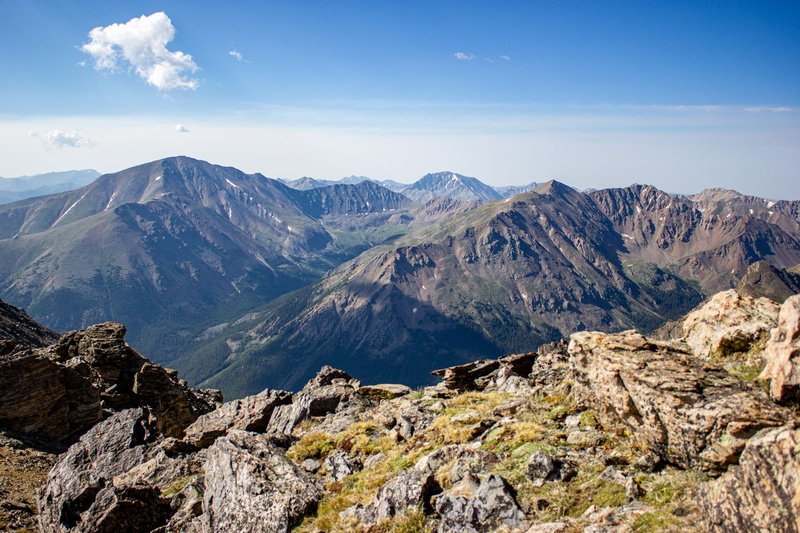
The country straddles three climate zones inside one small footprint. The Vardar valley running through the center is Mediterranean-dry, baked and rocky enough that it functions like a corridor pulling warmth-loving species up from Greece. The mountains ringing it — Šar, Pelister, Galičica — bring cooler, alpine conditions that favor a different set of specialists. And the handful of ancient lakes, Ohrid and Prespa chief among them, add wetland habitat that neither the scrubland nor the peaks can offer.
That layering is the reason a Caspian whipsnake and an alpine-adapted viper can both call the same country home without ever meeting.
Tortoises and Terrapins
North Macedonia’s shelled reptiles split evenly between land and water — two tortoises, two aquatic species.
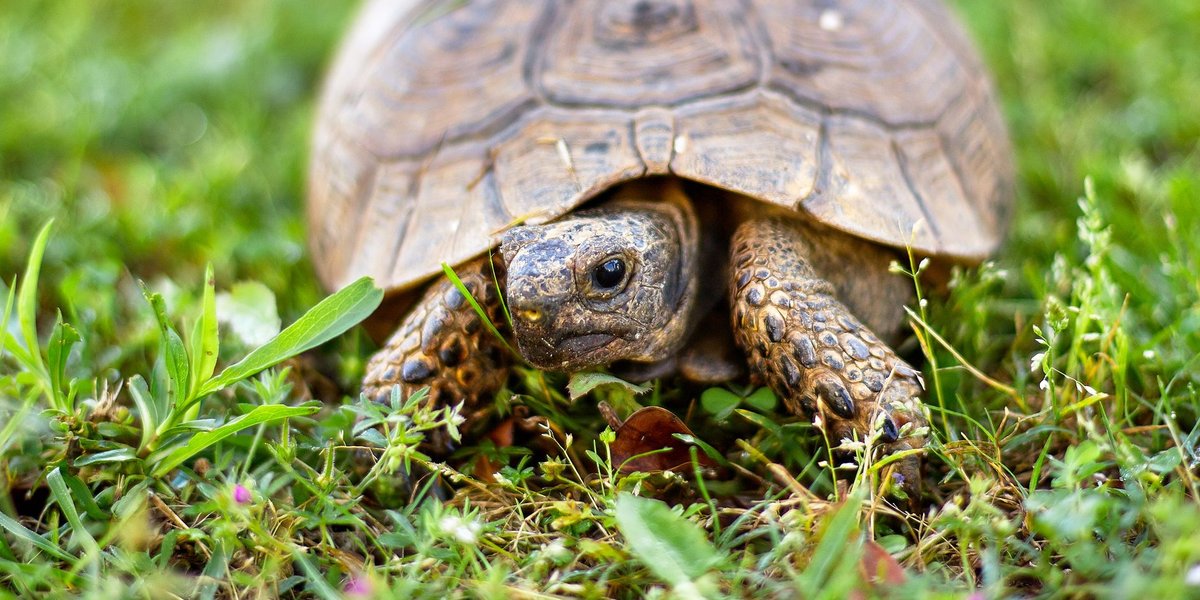
Hermann’s tortoise (Testudo hermanni) is the one most people picture. It’s got a domed, yellow-and-black patterned shell and a horny spur at the tip of its tail that its lookalike cousin lacks. You’ll find it grazing on scrubby, sun-baked slopes below about 1,000 meters, moving with the unhurried confidence of an animal that’s been doing this since before Rome existed.
Spur-thighed tortoise (Testudo graeca), sometimes called the Greek tortoise, shares similar terrain but is distinguishable by the conical tubercle on each thigh instead of a tail spur. Both tortoise species are listed under the IUCN Red List as vulnerable across parts of their range, largely from habitat loss and illegal pet-trade collection.
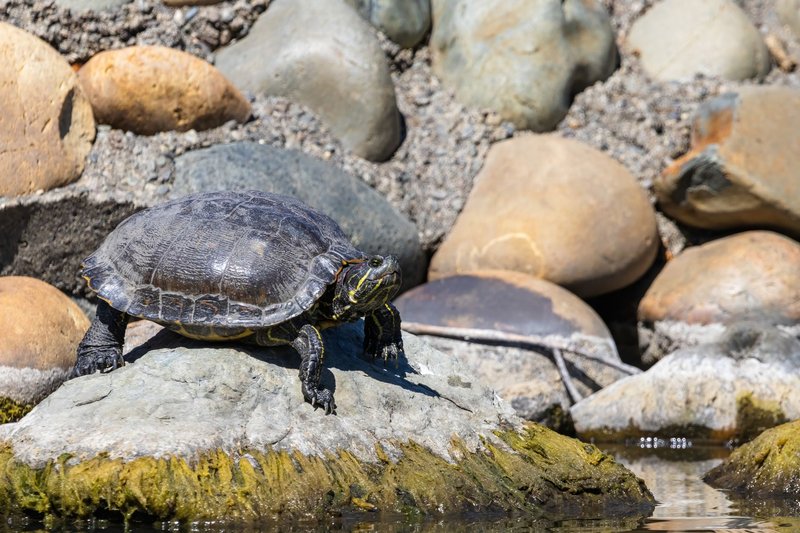
European pond turtle (Emys orbicularis) is the freshwater counterpart — dark, almost black shell flecked with yellow spots, usually spotted basking on a log with its neck fully extended before it slides underwater at the first sign of a footstep.
Balkan terrapin (Mauremys rivulata) rounds out the four, favoring slower rivers and lake margins, often sharing a basking log with the pond turtle in an uneasy truce.
Lizards
The lizard roster runs from garden-variety wall lizards to a genuine showstopper.
Balkan green lizard (Lacerta trilineata) is the one that stops hikers mid-stride — males flash an electric emerald body with a blue throat during breeding season, and they can run close to 40 centimeters nose to tail, making them one of Europe’s largest lizards.
European green lizard (Lacerta viridis) looks similar but smaller and is easy to confuse with its bigger cousin unless you catch the throat coloring.
Common wall lizard (Podarcis muralis) is the background species of every stone wall and ruin in the country — brown, quick, and completely unbothered by human proximity.
Balkan wall lizard (Podarcis tauricus) and Erhard’s wall lizard (Podarcis erhardii) fill similar niches in drier, rockier patches, distinguished mostly by subtle scale and color differences that matter to specialists more than casual observers.
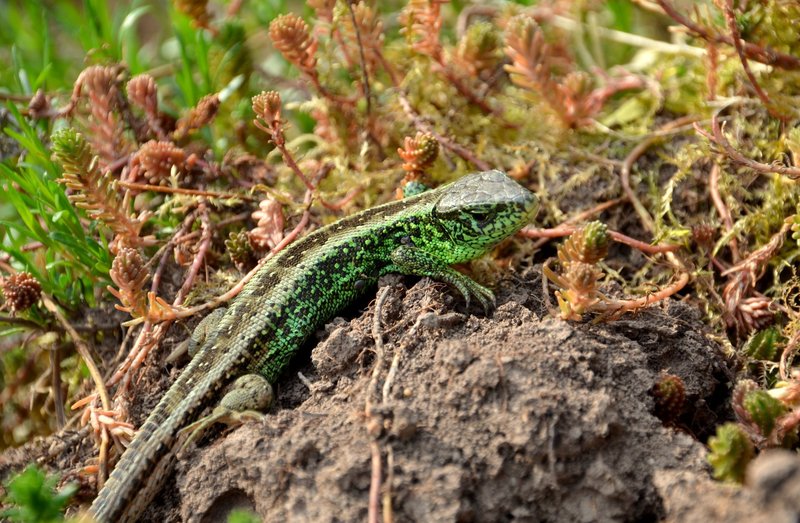
Sand lizard (Lacerta agilis) and viviparous lizard (Zootoca vivipara) take the cooler, higher ground — the viviparous lizard is one of the only reptiles on Earth found north of the Arctic Circle, and in North Macedonia it sticks to the mountain meadows where its live-birth strategy (rather than egg-laying) pays off in a shorter, colder growing season.
Slow worm (Anguis fragilis) confuses almost everyone who meets one — it’s a legless lizard, not a snake, identifiable by eyelids it can blink and a tail it can drop and regrow, tricks no snake can pull off.
Snakes
Sixteen snake species live here, spanning three families. A few are worth knowing by sight.
Caspian whipsnake (Dolichophis caspius) is the headline act — Europe’s longest snake, regularly topping two meters. It’s fast, alert, and diurnal, meaning you’re more likely to see one bolt across a trail in broad daylight than any other species on this list. Completely harmless to humans, though it won’t hesitate to bite if cornered.
Balkan whip snake (Hierophis gemonensis) is a smaller, slimmer relative sharing the same nervous energy and daytime habits.
Aesculapian snake (Zamenis longissimus) has a claim to fame beyond biology — it’s the snake wound around the Rod of Asclepius, the symbol still used in medicine today. Excellent climber, often found well off the ground in shrubs and low tree branches.
Leopard snake (Zamenis situla) is arguably the most strikingly patterned snake in Europe, marked with bold reddish-orange blotches outlined in black. It’s also one of the harder species to find, favoring rocky, undisturbed terrain.
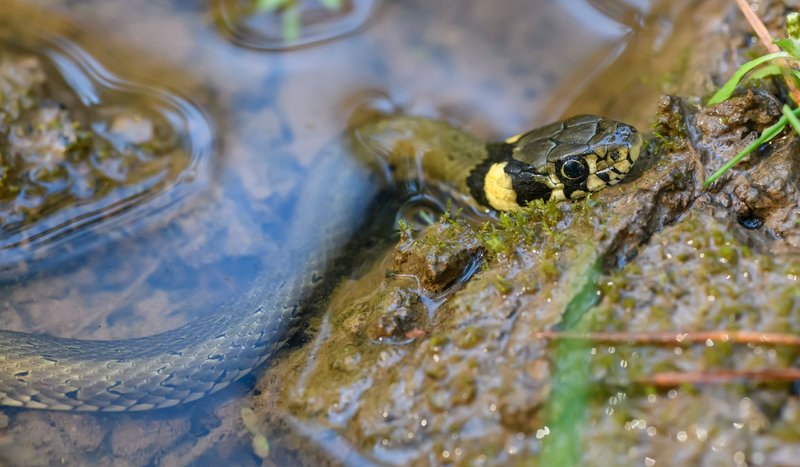
Grass snake (Natrix natrix) and dice snake (Natrix tessellata) are the water-associated pair, both non-venomous and both prone to playing dead — flipping belly-up, mouth open, tongue out — when they feel cornered near a pond edge.
Four-lined snake (Elaphe quatuorlineata) is a heavyset constrictor, one of the bulkiest non-venomous snakes in Europe, and slow-moving enough that it relies on camouflage over speed.
Cat snake (Telescopus fallax) is mildly venomous to small prey via rear fangs but poses no real threat to people — it’s nocturnal, small, and rarely encountered outside rocky crevices after dark.
The One Snake to Actually Worry About
North Macedonia has two viper species, and the distinction matters.
Nose-horned viper (Vipera ammodytes) is the more commonly encountered of the two and the most medically significant snake in the Balkans. It’s identified by a distinctive soft horn on the tip of its snout and a thick, zigzag-patterned body. It favors dry, rocky, south-facing slopes with good sun exposure — exactly the terrain hikers gravitate toward. Bites are serious and require medical attention, though fatalities are rare when treated promptly.
Meadow viper (Vipera ursinii), specifically the Balkan subspecies macrops, is smaller, far less commonly encountered, and restricted to high-altitude grassland. Its venom is considerably less dangerous to humans than the nose-horned viper’s, but it’s also one of Europe’s most range-restricted reptiles and carries serious conservation concern rather than safety concern.
Practical advice: watch foot placement on rocky, sun-warmed trails between April and October, don’t reach into crevices or under rocks without looking first, and give any snake room to retreat — vipers strike defensively, not aggressively, and almost every bite recorded happens when a person steps on or grabs one.
Where and When to Look
Reptile activity in North Macedonia peaks from April through June and again in September, when temperatures sit in that sweet spot — warm enough for ectotherms to be active, not so hot that they retreat to shade during daylight hours. Midday in July and August is often quiet; early morning and late afternoon are better bets.
The Vardar valley and the lower slopes around Lake Ohrid and Lake Prespa offer the best odds for tortoises and green lizards. Mavrovo National Park’s rockier terrain is a solid spot for whipsnakes and wall lizards. If you’re specifically hoping to spot a nose-horned viper — or more accurately, hoping to avoid stepping on one — dry, south-facing scree slopes below 1,200 meters are the habitat to watch.
Protected Status and Why It Matters
Most of North Macedonia’s reptiles, including both tortoise species and both vipers, are protected under the Bern Convention, the European treaty governing wildlife conservation. Collection, killing, and habitat disturbance of listed species carry legal penalties in the country, not just moral ones. Hermann’s tortoise in particular has suffered from decades of illegal collection for the pet trade across the Balkans, which is a bigger driver of its declining numbers than any natural predator.
The takeaway for visitors is simple: look, photograph, leave everything exactly where you found it. A tortoise moved “to help it cross the road” often ends up relocated far from the territory it knows, which does it no favors at all.