TLDR
Brazilian agoutis (most commonly the red-rumped agouti, Dasyprocta leporina) eat mostly fruit, nuts, and seeds — with Brazil nuts and Araucaria pine seeds as regional specialties — plus roots, leaves, and fungi. They’re also opportunistic omnivores, occasionally snacking on insect larvae, bird eggs, and even carrion. And they do something almost no other animal manages: they crack open the rock-hard husk of a Brazil nut pod with their teeth.
The short answer: fruit, nuts, and seeds first
An agouti’s day revolves around foraging on the forest floor for whatever has just dropped. That means fallen fruit, palm nuts, seeds, and the occasional root or shoot when fruit is scarce. In the Amazon basin, Brazil nuts are the marquee item — not because agoutis are picky, but because almost nothing else can get into one.
The Brazil nut pod is a woody capsule about the size of a coconut, and it takes serious force to open. Agoutis have jaw muscles and incisors built for exactly this job, which makes them one of the only wild animals capable of accessing the seeds inside without help from a machete. Squirrels and other rodents scavenge nuts agoutis have already opened; the agouti does the opening.
Why “Brazilian agouti” needs a footnote
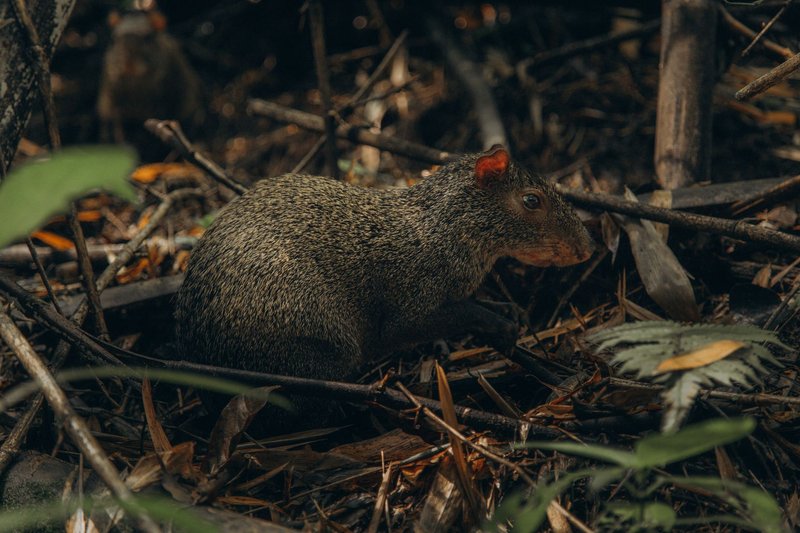
“Brazilian agouti” isn’t a single, tidy species — it’s a loose label that gets applied to whichever Dasyprocta species locals are talking about. The red-rumped agouti (D. leporina) is the one most often meant, and it ranges across northern South America and parts of the Amazon. But black agoutis (D. fuliginosa) and Azara’s agoutis (D. azarae) also turn up in Brazil, with overlapping but not identical diets shaped by whatever’s fruiting in their particular patch of forest. An agouti in the Amazon and an agouti in the Atlantic Forest further south are working with two different pantries.
Regional menus: Amazon nuts vs. southern pine seeds
That regional difference shows up most clearly in southern Brazil, where Araucaria trees — the umbrella-shaped pines locals call pinheiro-do-paraná — replace Brazil nut trees as the dominant food source. Agoutis there feed heavily on Araucaria angustifolia seeds, which are smaller and less armored than Brazil nut pods but no less important to the agouti’s calorie budget. Swap the tree, and the agouti’s whole feeding rhythm shifts with it — same animal, same basic strategy, different raw material.
The part almost nobody mentions: scatter hoarding
Agoutis don’t just eat what they find — they bury a lot of it for later. This is called scatter hoarding: burying single seeds in dozens of separate spots across the forest floor rather than one big stash, which spreads the risk if another animal finds a cache. The agouti doesn’t dig up every seed it buries. The ones it forgets, or dies before reclaiming, germinate.
That forgetfulness is a big deal ecologically. Several tree species, including Brazil nut trees, depend heavily on agoutis to move their seeds away from the parent tree and into the ground. Lose the agouti population in a patch of forest, and you start losing the next generation of the trees that fed it. Researchers studying seed dispersal by scatter-hoarding rodents have documented this same pattern of opportunistic, broad-diet rodents acting as accidental foresters — burying more than they ever eat.
The surprising part: agoutis aren’t strict vegetarians
Most write-ups stop at fruit and nuts, but agoutis are documented omnivores. Field and lab observations have recorded them eating insect larvae, bird eggs, and carrion when the opportunity presents itself — not as a dietary staple, but as protein they won’t pass up. A study on omnivorous foraging in scatter-hoarding rodents backs this up with direct behavioral evidence, which matters because most animal-facts pages still describe agoutis as pure herbivores. That’s a rounding error, not the full picture.
Wild diet vs. captive diet
Zoos can’t recreate a rainforest floor, so captive agoutis eat a more curated version of the same idea: nutritionally complete rather than foraged.
| Wild diet | Captive/zoo diet | |
|---|---|---|
| Base | Fallen fruit, nuts, seeds | Commercial rodent pellets |
| Produce | Whatever’s fruiting locally | Chopped vegetables, leafy greens |
| Protein/treats | Insect larvae, eggs, carrion (occasional) | Occasional nuts, mealworms as enrichment |
| Foraging behavior | Extensive scatter hoarding | Simulated with scatter-feeding enrichment |
The Smithsonian’s National Zoo keeps red-rumped agoutis on a diet built around rodent pellets supplemented with fresh produce — a setup designed to hit the same nutritional targets as a wild diet without needing an actual Brazil nut tree on-site. Keepers often hide food to encourage the same digging and searching behavior the animals would do naturally, since a bowl of food with nothing to look for is a poor substitute for a forest floor.
The bottom-line list
If you just want the rundown, here’s what’s actually on the menu:
- Fruit — fallen, ripe, whatever’s available
- Brazil nuts — a specialty only agoutis and a few other animals can crack open
- Araucaria seeds — the southern Brazil equivalent of Brazil nuts
- Roots and leaves — fallback food when fruit is scarce
- Fungi — opportunistic, not a staple
- Insect larvae, bird eggs, carrion — occasional protein, underreported but confirmed
An agouti’s diet isn’t a fixed menu so much as a running inventory of whatever the forest has dropped that week — with a standing talent for the one nut nothing else can open.