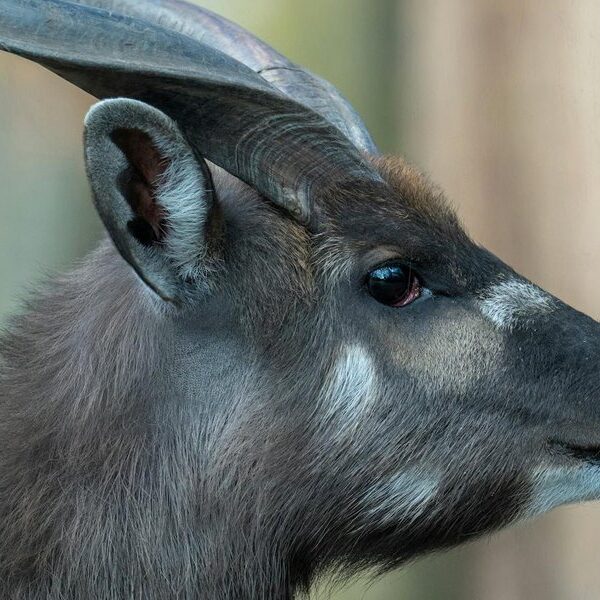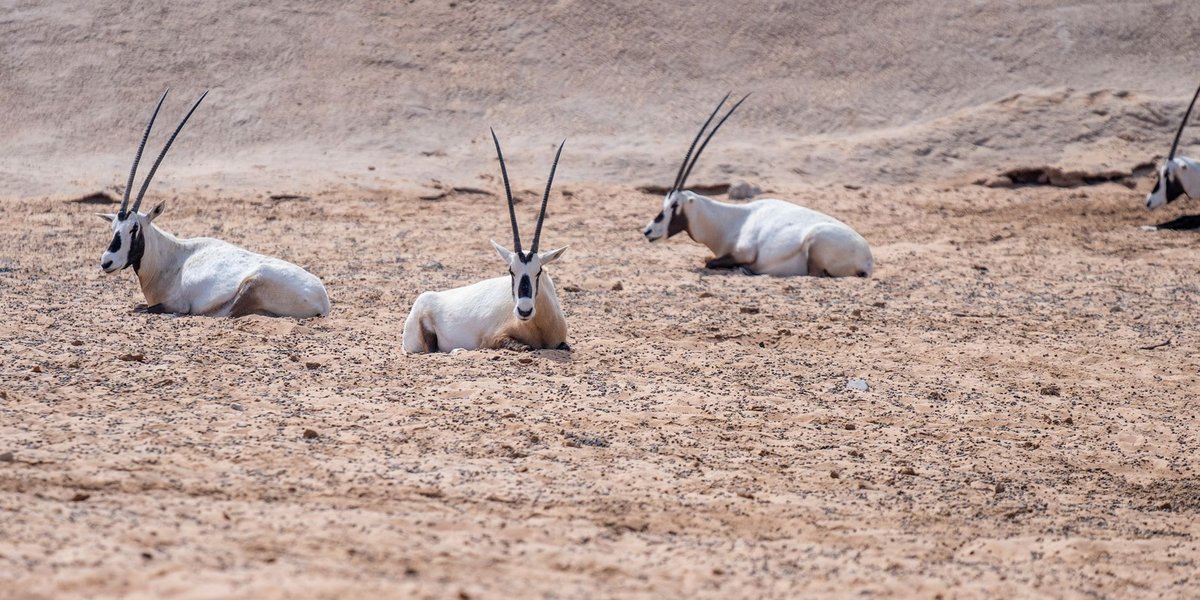
The Arabian oryx was declared extinct in the wild in 1972. The last one was shot in Oman. Today it grazes again across the Arabian Peninsula, including in Bahrain’s Al Areen Wildlife Park — the first animal ever to move from “Extinct in the Wild” back to “Vulnerable” on the IUCN Red List. That comeback story is the reason Bahrain’s conservation work is worth paying attention to.
The country is small and mostly desert, ringed by some of the warmest, saltiest seawater on Earth. That sounds like a hard place to be a wild animal, and it is. But the mix of sabkha flats, mangrove fringes, and the shallow Gulf around the Hawar Islands supports species you won’t find together anywhere else. Several of them are in trouble. Here’s who they are, where they live, and what’s pushing them toward the edge.
Table of Contents
- At-a-glance: status of each species
- Arabian oryx
- Dugong
- Goitered (sand) gazelle
- Socotra cormorant
- Houbara bustard
- Ocellated eagle ray
- What Bahrain is doing about it
- Where to actually see them
- FAQ
At-a-glance: status of each species
| Species | IUCN status | Rough population | Where in Bahrain |
|---|---|---|---|
| Arabian oryx | Vulnerable | ~1,200 wild region-wide | Al Areen Wildlife Park |
| Dugong | Vulnerable | Gulf herd is world’s 2nd largest | Hawar Islands waters |
| Goitered gazelle | Vulnerable | Captive/protected herds | Al Areen, Hawar |
| Socotra cormorant | Vulnerable | ~33,000 pairs nest on Hawar | Hawar Islands |
| Houbara bustard | Vulnerable | Declining, migratory | Desert interior, reserves |
| Ocellated eagle ray | Vulnerable | Unassessed locally | Coastal Gulf waters |
Arabian oryx
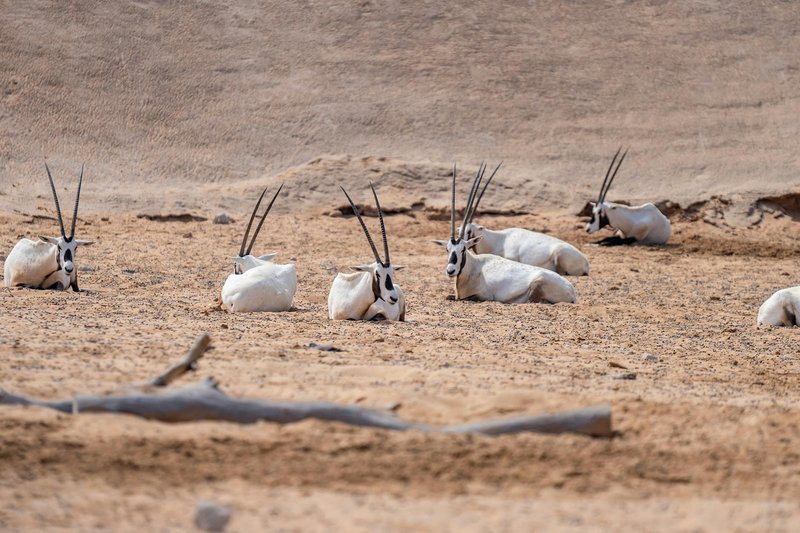
Start here, because this is the win. The Arabian oryx is a white desert antelope with long, nearly straight horns — the animal that probably seeded the unicorn myth, since in profile the two horns line up as one. It went functionally extinct in the wild in the early 1970s after decades of hunting from vehicles.
What saved it was captive breeding. A handful of survivors in zoos and royal collections — including stock that fed reserves like Bahrain’s Al Areen Wildlife Park — were bred up and reintroduced. The IUCN Red List now lists it as Vulnerable, the first species ever downlisted from Extinct in the Wild. Regional wild numbers sit around 1,200, with thousands more in semi-wild herds.
In Bahrain, Al Areen holds a breeding population, and the oryx is something of a national emblem — it’s the namesake of the country’s flag carrier. The animal is built for this climate: pale coat to reflect heat, hooves that splay across sand, and a tolerance for going long stretches without drinking, pulling moisture from the plants it eats.
Dugong
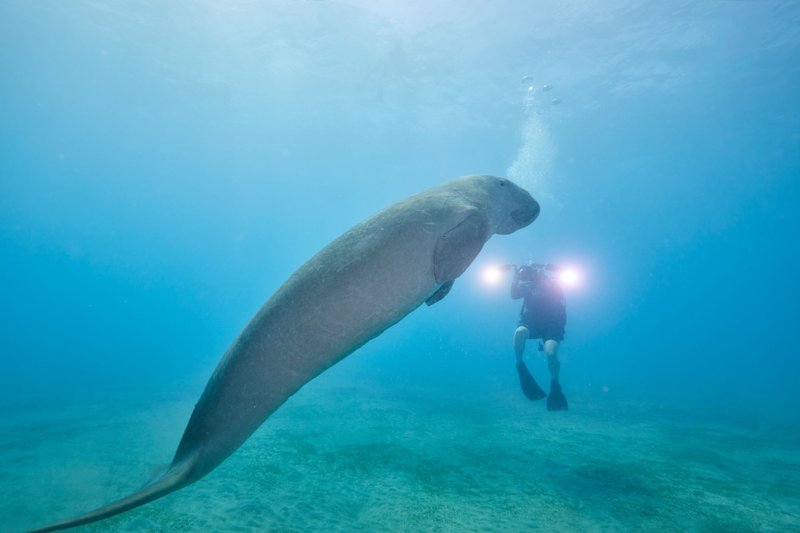
The dugong is the Gulf’s answer to the manatee — a slow, round-bodied marine mammal that grazes seagrass meadows like an underwater cow. The waters off Bahrain and the wider Gulf host the second-largest dugong population in the world, after Australia. Herds of several hundred have been recorded moving through the shallows near the Hawar Islands.
That’s the good news. The bad news is that dugongs are slow to reproduce — a single calf every few years — so the population recovers painfully slowly from losses. And the losses are real. Dugongs drown in fishing nets, get struck by boats, and depend entirely on seagrass beds that suffer from coastal dredging, land reclamation, and oil pollution. The 1991 Gulf War oil spills were catastrophic for Gulf seagrass.
A dugong can live past 70 years and grazes the same meadows its whole life. Lose the meadow and you lose the animal, even if the animal itself was never touched.
Goitered (sand) gazelle
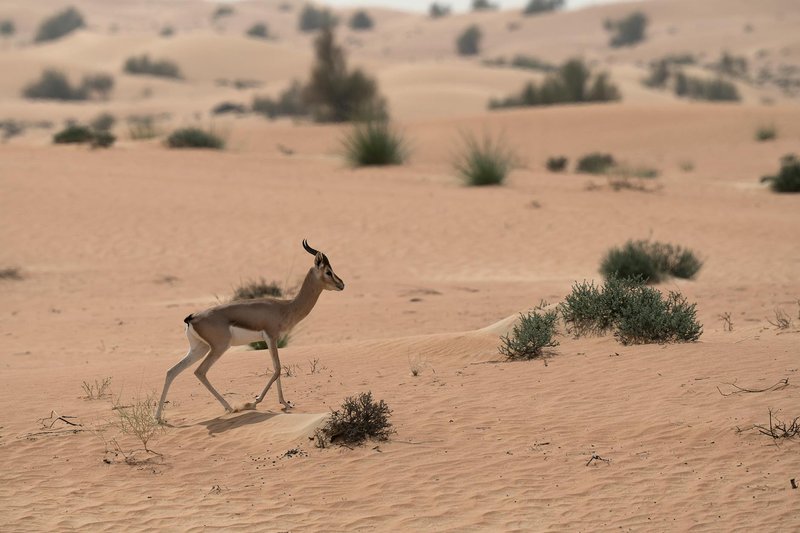
The goitered gazelle gets its name from the swelling on the male’s throat during the rut — a “goiter” that’s really an enlarged larynx. It’s a small, sandy-colored gazelle adapted to flat semi-desert, and it once ranged widely across the region before hunting and habitat loss shrank it to fragments.
Listed as Vulnerable, with populations still declining across its range, the gazelle survives in Bahrain mostly inside protected ground — Al Areen and the Hawar Islands reserve. Outside fences, the same pressures that hit the oryx hit the gazelle: off-road hunting, competition with livestock, and disappearing desert vegetation as land gets built on.
These animals can hit 60 km/h in a sprint, which used to be their defense. Against a vehicle, speed stopped being enough — which is exactly why the protected reserves matter.
Socotra cormorant
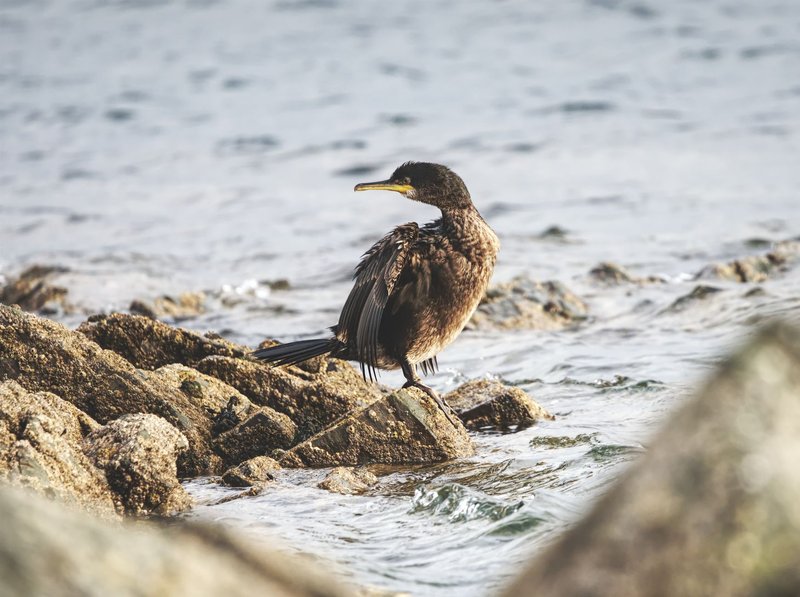
This is the species that makes Bahrain genuinely important on a global scale. The Socotra cormorant breeds in only a handful of sites in the Gulf and around the Arabian Sea, and the Hawar Islands host one of the largest colonies on Earth — on the order of tens of thousands of breeding pairs packed onto the islands’ flat ground.
It’s a dark seabird that fishes in dense, coordinated flocks, sometimes thousands strong, driving shoals of fish toward the surface. Because it nests in just a few crowded colonies, the whole species is exposed: one bad oil spill, one disturbance event, one disease outbreak at a major colony can dent the global population. BirdLife International classes it as Vulnerable largely for that reason — eggs in too few baskets.
Bahrain designated the Hawar Islands as a protected area partly to shield this colony, and the site is recognized internationally as a wetland of importance.
Houbara bustard
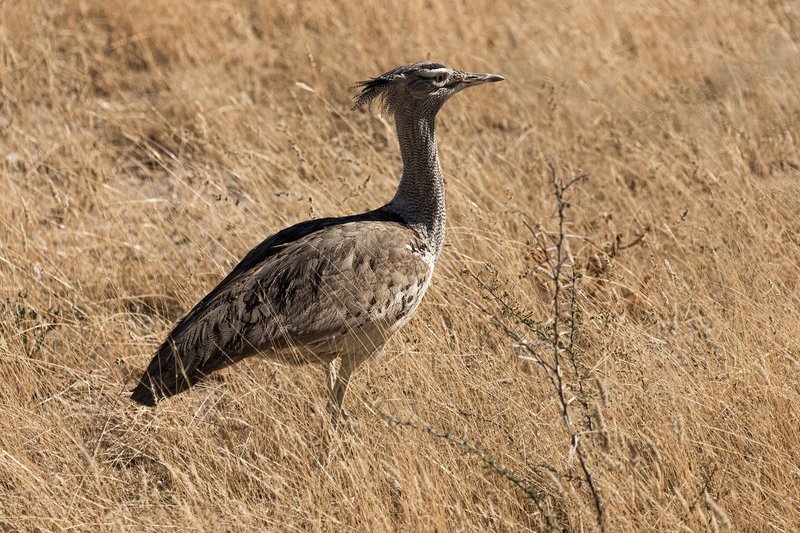
The houbara bustard is a large, ground-dwelling bird the color of dry grass — cryptic enough that you can walk close before it flushes. It’s a desert specialist that winters in and migrates through the Arabian Peninsula, including Bahrain.
Its decline is tied tightly to falconry. The houbara is the traditional quarry of Arabian falconers, and decades of intense hunting pressure — plus habitat loss along its migration routes — pushed numbers down hard enough to earn it a Vulnerable listing. The response has been large-scale captive breeding and release programs across the Gulf, releasing tens of thousands of birds annually to prop up the wild population.
The males put on one of the more bizarre courtship displays in the bird world: they puff out a fan of white neck feathers until the head nearly vanishes, then trot in a near-blind shuffle. It works on females. It also makes them easy to spot, which hasn’t helped them.
Ocellated eagle ray
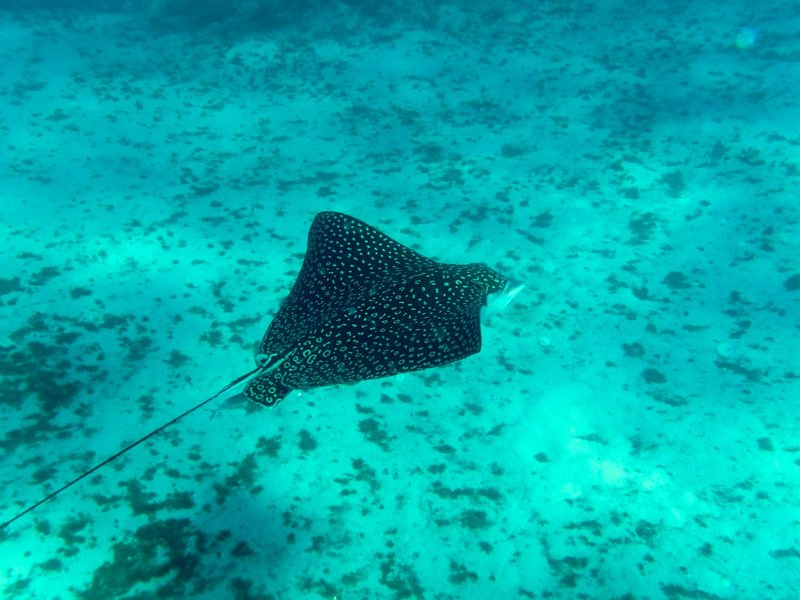
The marine list usually stops at dugongs and turtles, but Bahrain’s shallow Gulf waters are also home to eagle rays — broad-winged, diamond-shaped rays that “fly” through open water and crush shellfish with plated teeth. The ocellated eagle ray, spotted with pale rings, is the regional representative, and like many rays it’s slow to mature and produces few young.
That life history makes rays especially vulnerable to fishing — both targeted catch and bycatch in nets meant for other species. Many Gulf ray and shark species have slid toward threatened status faster than anyone tracked them, simply because they reproduce too slowly to absorb the pressure. Coastal development that muddies and shrinks their feeding flats adds to the squeeze.
It’s the least-documented animal on this list, which is part of the point: Bahrain’s marine endangered species go well beyond the charismatic dugong, and the rays rarely get a mention.
What Bahrain is doing about it
The backbone of the effort is two protected sites. Al Areen Wildlife Park, on the main island, functions as both a reserve and a breeding center for desert species — oryx, gazelle, and a long list of birds — and a lot of the region’s reintroduction stock has roots in places like it. The Hawar Islands, off the southeast coast, protect the marine and seabird side: the cormorant colony, dugong feeding grounds, and turtle nesting beaches.
On paper, the framework is Bahrain’s National Biodiversity Strategy and Action Plan, the national commitment under the global Convention on Biological Diversity. The hard part is the same everywhere in the Gulf: balancing fast coastal development and land reclamation against the shallow-water habitats that dugongs, cormorants, and rays all depend on. Seagrass and mudflats don’t generate headlines, but they’re the foundation the whole list stands on.
Where to actually see them
If you want to see these animals rather than just read about them, your two realistic options are:
- Al Areen Wildlife Park — the easiest by far. It’s open to visitors, sits near the Sakhir area in the south of the main island, and is where you’ll reliably see oryx and gazelle in large enclosures along with regional birds.
- Hawar Islands — harder to reach and more restricted, since it’s a protected reserve, but accessible via organized boat trips from the southern coast. This is the place for dugongs, the cormorant colony, and turtles, ideally with a guide who knows the seasons.
For the marine species especially, timing matters — cormorant breeding and dugong movements are seasonal — so check current access rules before planning a trip.
FAQ
What is the most endangered animal in Bahrain? By global conservation profile, the dugong and the Socotra cormorant are the standout concerns, because Bahrain’s waters and islands hold globally significant populations of both. The dugong’s slow breeding and the cormorant’s reliance on just a few crowded colonies make small losses hard to recover from.
Is the Arabian oryx still endangered? It’s no longer critically endangered. It was extinct in the wild in the 1970s and is now listed as Vulnerable — the first species ever to recover from Extinct in the Wild — but it still depends on managed reserves like Al Areen and isn’t out of the woods.
Are there dugongs in Bahrain? Yes. The Gulf waters around Bahrain, especially near the Hawar Islands, support the second-largest dugong population in the world after Australia, with herds of several hundred recorded.
Can you see endangered species in Bahrain as a visitor? Yes. Al Areen Wildlife Park is open to the public and is the simplest place to see oryx and gazelle. The Hawar Islands, reachable by boat, are the spot for dugongs, the Socotra cormorant colony, and nesting turtles, though access is more controlled.
Why are Bahrain’s marine species at risk? Coastal development, land reclamation, dredging, oil pollution, and fishing-net entanglement all degrade the shallow seagrass beds and mudflats that dugongs, rays, and seabirds depend on. The 1991 Gulf War oil spills did lasting damage to those habitats.