Palau is a string of more than 300 islands scattered across the western Pacific, and that isolation is exactly what makes it so vulnerable. For millions of years, the plants and animals here evolved with almost no large predators, no aggressive ant colonies, no beetles boring through the palms. A species that arrives now — in a shipping container, a potted plant, a tourist’s hiking boot — lands in a place with few natural checks. It spreads fast, and the native wildlife has no playbook for fighting back.
That’s the short version of why invasive species in Palau get so much attention from conservationists, farmers, and government biosecurity teams. Palau’s national clearing-house lists 53 species classed as invasive or potentially invasive, with another 249 on a watch-list of organisms that could establish if they slip past the border. This is a profile of the worst offenders — what they are, where they came from, the damage they do, and what’s actually being done about them.
Table of Contents
- Quick Facts
- Why Islands Like Palau Are So Exposed
- Coconut Rhinoceros Beetle
- Little Fire Ant
- Coqui Frog
- Invasive Vines: Merremia and Mikania
- Water Lettuce
- Crab-Eating Macaques
- Rats
- Palau’s National Strategy and Biosecurity
- What Visitors Can Do
Quick Facts {#quick-facts}
- 53 species listed as invasive or potentially invasive in Palau
- 249 additional species on the national watch-list
- The Coconut Rhinoceros Beetle is one of the single biggest threats to Palau’s coconut and oil palms
- The Little Fire Ant delivers a sting strong enough to blind pets and livestock over repeated exposure
- Palau adopted a formal National Invasive Species Strategy to coordinate prevention, control, and response across agencies
Why Islands Like Palau Are So Exposed {#why-islands}
Island ecosystems run on a kind of evolutionary truce. Without big mammalian predators or the constant arms race you see on continents, native species drop their defenses. Birds nest on the ground. Plants stop investing in thorns and toxins. Snails and insects evolve into hundreds of localized forms found nowhere else.
Then a continental species shows up — a rat that climbs, an ant that swarms, a vine that grows a foot a day — and the truce collapses. The newcomer arrived from a place where it competed against everything, so it’s tougher, hungrier, and faster than anything the island ever produced. The IUCN ranks invasive species among the leading drivers of extinction worldwide, and the effect is sharpest on small islands. Palau fits the pattern exactly: limited land, irreplaceable endemics, and a busy port that connects it to the rest of the Pacific.
The damage isn’t only ecological. In Palau, many invasive species hit the things people depend on directly — the coconut palms that feed families, the taro patches at the center of local food culture, the reefs and forests that draw tourists.
Coconut Rhinoceros Beetle {#crb}
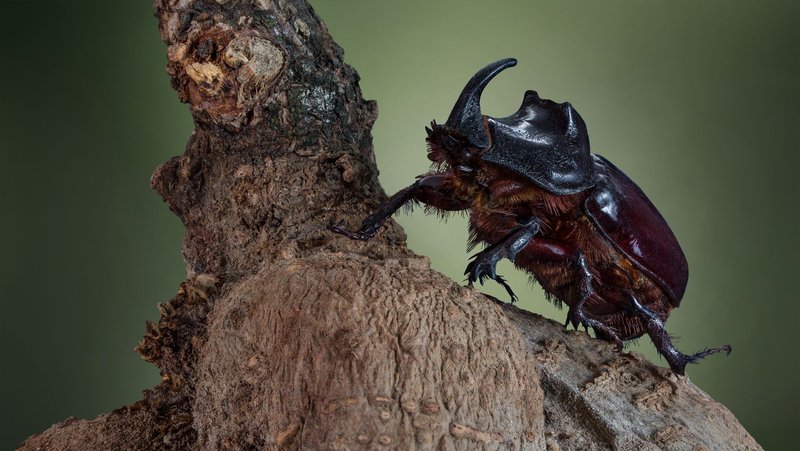
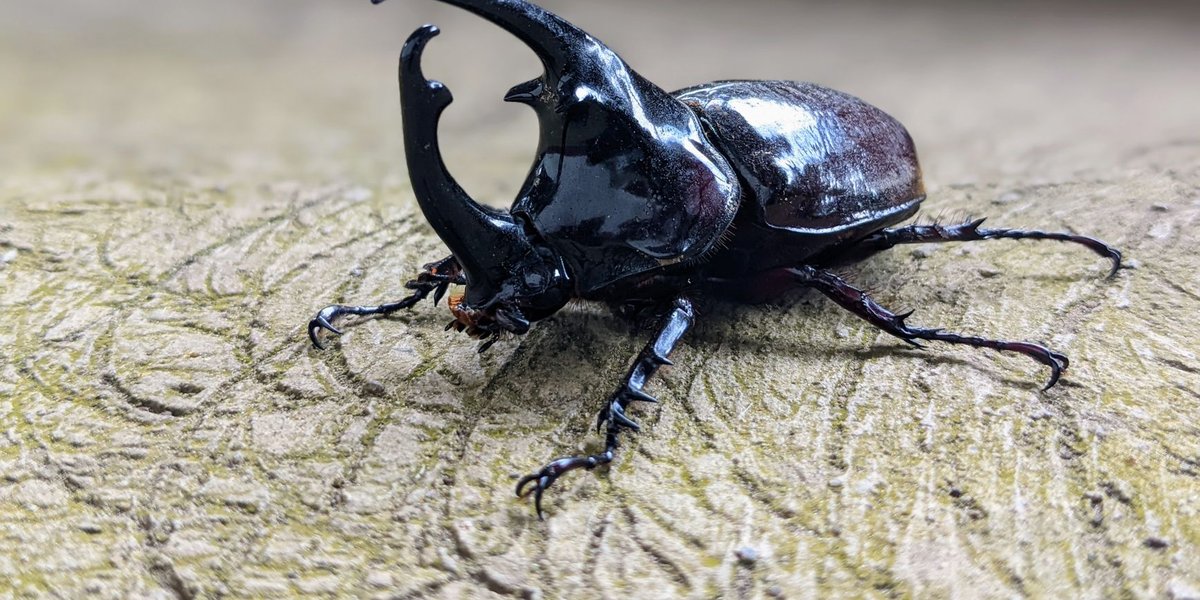
If Palau has a public enemy number one, this is it. The Coconut Rhinoceros Beetle (Oryctes rhinoceros) is a heavy, glossy-black beetle the size of your thumb, with a single curved horn on the male’s head. Native to Southeast Asia, it has spread across the Pacific island by island, and it does its damage in a brutally simple way: the adult bores straight into the crown of a palm to feed on the sap, cutting through the unopened fronds. Each feeding bore leaves the classic V-shaped notch in the leaves that fan out later.
A few beetles a tree can survive. A heavy infestation kills it. The larvae, meanwhile, develop in any pile of rotting vegetation — dead palm trunks, compost, mulch, green waste — which means a cleared lot or a storm-damaged grove can become a breeding factory.
The standard biological control for this beetle is Oryctes nudivirus (OrNV), a virus that infects and kills the beetle and has held populations down across much of the Pacific for decades. The catch is that a newer biotype of the beetle, often called CRB-G, has proven resistant to the classic strains of the virus, which is part of why outbreaks have flared up again across Micronesia. It is far from the only pest the region shares — the beetle turns up alongside the ants, frogs, and weeds on the complete list of invasive species in Micronesia that conservation teams track island by island. Control today leans on a combination of tactics: pheromone traps to monitor and catch adults, removing or treating the rotting breeding sites, and continued work on virus strains that the resistant biotype can’t shrug off.
Little Fire Ant {#little-fire-ant}
The Little Fire Ant (Wasmannia auropunctata) is tiny — barely a couple of millimeters, a pale orange speck you’d never notice until it’s everywhere. Originally from Central and South America, it has become one of the most damaging invasive ants across the Pacific, and it has a foothold in the wider Micronesia region.
Its size is the trap. The colonies build up enormous numbers in leaf litter, low vegetation, and the canopy, and they sting anything that disturbs them. For people, that means welts and a burning itch — which earns the ant a place among the more painful dangerous animals in Palau despite its tiny size. For animals, it’s worse: repeated stings to the eyes cause clouding and blindness in pets, livestock, and wildlife, and farm workers in heavily infested areas can find whole plots almost unworkable. The ants also farm sap-sucking insects for honeydew, which damages crops and spreads plant disease.
What makes the Little Fire Ant so hard to beat is how it travels. It moves in potted plants, garden soil, mulch, and produce, and because the colonies have many queens and reproduce by simply budding off, a single fragment carried to a new spot can start a fresh infestation. Control relies on careful inspection of incoming plant material and targeted baiting, but eradication once it’s established is extremely difficult.
Coqui Frog {#coqui-frog}
The Coqui (Eleutherodactylus coqui) is a small tree frog native to Puerto Rico, where it’s a beloved national symbol. Transplanted to the Pacific, it becomes a different kind of resident. The males call all night — a loud, two-note “ko-KEE” that gives the frog its name — and in dense populations the chorus can reach noise levels that genuinely disrupt sleep and lower property values.
Beyond the noise, the ecological worry is appetite. Coquis breed quickly and reach very high densities, and they eat a tremendous volume of insects and other invertebrates. On islands where native birds, spiders, and insects already compete for the same food, that’s direct pressure on the food web, plus a new prey source that can prop up other invaders. The frog spreads through the nursery trade, hiding in potted plants, which is why plant inspection sits at the center of keeping it out.
Invasive Vines: Merremia and Mikania {#vines}
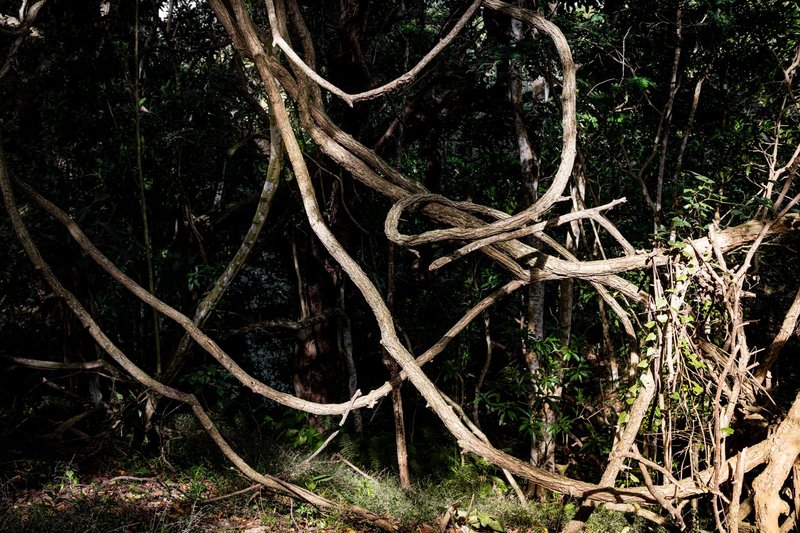
Two fast-growing vines do much of the plant-world damage in Palau, and both work by smothering.
Merremia (a group of woody morning-glory vines, sometimes called the “mile-a-minute” of the Pacific) climbs over everything in its path — shrubs, small trees, whole sections of forest edge — and forms a heavy blanket that blocks sunlight. The plants underneath die for want of light, and what was a layered, diverse forest edge collapses into a single rolling mat of vine.
Mikania micrantha, true mile-a-minute weed, is even faster. It’s a slender climbing vine from tropical America that can grow several centimeters a day under good conditions and is consistently ranked among the world’s worst invasive weeds. It overwhelms young plantations, native regrowth, and agricultural land, and it releases chemicals that suppress the plants it grows over.
Both vines are tough to remove because they regenerate from fragments and seed prolifically. Manual clearing helps in small areas, but on the scale of an island it’s a constant, losing battle without sustained effort, and researchers continue to look at biological controls used elsewhere in the region.
Water Lettuce {#water-lettuce}
Water lettuce (Pistia stratiotes) is a floating aquatic plant that looks exactly like a small, pale-green head of lettuce drifting on the surface. It’s attractive enough that it spreads partly through the ornamental pond trade, and that’s the problem — it doesn’t stay where it’s put.
In still and slow-moving freshwater, water lettuce reproduces fast and forms dense floating mats that seal off the surface. Underneath, the blocked light kills submerged plants, oxygen levels crash, and fish and other aquatic life suffer. The mats clog waterways, foul irrigation channels, and create perfect breeding habitat for mosquitoes. For an island nation where freshwater is limited and precious, choking a wetland or a channel with water lettuce is a real cost. Control means physically removing the mats and, critically, keeping the plant out of new water bodies in the first place.
Crab-Eating Macaques {#macaques}
Palau is home to a feral population of crab-eating macaques (Macaca fascicularis) on the island of Angaur — descendants of monkeys brought in during the German colonial era. They are the only established wild monkey population in Micronesia, a striking exception among the otherwise modest mammals of Palau, and that novelty doesn’t make them harmless.
The macaques raid crops, taro, and gardens, taking a direct bite out of local food production. They also disturb native vegetation and prey on bird eggs and nestlings, which is a serious concern on islands where ground- and low-nesting birds never evolved alongside a clever, dexterous mammal. Managing an established primate population is one of the harder problems in island conservation: they’re intelligent, mobile, and politically complicated to control, which is exactly why keeping such animals from establishing in the first place matters so much.
Rats {#rats}
Rats are the quiet catastrophe of Pacific islands, and Palau is no exception. Several species — the black rat (Rattus rattus) chief among them — arrived on ships and have been part of the island fauna for a long time, which makes them easy to overlook precisely because they’re everywhere.
They are also among the most destructive invaders on Earth. Rats climb to seabird and forest-bird nests and eat eggs and chicks, they consume seeds and seedlings and so reshape which plants regenerate, and they spread disease and ruin stored food and crops. On many Pacific islands, rats are the single biggest reason native birds and reptiles have vanished. Where eradication has been achieved on smaller, defined islands, seabird colonies and native plants have rebounded dramatically — which is why rat control and island eradication projects remain a high-value tool in Palau’s conservation kit.
Palau’s National Strategy and Biosecurity {#strategy}
A scattered list of pests is only as manageable as the system fighting them, and Palau’s answer is its National Invasive Species Strategy — a coordinating framework that pulls together the agencies handling quarantine, agriculture, environment, and conservation so they’re not each working in isolation. The strategy’s logic follows the order that actually works: prevention first, early detection second, and control or eradication only as the last and most expensive resort.
Prevention is the cheapest line of defense by a wide margin, and it lives at the border. Palau’s biosecurity and quarantine work means inspecting incoming cargo, plants, soil, and produce — the exact pathways that carry the Little Fire Ant, the Coqui, and water lettuce. Once a species establishes, the cost of fighting it multiplies, as the Coconut Rhinoceros Beetle outbreak shows. The strategy also leans on regional cooperation, since Palau shares both pests and solutions with its neighbors across Micronesia and the wider Pacific; organizations like the Secretariat of the Pacific Regional Environment Programme (SPREP) coordinate invasive-species work across the region. The Convention on Biological Diversity tracks Palau’s national efforts as part of the global push to slow the spread of invasive species.
What Visitors Can Do {#visitors}
You don’t have to be a biologist to help, and travelers are part of the pathway whether they realize it or not. A few simple habits make a real difference:
- Clean your gear before you arrive. Hiking boots, daypacks, and dive gear can carry seeds, soil, and tiny insects. Brush off and rinse anything that touched the ground or water at your last destination.
- Declare everything at the border. Palau’s quarantine questions aren’t bureaucratic theater. Fresh food, plant material, and wooden items are exactly how invaders hitch a ride, and honesty at customs is part of the defense.
- Don’t move plants, seeds, or soil between islands. What’s harmless on one island can be a disaster on the next.
- Stay on marked trails and follow guide instructions in protected areas, where managers are often actively trying to keep specific sites pest-free.
Palau’s wildlife evolved in isolation, and that’s both its wonder and its weakness. Every shipping container and suitcase is a potential vector, which means the fight against invasive species in Palau is never really finished — it’s prevention, vigilance, and a lot of unglamorous inspection work, repeated indefinitely. The species already here, from the rhinoceros beetle to the rats, show exactly what’s at stake when that vigilance slips.