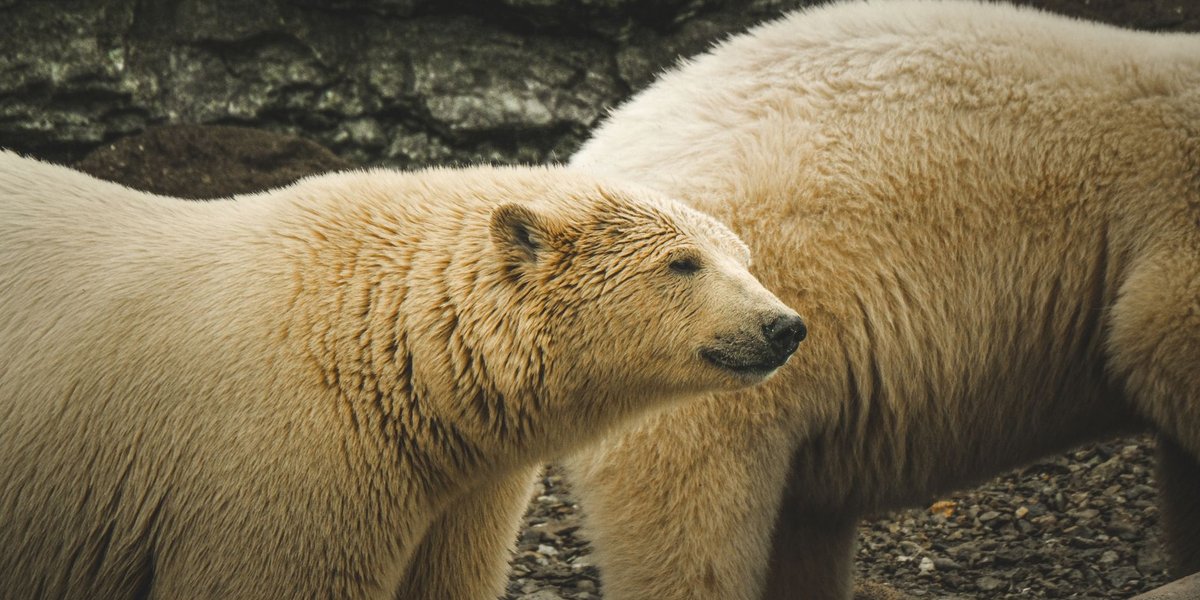
The Arctic is a place where breathing wrong can freeze the inside of your nose, and yet roughly 21,000 species call it home — from microscopic algae locked in sea ice to the largest land carnivore on Earth. Most “arctic animals” lists hand you the same polar-bear-fox-narwhal trio and move on. This one goes deeper: 23 animals, grouped by where they live, each with the one trick that lets it survive a winter that would kill almost anything else.
Because that’s the real story here. It’s not just which animals live in the Arctic. It’s how. A musk ox doesn’t tough out -40°F through willpower. It has an undercoat eight times warmer than sheep’s wool. Every animal on this list has a specific, evolved answer to the same brutal question.
Table of Contents
- Arctic vs. Antarctic: a quick clarifier
- The icons (start here)
- Land mammals
- Marine mammals
- Birds of the Arctic
- Smaller and lesser-known species
- Quick-reference table
- Frequently asked questions
Arctic vs. Antarctic: a quick clarifier
People mix these up constantly, so let’s settle it before the list.
The Arctic is the region around the North Pole — a frozen ocean ringed by the northern edges of North America, Europe, and Asia. It has land mammals, Indigenous human populations, and, yes, polar bears.
The Antarctic is the region around the South Pole — a continent surrounded by ocean. It has penguins, seals, and no native land mammals at all. If you want the full picture of how life diverged at the two ends of the planet, our guide to polar fauna adapted to Earth’s extremes lays out what each pole supports and why.
The simplest version: polar bears live in the Arctic, penguins live in the Antarctic, and they never meet in the wild. If a nature documentary shows a polar bear hunting a penguin, it’s a fake. The two poles are about 12,000 miles apart, and the word “Arctic” itself comes from the Greek arktos, meaning bear — while “Antarctic” literally means “opposite the bear.”
The icons (start here)
These are the three you came for. They earn the top spots.
1. Polar Bear
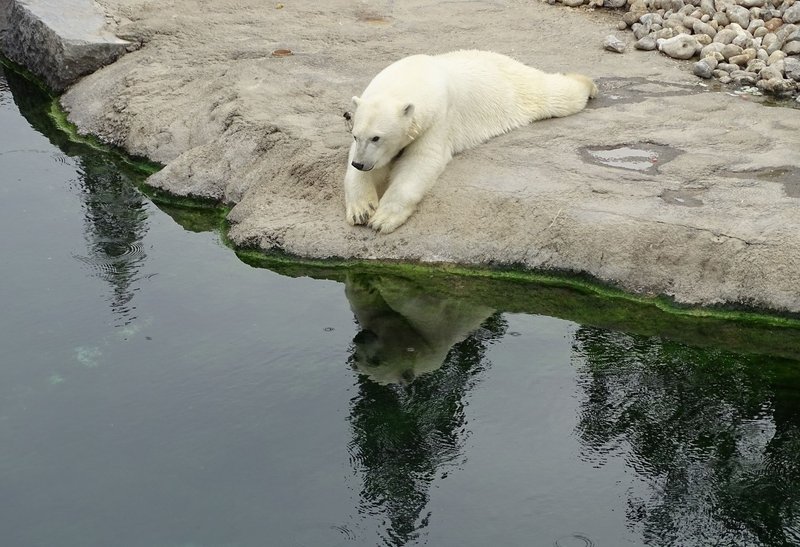
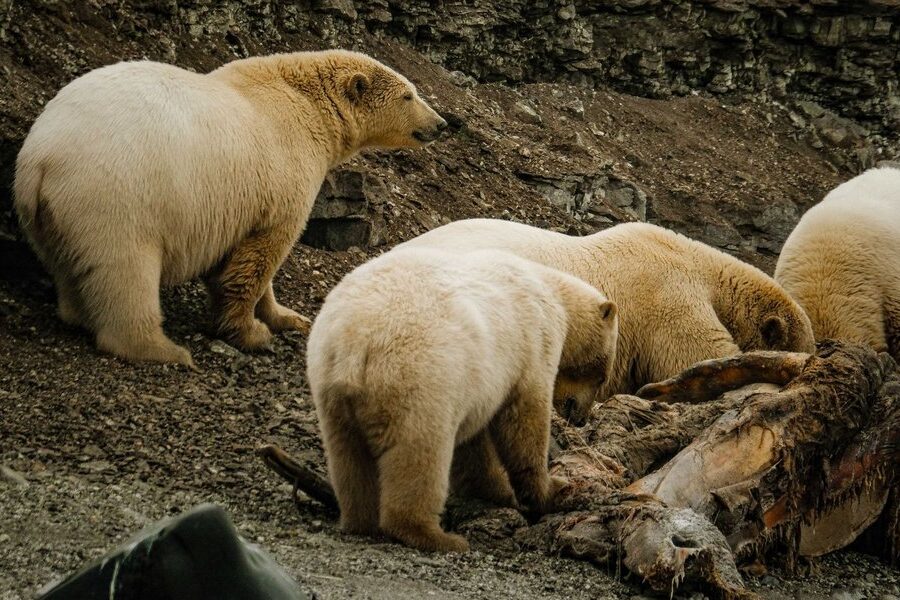
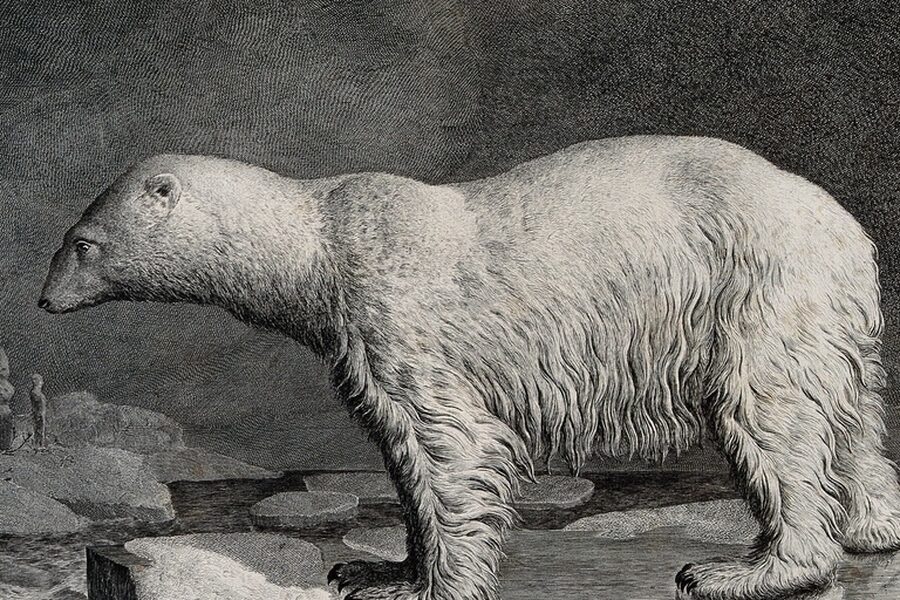
Fast fact: The largest land carnivore on Earth, weighing up to 1,500 pounds. Size & diet: 8–10 feet long; eats almost exclusively ringed and bearded seals. Cold-survival adaptation: Black skin under transparent (not white) fur. Each hair is a hollow tube that scatters light, making the bear look white while the black skin underneath soaks up solar heat. Add a four-inch layer of blubber, and a polar bear is so well insulated it’s more likely to overheat than freeze. According to the IUCN Red List, the species is classified as Vulnerable, with sea-ice loss as the primary threat.
2. Arctic Fox
Fast fact: Stays active outdoors down to -58°F without shivering. Size & diet: House-cat-sized (6–9 lbs); eats lemmings, birds, eggs, and polar bear leftovers. Cold-survival adaptation: The best fur-to-body insulation of any Arctic mammal, plus a compact build — short muzzle, short legs, small rounded ears. Less surface area means less heat lost. Its coat also swaps from brown in summer to thick white in winter, doubling as camouflage. The paws have fur on the soles, basically built-in snow boots.
3. Narwhal
Fast fact: The “unicorn of the sea,” with a tusk that’s actually a tooth. Size & diet: 13–18 feet; eats Greenland halibut, cod, and squid. Cold-survival adaptation: A thick blubber layer for warmth, but the real marvel is that 8–10-foot tusk — a single canine tooth that grows through the lip, packed with millions of nerve endings. Researchers think narwhals use it to sense water salinity and temperature, helping them navigate shifting sea ice. They survive winter under near-complete ice cover, surfacing through narrow cracks to breathe.
Land mammals
The tundra is treeless, windswept, and frozen solid for much of the year. These animals don’t migrate away from it.
4. Musk Ox
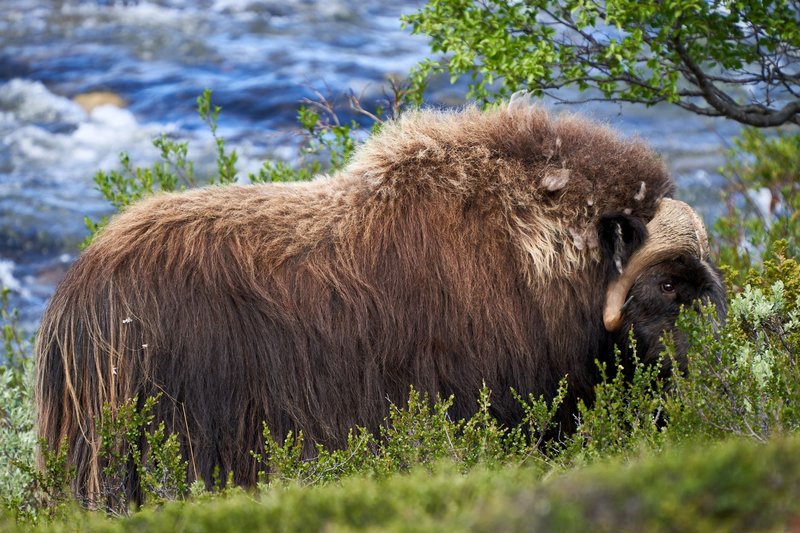
Fast fact: Wears the warmest natural fiber on the planet. Size & diet: 400–900 lbs; grazes on grasses, lichens, and roots dug from under snow. Cold-survival adaptation: An underwool called qiviut that’s roughly eight times warmer than sheep’s wool and softer than cashmere. When wolves attack, the herd forms a defensive circle with calves in the center and horned adults facing out — a tactic unchanged since the Ice Age.
5. Caribou (Reindeer)
Fast fact: The only deer where both sexes grow antlers. Size & diet: 240–700 lbs; eats lichen (especially “reindeer moss”), grasses, and shoots. Cold-survival adaptation: Hollow guard hairs that trap air for insulation and buoyancy when swimming icy rivers. Their hooves change with the seasons — soft and spongy in summer, hard and sharp-edged in winter for cutting into ice and snow. Some herds migrate over 3,000 miles a year, the longest land migration of any mammal. Much of their winter forage comes from the boreal forest plants of the taiga, the spruce-and-lichen belt that rings the tundra to the south.
6. Arctic Hare
Fast fact: Can sprint up to 40 mph across open tundra. Size & diet: 6–12 lbs; eats woody plants, mosses, and lichens. Cold-survival adaptation: A round, compact body and shortened ears that minimize heat loss. In the far north its coat stays white year-round. Arctic hares often huddle in groups of dozens — sometimes hundreds — to share warmth and watch for predators.
7. Snowshoe Hare
Fast fact: Its hind feet work like literal snowshoes. Size & diet: 2–4 lbs; eats grasses and plants in summer, bark and twigs in winter. Cold-survival adaptation: Oversized, heavily furred hind feet that spread its weight across snow so it doesn’t sink. The coat shifts from rust-brown to white as daylight shortens, triggered by photoperiod rather than temperature.
8. Gray Wolf (Arctic Wolf)
Fast fact: One of the only large predators to live this far north year-round. Size & diet: 70–175 lbs; hunts musk oxen, caribou, and arctic hares. Cold-survival adaptation: Two fur layers — a waterproof outer coat and a dense insulating undercoat — plus smaller, more rounded ears than southern wolves to reduce heat loss. They can go days without food, then gorge on up to 20 pounds of meat in a single sitting.
9. Wolverine
Fast fact: Pound for pound, one of the strongest mammals alive. Size & diet: 20–55 lbs; scavenges carcasses and hunts prey larger than itself. Cold-survival adaptation: Frost-resistant fur that doesn’t hold moisture, so ice won’t cling and freeze against the skin — a property that made it prized for parka-hood trim. Big snowshoe-like paws let it chase prey across deep snow where heavier predators bog down.
10. Arctic Ground Squirrel
Fast fact: Survives winter with a body temperature below freezing. Size & diet: About 1.5 lbs; eats seeds, fruits, roots, and insects. Cold-survival adaptation: The most extreme hibernator known. During its eight-month sleep, its core temperature drops to around 27°F — below the freezing point of water — without its blood actually crystallizing. It’s the lowest body temperature ever recorded in a mammal.
11. Lemming
Fast fact: A boom-and-bust population that drives the whole tundra food web. Size & diet: 1–4 oz; eats grasses, sedges, and mosses. Cold-survival adaptation: Doesn’t hibernate. Instead it stays active under the snow all winter, tunneling through the insulated gap between snowpack and ground where temperatures hold steady. Their population crashes and surges on a roughly four-year cycle that arctic foxes and snowy owls depend on.
12. Stoat (Ermine)
Fast fact: Its winter-white pelt was once reserved for royal robes. Size & diet: 4–12 oz; hunts lemmings, voles, and rabbits. Cold-survival adaptation: A long, slender body that lets it follow prey straight into burrows and under the snow. The brown summer coat turns pure white in winter except for a black tail tip — a detail thought to confuse predators about where the animal actually ends.
Marine mammals
The Arctic Ocean is cold enough to kill a human in minutes. These animals live in it.
13. Walrus
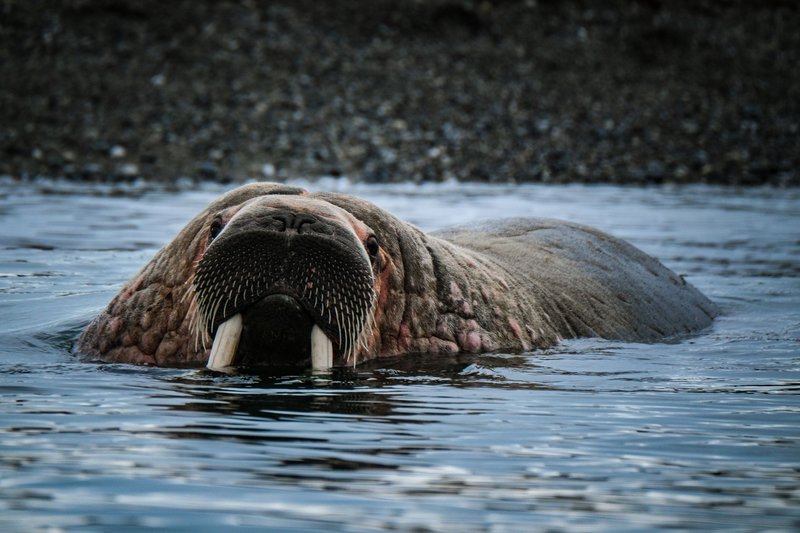
Fast fact: Uses its tusks to haul a one-ton body onto the ice. Size & diet: 1,800–3,700 lbs; eats clams and shellfish vacuumed off the seafloor. Cold-survival adaptation: Up to six inches of blubber, plus the ability to shunt blood away from the skin in cold water — which is why a walrus can look pale gray in the sea and turn pinkish-brown once it warms up on land. The whiskers (vibrissae) are sensitive enough to find clams in pitch-dark, muddy water.
14. Bearded Seal
Fast fact: Named for its luxuriant, sensor-packed whiskers. Size & diet: 575–800 lbs; eats clams, crabs, and bottom-dwelling fish. Cold-survival adaptation: Maintains breathing holes in the ice and a blubber layer that doubles as an energy reserve through lean months. It’s also the polar bear’s single most important prey species.
15. Ringed Seal
Fast fact: The smallest and most abundant Arctic seal. Size & diet: 110–150 lbs; eats fish and crustaceans. Cold-survival adaptation: Uses the strong claws on its front flippers to scratch and maintain breathing holes through sea ice up to six feet thick. Females build snow caves above the holes to birth and shelter pups, hiding them from polar bears and arctic foxes.
16. Beluga Whale
Fast fact: Nicknamed the “sea canary” for its chirps and whistles. Size & diet: 13–20 feet, up to 3,500 lbs; eats fish, squid, and crustaceans. Cold-survival adaptation: No dorsal fin — a tough ridge replaces it — so the whale can swim directly beneath ice and surface in narrow cracks without injury. It can also turn its head, unusual among whales, to scan for breathing holes. Its white coloring is camouflage against the ice.
17. Bowhead Whale
Fast fact: May be the longest-living mammal on Earth, topping 200 years. Size & diet: Up to 60 feet; filter-feeds on tiny crustaceans through baleen. Cold-survival adaptation: The thickest blubber of any animal — up to 20 inches — and a massive, reinforced skull it uses to break through sea ice nearly a foot thick to breathe. Like the more migratory baleen whales whose krill-heavy feeding habits we cover in our fin whale diet guide, the bowhead filters tiny crustaceans by the ton — but per NOAA Fisheries, it’s the only baleen whale that spends its entire life in Arctic and subarctic waters.
18. Orca (Killer Whale)
Fast fact: The Arctic’s apex marine predator, hunting in coordinated pods. Size & diet: Up to 32 feet; eats fish, seals, and even other whales. Cold-survival adaptation: Less an Arctic specialist than an Arctic opportunist — but as sea ice retreats, orcas push farther north each year, hunting seals and narwhals in waters that were once locked under ice. Their intelligence and pack tactics, not their physiology, are the adaptation here.
Birds of the Arctic
Most Arctic birds leave before winter. A few don’t.
19. Snowy Owl
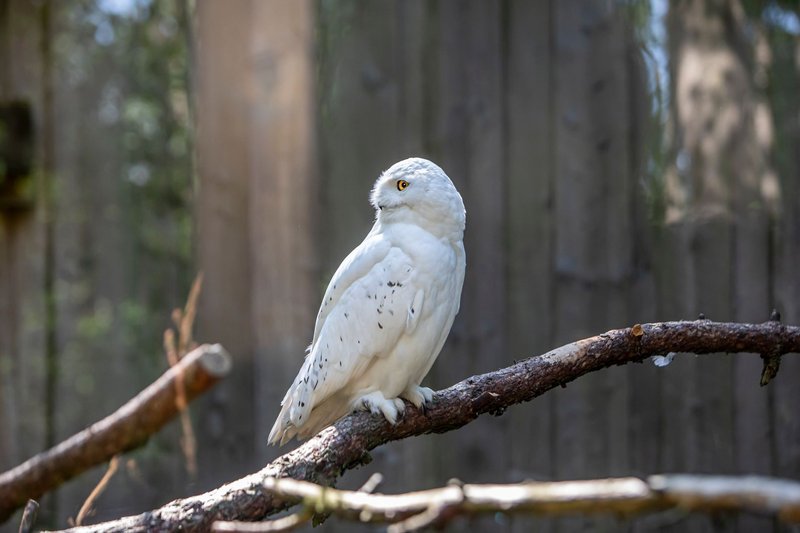
Fast fact: One of the few raptors that hunts in broad daylight. Size & diet: 4–6.5 lbs, up to a 5-foot wingspan; eats lemmings, voles, and birds. Cold-survival adaptation: Dense feathering all the way down to the toes, plus feathers on the face and feet that few other owls have. A single snowy owl can eat more than 1,600 lemmings in a year, which ties its breeding success directly to the lemming population cycle.
20. Rock Ptarmigan
Fast fact: Changes color three times a year to stay hidden. Size & diet: About 1 lb; eats buds, leaves, berries, and seeds. Cold-survival adaptation: Feathered feet that act as snowshoes and insulation, and a seasonal molt cycle that keeps it camouflaged from mottled summer rock to pure winter white. On bitter nights it burrows into the snow to trap body heat.
21. Atlantic Puffin
Fast fact: The “clown of the sea,” with a bill that brightens for mating season. Size & diet: About 1 lb; eats small fish like sand eels and herring. Cold-survival adaptation: Waterproof, tightly layered feathers and the ability to dive 200 feet deep, using its wings to “fly” underwater. Spiny ridges on its tongue and palate let it hold a dozen or more fish crosswise in its bill at once.
Smaller and lesser-known species
The Arctic isn’t all megafauna. These two close out the list.
22. Ribbon Seal
Fast fact: The most distinctively patterned of all seals. Size & diet: 175–200 lbs; eats fish, squid, and crustaceans. Cold-survival adaptation: Bold cream-colored “ribbons” loop around a dark body — striking, but the real adaptation is an inflatable air sac near the windpipe, unique among seals, thought to help with underwater sound. Ribbon seals stay far out on the drifting pack ice, rarely coming near land.
23. Arctic Tern
Fast fact: Migrates farther than any animal on Earth. Size & diet: About 4 oz; eats small fish and crustaceans. Cold-survival adaptation: It doesn’t survive Arctic winter — it outruns it. Every year the Arctic tern flies from the Arctic to the Antarctic and back, a round trip of roughly 44,000 miles. Over a 30-year lifespan that’s the equivalent of three trips to the moon, and it means this bird sees more daylight than any other creature alive.
Quick-reference table
| Animal | Habitat | Key adaptation | Conservation status |
|---|---|---|---|
| Polar bear | Sea ice | Black skin under hollow fur | Vulnerable |
| Arctic fox | Tundra | Best fur insulation; compact body | Least Concern |
| Narwhal | Arctic Ocean | Sensory tusk; blubber | Least Concern |
| Musk ox | Tundra | Qiviut underwool (8× wool) | Least Concern |
| Caribou | Tundra | Hollow hairs; seasonal hooves | Vulnerable |
| Arctic hare | Tundra | Compact body; year-round white | Least Concern |
| Snowshoe hare | Boreal/tundra | Snowshoe hind feet | Least Concern |
| Arctic wolf | Tundra | Double coat; small ears | Least Concern |
| Wolverine | Tundra/taiga | Frost-shedding fur | Least Concern |
| Arctic ground squirrel | Tundra | Subfreezing hibernation | Least Concern |
| Lemming | Under snowpack | Active under-snow tunnels | Least Concern |
| Stoat (ermine) | Tundra | Slender body; white winter coat | Least Concern |
| Walrus | Coastal ice | Thick blubber; sensing whiskers | Vulnerable |
| Bearded seal | Sea ice | Breathing holes; blubber reserve | Least Concern |
| Ringed seal | Sea ice | Claws cut breathing holes | Least Concern |
| Beluga | Arctic Ocean | No dorsal fin for under-ice swimming | Least Concern |
| Bowhead whale | Arctic Ocean | 20-inch blubber; ice-breaking skull | Least Concern |
| Orca | Arctic Ocean | Pack hunting intelligence | Data Deficient |
| Snowy owl | Tundra | Feathered feet; daytime hunting | Vulnerable |
| Rock ptarmigan | Tundra | Triple seasonal molt; snow roosting | Least Concern |
| Atlantic puffin | Coastal cliffs | Waterproof plumage; deep diving | Vulnerable |
| Ribbon seal | Pack ice | Inflatable air sac | Least Concern |
| Arctic tern | Arctic to Antarctic | Pole-to-pole migration | Least Concern |
Frequently asked questions
What is the most common animal in the Arctic? By sheer numbers, small creatures dominate — lemmings and other rodents during their population peaks, and seabirds like the little auk, which nests in colonies of millions. Among the well-known species, the ringed seal is the most abundant Arctic marine mammal.
What animal is the apex predator of the Arctic? On land and ice, the polar bear sits at the top with no natural predators. In the open ocean, the orca takes that role. The two rarely overlap, since polar bears stick to the ice and orcas to open water.
Do penguins live in the Arctic? No. Penguins live almost exclusively in the Southern Hemisphere, mostly around Antarctica. The Arctic has never had wild penguins. The bird people sometimes confuse with them, the now-extinct great auk, wasn’t a penguin at all.
How do Arctic animals stay warm? Three main strategies. Insulation (blubber, dense fur, or layered feathers), body shape (compact bodies and small extremities lose less heat), and behavior (huddling, burrowing under snow, hibernating, or migrating away entirely). Most Arctic animals use more than one.
Which Arctic animals hibernate? Fewer than you’d think. The arctic ground squirrel is the standout, dropping its body temperature below freezing for eight months. Most large Arctic mammals — polar bears, caribou, musk oxen — stay active all winter. Pregnant female polar bears den up, but it’s not true hibernation.
What’s the biggest threat to Arctic animals? Sea-ice loss. Species that hunt, rest, or breed on ice — polar bears, walruses, ringed seals — are losing the platform their lives depend on as the Arctic warms faster than anywhere else on the planet.