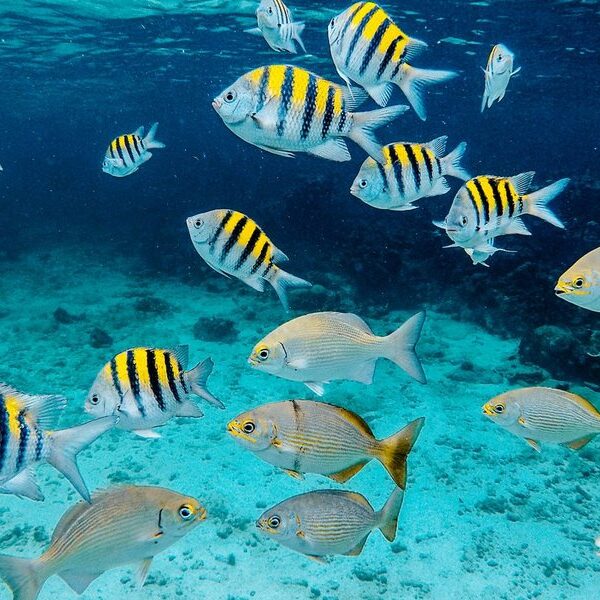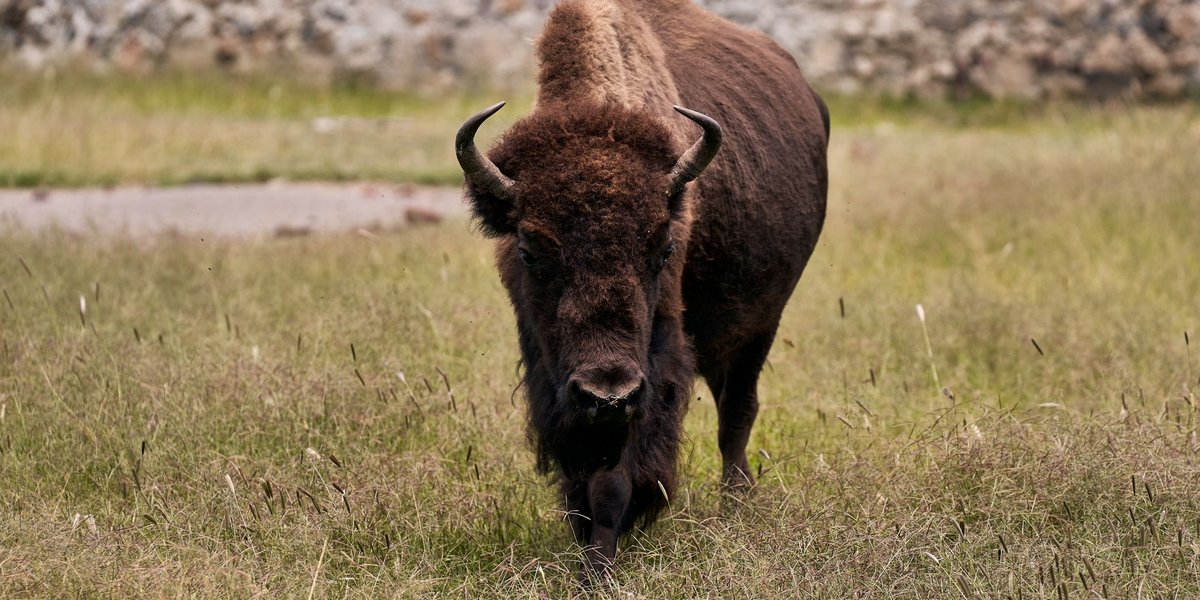
The United States holds roughly 21,715 native species of plants and animals. Of those, about 2,972 are animals — enough to put America on the short list of just 17 megadiverse countries on Earth. That number breaks down into roughly 428 mammals, 784 birds, 311 reptiles, 295 amphibians, and more than 1,150 fish. Insects blow past all of that, with an estimated 91,000 species, most of them still being sorted out.
But a species count is a cold way to meet a continent’s wildlife. The bison that nearly vanished, the condor with a ten-foot wingspan, the Hawaiian birds found nowhere else on the planet — those are the animals worth knowing. This guide walks the country by region: what lives there, where you can actually see it, and which species clawed their way back from the edge.
Table of Contents
- The data snapshot
- The two national animals
- The West and Rocky Mountains
- The Great Plains
- Eastern forests and wetlands
- Alaska
- Hawaii: the endemism capital
- Comeback stories
- Native vs. invasive: why the distinction matters
- Quick comparison table
- FAQ
The data snapshot {#snapshot}
Here is the shape of American wildlife in numbers, drawn from native-species counts (the ones that evolved here, not the starlings and feral hogs that arrived later):
- Mammals: ~428 species
- Birds: ~784 species
- Reptiles: ~311 species
- Amphibians: ~295 species
- Fish: ~1,150+ species
- Insects: ~91,000 described species (and counting)
The spread isn’t even. The arid Southwest is a reptile stronghold. The Southeast holds the densest salamander diversity on Earth — the southern Appalachians alone host dozens of species found nowhere else. And Hawaii, a speck of land by comparison, carries a level of endemism that distorts every national average. If you want to go deeper on the warm-blooded side of that list, our complete list of mammals of the United States breaks down ranges and conservation status species by species.
The two national animals {#national}
Most countries pick one national animal. The U.S. runs two, and the split tells you something about how Americans see their own wildlife.
The bald eagle (Haliaeetus leucocephalus) is the national bird, written into the Great Seal in 1782. The American bison (Bison bison) is the national mammal, made official by the National Bison Legacy Act in 2016. One rules the sky over every coast and big river; the other once thundered across the Plains in herds visible from miles off. Both came within a hair of being lost, which is part of why they carry the weight they do.
The West and Rocky Mountains {#west}
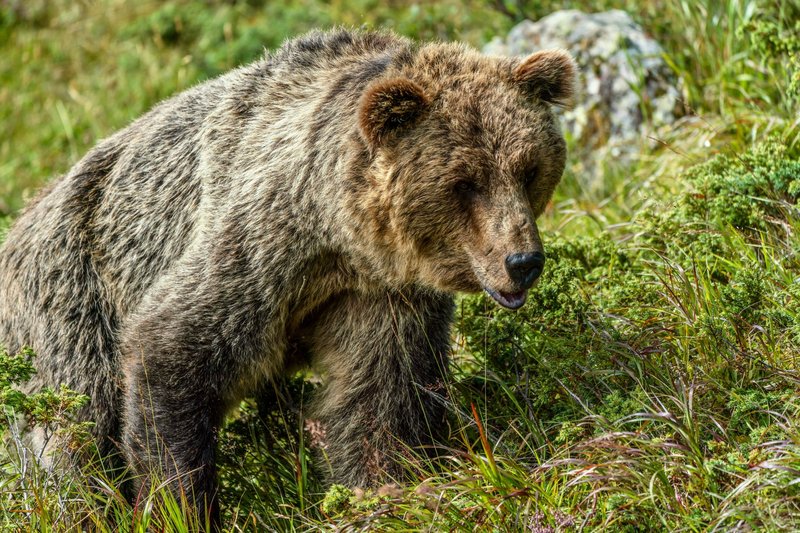
The Mountain West is the closest thing the lower 48 has to genuine wilderness, and its animals are built for altitude and cold.
- Grizzly bear (Ursus arctos horribilis) — Range: Greater Yellowstone, northern Rockies of Montana and Wyoming. Status: threatened in the lower 48. Where to see it: Yellowstone’s Lamar Valley and Grand Teton at dawn, from a respectful distance.
- Gray wolf (Canis lupus) — Reintroduced to Yellowstone in 1995 after being wiped out of the park. Watching a pack work an elk herd in the Lamar Valley is one of the few places in America you can witness a fully intact predator-prey system.
- Pronghorn (Antilocapra americana) — The fastest land animal in the Western Hemisphere, clocked over 55 mph. It evolved that speed to outrun the American cheetah, a predator that went extinct 12,000 years ago. The pronghorn is, in effect, running from a ghost.
- Mountain goat (Oreamnos americanus) — Glacier National Park, clinging to cliff faces that look unsurvivable.
The pronghorn is worth a second look. It’s not an antelope despite the nickname — it’s the sole surviving member of its entire family, Antilocapridae. There is no close relative anywhere on Earth.
The Great Plains {#plains}
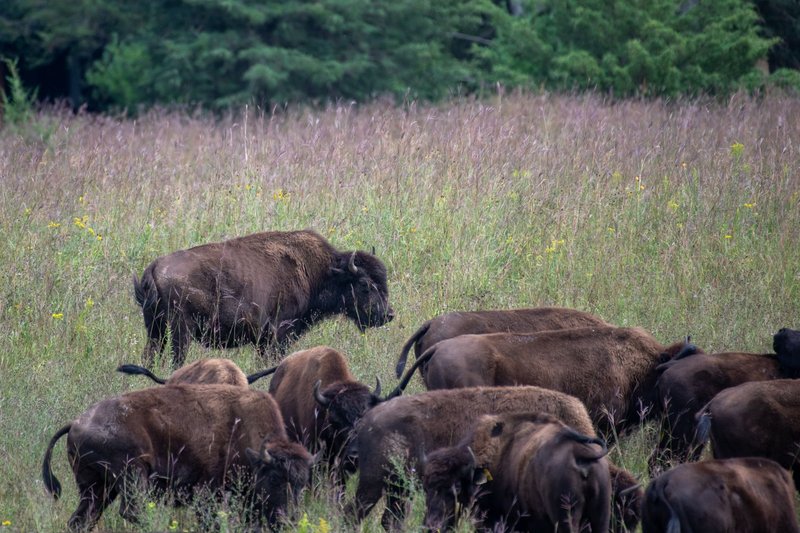
The Plains are where America’s most famous conservation story plays out, and where the bison still defines the landscape.
- American bison (Bison bison) — Yellowstone holds the only continuously wild, free-ranging herd in the country. The National Park Service manages bison there as wildlife, not livestock. Where to see them: Yellowstone, Wind Cave National Park, and the Tallgrass Prairie Preserve in Oklahoma.
- Black-footed ferret (Mustela nigripes) — Once declared extinct, twice. It depends almost entirely on prairie dogs for food and shelter, which is exactly why it nearly disappeared when the prairie dog towns were poisoned out.
- Greater prairie-chicken — Famous for its spring “booming” displays, where males inflate orange air sacs on their necks and stamp across communal grounds called leks.
Eastern forests and wetlands {#east}
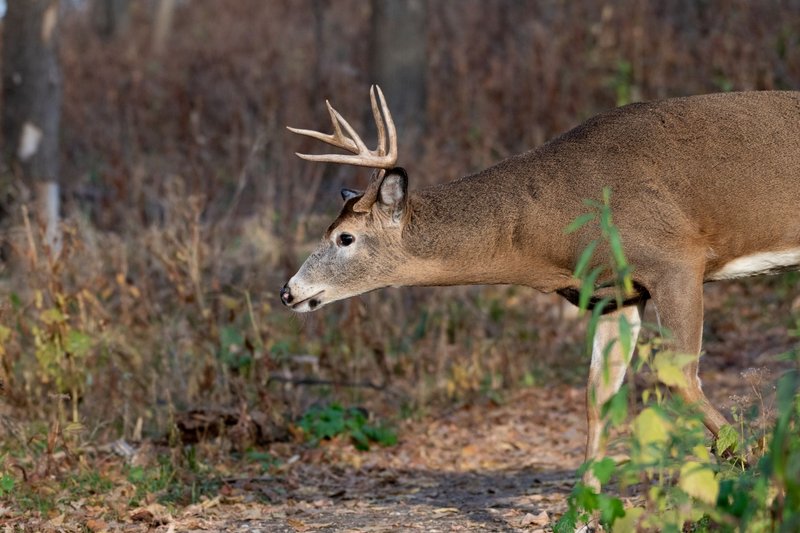
The East lost most of its old-growth forest to logging, then watched a surprising amount of wildlife move back in as farms were abandoned.
- White-tailed deer (Odocoileus virginianus) — So recovered it’s now overabundant in many suburbs. A century ago, overhunting had pushed it to near-collapse in much of its range. As a browser rather than a grazer, it shifts its menu with the seasons — our guide to what white-tailed deer eat through the year explains why it thrives in the patchy, regrown forests of the modern East.
- American alligator (Alligator mississippiensis) — A genuine success story. Federally protected in 1967 when it was vanishing, it rebounded so completely it was delisted by 1987. The Everglades and Louisiana bayous are full of them.
- Eastern box turtle (Terrapene carolina) — A land turtle that can live past 80 and rarely travels more than a few hundred yards from where it hatched.
- American black bear (Ursus americanus) — Smoky Mountains, Shenandoah, and increasingly the edges of Eastern cities.
Alaska {#alaska}
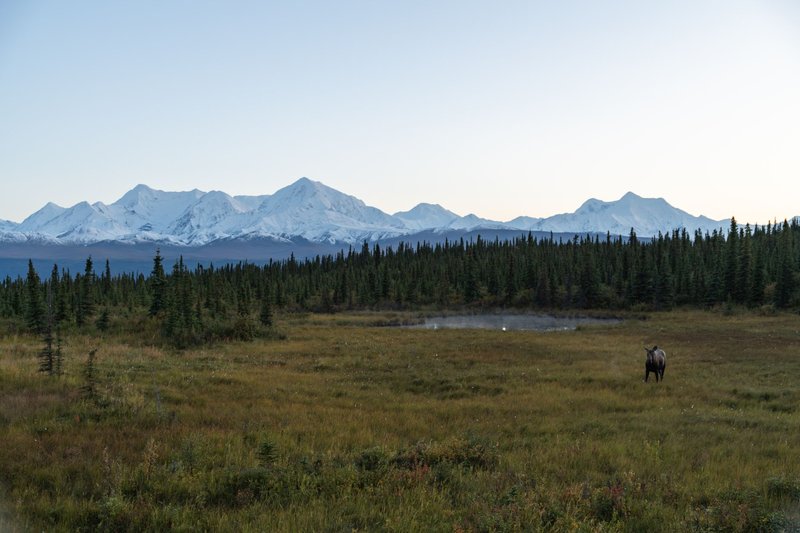
Alaska is where American wildlife stops being managed and starts being genuinely wild. Densities are low, distances are vast, and the megafauna is intact.
- Moose (Alces alces) — The largest member of the deer family, with bulls topping 1,500 pounds. Common right inside Anchorage city limits.
- Caribou (Rangifer tarandus) — The Porcupine herd migrates across hundreds of miles of the Arctic Refuge, one of the last great land migrations on the continent.
- Brown bear (Ursus arctos) — The coastal Katmai bears fishing the falls at Brooks River are the same species as the inland grizzly, just fattened on salmon to enormous size.
- Muskox (Ovibos moschatus) — Survivors from the Ice Age, with a soft underwool called qiviut that’s warmer than wool by weight.
Hawaii: the endemism capital {#hawaii}
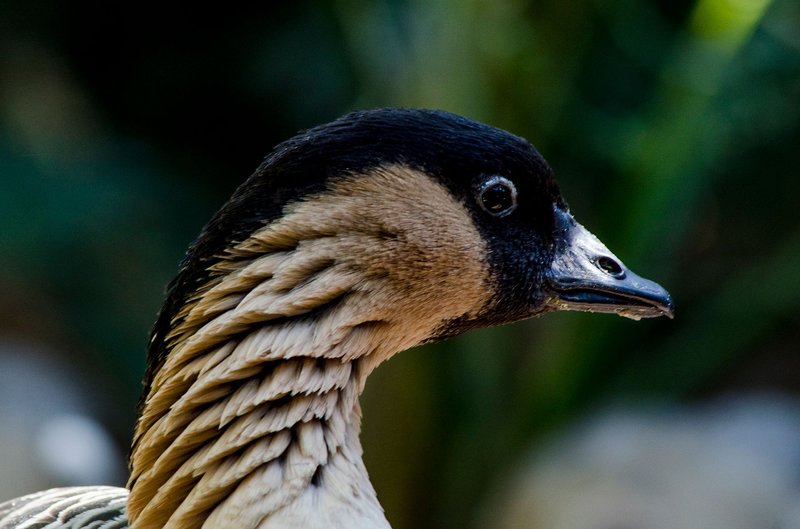
Hawaii is the most biologically isolated archipelago on Earth, and the numbers show it. Roughly 90 percent of its native terrestrial species exist nowhere else. Every native Hawaiian forest bird is found only on these islands.
The headline group is the Hawaiian honeycreepers — a single finch ancestor that arrived millions of years ago and radiated into dozens of forms, some with curved bills for nectar, some with thick bills for cracking seeds. It’s one of the textbook cases of adaptive radiation, on par with Darwin’s finches.
It’s also a crisis. Eleven of Hawaii’s surviving honeycreeper species are federally listed under the Endangered Species Act, and avian malaria carried by introduced mosquitoes is pushing several toward extinction within years, not decades. The nene (Branta sandwicensis), Hawaii’s state bird, offers a counterweight: it fell to about 30 individuals in the 1950s and has been rebuilt to several thousand through captive breeding.
Comeback stories {#comeback}
Thin listicles skim these. They’re the most important part of the story, because they’re the part the U.S. actually got right.
American bison. From an estimated 30–60 million animals down to fewer than 1,000 by 1900, slaughtered for hides, sport, and as a tactic against Plains tribes. Protected herds at Yellowstone and on tribal lands brought the count back to roughly 500,000 today, though most are managed livestock rather than wild.
Bald eagle. The pesticide DDT thinned eagle eggshells until they cracked under the parents’ weight. By 1963 only 417 nesting pairs remained in the lower 48. The U.S. banned DDT in 1972 and protected the bird under the Endangered Species Act; by 2007 it was delisted, and the population has kept climbing past 70,000 pairs since. You can now see bald eagles in all 49 continental states.
California condor. North America’s largest flying bird, with a wingspan near ten feet. By 1982 there were only 22 left on the planet. Biologists made the wrenching call to trap every remaining wild bird for captive breeding. The first releases came in 1991, and the wild population now sits around 350, spread across California, Arizona, Utah, and Baja.
American alligator. Listed as endangered in 1967, fully recovered and delisted by 1987 — fast enough that it’s now legally hunted in several Southern states.
These four share a pattern: a clear cause of decline, a federal protection that addressed it directly, and decades of patient follow-through. No clever workaround, just removing the thing that was killing them.
Native vs. invasive: why the distinction matters {#invasive}
Not every wild animal in America is American. The European starling, the house sparrow, the feral hog, the Burmese python now eating its way through the Everglades — all introduced, all damaging. A “native” species is one that evolved in or naturally colonized a region without human help, and the line matters because native wildlife sits inside food webs that took millennia to balance. Drop in a python with no natural predators, and you get the Everglades’ mammal collapse: marsh rabbits and raccoons all but gone from the southern reaches of the park. The same pattern repeats worldwide, and the broader facts about invasive species impact show just how far the damage reaches — into economies and human health as well as ecosystems.
When you’re identifying what you see, the native-or-not question is the first one worth asking.
Quick comparison table {#table}
| Animal | Region | Conservation status | Best place to see it |
|---|---|---|---|
| American bison | Great Plains | Near threatened (recovering) | Yellowstone, Wind Cave NP |
| Bald eagle | Nationwide | Least concern (recovered) | Pacific NW, Mississippi River |
| Grizzly bear | Northern Rockies | Threatened (lower 48) | Yellowstone, Grand Teton |
| Pronghorn | West / Plains | Least concern | Wyoming, Montana grasslands |
| California condor | Southwest | Critically endangered | Grand Canyon, Big Sur |
| Moose | Alaska / North | Least concern | Denali, Anchorage |
| American alligator | Southeast | Least concern (recovered) | Everglades, Louisiana bayous |
| Hawaiian honeycreepers | Hawaii | Mostly endangered | Hakalau Forest, Kauai uplands |
FAQ {#faq}
How many native animal species does the United States have? About 2,972 native animal species, part of roughly 21,715 total native plant and animal species. That count covers mammals, birds, reptiles, amphibians, fish, and described insects.
What is the national animal of the United States? There are two. The bald eagle is the national bird, and the American bison became the official national mammal in 2016.
What’s the rarest native animal in the U.S.? The California condor is among the closest to extinction — it dropped to 22 individuals in 1982 and remains critically endangered today, with around 350 birds in the wild.
Which state has the most endemic species? Hawaii, by a wide margin. Roughly 90 percent of its native terrestrial species are found nowhere else on Earth.
Where can I see the most native wildlife in one trip? Yellowstone offers the best concentration in the lower 48 — bison, wolves, grizzlies, elk, and pronghorn all in one ecosystem. For sheer scale and intact megafauna, Alaska’s Denali is unmatched.