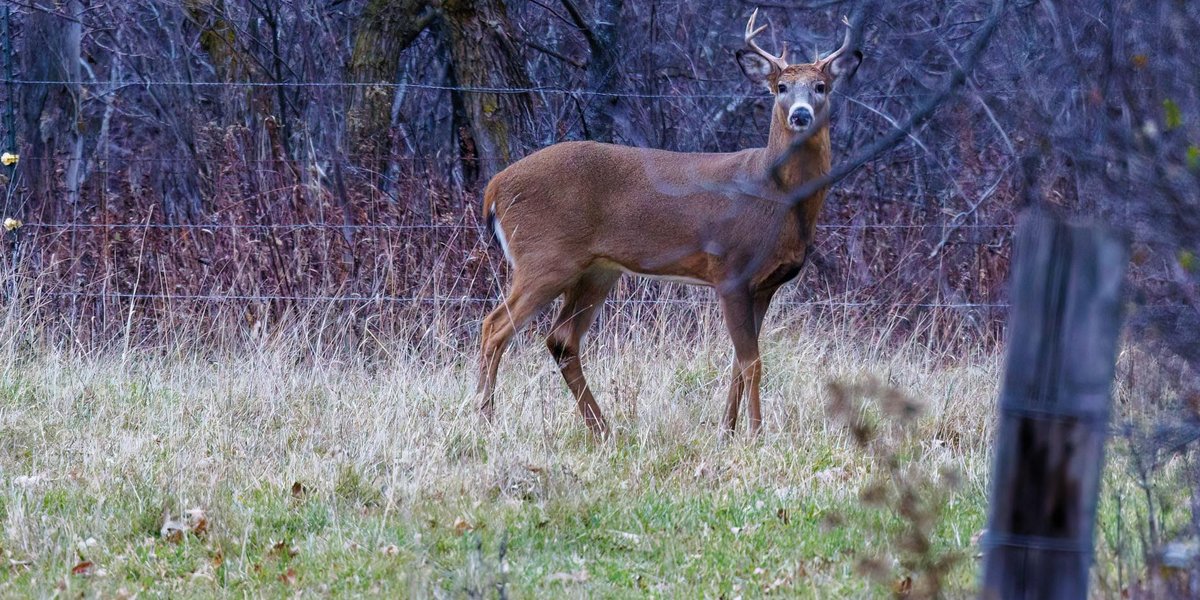
A white-tailed deer is not out there eating grass like a cow. That single fact explains almost everything about its diet. Deer are browsers, not grazers, and the difference shapes what they put in their mouths from January to December.
If you watch a doe work a field edge, she’s not mowing. She’s picking. A bite of clover here, the tender tip off a greenbrier vine there, a few acorns scratched out from under the leaf litter. Selective to the point of being picky. Researchers have catalogued more than 400 plant species in whitetail diets across their range, yet roughly a third of those plants make up about 93% of what they actually eat. The rest are snacks and emergencies.
Here’s what’s on the menu, how it shifts through the year, and the foods that do more harm than good.
Table of Contents
- The diet breakdown at a glance
- Why deer are browsers, not grazers
- Spring and summer: forbs and green growth
- Fall: mast, acorns, and crops
- Winter: browse and survival mode
- Favorite plants whitetails seek out
- How much does a deer eat per day?
- What NOT to feed deer
- Quick-reference seasonal table
The diet breakdown at a glance
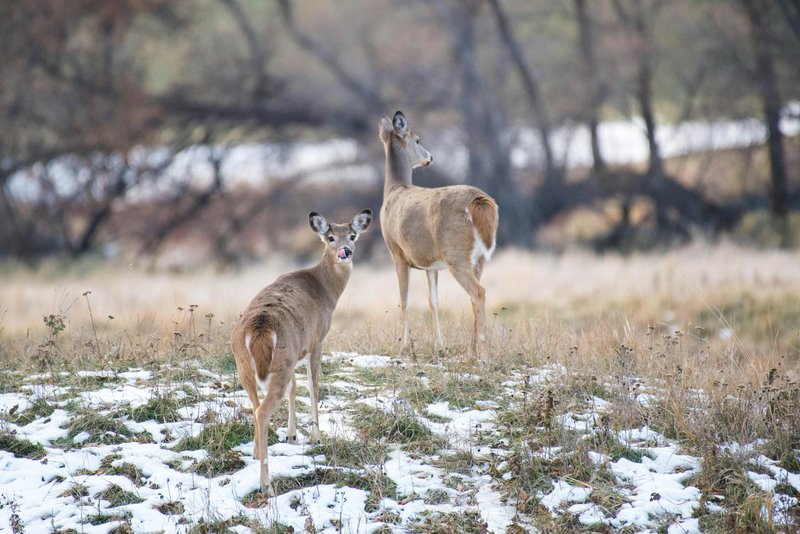
Across most of the whitetail’s range, the diet sorts into a handful of categories. The proportions shift by region and season, but the long-term averages from wildlife research look roughly like this:
| Food type | Share of diet | What it includes |
|---|---|---|
| Browse | ~46% | Twigs, leaves, buds, and woody growth from shrubs and trees |
| Forbs | ~24% | Broadleaf weeds and wildflowers — clover, ragweed, pokeweed |
| Mast | ~11% | Acorns and other nuts (hard mast), plus soft fruits |
| Grasses | small | Mostly young, tender shoots, not mature blades |
| Crops | ~4% | Corn, soybeans, alfalfa, winter wheat |
| Fungi | minor | Mushrooms, eaten opportunistically |
Browse is the foundation. It’s available year-round, it’s reliable, and it’s the category deer fall back on when everything else disappears. Forbs are the preferred summer food when they’re growing. Mast is the high-value fall windfall that fattens deer for winter. Notice how small grasses are — that’s the single biggest misconception about deer, and it comes straight from their anatomy.
Why deer are browsers, not grazers
A whitetail’s stomach has four chambers, like a cow’s, but its feeding strategy is the opposite. Cattle are bulk grazers built to process large volumes of low-quality grass. Deer are concentrate selectors, evolved to pick out the most nutritious, easily digestible bits and leave the rough fiber behind. It’s a strategy they share with other browsing herbivores of the northern forests, from moose to caribou, that all depend on woody plants rather than open grassland.
Their rumen is comparatively small, and the microbes living in it are tuned to break down the lignin and cellulose in woody browse and tender forbs rather than mature grass. That’s why a deer can thrive on a winter diet of twig tips that would barely sustain a goat. Their narrow muzzle and prehensile tongue let them strip individual leaves and buds with surgical precision — the physical tools of a picky eater.
This also explains a seasonal quirk. The gut microbiome of a deer shifts through the year to match the available food, which is part of why a deer suddenly switched onto a high-starch food (like a pile of corn) in deep winter can get sick or even die. The bacteria built for browse can’t handle a flood of starch fast enough. More on that below.
Spring and summer: forbs and green growth
When the world greens up, deer eat like kings. Spring brings a flush of new growth that’s high in protein and easy to digest — exactly what they need after a hard winter, and exactly what a doe needs while nursing fawns and a buck needs while growing antlers.
The stars of the warm season are forbs: clover, alfalfa, chicory, pokeweed, ragweed, and dozens of other broadleaf weeds and wildflowers. These pack 15 to 30% crude protein at their peak, well above what woody browse offers. Deer also hit the tender new leaves of shrubs and trees, early soft mast like wild strawberries and blackberries, and the occasional mushroom.
Soft, leafy, green, and protein-rich. Summer is the easy season, the one that builds the body condition deer will spend down later in the year.
Fall: mast, acorns, and crops
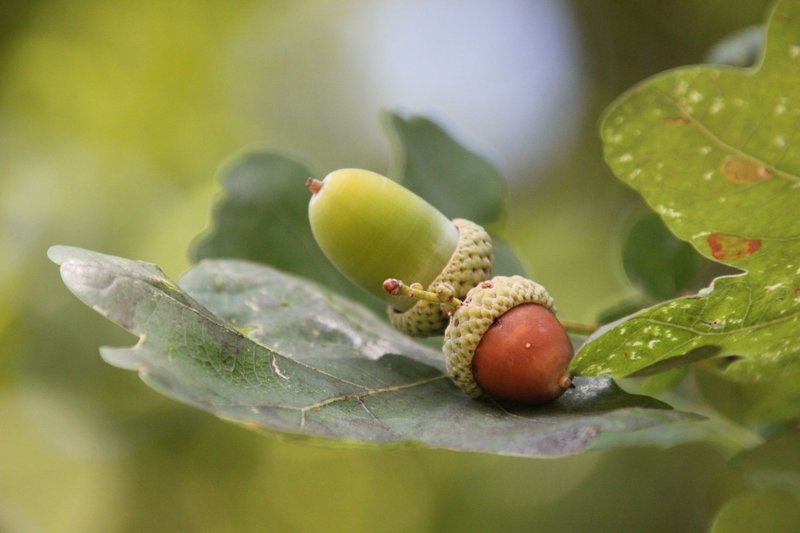
Fall is about one thing: packing on fat before winter. And nothing does that like mast.
Yes, deer eat acorns — they love them. Acorns are the headline hard mast, dense with carbohydrates and fat, and a good acorn year can pull deer off everything else in the woods. White oak acorns get eaten first because they’re lower in bitter tannins; red oak acorns are more bitter but more abundant and store longer on the ground, so they carry deer deeper into the season. Where you find dropping white oaks in October, you’ll find deer.
Beyond acorns, fall mast includes beechnuts, chestnuts, and soft mast like persimmons, apples, and grapes. In farm country, this is also when deer raid agricultural crops hard — standing corn, soybeans, and the green flush of winter wheat and rye. Those crops are only about 4% of the rangewide diet on average, but in the right county at the right week, they can be most of what a local herd eats.
The strategy is simple. Eat the richest food available, build a fat layer, and get ready for the lean months.
Winter: browse and survival mode
Winter is when being a browser pays off. The forbs are dead, the mast is gone or buried, and the crops are harvested. What’s left is woody browse — and that’s the food deer were built for.
Through the cold months, whitetails live on the twig tips, buds, and dormant woody growth of shrubs and young trees: dogwood, sumac, maple, greenbrier, honeysuckle, and the buds of oaks and other hardwoods. They’ll strip the bark and nip the terminal buds, which is why heavily browsed winter habitat develops a visible “browse line” — a neat horizontal edge at about the height a deer can reach.
Northern herds lean on browse even harder than southern ones. With deeper snow and longer winters, a deer in Maine or Minnesota — or across the broad range whitetails occupy among the animals of Canada — may spend most of the season eating almost nothing but woody twigs, and it survives partly by burning the fat it stored in fall and partly by dropping its metabolism. Winter browse is low in protein and energy, so a deer can actually lose weight all winter even while eating steadily. It’s a holding pattern, not a feast.
This is also the season people are most tempted to “help” — and where help most often backfires.
Favorite plants whitetails seek out
If you’re managing habitat or just want to know what draws deer, these are the species that consistently rank high in whitetail preference across much of the eastern and central U.S., where the deer is one of the most familiar mammals of the United States:
- Greenbrier — a year-round favorite; deer eat the leaves, tendrils, and even the thorny stems
- Sumac — readily browsed, especially the new growth
- Dogwood — one of the most preferred winter browse species
- Elm and maple — twigs and buds taken heavily in winter
- Honeysuckle — native varieties are high-preference browse
- Oak — both for acorns in fall and buds/twigs in winter
- Clover and alfalfa — top warm-season forbs, the reason food plots lean on them
- Persimmon and apple — soft mast deer will travel for
Preference isn’t fixed. A plant deer ignore in summer (when better food exists) can become important in winter, and vice versa. The list above is a starting point, not a guarantee for every region.
How much does a deer eat per day?
A common rule of thumb: an adult white-tailed deer eats roughly 2 to 4 pounds of food per 100 pounds of body weight per day in dry-matter terms. For a typical 150-pound deer, that lands somewhere around 5 to 9 pounds of forage daily, and on the higher end during the growing season when food is abundant and the deer is putting on condition.
Intake drops in winter. Partly there’s less food, and partly the deer’s metabolism slows to conserve energy, so it simply needs less. A whitetail doesn’t try to eat its way through January at summer rates — it can’t, and it doesn’t need to.
What NOT to feed deer
This is the part the agency pages and ecology articles tend to skip, and it’s the part most likely to actually matter to you. Feeding deer can hurt them, and a few foods are dangerous.
Corn in deep winter is the big one. It seems kind — a deer is struggling, here’s a high-energy food. But a deer that’s been living on woody browse has a gut tuned for browse. Dumping corn or other high-starch grain into that gut can cause rumen acidosis, a rapid drop in stomach pH that can kill a deer within 24 to 72 hours, sometimes with a full stomach. Deer have starved to death surrounded by corn they couldn’t digest. If you must feed in an emergency, wildlife biologists point to browse and specially formulated deer pellets that transition the gut slowly — not a bucket of corn.
Hay is nearly useless to a deer. Their gut can’t extract enough from mature grass hay to make it worth the digestive effort, and deer have died with bellies full of hay.
Bread, crackers, and other processed human food are empty calories at best and can disrupt digestion at worst.
And then there’s the bigger argument against feeding at all: concentrating deer at a feed site spreads disease. The CDC and state wildlife agencies warn that artificial feeding raises the transmission risk of Chronic Wasting Disease, a fatal neurological illness, by crowding deer nose-to-nose. Many states have banned baiting and feeding for exactly this reason. The kindest thing you can usually do for local deer is protect good habitat — native browse, oaks, and forbs — and let them eat the way they’re built to.
Quick-reference seasonal table
| Season | Primary foods | What’s driving it |
|---|---|---|
| Spring | Forbs, fresh shrub leaves, clover, early shoots | High protein for fawning, antler growth, recovery |
| Summer | Forbs, soft mast (berries), green browse, crops | Abundance; building body condition |
| Fall | Acorns and hard mast, soft mast, corn/soybeans | Maximizing fat for winter |
| Winter | Woody browse — twigs, buds, dogwood, greenbrier | Survival; browse is all that’s left |
The throughline is consistency in the face of change. The menu rotates hard from spring forbs to fall acorns to winter twigs, but the strategy never moves: find the most nutritious food available right now, eat it selectively, and store what you can for the months when the woods have nothing left to offer. That’s what makes the whitetail one of the most adaptable large mammals in North America — and why it thrives everywhere from deep wilderness to the edge of your backyard.