Algeria holds somewhere between 104 and 112 reptile species, depending on which checklist you trust and how the taxonomists carved things up last. Around one in six of them lives nowhere else on Earth. That makes the country one of the richest patches of reptile life anywhere in the Mediterranean Basin — a fact that gets buried because most sources either dump a bare species list on you or profile the same five charismatic snakes and call it a day.
This guide does it differently. We’re going group by group — geckos, skinks, agamas and lizards, snakes, tortoises, and the sea turtles that haul out on Algeria’s coast — with the habitat, the scientific name, and where each sits on the conservation ledger. The country’s geography does the heavy lifting here: a green Mediterranean strip up north, the Tell and Saharan Atlas mountains in the middle, then the Sahara swallowing the bottom 80 percent of the map. Each zone runs its own cast of reptiles.
Table of Contents
- The numbers, quickly
- Geckos
- Skinks
- Agamas and other lizards
- Snakes (and which ones are venomous)
- Tortoises and freshwater turtles
- Mediterranean sea turtles
- Coastal vs. Saharan: two different reptile worlds
- Algerian endemics worth knowing
- Conservation: the real pressures
The numbers, quickly
If you only want the headline figures:
- ~104–112 reptile species recorded in Algeria, with new records still trickling in from Saharan surveys.
- Roughly 17% endemic or near-endemic to Algeria or the wider Maghreb — high for the region.
- Lizards dominate the count: geckos, skinks, lacertids and agamas together outnumber snakes by a wide margin.
- Around 20-plus snake species, of which a handful are dangerously venomous — mostly vipers and the desert cobra.
- Three tortoise/freshwater turtle species on land and in fresh water, plus two regularly nesting or foraging sea turtles on the Mediterranean coast.
The diversity tracks Algeria’s habitat range. Few countries pack a wet Mediterranean coast, alpine cedar forest, high steppe, and hyper-arid desert into one border, and reptiles — cold-blooded specialists that they are — split neatly along those lines. The same geography shapes the rest of the country’s wildlife too, from the mammals of Algeria down to the insects, but reptiles are where it shows most cleanly.
Geckos
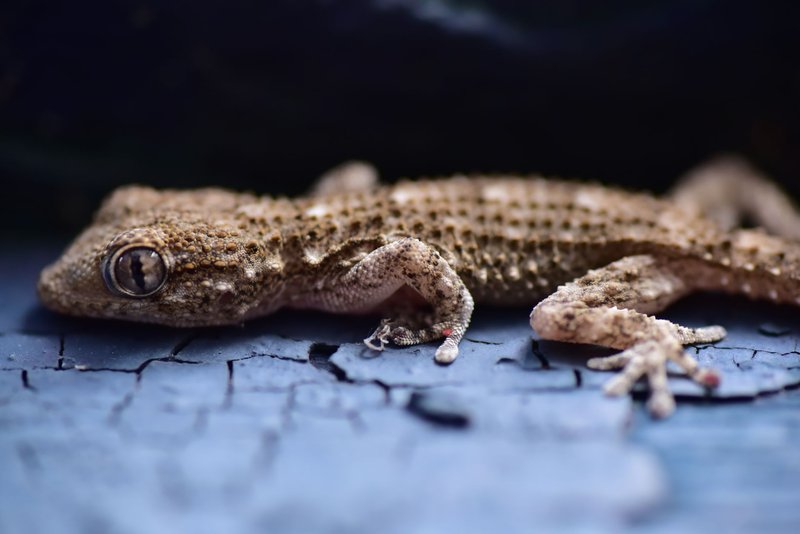
Geckos are Algeria’s night shift. They turn up on rock faces, palm trunks, and the walls of any building with a porch light, snapping up moths.
The Moorish gecko (Tarentola mauritanica) is the one you’ll actually meet — a stout, warty, grey-brown climber plastered across walls from the coast inland. It’s flexible about habitat, abundant, and listed as Least Concern. Its desert cousin, the fringe-toed Saharan gecko (Tarentola and Stenodactylus groups), trades wall-climbing for sand, with toe fringes that work like snowshoes on loose dunes.
Then there’s the genuinely strange one: the Saharan fan-footed gecko and the wonderfully named Stenodactylus sand geckos, which have enormous, lidless eyes they clean by licking — no blinking. Out in the deep desert, these are among the few reptiles active on cool nights when the day’s heat would cook anything that moved at noon.
Skinks
Skinks are the smooth-scaled, low-slung burrowers of the bunch, and Algeria has a strong showing. Their polished scales aren’t for looks — they reduce friction so the animal can “swim” through sand or leaf litter.
The standout is the Berber skink or sandfish (Scincus scincus), a Saharan specialist that literally dives into soft sand and moves below the surface, surfacing only to grab insects. Its wedge-shaped snout and countersunk lower jaw keep grains out while it submarines along. Watching one vanish into a dune is one of the more surreal things the Algerian desert offers.
Up in the Mediterranean zone you get the ocellated skink (Chalcides ocellatus), a glossy, eye-spotted lizard of gardens, walls, and dry grassland, and several smaller Chalcides species with reduced limbs — evolution caught mid-step between lizard and snake. Most skinks here sit at Least Concern, though the range-restricted ones are harder to assess simply because nobody has surveyed their patch recently.
Agamas and other lizards
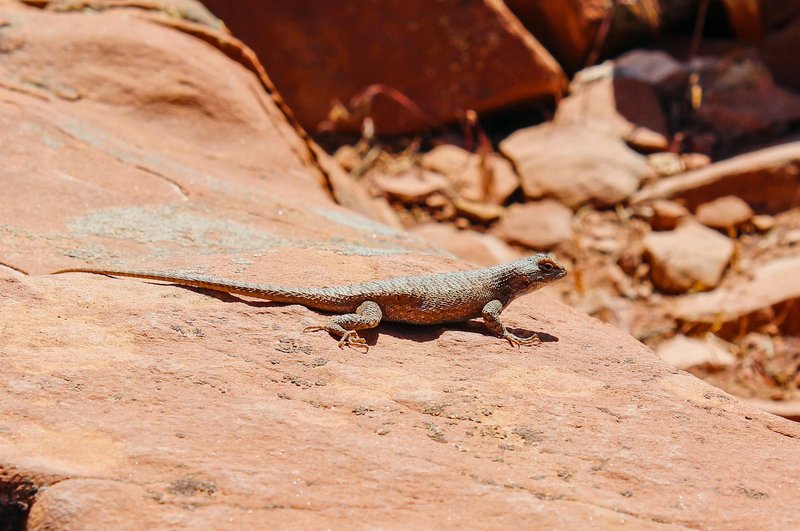
This is the group that gives you the desert-postcard reptiles: alert, fast, sun-basking lizards perched on rocks.
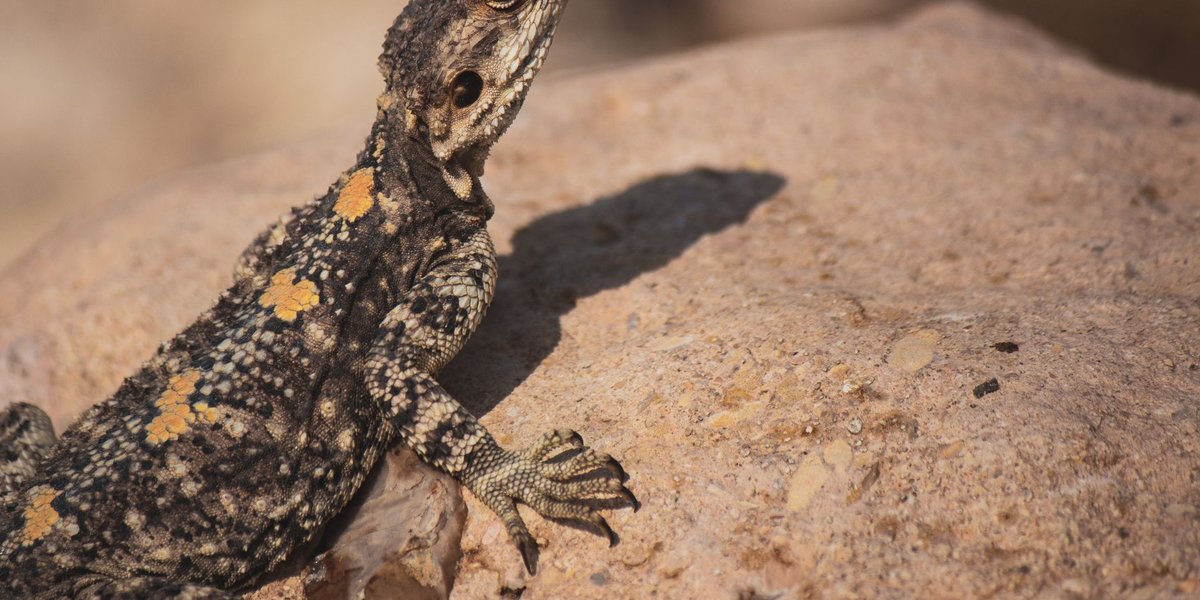
The Bibron’s agama (Agama impalearis), the North African agama, is a rock-dweller of the arid south, the males flushing blue-headed in breeding season. More impressive is the spiny-tailed lizard (Uromastyx acanthinura) — a chunky, herbivorous desert lizard with a club of a tail it swings like a mace at predators. Uromastyx are heavily collected for the pet trade across North Africa, which has pushed some populations onto regional watch lists; international trade is regulated under CITES.
The fast-moving lacertids — the typical “wall lizards” — round out the group. The Algerian psammodromus (Psammodromus algirus) darts through Mediterranean scrub, while Acanthodactylus fringe-fingered lizards own the open desert flats, where their long toe fringes grip loose sand at speed. Acanthodactylus is one of the most species-rich and taxonomically messy lizard groups in the country, and several forms are candidates for endemic status pending more genetic work.
Snakes (and which ones are venomous)
Algeria has just over 20 snake species. Most are harmless to people. A few are emphatically not.
The venomous ones to respect:
- Saharan horned viper (Cerastes cerastes) — the iconic desert viper, with a horn over each eye and a sidewinding gait that leaves J-shaped tracks in the sand. It buries itself with only the eyes and horns showing. Bites cause serious tissue damage.
- Desert horned viper’s hornless relative (Cerastes vipera), the Sahara sand viper — smaller, also a sand-ambusher.
- Egyptian/desert cobra (Walterinnesia / Naja haje group) — Algeria’s true cobra presence, a potent neurotoxic snake of the arid regions.
- Lataste’s viper (Vipera latastei) — a Mediterranean-zone viper of rocky northern slopes, with a small upturned snout-horn.
Many of these desert serpents range far south of the border, and the same horned vipers and sand-ambushers turn up across the reptiles of Mali and the wider Sahara — the desert doesn’t care about national lines. Snakebite remains a real rural health issue across the Sahara and Sahel; the World Health Organization classifies snakebite envenoming as a neglected tropical disease and tracks antivenom access across the region.
The harmless majority include the Montpellier snake (Malpolon monspessulanus), a large, fast, rear-fanged hunter that’s mildly venomous but no threat to humans, plus a range of whip snakes, sand snakes (Psammophis), and the small, burrowing worm snakes that look more like earthworms than serpents. Most of Algeria’s snakes are Least Concern, with population data thinnest for the deep-desert species.
Tortoises and freshwater turtles
Algeria’s flagship chelonian is the spur-thighed tortoise (Testudo graeca), the familiar domed Mediterranean tortoise of scrubland and open forest in the north. It’s classified as Vulnerable on the IUCN Red List, squeezed by habitat loss and decades of collection for the pet trade — one of the most heavily traded tortoises in the Mediterranean.
In wetlands and slow rivers you’ll find the Mediterranean pond turtle (Mauremys leprosa) and the European pond turtle (Emys orbicularis), both tied to permanent fresh water. That dependence makes them the most exposed reptiles in the country, because Algeria’s wetlands are exactly what’s disappearing fastest.
Mediterranean sea turtles
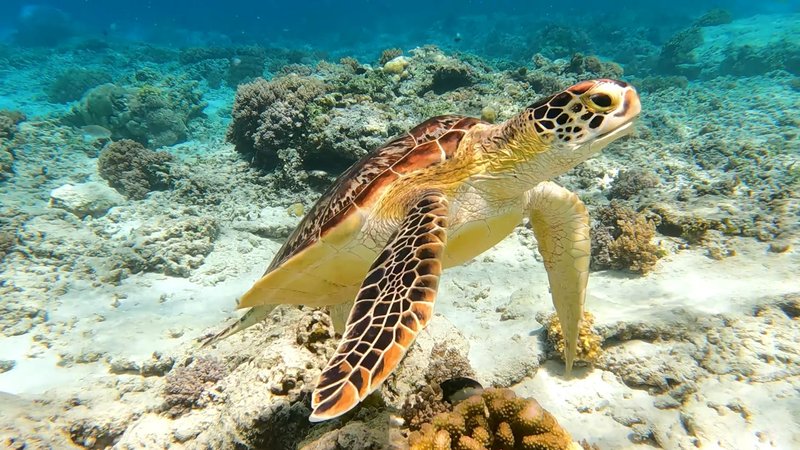
Algeria’s 1,600-plus kilometers of Mediterranean coast bring two sea turtles into the picture. The loggerhead (Caretta caretta) is the regular — it forages in Algerian waters and occasionally nests on the coast, part of the wider Mediterranean loggerhead population. The green turtle (Chelonia mydas) shows up less often, more visitor than resident.
Both are protected, both face the standard Mediterranean gauntlet: bycatch in fishing gear, coastal development eating nesting beaches, and plastic. Loggerheads are listed as Vulnerable globally, and the Mediterranean subpopulation gets its own conservation attention.
Coastal vs. Saharan: two different reptile worlds
The single most useful thing to understand about Algerian reptiles is that the north and south barely overlap.
The Mediterranean coast and Tell Atlas run a fauna you’d recognize from Spain or Morocco — wall lizards, ocellated skinks, spur-thighed tortoises, Lataste’s viper, pond turtles in the wetlands. These are moisture-tolerant species tied to forest, scrub, and fresh water, and the overlap with the reptiles of Morocco just across the border is close enough that many species are shared outright.
The Sahara flips the cast entirely. Down here it’s all desert specialists: sandfish that swim through dunes, fringe-toed lizards built for loose sand, horned vipers that vanish under the surface, spiny-tailed Uromastyx, and night-active sand geckos. These animals solve the same problem — surviving heat and water scarcity — with a toolkit the coastal species never needed.
Between the two sits the High Plateau steppe, a transition zone where ranges blur and where some of the least-studied populations live.
Algerian endemics worth knowing
The endemics are the reason Algeria matters to herpetologists rather than just to checklist-keepers. Roughly 17 percent of the country’s reptiles are restricted to Algeria or the immediate Maghreb, and the figure keeps shifting as genetic studies split widespread “species” into local ones.
The richest pool of endemism is in the lacertid lizards — the Acanthodactylus fringe-fingered complex and several Mesalina and Scelarcis relatives — where mountain isolation and desert barriers have carved populations into distinct lineages. Several Chalcides skinks are similarly restricted. New species and records continue to come out of Saharan and Atlas surveys, which is part of what makes the exact total a moving target between 104 and 112.
Conservation: the real pressures
Reptiles rarely top conservation campaigns, which is exactly why the threats slide under the radar. Three pressures matter most in Algeria.
Wetland loss is the sharpest. Pond turtles and the amphibian-eating snakes that depend on fresh water have nowhere to go when a marsh is drained or a river runs dry, and Mediterranean Algeria’s wetlands are under heavy agricultural and development pressure.
Agricultural expansion chews into the coastal scrub and steppe that tortoises and lacertids need, fragmenting populations of animals that — being cold-blooded and slow — can’t simply relocate. Low mobility is the quiet killer here: a tortoise can’t outrun a bulldozer or a plough season.
Collection for the pet trade hits the charismatic species hardest — spur-thighed tortoises and Uromastyx spiny-tailed lizards especially, both traded internationally and both feeling it.
The encouraging part is how much room there is to actually learn something. Algeria’s deep desert remains under-surveyed, the endemic lizard groups are still being untangled, and the species count is genuinely open-ended. For a country routinely overlooked on the world’s wildlife maps, that’s a rare thing: a reptile fauna that still has secrets left to give up.