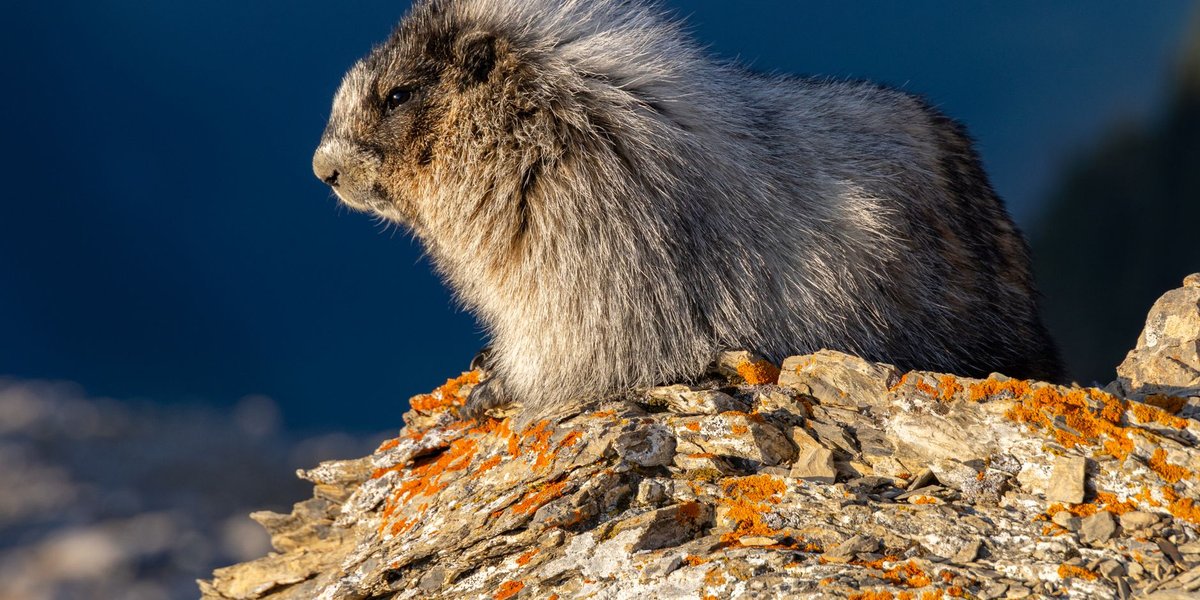
Hoary marmots are strict herbivores, and their diet is almost entirely green: grasses, sedges, and the flowering plants that carpet alpine meadows in summer. If you’ve ever watched one of these chunky, silver-shouldered rodents on a talus slope in the Cascades or the Canadian Rockies, it was probably mid-chew. Eating is most of what a hoary marmot does between waking up in May and disappearing underground in September.
That’s the short answer. The longer one is more interesting, because what they eat shifts with the season, varies wildly by region, and is built entirely around one goal: getting fat enough to sleep through eight months of winter.
Table of Contents
- The Quick Answer
- Staple Foods: What’s on the Menu
- Regional Differences in Diet
- How the Diet Changes With the Seasons
- Eating for Hibernation
- Where the Water Comes From
- Frequently Asked Questions
The Quick Answer
Hoary marmots (Marmota caligata) are herbivores that feed on alpine and subalpine vegetation. Their core diet is grasses and sedges, supplemented heavily by broad-leaved flowering plants. They’ll also take roots, mosses, lichens, berries, and the occasional bit of willow.
They don’t eat meat. They don’t store food for winter the way a squirrel hoards nuts. Instead, they eat constantly through the short alpine summer, convert that food into a thick layer of body fat, and live off that fat while hibernating.
Staple Foods: What’s on the Menu
The bulk of a hoary marmot’s diet comes from a predictable set of high-country plants. Here’s what they actually browse on:
- Grasses and sedges — the foundation of the diet, available across nearly all marmot habitat
- Silky lupine — a purple-flowered legume that shows up repeatedly in foraging studies
- Indian paintbrush — favored for its flower heads
- Glacier lily — one of the first plants up after snowmelt, both flowers and tender leaves
- Vetches — another nitrogen-rich legume they seek out
- Fescues — common alpine grasses
- Mosses and lichens — eaten more when fresh greens are scarce
- Willow — leaves and soft shoots
- Roots and berries — taken opportunistically, more often later in the season
Notice the pattern. Legumes like lupine and vetch show up over and over, and that’s not an accident. They’re protein-dense and help a growing marmot pack on weight faster than grass alone. Marmots are selective foragers when they can afford to be, picking the most nutritious parts of a plant rather than grazing indiscriminately. According to Animal Diversity Web, they concentrate on the flowering plants and forbs that deliver the most calories per bite.
Regional Differences in Diet
Hoary marmots range from Alaska down through British Columbia and into the northwestern United States, and what they eat depends a lot on where they live.
On Alaska’s Kenai Peninsula, researchers found that a single category of food — grasses and sedges — made up close to 90% of the diet. These are graminoid specialists, eating whatever grows thickest in those particular meadows.
Mountain populations in the lower 48 and the southern Canadian Rockies tell a different story. There, marmots lean harder on flowering plants, often targeting the flower heads specifically. A marmot in a Washington alpine basin full of paintbrush and lupine is eating a noticeably more colorful diet than its cousin grazing Alaskan sedge flats.
The takeaway: there’s no single hoary marmot diet. There’s a regional one, shaped by whatever the local alpine meadow happens to grow. That’s part of why broad species profiles tend to gloss over diet — the honest answer is “it depends on the mountain.”
How the Diet Changes With the Seasons
A hoary marmot’s active year is brutally short — roughly four to five months — so timing matters.
Spring (May–June): When marmots first emerge, the snow is barely gone and food is thin. They go for the earliest green-up: fresh leaves, new shoots, and the first blossoms like glacier lily that push through receding snowbanks. This is the lean stretch, and marmots often lose weight before the meadows fully wake up.
Summer (July–August): Peak abundance. The meadows explode with grasses, sedges, and wildflowers, and marmots eat with real urgency. This is when they do the serious work of putting on fat.
Late summer to fall (late August–September): The flowers fade and go to seed, so the diet shifts toward seeds, dried vegetation, roots, and berries. By now a healthy marmot is noticeably rounder than it was in June.
The whole sequence is a race. The alpine growing season is so compressed that a marmot has only weeks to eat a year’s worth of survival into its body.
Eating for Hibernation
Everything a hoary marmot eats in summer is, ultimately, about winter. These animals hibernate for seven to eight months — one of the longest hibernation periods of any North American mammal — and they do it without eating a single bite.
Unlike chipmunks or pikas, hoary marmots don’t cache food. There’s no underground pantry. Their entire winter strategy is to burn stored body fat, so the late-summer feeding frenzy isn’t optional — it’s the whole plan. A marmot that fails to fatten up properly may not survive until spring.
By the time they retreat to their burrows, a well-fed adult can be carrying a substantial fraction of its body weight as fat. They then drop into deep torpor, slowing their heart rate and metabolism to a crawl, and live off that reserve until the snow melts and the cycle starts over. Hibernation is energetically expensive even at rest, which is why a single bad foraging summer can be fatal.
Where the Water Comes From
Here’s a detail most profiles skip: hoary marmots rarely drink standing water. Up on a dry, rocky alpine slope, open water can be scarce.
Instead, they get most of their moisture from the food itself. Fresh alpine plants are high in water content, and marmots supplement that by licking dew off vegetation in the early morning and eating snow when it’s available, especially early in the season. It’s a quiet adaptation to a habitat where a reliable creek isn’t guaranteed.
Frequently Asked Questions
Do hoary marmots eat meat? No. Hoary marmots are herbivores. Their diet is plant-based — grasses, sedges, flowering plants, roots, and berries. They don’t hunt or scavenge animal prey.
Are hoary marmots herbivores? Yes, completely. There’s no insect or animal component to their diet. They’re among the more specialized plant-eaters in the alpine, selecting nutrient-rich forbs and legumes when they can.
What do baby marmots eat? Young marmots nurse on their mother’s milk for the first several weeks after birth. As they’re weaned, they transition to the same vegetation the adults eat — starting with tender, easy-to-digest greens close to the burrow before ranging farther to forage on their own.
Do hoary marmots store food for winter? No. They don’t cache food. They survive winter entirely on body fat built up during summer, which is why their late-season eating is so intense.
How long do they go without eating? During hibernation, hoary marmots can go seven to eight months without food, relying solely on stored fat reserves until spring.
The pattern behind all of it is simple. A hoary marmot lives in a place where food is abundant for a few short weeks and absent for most of the year. Everything about how it eats — the selectivity, the legume-hunting, the frantic August grazing, the dew-licking — is shaped by that hard alpine math. They eat plants, yes. But more precisely, they eat winter survival, one wildflower at a time.