Iran’s ecosystems — from Caspian coasts to central deserts and southern wetlands — are facing growing pressure from non-native plants, animals and pathogens. These species can alter habitats, harm agriculture and fisheries, and change how people use the land and water; understanding what’s present is the first step to managing risk.
There are 31 Invasive Species in Iran, ranging from Asian tiger mosquito to Zebra mussel. For each entry we provide Scientific name,Category,Distribution (regions/habitats) so you can quickly see identity, type and where it’s found — you’ll find below.
How do these invasive species usually arrive and spread in Iran?
Most arrive via trade and travel: ballast water from ships, aquarium and ornamental plant releases, aquaculture escapes, and accidental transport on vehicles or equipment. Once established, many spread along waterways, road corridors and disturbed habitats; early detection and border biosecurity are key to slowing new introductions.
What practical steps can residents and local authorities take to limit their spread?
Report unusual plants or animals to local environmental agencies, avoid releasing pets or live bait, clean boats and gear between water bodies, and support monitoring programs. Coordinated outreach and simple prevention measures cut the cost and effort of later control.
Invasive Species in Iran
| Common name | Scientific name | Category | Distribution (regions/habitats) |
|---|---|---|---|
| Parthenium weed | Parthenium hysterophorus | Plant | Khuzestan, southwestern plains |
| Water hyacinth | Eichhornia crassipes | Plant | Rivers, canals, wetlands (Khuzestan, south) |
| Water lettuce | Pistia stratiotes | Plant | Lakes and slow rivers (south, Caspian fringe) |
| Mesquite | Prosopis juliflora | Plant | Coastal and arid south (Hormozgan, Bushehr) |
| Prickly pear | Opuntia ficus-indica | Plant | Southern and central drylands |
| Tree-of-heaven | Ailanthus altissima | Plant | Urban and riparian areas (cities north/central) |
| Mosquitofish | Gambusia affinis | Vertebrate | Ponds, irrigation canals nationwide |
| Rainbow trout | Oncorhynchus mykiss | Vertebrate fish | Cold mountain streams, stocked rivers |
| Nile tilapia | Oreochromis niloticus | Vertebrate fish | Southern reservoirs and canals |
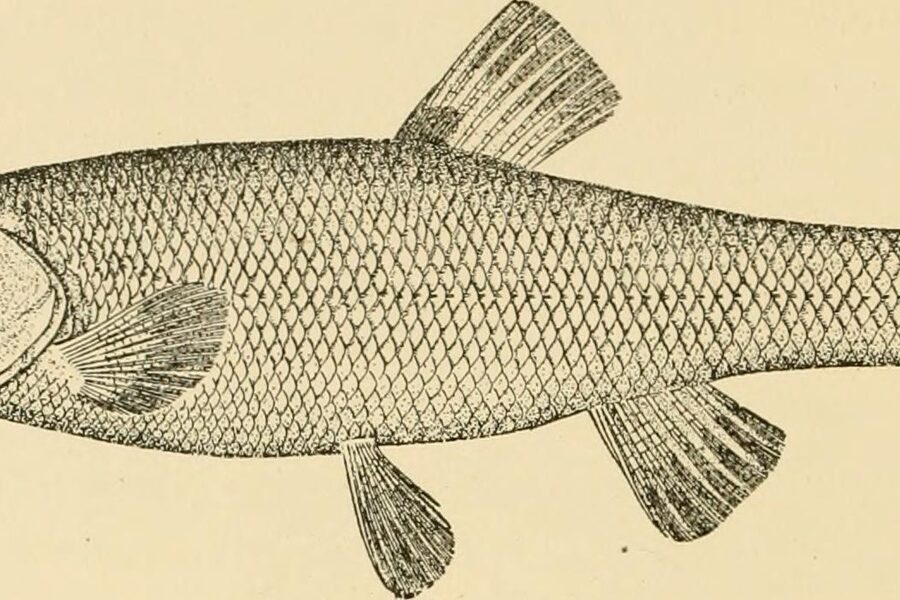
| Silver carp | Hypophthalmichthys molitrix | Vertebrate fish | Rivers and reservoirs |
| Red swamp crayfish | Procambarus clarkii | Invertebrate | Wetlands and rice fields (Gilan, northwest) |
| Nutria | Myocastor coypus | Vertebrate mammal | Caspian delta, wetlands |
| Feral cat | Felis catus | Vertebrate mammal | Urban and natural habitats nationwide |
| Brown rat | Rattus norvegicus | Vertebrate mammal | Urban, agricultural areas nationwide |
| Black rat | Rattus rattus | Vertebrate mammal | Ports, rural and urban areas nationwide |
| House mouse | Mus musculus | Vertebrate mammal | Human settlements and farms nationwide |
| Feral pigeon | Columba livia (feral) | Vertebrate bird | Urban areas nationwide |
| Common myna | Acridotheres tristis | Vertebrate bird | Southern port cities (Bandar Abbas) |
| Rose-ringed parakeet | Psittacula krameri | Vertebrate bird | Tehran and other cities |
| Red palm weevil | Rhynchophorus ferrugineus | Invertebrate | Date palm plantations nationwide (south) |
| Whitefly | Bemisia tabaci | Invertebrate | Agricultural regions nationwide |
| Tomato leafminer | Tuta absoluta | Invertebrate | Greenhouses and open fields nationwide |
| Peach fruit fly | Bactrocera zonata | Invertebrate | Southern orchards and fruit-growing areas |
| Mediterranean fruit fly | Ceratitis capitata | Invertebrate | Fruit-growing regions nationwide |
| Asian tiger mosquito | Aedes albopictus | Invertebrate | N. and W. Iran, urban/peri-urban |
| Zebra mussel | Dreissena polymorpha | Invertebrate | Caspian Sea coasts, freshwater systems |
| Potato late blight | Phytophthora infestans | Pathogen | Potato-growing regions nationwide |
| Mediterranean coastal jellyfish (invasive blooms) | Rhopilema nomadica | Invertebrate | Persian Gulf coasts (seasonal outbreaks) |
| Black locust (invasive stands) | Robinia pseudoacacia | Plant | Woodland edges, hillsides (north/central) |
| Citrus canker (bacterial) | Xanthomonas citri | Pathogen | Citrus orchards (south) |
| Rice black bug (pest) | Scotinophara coarctata | Invertebrate | Coastal rice paddies (south) |
Images and Descriptions
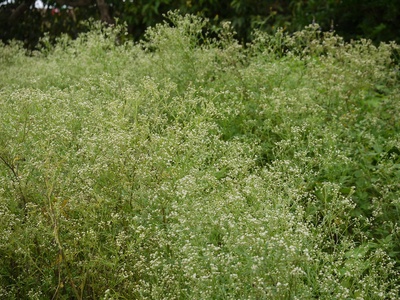
Parthenium weed
Native to the Americas; causes severe allergic reactions, suppresses native plants and reduces crop yields; invades disturbed soils. Control efforts include mechanical removal, herbicides and biological control trials, but spread continues in agricultural and roadside habitats.
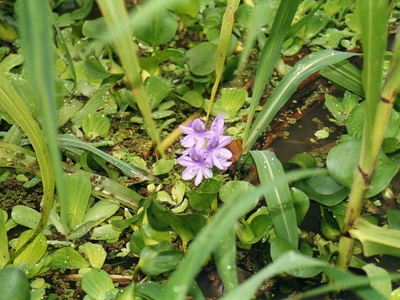
Water hyacinth
South American origin; forms dense mats that block waterways, reduce oxygen, harm fisheries and irrigation. Mechanical removal, herbicides and community clean-ups are used, but recurring infestations persist in slow-flowing waterbodies.
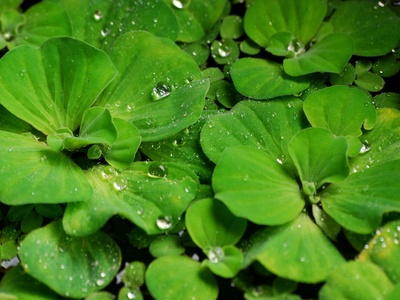
Water lettuce
Tropical American origin; clogs waterways, reduces light and oxygen, and harms native aquatic life and irrigation. Management relies on mechanical harvesting and local removal; natural spread makes eradication difficult.

Mesquite
Native to the Americas; invades drylands, forms dense thorny thickets, displaces native vegetation and lowers groundwater. Clearing and fencing are used but control is costly and re-establishment is common.
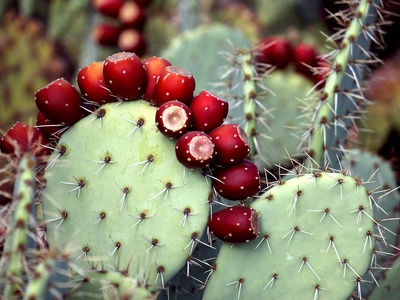
Prickly pear
Introduced from the Americas; forms impenetrable stands that alter grazing lands, harm livestock and reduce native plant diversity. Local removal and biological controls have been tried with mixed success.
Tree-of-heaven
Native to China; fast-growing urban colonizer that outcompetes natives, damages infrastructure and regenerates after cutting. Management includes cutting, herbicide treatment and urban removal programs.
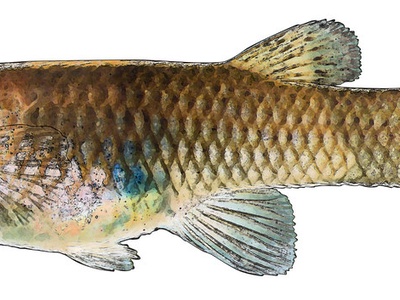
Mosquitofish
Native to North America; stocked for mosquito control but preys on native larvae and invertebrates, altering aquatic communities. Widely established; management focuses on preventing further releases and habitat restoration.
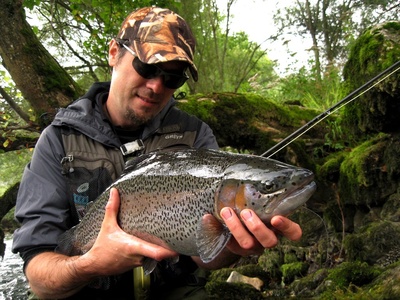
Rainbow trout
Native to N. America; widely stocked for fisheries and aquaculture. Escapes compete and hybridize with native trout, impacting wild populations. Regulations and stocking controls are in place but escapes persist.
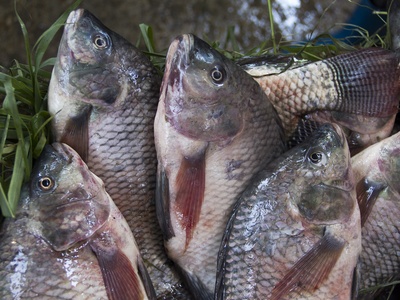
Nile tilapia
African origin; introduced for aquaculture and now established in warm waters. Competes with natives, alters food webs and affects fisheries. Containment and removal are limited and populations remain widespread.
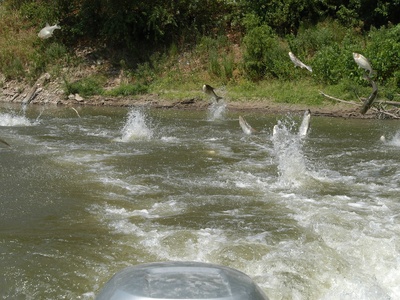
Silver carp
Native to East Asia; stocked for aquaculture and now established in some reservoirs. Filters plankton, altering nutrient cycles and food webs. Management focuses on stocking restrictions and local removal.
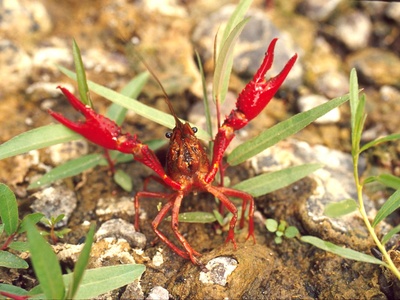
Red swamp crayfish
Native to N. America; burrowing damages banks, rice paddies and irrigation, preys on native fauna and spreads disease. Established populations are controlled locally by trapping, but eradication is unlikely.
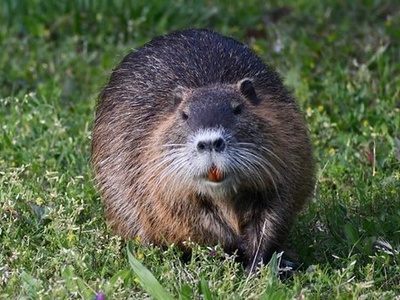
Nutria
South American origin; destructive herbivory and burrowing cause wetland loss and bank erosion, damaging crops and infrastructure. Control programs (trapping) are implemented regionally with ongoing impacts.
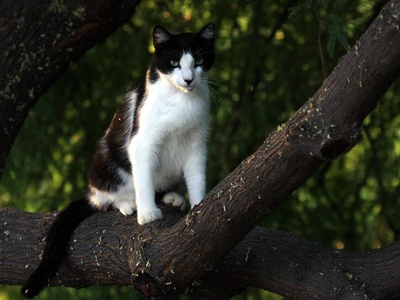
Feral cat
Domesticated origin; feral populations prey heavily on native birds, reptiles and small mammals, contributing to biodiversity loss and disease spread. NGOs and municipalities run trap-neuter-release and removal programs with limited coverage.
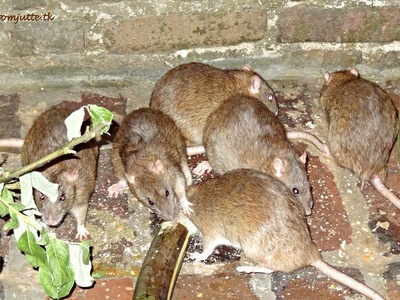
Brown rat
Eurasian origin but non-native as commensal; causes crop and stored-food losses, transmits diseases and damages infrastructure. Widespread pest control (poisoning, trapping) is routine but populations persist.
Black rat
Originating in Asia; major pest of stored produce and orchards, spreads pathogens and harms native fauna on islands and rural zones. Quarantine and control measures are ongoing, especially in agriculture and ports.
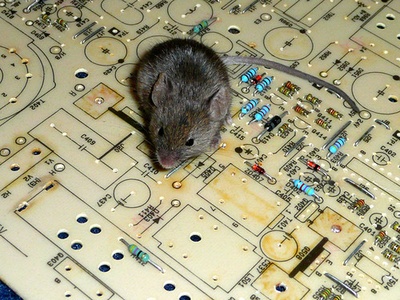
House mouse
Cosmopolitan commensal species; causes stored-food losses, crop damage and transmits disease. Standard pest management is common but populations remain ubiquitous.
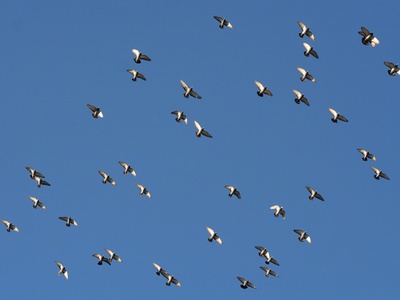
Feral pigeon
Domesticated rock dove derivative; fouls buildings, spreads pathogens and displaces some native urban species. Urban control uses exclusion, culling and management of feeding, with varied success.
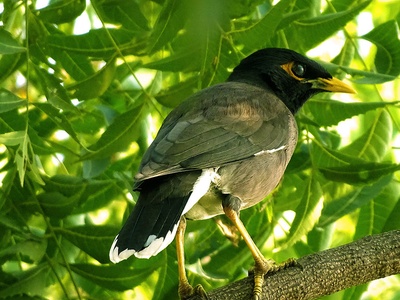
Common myna
Native to South Asia; established in southern Iranian cities, aggressively competes for nest sites, damages crops and annoys residents. Local control and monitoring occur in port cities.
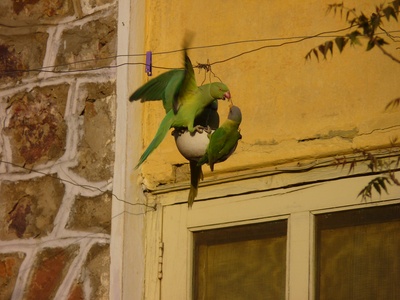
Rose-ringed parakeet
African/Asian origin; forms feral flocks that damage fruit crops, create noise and compete for cavities. Management is mostly localized culling and nest control in urban areas.
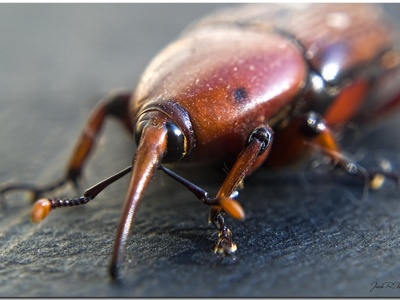
Red palm weevil
Native to Southeast Asia; serious pest of date palms, larvae bore trunks and kill trees, causing large economic losses. Monitoring, pheromone traps and sanitary felling are widely used to limit outbreaks.
Whitefly
Likely African/Asian origin; major sap-sucking pest that transmits viral diseases to vegetables and cotton, causing severe yield losses. Management uses insecticides, resistant varieties and integrated pest management to combat resistance.
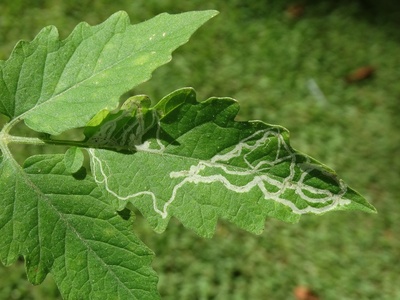
Tomato leafminer
Native to South America; rapidly spread to Iran and causes devastating damage to tomato crops. Integrated pest management, pheromone traps and insecticides are used, but outbreaks remain economically important.
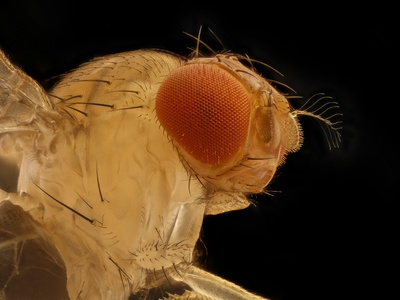
Peach fruit fly
Originating in South Asia; infests many fruit species causing yield losses and quarantine issues. Control includes baiting, trapping and quarantine measures to protect exports.
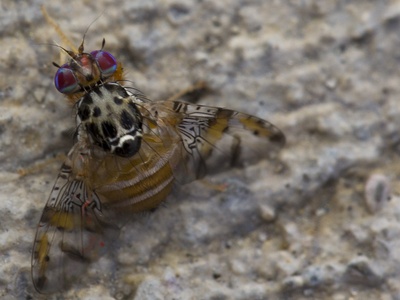
Mediterranean fruit fly
Native to Africa; highly polyphagous invasive pest attacking many fruits, leading to losses and trade restrictions. Control employs bait stations, mass trapping and sterile insect technique in hotspot areas.
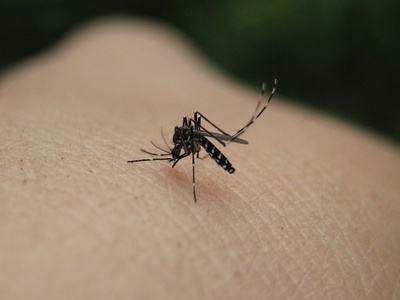
Asian tiger mosquito
Native to Southeast Asia; invasive vector of dengue, chikungunya and other viruses. Detected in multiple provinces; surveillance and larval control are ongoing to reduce public-health risk.
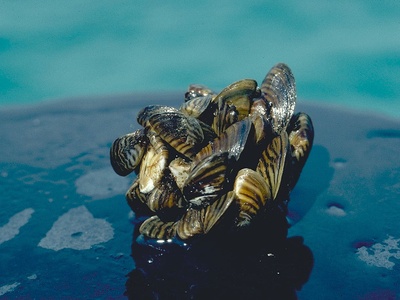
Zebra mussel
Ponto-Caspian/European spread; colonizes hard substrates, fouls intake pipes and alters food webs. Established in Caspian basin; monitoring and infrastructure cleaning are primary management actions.
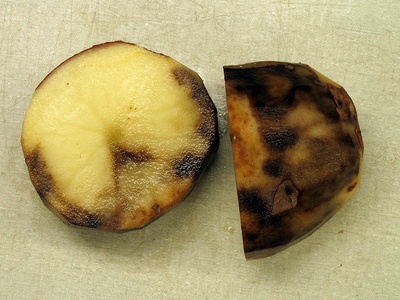
Potato late blight
Origin likely Central/South America; causes severe potato and tomato blight, recurring epidemics and crop losses. Fungicide use, resistant cultivars and monitoring programs are standard control measures.
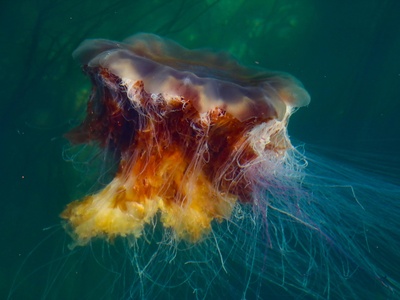
Mediterranean coastal jellyfish (invasive blooms)
Originally Red Sea/Mediterranean invasive; causes beach closures, fishery impacts and stings to swimmers. Monitoring and public warnings are used during seasonal bloom events.
Black locust (invasive stands)
Native to North America; planted and escaped to form dense stands that outcompete natives and alter soils. Mechanical removal and herbicide treatments are applied in forestry and protected areas.
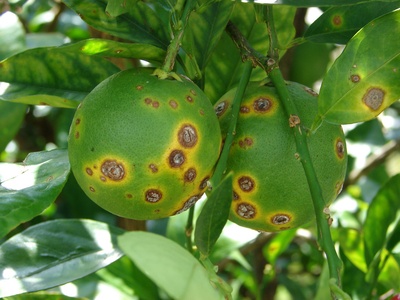
Citrus canker (bacterial)
Originating from Asia; causes defoliation, fruit drop and reduced yields in citrus. Quarantine, tree removal and chemical controls are used to limit spread and protect production.
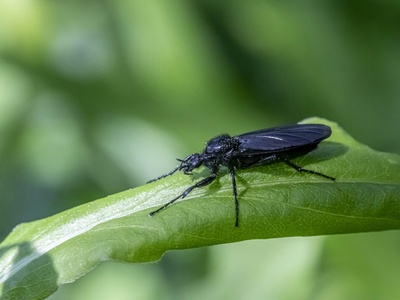
Rice black bug (pest)
Originally from tropical Asia; feeding causes yield loss in coastal rice systems and complicates pest management. Farmers use cultural practices and targeted insecticides to reduce damage.