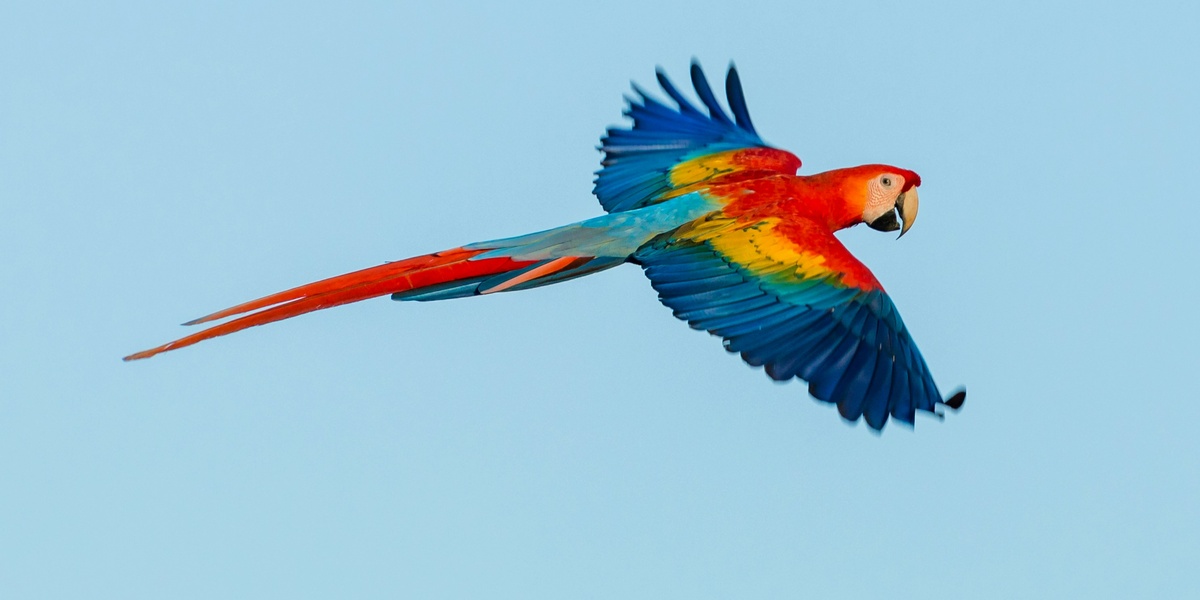
Tropical reefs, cloud forests and island shores are full of surprising color — from tiny fish that flash like gemstones to birds that wear entire rainbows. Watching this variety helps explain how color evolves for camouflage, display and signaling across habitats.
There are 31 beautiful colorful animals, ranging from Atlantic Puffin to Wilson’s Bird-of-paradise, chosen to show a broad geographic spread. For each species you’ll find below the following data columns: Scientific name,Range/habitat,Size (cm), so you can quickly compare where they live and how big they are — see the full list you’ll find below.
How can I use this list to plan wildlife watching trips?
Pick species by range/habitat in the table to narrow targets for a destination, then match seasons and local guides; small size columns help set realistic expectations for spotting distance and gear (e.g., binoculars vs. camera lens).
Are any of the listed species at risk and where can I learn more?
Conservation status varies — check IUCN or local conservation sites linked in detailed guides for up-to-date assessments, and use the range/habitat column here to identify populations and nearby protected areas to support or visit.
Beautiful Colorful Animals
| Name | Scientific name | Range/habitat | Size (cm) |
|---|---|---|---|
| Resplendent Quetzal | Pharomachrus mocinno | Central American cloud forests | 36–90 cm |
| Scarlet Macaw | Ara macao | Neotropical rainforests from Mexico to Amazon | 81 cm |
| Indian Peafowl (Peacock) | Pavo cristatus | Indian subcontinent woodlands and parks | 100–200 cm |
| Mandarin Duck | Aix galericulata | East Asian freshwater woodlands, parks | 41 cm |
| Wilson’s Bird-of-paradise | Cicinnurus respublica | Waigeo lowland forests, Indonesia | 16 cm |
| Raggiana Bird-of-paradise | Paradisaea raggiana | New Guinea lowland forests | 34 cm |
| Rainbow Lorikeet | Trichoglossus moluccanus | Eastern Australia coastal forests and urban parks | 30 cm |
| Keel-billed Toucan | Ramphastos sulfuratus | Central American tropical forests | 55 cm |
| Painted Bunting | Passerina ciris | SE U.S. breeding scrub and woodland edges | 13 cm |
| Atlantic Puffin | Fratercula arctica | North Atlantic coasts and rocky colonies | 28 cm |
| Common Kingfisher | Alcedo atthis | Eurasian rivers, streams and reedbeds | 17 cm |
| Greater Flamingo | Phoenicopterus roseus | Shallow lakes, lagoons in Africa, Europe, Asia | 120–145 cm |
| Blue-footed Booby | Sula nebouxii | Eastern Pacific islands and coastal cliffs | 80 cm |
| Mandrill | Mandrillus sphinx | Central African rainforests | 75 cm |
| Golden Lion Tamarin | Leontopithecus rosalia | Atlantic coastal forests, Brazil | 26 cm |
| Blue Morpho Butterfly | Morpho menelaus | Central and South American rainforests | 7.5–15 cm |
| Monarch Butterfly | Danaus plexippus | North America to Central America, open habitats | 9–10 cm |
| Blue Dragon (sea slug) | Glaucus atlanticus | Pelagic tropical and temperate oceans | 3 cm |
| Mandarin Fish | Synchiropus splendidus | Western Pacific coral reefs | 6–8 cm |
| Clownfish (Ocellaris) | Amphiprion ocellaris | Indo-Pacific coral reefs, sea anemones | 11 cm |
| Regal Tang | Paracanthurus hepatus | Indo-Pacific coral reefs | 30 cm |
| Lionfish | Pterois volitans | Indo-Pacific reefs (invasive in Atlantic) | 38 cm |
| Moorish Idol | Zanclus cornutus | Indo-Pacific reefs and lagoons | 23–38 cm |
| Stoplight Parrotfish | Sparisoma viride | Caribbean coral reefs | 30–60 cm |
| Peacock Spider | Maratus volans | Southern Australia leaf litter and shrubs | 0.4–0.6 cm |
| Jewel Beetle | Chrysochroa fulgidissima | Asian forests and woodlands | 3–4 cm |
| Rainbow Stag Beetle | Phalacrognathus muelleri | Australian rainforests | 2.5–4.5 cm |
| Spanish Dancer (nudibranch) | Hexabranchus sanguineus | Indo-Pacific coral reefs | 20–60 cm |
| Chromodoris annae | Chromodoris annae | Indo-Pacific shallow reefs | 3–5 cm |
| Blue Iguana | Cyclura lewisi | Grand Cayman rocky forests and dry habitats | 120 cm |
| Torch Coral | Euphyllia glabrescens | Indo-Pacific coral reefs and lagoons | 10–30 cm |
Images and Descriptions
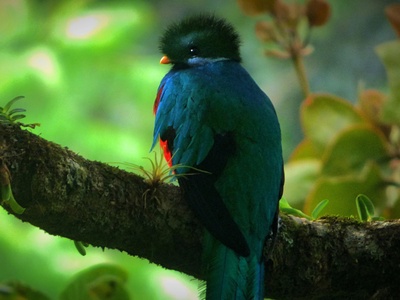
Resplendent Quetzal
Iridescent emerald-green body with a crimson belly and extraordinary long tail streamers used in mate display; best seen in cloud-forest canopy. Notable: tail plumes were sacred in Mesoamerican cultures and play a key role in courtship.
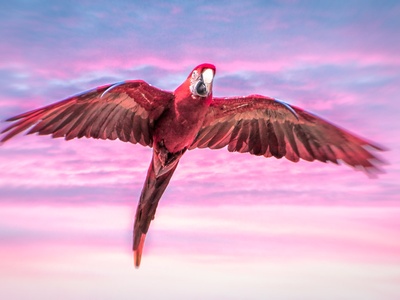
Scarlet Macaw
Brilliant red, yellow and blue plumage advertises health and helps pairs recognize each other; noisy canopy-dweller often seen in flocks. Notable: strong seed dispersers with long lifespans and lifelong pair bonds.
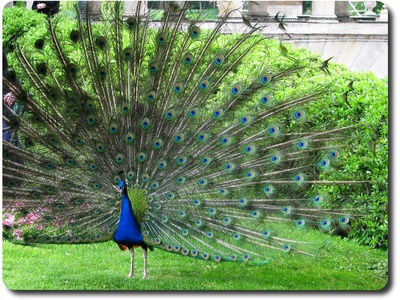
Indian Peafowl (Peacock)
Male’s iridescent blue-green train with eye-spot ocelli is displayed in courtship; colors result from structural feather microstructure. Seen in forests and gardens. Notable: train feathers are elongated coverts, not true tail feathers.
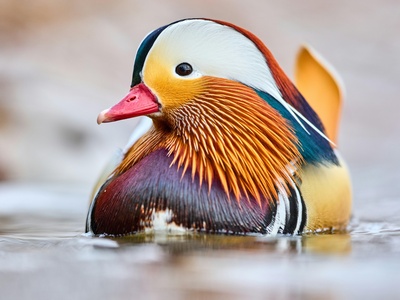
Mandarin Duck
Male has flamboyant crest, orange “sails” and multicolored plumage used to attract mates; often found in quiet ponds and ornamental lakes. Notable: highly prized in art and cultural symbolism.
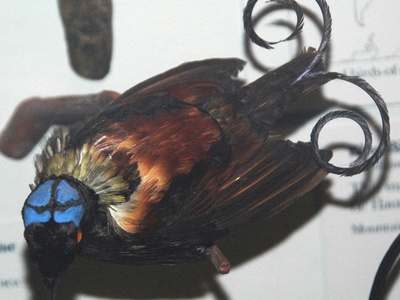
Wilson’s Bird-of-paradise
Tiny male explodes in electric blue, red and yellow during elaborate courtship on cleared leaf platforms; colors and shapes are sexual signals. Notable: highly localized range with unique display choreography.
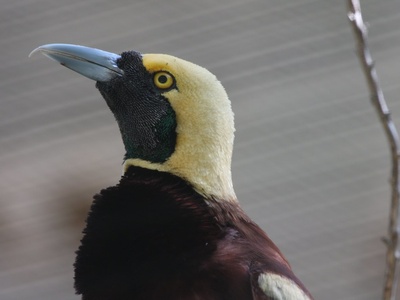
Raggiana Bird-of-paradise
Male shows vivid red flank plumes and shimmering greenish-gold feathers in complex displays to attract females; seen at communal display trees. Notable: national bird of Papua New Guinea.
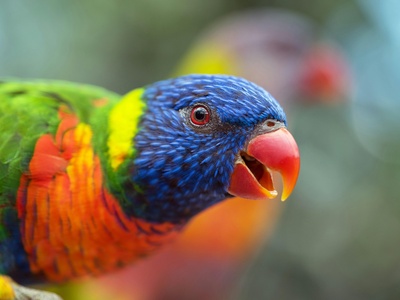
Rainbow Lorikeet
Spectacular rainbow plumage—blue head, green wings, orange chest—used for species recognition and social signaling while feeding on nectar in treetops. Notable: brush-tipped tongue specialized for nectar.
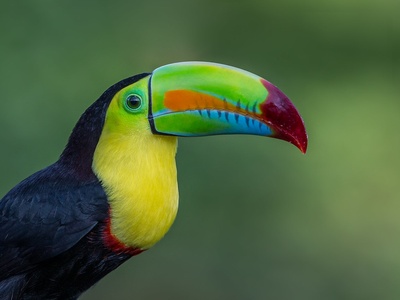
Keel-billed Toucan
Huge multicolored bill (green, orange, red) set against black plumage used in display and thermoregulation; frugivore seen hopping through canopy. Notable: bill is lightweight keratin with internal honeycomb struts.
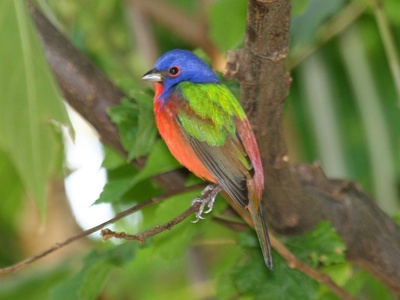
Painted Bunting
Male glows with blue head, red belly and green back used for courtship signals; secretive in dense brush and migrates south in winter. Notable: one of North America’s most colorful songbirds.
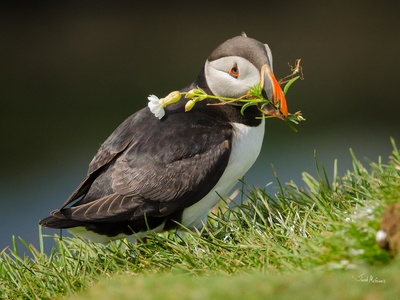
Atlantic Puffin
Black-and-white seabird with a triangular colorful bill in breeding season used in mate signaling; nests in cliff burrows and dives for fish. Notable: bill fades to duller colors in winter.
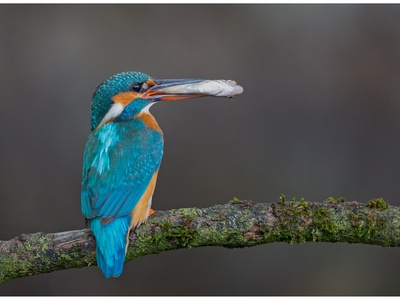
Common Kingfisher
Iridescent blue back and orange underside provide camouflage over water and signal fitness; perches quietly then dives for fish. Notable: blue color is structural, not pigment-based.
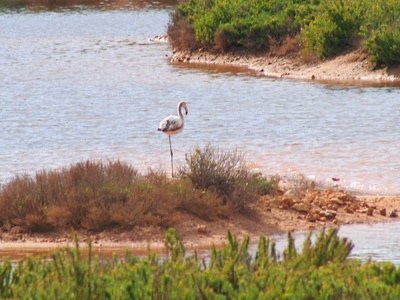
Greater Flamingo
Pink plumage derives from carotenoid-rich diet of algae and crustaceans; conspicuous in large breeding colonies where color signals health and breeding condition. Notable: shade intensity reflects diet quality.
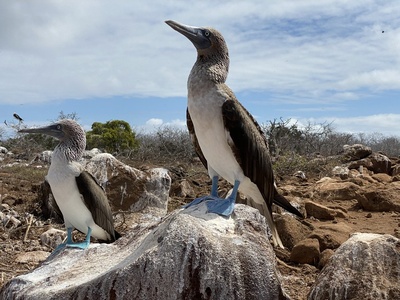
Blue-footed Booby
Bright cerulean feet used in elaborate courtship dances; foot color indicates diet and health. Seen on Galápagos and Pacific coasts. Notable: foot color fades without carotenoid-rich diet.
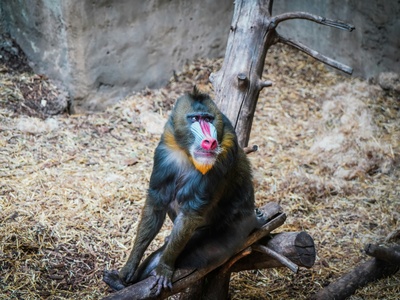
Mandrill
Males show intense blue and red facial and rump coloration used in dominance signaling and mate attraction; terrestrial and social. Notable: color intensity correlates with testosterone and rank.
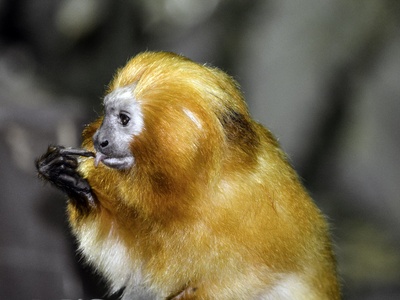
Golden Lion Tamarin
Striking golden-orange fur makes this small primate visually conspicuous in sunlit canopy and aids species recognition; highly arboreal and endangered. Notable: successful captive-breeding and reintroduction programs exist.
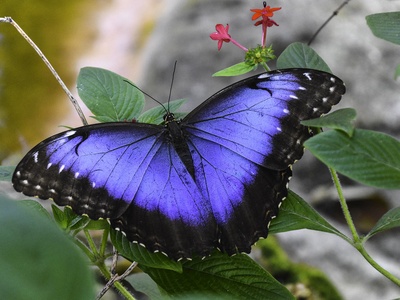
Blue Morpho Butterfly
Brilliant iridescent blue wings created by microscopic wing-scale structures flash to startle predators; underside is brown for camouflage while resting. Notable: flight through understory appears as flashes of blue.
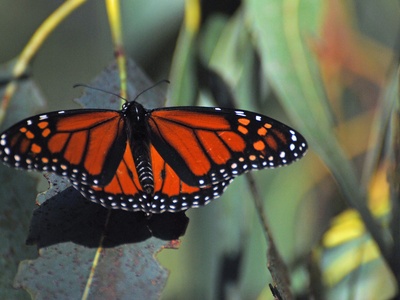
Monarch Butterfly
Vivid orange-and-black pattern signals chemical toxicity from milkweed and deters predators; famous for long-distance migrations to overwintering sites. Notable: migrates thousands of kilometers.
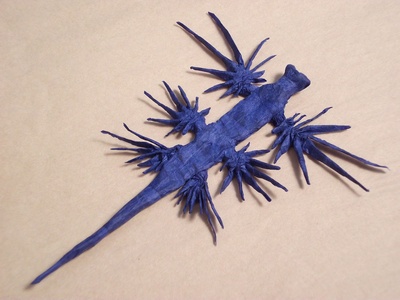
Blue Dragon (sea slug)
Striking blue upper surface and silver underside provide camouflage from both above and below; feeds on venomous siphonophores and stores nematocysts for defense. Notable: floats upside-down on the ocean surface.
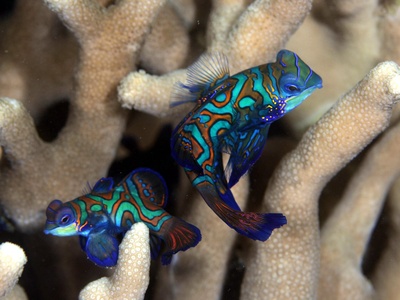
Mandarin Fish
Psychedelic swirls of blue, orange and green used in species recognition and courtship on reef rubble; often seen in crepuscular mating displays. Notable: secretes mucus and lacks scales.
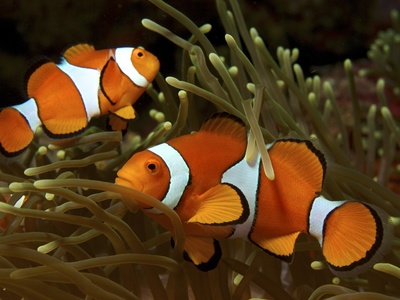
Clownfish (Ocellaris)
Bright orange with white bands signals species identity while living among toxic anemone tentacles; mutualism offers protection and feeding sites. Notable: sequential hermaphrodite that can change sex.
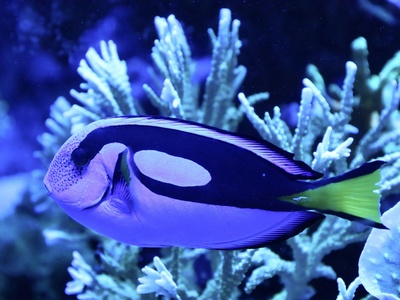
Regal Tang
Electric blue body with a black palette and yellow tail used for species recognition on reefs; grazes algae and forms loose groups. Notable: iconic aquarium species but wild populations depend on healthy reefs.
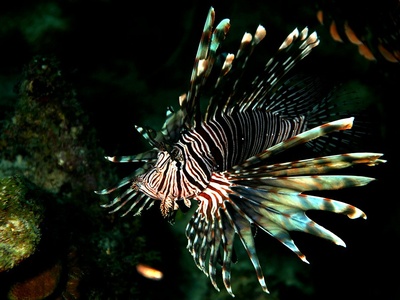
Lionfish
Bold red-and-white bands and long venomous dorsal fins act as aposematic warning; ambush predator on reefs and crevices. Notable: invasive in the Atlantic, harming reef communities.
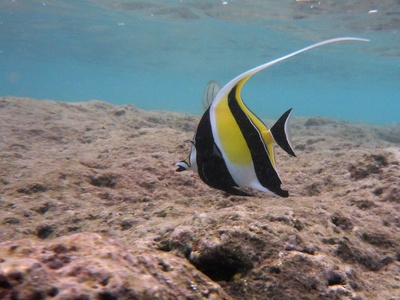
Moorish Idol
Bold black-white-yellow bands and long dorsal filament make it highly visible while feeding on sponges and algae; seen near reef slopes. Notable: notoriously difficult to keep in captivity.
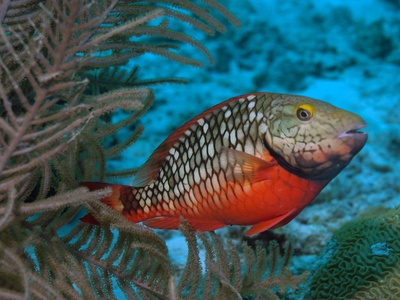
Stoplight Parrotfish
Bright green, blue and pink hues vary with age and sex; colors communicate reproductive status. Herbivorous reef grazer that produces sand by grinding coral. Notable: important reef bioeroder and sand producer.
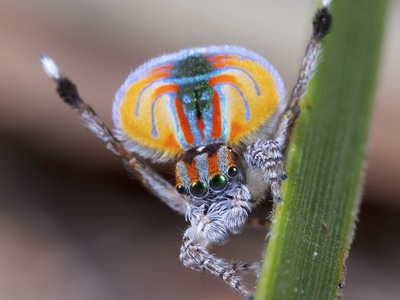
Peacock Spider
Tiny jumping spider with an iridescent, fan-like abdominal display used in elaborate courtship dances; vivid patterns attract females. Notable: males vibrate legs and abdomen during performance.
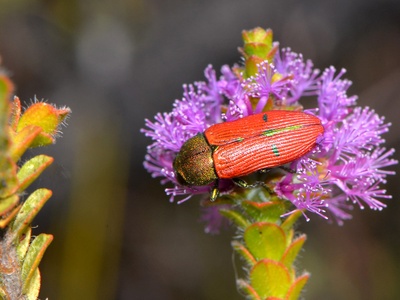
Jewel Beetle
Metallic, rainbow-like elytra created by structural coloration reflect light brilliantly and can act as camouflage or signaling; often found on sunlit trunks. Notable: iridescence arises from microstructured cuticle.
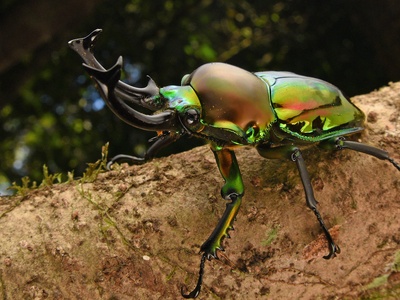
Rainbow Stag Beetle
Glossy iridescent exoskeleton shifts from green to red for visual signaling during courtship; larvae develop in decaying wood. Notable: prized by collectors yet naturally vivid.
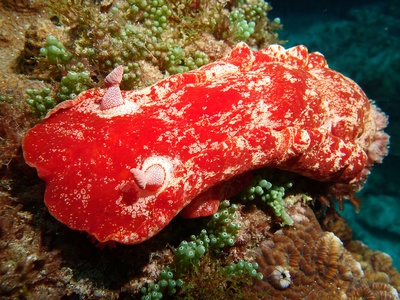
Spanish Dancer (nudibranch)
Large, waving red-orange mantle displayed while swimming warns predators of toxic chemicals gleaned from sponges; often seen on reefs at night. Notable: one of the largest dorid nudibranchs.
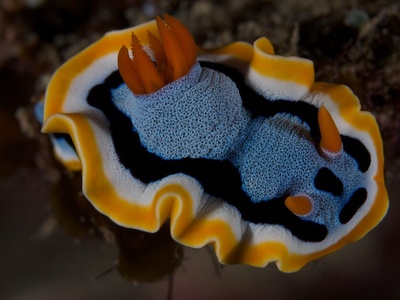
Chromodoris annae
Electric blue body with black stripes and orange rhinophores; bright aposematic coloration signals toxicity and warns predators. Notable: sequesters chemicals from sponges it eats.
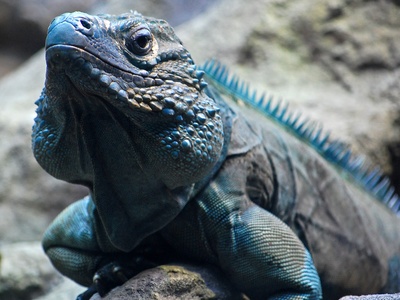
Blue Iguana
Males turn powder-blue during breeding season to signal dominance and attract mates; endemic and endangered, basking on rocky outcrops. Notable: conservation programs have helped population recovery.
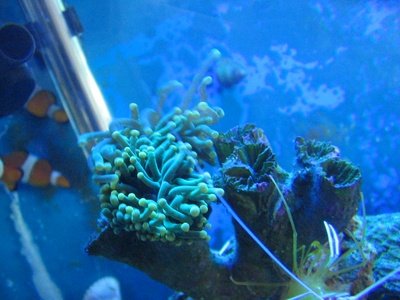
Torch Coral
Long, colorful tentacles often with fluorescent tips create a vivid display on reef slopes; coloration relates to symbiotic algae and lighting. Notable: provides habitat complexity for reef fishes.