Most “yellow fish” lists hand you ten species in a slightly different order and call it a day. They tell you a yellow tang is yellow. Thanks. What they skip is the part you actually need before you commit a fish to your tank: is it beginner-proof or will it bully everything in there, does it need a 100-gallon reef or a 20-gallon corner, and is “yellow” even the right word for what you saw at the store.
Test yourself with our fish identification quiz: 10 photos of live fish, four choices each, on Easy, Medium or Hard.
So here are 14 genuinely yellow fish, split into freshwater and saltwater, with the identification cue that separates each one from its lookalikes, a scientific name so you can verify it, and a quick care read. The best beginner picks are flagged. There’s also a comparison table near the top if you just want the bottom line.
Table of Contents
- Why Are Some Fish Yellow?
- Quick Comparison Table
- Freshwater Yellow Fish
- Saltwater Yellow Fish
- Best Beginner Yellow Fish
- FAQ
Why Are Some Fish Yellow?
Yellow isn’t an accident. It usually does one of three jobs.
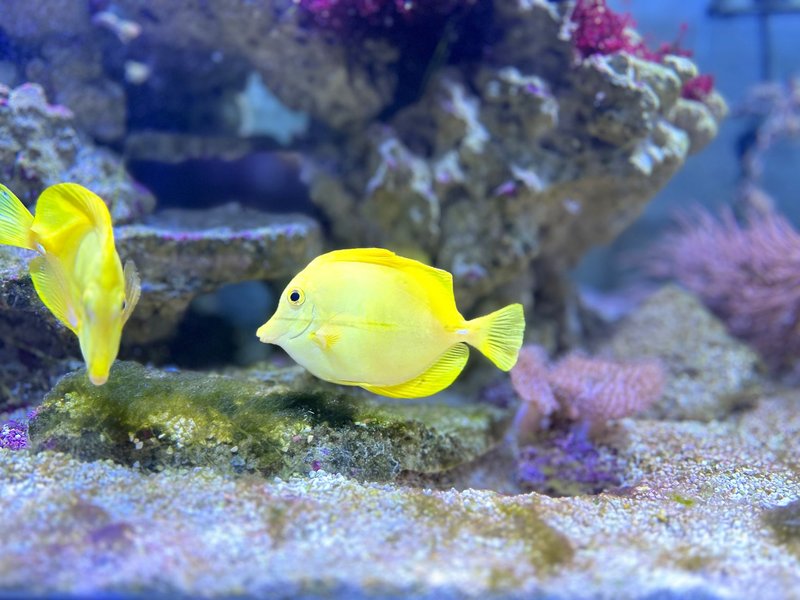
On a reef, bright yellow can actually be camouflage. Underwater, longer wavelengths like red and yellow get filtered out with depth, so a yellow tang against a sunlit reef reads as a muted gray-green to a predator a few meters off. The color that screams in your aquarium disappears in open water. It’s the same trick you see across the animal kingdom, where the reasons big animals look green — scales, pigments, lighting, camouflage — turn out to have surprisingly little to do with the color we actually perceive.
In other species it’s the opposite — a warning. Vivid yellow paired with black often signals “I’m venomous or I taste terrible,” the same logic wasps run on. And in shoaling fish, a shared yellow flash helps the group stay tight and turn as one unit, which makes any single fish harder to pick off. Worth remembering, too, that a predator’s eyes may not work like ours — plenty of animals that see ultraviolet light read patterns and signals that are completely invisible to us.
Worth knowing before you buy: most of that yellow comes from carotenoid pigments the fish can’t manufacture themselves. They get it from food — algae, crustaceans, the right prepared diet. Feed a yellow fish a poor diet for a year and it’ll fade. The color on the shelf is a snapshot, not a guarantee.
Quick Comparison Table
| Species | Type | Adult Size | Min Tank | Care Level | Reef Safe |
|---|---|---|---|---|---|
| Electric Yellow Cichlid | Freshwater | 3–4 in | 30 gal | Beginner | — |
| Yellow Lab (same fish, common name) | Freshwater | 3–4 in | 30 gal | Beginner | — |
| Gold Barb | Freshwater | 3 in | 20 gal | Beginner | — |
| Golden Wonder Killifish | Freshwater | 4 in | 20 gal | Intermediate | — |
| Lemon Tetra | Freshwater | 2 in | 15 gal | Beginner | — |
| Honey Gourami | Freshwater | 2 in | 10 gal | Beginner | — |
| Goldfish (yellow variants) | Freshwater | 6–12 in | 20+ gal | Beginner | — |
| Yellow Tang | Saltwater | 7–8 in | 75 gal | Intermediate | Yes |
| Yellow Watchman Goby | Saltwater | 3–4 in | 20 gal | Beginner | Yes |
| Foxface Rabbitfish | Saltwater | 9 in | 100 gal | Intermediate | Yes (caution) |
| Lemonpeel Angelfish | Saltwater | 5–6 in | 70 gal | Intermediate | No (nips coral) |
| Coris Yellow Wrasse | Saltwater | 5 in | 50 gal | Intermediate | Yes |
| Yellow Clown Goby | Saltwater | 1.5 in | 10 gal | Beginner | Yes |
| Yellow Assessor | Saltwater | 3 in | 30 gal | Intermediate | Yes |
Freshwater Yellow Fish
1. Electric Yellow Cichlid (Labidochromis caeruleus)
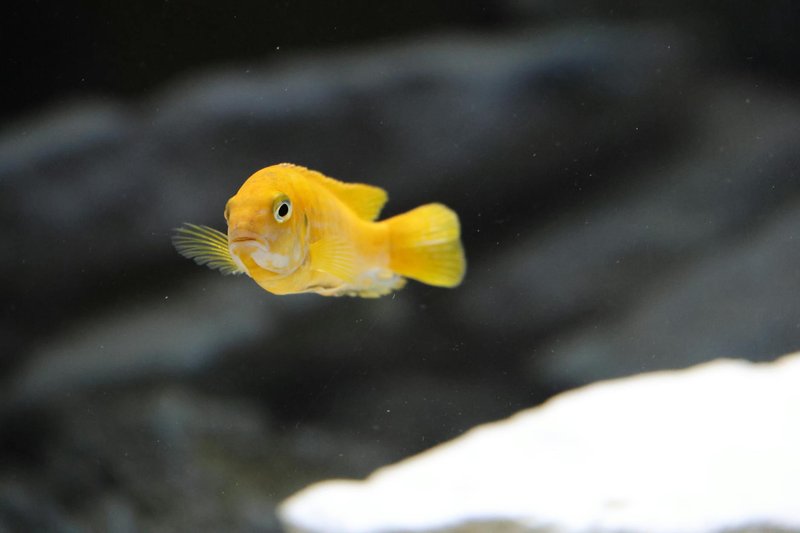
The most reliably yellow freshwater fish you can buy, and it’s not close. A good specimen is a flat, even canary yellow from nose to tail with a single crisp black stripe running along the top of the dorsal fin. That black-on-yellow dorsal is the ID tell — it separates it from random yellow mbuna that fade or blotch.
It comes from Lake Malawi, so it wants hard, alkaline water (pH 7.8–8.6) and a rocky setup with caves. Among Malawi cichlids it’s about as peaceful as they get, which is why it’s a classic gateway into the African cichlid hobby. Don’t mix it with soft-water community fish, though — the water chemistry is non-negotiable.
2. Yellow Lab
Same fish as above, different store tag. “Yellow lab” is shorthand for Labidochromis caeruleus, and you’ll see both names used interchangeably. Mentioning it here because beginners regularly think they’re two species and end up with the same cichlid twice. If the label says yellow lab, electric yellow, or “yellow electric,” it’s all L. caeruleus.
3. Gold Barb (Barbodes semifasciolatus var.)
A pale gold body dotted with a row of small dark blotches along the lower flank, often with a faint green-gold back. The give-away is the scattered black spots — true gold barbs aren’t solid yellow, and a “gold barb” with no markings is usually just dyed or mislabeled. They’re an active, hardy shoaling fish; keep six or more or they get nippy. Cooler-tolerant than most tropicals, which makes them forgiving for a first community tank.
4. Golden Wonder Killifish (Aplocheilus lineatus)
A slim, pike-shaped surface fish with a metallic gold-green sheen and a flat top of the head built for ambushing prey from below. The flat head plus the gold flank is the ID. Stunning fish, but two warnings: it’s a jumper — a tight-fitting lid is mandatory — and it will eat any fish small enough to fit in its mouth. Great alone or with similar-sized tankmates.
5. Lemon Tetra (Hyphessobrycon pulchripennis)
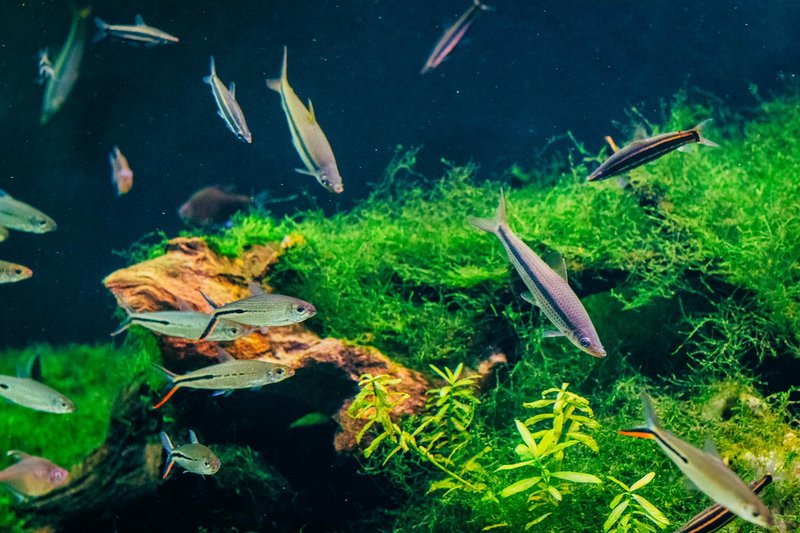
A translucent, pale-lemon body with two black flecks near the tail and bright yellow leading edges on the anal and dorsal fins. The trick with lemon tetras: color is mood-dependent. A stressed or newly-bought one looks washed-out gray. Get them into a planted tank with a dark substrate, keep them in a group of eight-plus, and the yellow comes up within days. One of the easiest small yellow fish for a community setup.
6. Honey Gourami (Trichogaster chuna)
The male flushes a warm honey-to-amber yellow, deepening toward orange on the throat when he’s displaying. Smaller and far more peaceful than its dwarf gourami cousin, it tops out around two inches and tolerates a 10-gallon tank, which makes it one of the few yellow fish that genuinely works in a nano setup. As a labyrinth fish it gulps air from the surface, so don’t fill the tank to the brim.
7. Goldfish — Yellow Variants (Carassius auratus)
The obvious one, and the one people get wrong. Plenty of “goldfish” are orange, not yellow — but true lemon-yellow strains exist, and some orange juveniles pale to yellow as they age. The honest note here is care: goldfish are cold-water fish that get big, produce a heavy bioload, and do not belong in a bowl. A single fancy goldfish wants 20 gallons minimum, more for common or comet types. Easy to keep alive, easy to keep badly.
Saltwater Yellow Fish
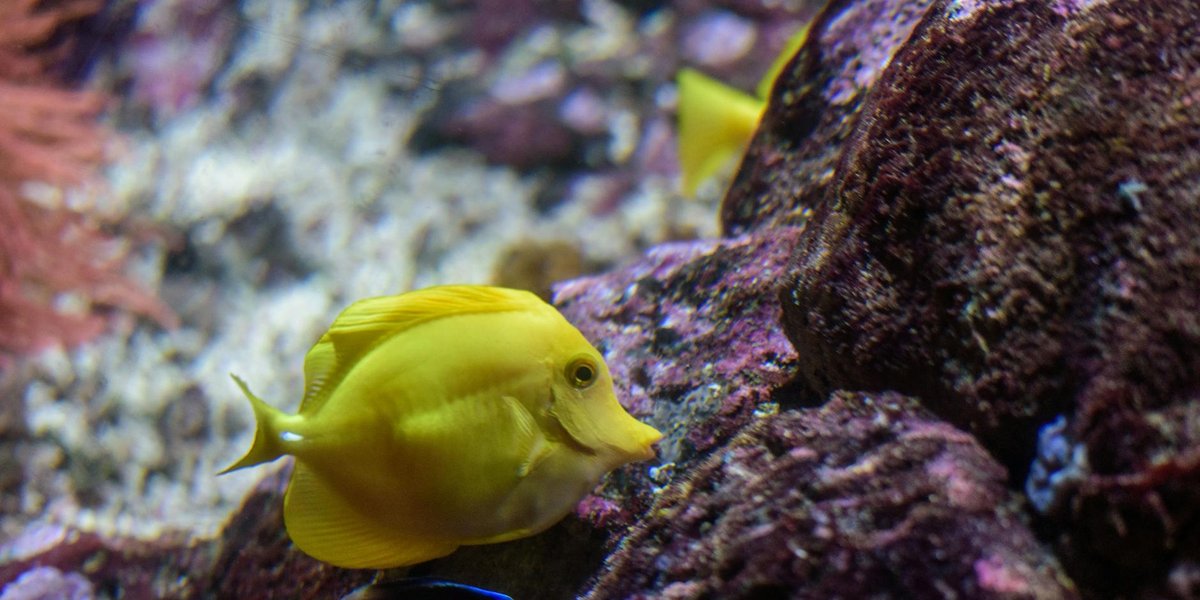
8. Yellow Tang (Zebrasoma flavescens)
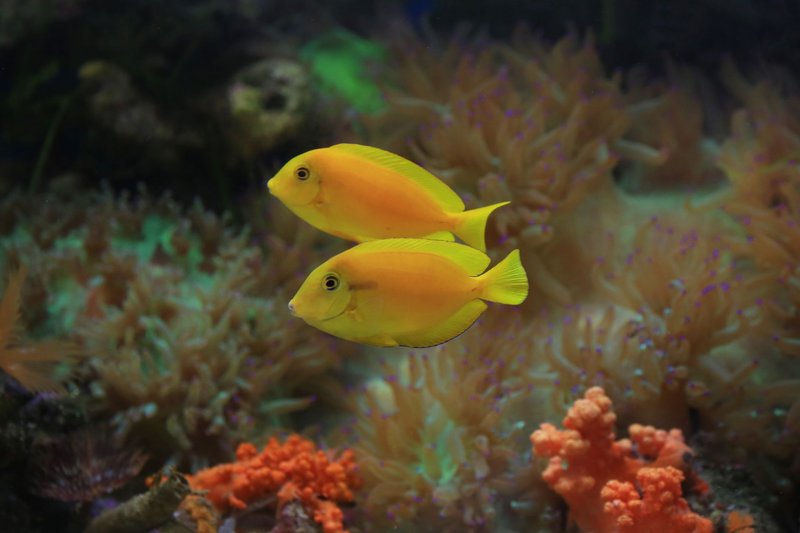
The poster fish for “yellow saltwater fish” — solid, uniform yellow with a disc-shaped body and a pointed snout for grazing algae off rock. The hidden ID detail: a small white scalpel-like spine at the base of the tail that flicks out when threatened. Handle with care, literally.
Most of the trade is now aquacultured rather than wild-caught from Hawaiian reefs, which is a real conservation win and means hardier captive-bred stock. It’s reef-safe and grazes nuisance algae, but it needs swimming room — a 75-gallon tank is the floor, not a target — and gets territorial with other tangs. Intermediate, not beginner.
9. Yellow Watchman Goby (Cryptocentrus cinctus)
A stubby yellow goby speckled with pale blue dots, almost always parked at the mouth of a burrow. Its signature behavior is the ID: it pairs up with a pistol shrimp in a classic mutualistic partnership — the near-blind shrimp digs and maintains the burrow, the sharp-eyed goby stands guard at the door. Peaceful, reef-safe, content in a 20-gallon nano, and endlessly watchable. One of the best beginner saltwater yellow fish.
10. Foxface Rabbitfish (Siganus vulpinus)
A big golden-yellow body with a striking black-and-white masked face. Beautiful, hardy, and a relentless algae mower — but the dorsal and anal fin spines are venomous, delivering a sting on par with a bad bee sting. It’s defensive only, but respect it during maintenance. Reef-safe in most cases, with the caveat that a hungry one may sample soft corals. Needs a 100-gallon-plus tank at full size.
11. Lemonpeel Angelfish (Centropyge flavissima)
A small bright-yellow dwarf angel with electric-blue trim around the eye, gill plate, and fin edges. That blue eye-ring on a solid yellow body is the unmistakable cue. The honest catch: it’s a dwarf angel, and dwarf angels nip coral polyps and clam mantles. Fine in a fish-only or carefully chosen aggressive-coral tank, risky in a prized SPS reef. Not reef-safe, despite how often it gets sold into reefs.
12. Coris Yellow Wrasse (Halichoeres chrysus)
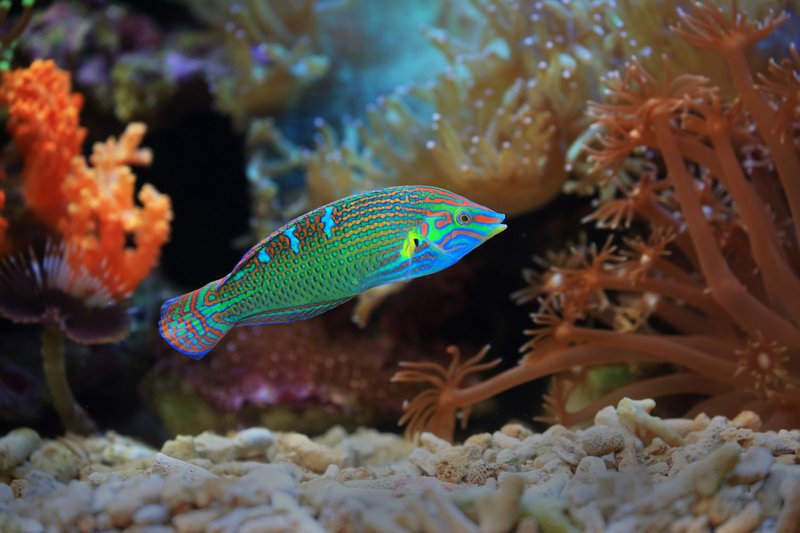
A slender, fast-moving canary-yellow wrasse with one to three small black eye-spots (ocelli) along the dorsal fin. Those false eye-spots are the ID. It’s an active, reef-safe fish that eats pest invertebrates like bristleworms and pyramid snails, earning its keep. Two quirks: it dives into the sand to sleep, so you need a deep sand bed, and it’s a jumper, so cover the tank.
13. Yellow Clown Goby (Gobiodon okinawae)
The smallest fish on this list at about an inch and a half — a tiny, bright-yellow goby with comically large lips that perches on coral branches like a bird. Perfect for nano reefs down to 10 gallons. It’s reef-safe with the one asterisk that it sometimes perches on and irritates SPS corals like Acropora. Peaceful to a fault; don’t house it with anything that’ll outcompete it for food.
14. Yellow Assessor (Assessor flavissimus)
An uncommon but gorgeous deep-yellow basslet that swims belly-up under ledges and inside caves, often hanging upside down against the rock. That inverted, cave-loving posture is the ID — nothing else yellow behaves like it. Shy, peaceful, fully reef-safe, and happy in a 30-gallon. Captive-bred specimens are widely available and adapt better than wild ones. A standout if you want something past the usual tang-and-goby roster.
Best Beginner Yellow Fish
If you’re new and want the color without the headaches, three picks:
- Freshwater: the electric yellow cichlid. Hardy, the most saturated yellow in the freshwater hobby, and forgiving as long as you keep the water hard and alkaline.
- Nano / small tank: the honey gourami. Peaceful, two inches, thrives in 10 gallons, and the male’s amber color is genuinely warm.
- Saltwater: the yellow watchman goby. A 20-gallon reef, near-bulletproof temperament, and the pistol shrimp pairing gives you a built-in nature documentary.
Skip the yellow tang, foxface, and lemonpeel angel until you’ve run a stable tank for a while. They’re not hard to keep alive, but they need space, stable water, and — in two cases — a healthy respect for venomous spines.
FAQ
What is the most popular yellow aquarium fish? Freshwater, it’s the electric yellow cichlid (yellow lab). Saltwater, it’s the yellow tang. Both are reliably, evenly yellow, which is rarer than it sounds.
Will a yellow fish stay yellow? Only if you feed it right. Yellow comes from carotenoids in food, not from the fish itself. A varied diet with algae or color-enhancing prepared foods keeps the color saturated; a poor diet fades it over months.
Are there small yellow fish for a nano tank? Yes. Honey gouramis and lemon tetras in freshwater; yellow clown gobies and yellow watchman gobies in saltwater. All work in tanks of 10–20 gallons.
Is the yellow tang endangered? No. Wild Hawaiian populations are healthy, and the aquarium trade has shifted heavily toward captive-bred stock, which has eased pressure on reefs and improved the fish you actually buy.