A rainforest doesn’t have one hunting ground. It has four, stacked on top of each other like floors in a building, and a different set of predators rules each one. The harpy eagle that snatches monkeys from the canopy never meets the jaguar prowling the forest floor sixty feet below. The arboreal viper waiting in the understory and the caiman lurking in a flooded creek are hunting completely separate menus.
That vertical layering is the most useful way to understand who eats whom in a rainforest, and it’s the way most “rainforest carnivores” lists skip right past. Below, the meat-eaters grouped by where they actually hunt: canopy, understory, forest floor, and water. Diet, the adaptation that makes each one deadly, geographic range, and conservation status for every species.
Table of Contents
- Quick Comparison Table
- Carnivore, Omnivore, or Apex Predator?
- How the Rainforest Food Chain Works
- Canopy Hunters
- Understory Hunters
- Forest Floor Hunters
- Water Hunters
- Amazon vs. Congo vs. Southeast Asia
- Frequently Asked Questions
Quick Comparison Table
| Carnivore | Forest Layer | Primary Prey | Range | Conservation Status |
|---|---|---|---|---|
| Harpy Eagle | Canopy | Sloths, monkeys | Central & South America | Vulnerable |
| Margay | Canopy/Understory | Small mammals, birds | Central & South America | Near Threatened |
| Emerald Tree Boa | Understory | Birds, small mammals | Amazon Basin | Least Concern |
| Ocelot | Understory/Floor | Rodents, reptiles | Americas | Least Concern |
| Jaguar | Forest Floor | Capybara, peccary, caiman | Central & South America | Near Threatened |
| Bush Dog | Forest Floor | Pacas, agoutis | South America | Near Threatened |
| Black Caiman | Water | Fish, capybara, deer | Amazon Basin | Least Concern |
| Giant Otter | Water | Fish, crustaceans | South America | Endangered |
| Leopard | Floor (Congo/Asia) | Antelope, monkeys, hogs | Africa & Asia | Vulnerable |
| Clouded Leopard | Canopy/Floor (Asia) | Gibbons, deer, birds | Southeast Asia | Vulnerable |
Carnivore, Omnivore, or Apex Predator?
These three labels get thrown around like they mean the same thing. They don’t.
A carnivore is any animal whose diet is mostly meat. That covers everything on this list, from a 200-pound jaguar to a margay that weighs less than a house cat.
An omnivore eats both meat and plants. Plenty of rainforest animals blur the line. Coatis hunt insects and lizards but also tear into fruit, so they’re omnivores, not carnivores, which is why they aren’t on this list.
An apex predator sits at the very top of its food chain with no natural predators of its own. The jaguar and the harpy eagle qualify. A margay does not. It eats meat, sure, but an ocelot or a larger snake will happily eat the margay. Apex status is about who eats you, not what you eat.
How the Rainforest Food Chain Works
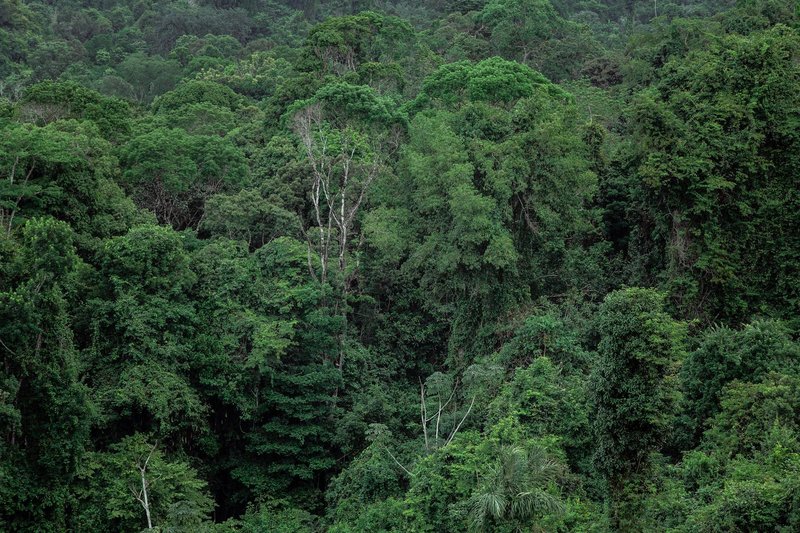
Energy in a rainforest moves up through trophic levels, and carnivores occupy the top two.
Producers come first: the trees, vines, and shrubs converting sunlight into sugar. Primary consumers, the herbivores, eat the plants. Howler monkeys strip leaves, agoutis crack open seeds, leafcutter ants farm fungus on harvested foliage. Secondary consumers eat the herbivores. That’s where most carnivores on this list operate. And tertiary consumers, the apex predators, eat the secondary consumers.
The catch in a rainforest is that this isn’t a tidy ladder. It’s a web. A jaguar eats capybara (herbivore) but also eats caiman (a carnivore itself). The harpy eagle eats sloths, which are herbivores, but also eats monkeys that eat insects. Energy crosses sideways constantly, which is part of why rainforests support such staggering predator diversity. The Amazon alone holds around 10% of all known species on Earth, and a big share of them are something else’s dinner. The biggest of those predators and their prey make up the complete list of big rainforest animals worth knowing.
Canopy Hunters
The canopy is the rainforest’s sunlit roof, a continuous layer of treetops roughly 60 to 130 feet up. Most rainforest life happens here, which means most rainforest hunting does too.
Harpy Eagle
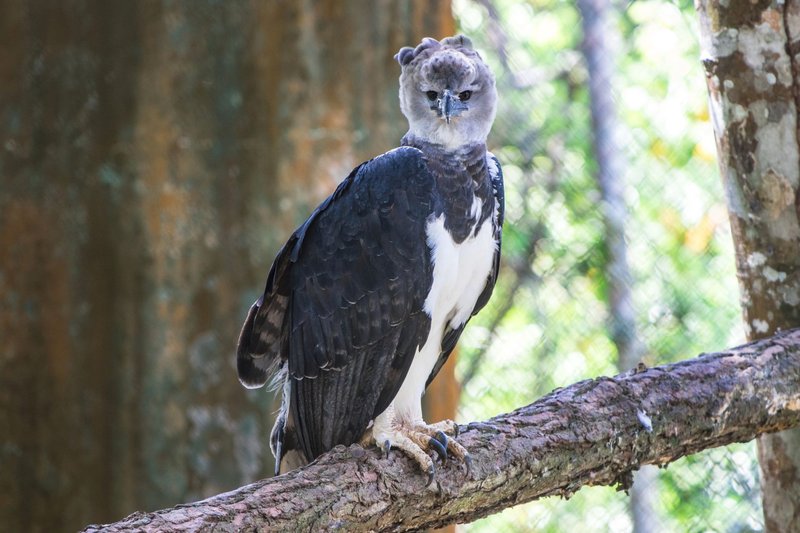
The harpy eagle is the heavyweight of the canopy and arguably the most powerful eagle alive. Females weigh up to 20 pounds with a wingspan near seven feet, and their rear talons grow to about five inches, longer than a grizzly bear’s claws. That grip generates enough force to crush a sloth’s skull.
Diet: Sloths and monkeys make up the bulk of it, supplemented by porcupines, coatis, and large birds. A harpy can carry off prey weighing as much as itself.
Hunting adaptation: It doesn’t soar in the open like other eagles. It flies through the canopy, using short broad wings to maneuver between branches, then ambushes prey at close range. Facial disc feathers funnel sound to its ears, the same trick owls use.
Range: Southern Mexico through Central America into the Amazon Basin and northern Argentina. At the northern edge of that range it’s one of the more striking entries among the mammals and large fauna of Mexico that depend on intact forest.
Conservation status: Vulnerable. Deforestation is the main threat, since a breeding pair needs a huge unbroken territory and raises just one chick every two to three years.
Margay
The margay is a small spotted cat built almost entirely for life in the trees. It rarely touches the ground.
Diet: Birds, small monkeys, tree frogs, rodents, and lizards taken in the branches.
Hunting adaptation: Its ankles rotate a full 180 degrees, so it can climb down a trunk headfirst and hang from a branch by a single hind foot. It’s one of only two cat species capable of this. Researchers have even documented a margay mimicking the call of a pied tamarin to lure the monkeys closer.
Range: Central and South America, from Mexico to Argentina.
Conservation status: Near Threatened, declining mostly from habitat loss and historic hunting for its fur.
Understory Hunters
Below the canopy sits the understory: a dim, humid zone of shorter trees, palms, and tangled vines where only a fraction of sunlight reaches. Ambush is the strategy of choice here.
Emerald Tree Boa
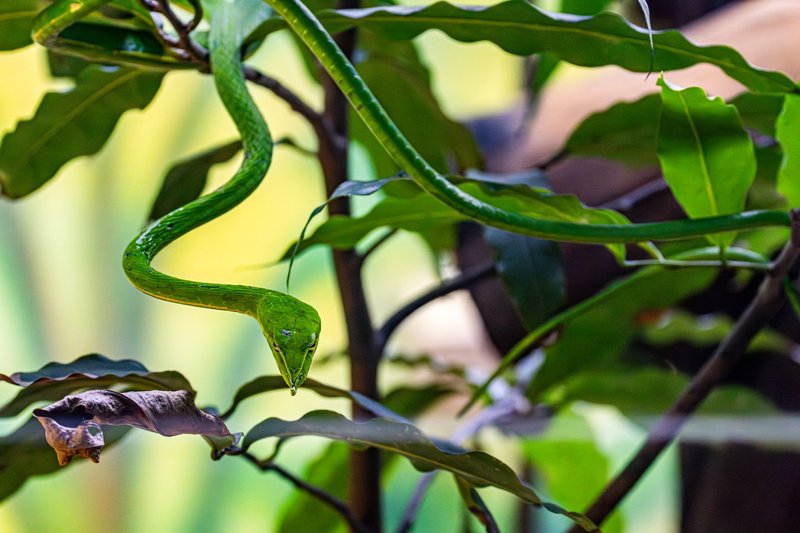
Coiled in a perfect series of loops over a branch, the emerald tree boa is one of the most recognizable snakes in the Amazon, and one of the most patient.
Diet: Mostly small mammals and birds, occasionally lizards and frogs.
Hunting adaptation: It has some of the longest teeth, relative to head size, of any non-venomous snake, ideal for hooking feathered prey through plumage. Deep pits along its lips detect the body heat of warm-blooded animals in total darkness, letting it strike with precision at night. It anchors its tail to a branch and lunges down at passing prey.
Range: The Amazon Basin across Brazil, Peru, Colombia, and the Guianas.
Conservation status: Least Concern.
Ocelot
The ocelot is roughly twice the size of a house cat and patrols both the understory and the forest floor.
Diet: Rodents, rabbits, birds, snakes, fish, and crabs. It eats whatever is most abundant in its territory.
Hunting adaptation: Exceptional night vision and a reflective layer behind the retina let it hunt in near-total darkness, when most of its prey is active. It hunts by slow patrol, covering a mile or more a night, then pouncing.
Range: From the southern United States through Central America and most of South America.
Conservation status: Least Concern overall, though northern populations near the U.S. border are critically low.
Forest Floor Hunters
The forest floor is dark, only about 2% of sunlight reaches it, and surprisingly open underfoot, since little can grow without light. This is where the rainforest’s largest land predators operate.
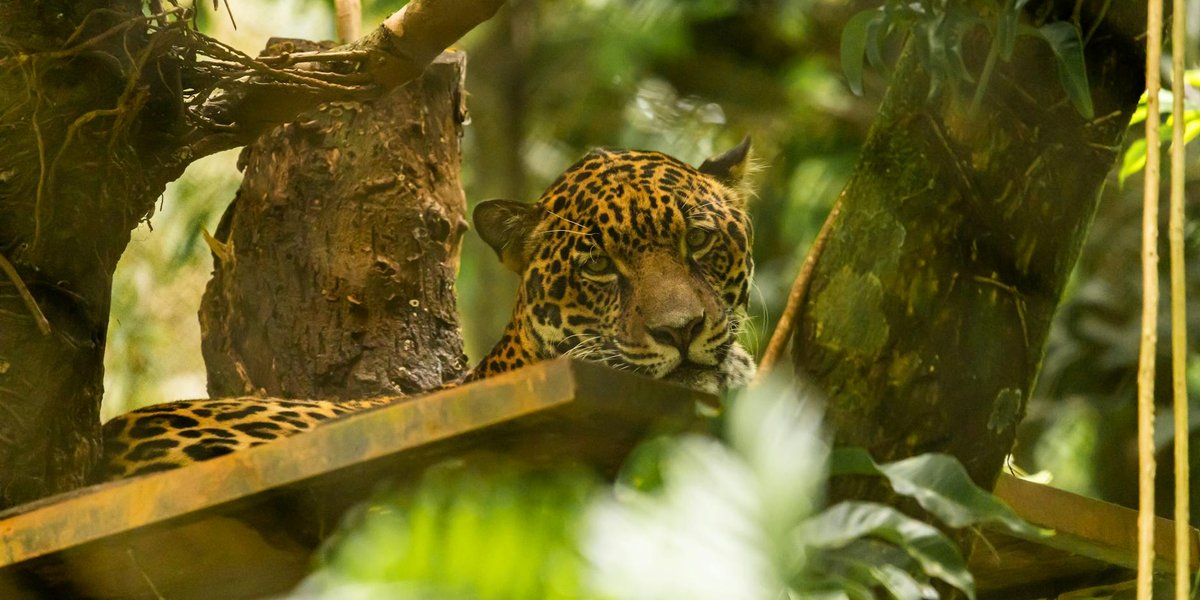
Jaguar
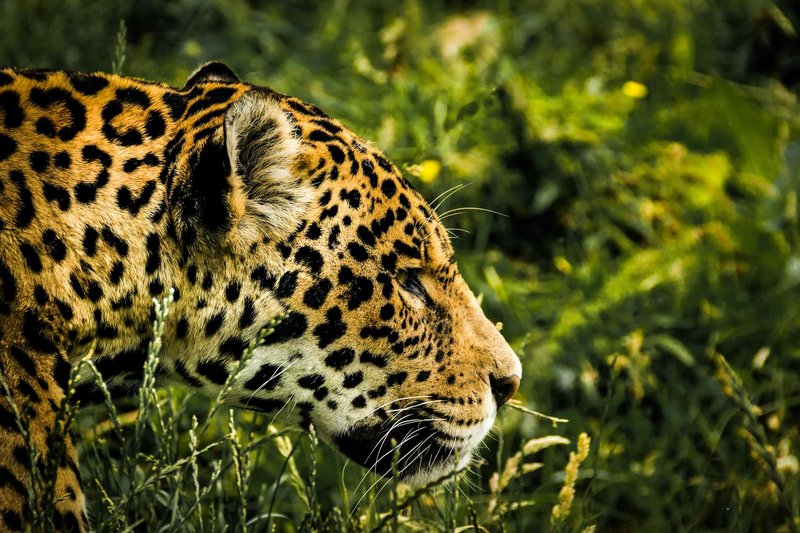
The jaguar is the apex predator of the American rainforest and the third-largest cat on Earth after tigers and lions. Big males in the Pantanal can top 250 pounds, and the cat ranks among the most iconic of the mammals of Brazil.
Diet: Astonishingly broad, more than 85 species recorded, including capybara, peccary, deer, tapir, caiman, turtles, and fish.
Hunting adaptation: It has the strongest bite force relative to size of any big cat, and a signature kill method no other cat uses: it bites straight through the skull, between the ears, piercing the brain. That bite is also how it punches through caiman armor and turtle shells. Unlike most cats, jaguars love water and hunt in it.
Range: Historically from the U.S. Southwest to Argentina; today mostly the Amazon and Pantanal.
Conservation status: Near Threatened, with populations fragmented by ranching and deforestation. The IUCN tracks the jaguar’s range loss, which now covers roughly half its historic territory.
Bush Dog
Few people have ever seen a bush dog. It looks more like an otter than a dog, with a stocky body, short legs, and webbed feet.
Diet: Pacas, agoutis, and other large rodents, plus armadillos and ground birds.
Hunting adaptation: It’s one of the only truly pack-hunting canids in South America. A group of bush dogs will coordinate to drive a paca toward water, where another dog waits to make the catch. They communicate through high-pitched squeaks in the dense undergrowth where they can’t see each other.
Range: Central America through much of South America, though sparsely distributed everywhere.
Conservation status: Near Threatened.
Water Hunters
Rainforest rivers, oxbow lakes, and seasonally flooded forest hold an entirely separate set of carnivores, including some of the largest predators in the whole ecosystem.
Black Caiman
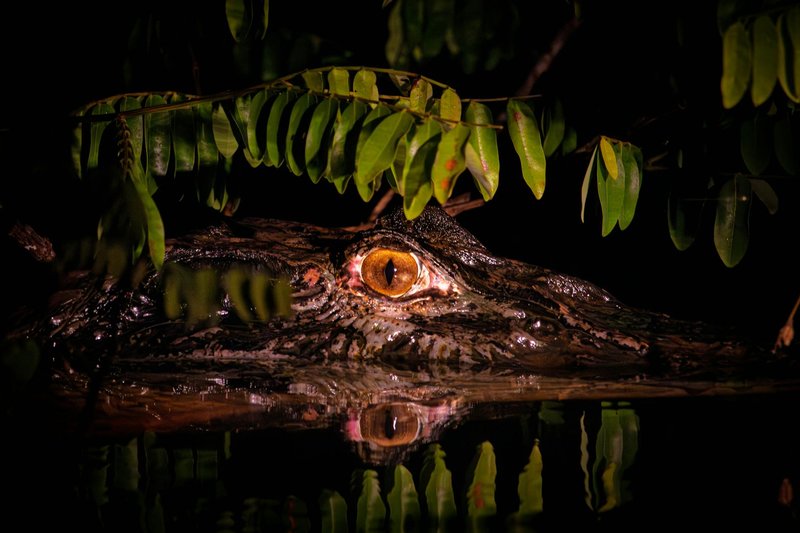
The black caiman is the apex predator of Amazon waterways and the largest predator in the Amazon Basin, growing past 16 feet.
Diet: Fish, including piranhas, plus capybara, deer, and anything that comes to drink at the water’s edge.
Hunting adaptation: Its dark, almost black hide provides camouflage for night hunting, and a reflective eye layer makes those night ambushes lethal. It floats nearly motionless with only nostrils and eyes above the surface, then explodes upward.
Range: Slow-moving rivers and flooded forest across the Amazon Basin.
Conservation status: Least Concern today, a genuine recovery story after the hide trade nearly wiped it out by the 1970s.
Giant Otter
The giant otter is the longest member of the weasel family, stretching close to six feet, and it hunts in tight family groups.
Diet: Mostly fish, around 90% of the diet, plus crabs, small caimans, and occasionally young anacondas.
Hunting adaptation: Dense, water-repellent fur and fully webbed feet make it a blistering swimmer. Families of up to eight hunt cooperatively, herding fish into the shallows. They’re loud, using a documented repertoire of distinct vocalizations to coordinate, which earned them the nickname “river wolves.”
Range: Rivers and lakes across northern and central South America.
Conservation status: Endangered. Hunted relentlessly for its pelt through the mid-20th century, it remains rare and sensitive to river pollution and gold-mining mercury.
Amazon vs. Congo vs. Southeast Asia
“Rainforest” isn’t one place, and the three great rainforest regions field completely different predator lineups.
The Amazon is the cat-and-reptile show described above: jaguars, ocelots, margays, caimans, anacondas. No big primates hunting, no large canids beyond the elusive bush dog.
The Congo Basin swaps in African players. The leopard takes the role the jaguar plays in the Amazon, the dominant big cat of the forest floor, climbing trees to stash kills away from scavengers. The Nile crocodile fills the caiman’s niche in the rivers, and the African golden cat handles the mid-size predator role.
Southeast Asia has the most crowded predator guild. The clouded leopard is the standout: it has the longest canine teeth relative to skull size of any living cat, and ankles that rotate like a margay’s, letting it descend trees headfirst despite weighing up to 50 pounds. It shares these forests with tigers, sun bears, reticulated pythons, and the leopard cat, all packed into shrinking habitat. The clouded leopard is listed as Vulnerable on the IUCN Red List, squeezed by deforestation across Borneo, Sumatra, and the mainland.
The pattern holds across all three: a dominant big cat on the floor, an ambush reptile in the water, and a roster of small and mid-size cats working the middle layers. Different continents, same blueprint.
Frequently Asked Questions
What is the apex predator of the rainforest?
It depends on the region. In the Amazon, the jaguar rules the land and the black caiman rules the water. In the Congo Basin, it’s the leopard and the Nile crocodile. In Southeast Asian forests where tigers survive, the tiger sits at the top. An apex predator is one with no natural predators of its own, and most rainforests have a separate apex hunter for land and water.
Are there carnivores in every layer of the rainforest?
Yes. The harpy eagle and margay hunt the canopy, snakes like the emerald tree boa and cats like the ocelot work the understory, jaguars and bush dogs patrol the forest floor, and caimans and giant otters hunt the rivers. Each layer has its own predators and its own prey.
What is the most dangerous carnivore in the Amazon?
To other animals, the jaguar and black caiman are the most formidable, both capable of taking large prey. To humans, the black caiman poses the most realistic risk because of its size and ambush hunting in water, though attacks are rare.
Do rainforest carnivores eat plants too?
True carnivores like jaguars, harpy eagles, and caimans eat almost exclusively meat. Animals that mix in fruit and plants, such as coatis and many bears, are classified as omnivores rather than carnivores.
Why are so many rainforest carnivores endangered?
The common thread is habitat loss. Large predators need big, unbroken territories to find enough prey, and deforestation fragments those territories into pieces too small to support them. Several species on this list, including the giant otter and black caiman, were also hunted heavily for their pelts and hides in the 20th century.