Table of Contents
- The Short Version
- 1. Goliath Birdeater
- 2. Brazilian Wandering Spider
- 3. Golden Silk Orb-Weaver
- 4. Huntsman Spider
- 5. Decoy-Building Orb Weaver
- 6. Spiny Orb-Weaver
- 7. Trechalea Amazonica (Giant Fishing Spider)
- 8. Social Spider (Anelosimus eximius)
- 9. Mirror Spider
- 10. Jumping Spiders of the Tropics
- 11. Redknee Tarantula
- 12. Net-Casting Spider
- Spotting Tropical Spiders Safely
The Short Version
Tropical rainforests have the highest spider diversity on Earth. Most species there are harmless to humans. A handful can cause serious harm — two in particular deserve genuine respect. But the spiders people fear are almost never the ones they should fear, and the ones worth fearing are usually nowhere near tourist trails. If you’re traveling to tropical regions, your energy is better spent being curious than anxious.
The tropics are where spiders go big. Or weird. Or both. Rainforest canopies, leaf litter, river banks, and even the undersides of palm fronds are stacked with species that haven’t made it into mainstream wildlife docs yet — species that build decoy versions of themselves out of debris, hunt fish, or spin silk strong enough to trap small birds.
This isn’t a list designed to scare you. It’s a guide to 12 of the most remarkable tropical spiders, with honest danger assessments so you actually know what’s worth worrying about.
1. Goliath Birdeater
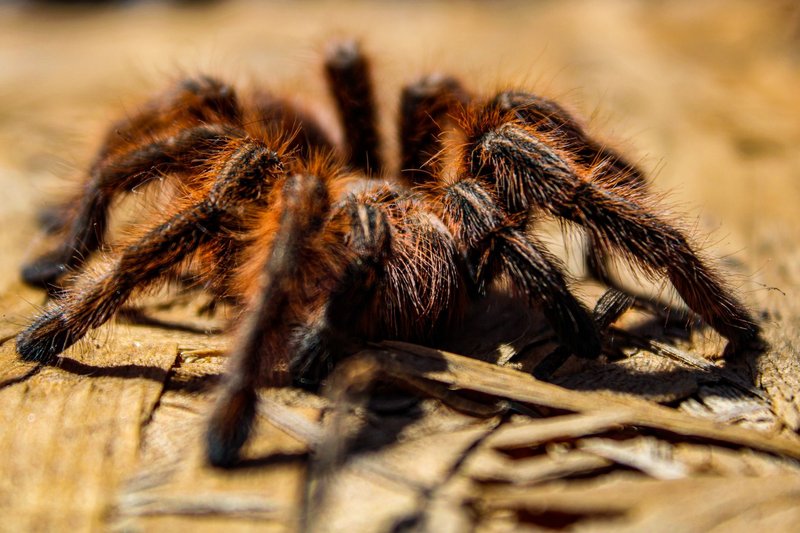
Danger level: Low (to humans)
The Goliath Birdeater (Theraphosa blondi) is the largest spider by mass on the planet — up to 170 grams, with a leg span that can hit 28 cm. It lives in the rainforests of Venezuela, Brazil, Guyana, and Suriname, typically in deep burrows in the forest floor.
Despite the name, birds are rarely on the menu. It mostly hunts earthworms, frogs, and the occasional rodent. Its venom is mild by spider standards — roughly equivalent to a wasp sting for most adults. The real nuisance is the urticating hairs it flicks from its abdomen when threatened. Those cause intense itching if they land in your eyes or nose.
The Goliath makes a hissing sound (stridulation) by rubbing its legs together when disturbed. Loud enough to hear from several feet away. If you’re walking in Venezuelan rainforest and you hear that, now you know. The frogs it occasionally preys on are themselves a remarkable part of the same ecosystem — rainforest amphibians fill a completely different niche in the same leaf-litter layer the Goliath calls home.
2. Brazilian Wandering Spider
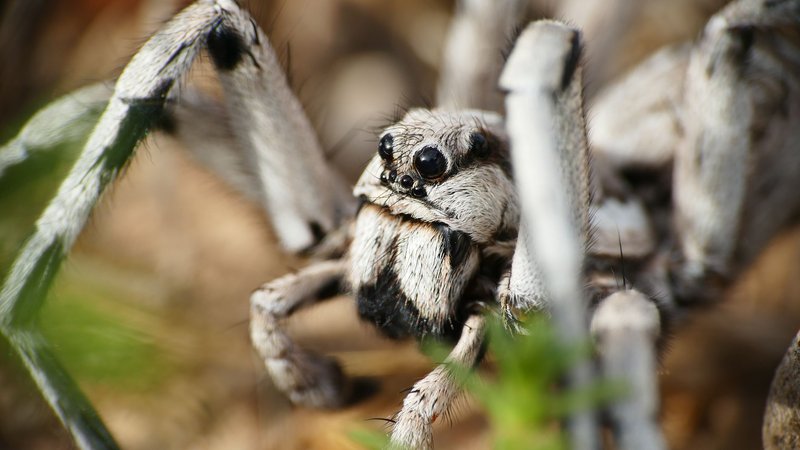
Danger level: High
The genus Phoneutria — often called armed spiders or banana spiders in Brazil — holds a legitimate claim to being the most venomous spider in the world by potency of neurotoxin. These spiders don’t build webs to catch prey. They hunt actively at night and are named “wandering” for exactly that reason.
Unlike most species that flee when encountered, Phoneutria often holds its ground, rearing up on its hind legs in a threat display. Bites happen most often when the spiders hide in fruit clusters, shoes, or folded clothing left outside overnight. According to research published in Toxicon, a significant fraction of reported Phoneutria envenomations in Brazil require antivenin.
The good news: if you’re not in Brazil, Paraguay, or nearby countries, the risk is extremely low. In tourist areas, encounters are uncommon. The species prefers dense vegetation and the edges of agricultural land over well-trodden trails.
3. Golden Silk Orb-Weaver
Danger level: Negligible
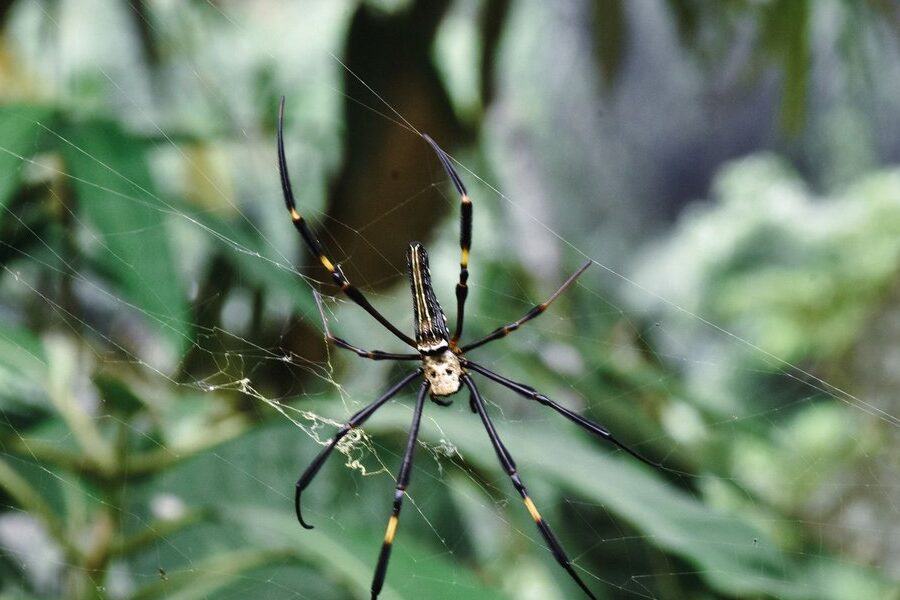
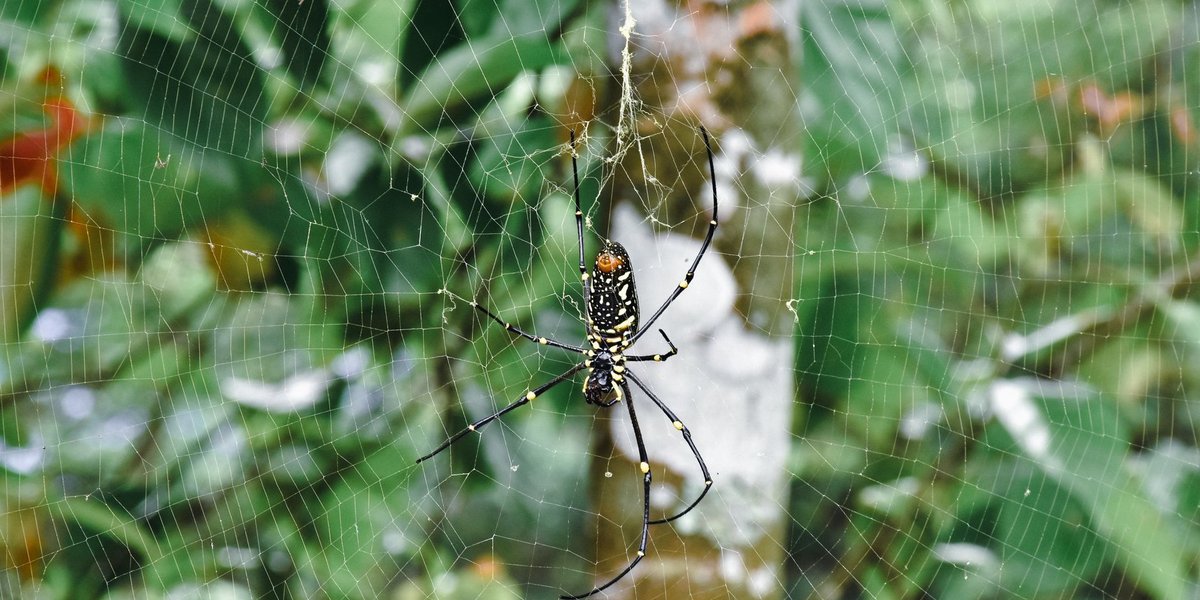
Nephila and related genera build the largest orb webs of any spider — some up to a meter across, spun from silk with a faint golden tint. That color isn’t decoration. The theory is it acts as a lure: some insects are attracted to the yellow hue, and the web blends into sunlit backgrounds for others.
The silk itself is famously strong. Studies at Oxford University have found that Nephila silk rivals high-grade steel wire by weight for tensile strength. There’s been genuine interest in harvesting or synthetically replicating it for medical sutures and bulletproof materials.
In parts of Papua New Guinea, locals traditionally used the webs as fishing nets. A practical solution that speaks to how durable this stuff really is.
4. Huntsman Spider
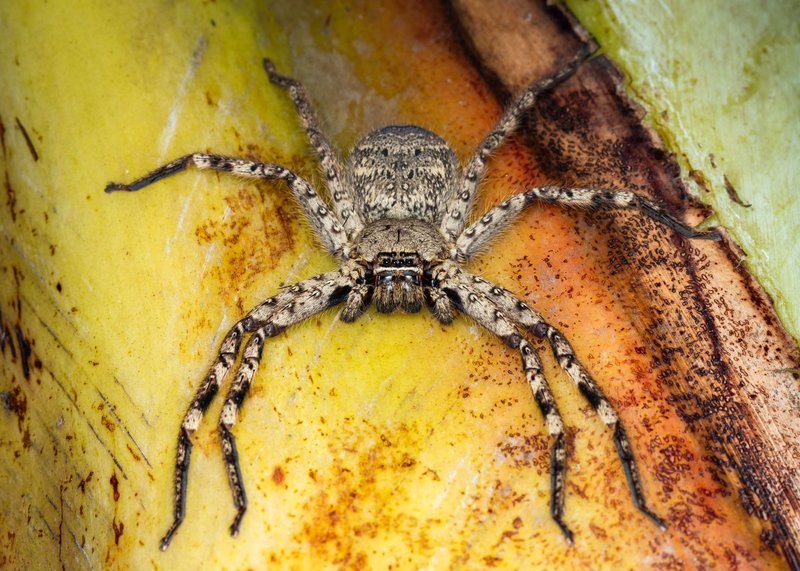
Danger level: Low
The giant huntsman (Heteropoda maxima) found in Laos holds the record for largest leg span of any spider — up to 30 cm. But the species most encountered across tropical Asia and Australia is Heteropoda venatoria, commonly called the cane spider or banana spider (this name is shared with Phoneutria in a completely different part of the world — confusing, but that’s common naming for you).
Huntsmans are fast, flat-bodied, and can appear startlingly large when you find one on a wall. They’re also genuinely useful: they eat cockroaches, moths, and other insects in and around human habitation. Locals in tropical Asia often leave them alone for this reason.
The bite can cause localized pain and swelling but is not medically significant for healthy adults. Their first move when surprised is usually to run sideways at speed, not to attack.
5. Decoy-Building Orb Weaver
Danger level: Negligible
This one is less well-known, and it deserves attention. Cyclosa mulmeinensis and similar species in the Peruvian Amazon construct elaborate decoys — dummy spiders made from dead insects, egg sacs, and plant debris — mounted in the center of their web. The decoys are roughly the same size and shape as the spider itself, and they vibrate when the web moves, mimicking a living spider.
Researchers reported in Scientific Reports that webs with decoys attracted significantly more predatory wasps than the decoy itself — effectively misdirecting the attack. It’s a spider building a fake version of itself as a shield. The first time you see one in the field and realize what you’re looking at, it’s genuinely unsettling in the best way. Peru’s forests harbor an outsized share of these behavioral oddities — the country’s wildlife is covered in detail in this guide to dangerous animals in Peru, which also profiles many of the predators these spiders have evolved to avoid.
6. Spiny Orb-Weaver
Danger level: Negligible
Spiny orb-weavers (Gasteracantha species) look like they belong in a science fiction film: small, brightly colored, and covered in hard pointed spines protruding from the sides of the abdomen. Red, yellow, white, orange — depending on the species. They’re found throughout tropical Asia, Africa, and the Americas.
The spines are thought to deter predators (birds mostly), and the bright coloration functions as an aposematic warning. For their size — often under 1 cm body length — they build impressive webs and are remarkably visible in the wild. If you’re walking through Central American or Southeast Asian lowland forest with a sharp eye, you’ll find them quickly.
7. Trechalea Amazonica (Giant Fishing Spider)
Danger level: Low
Several spider genera in tropical South America have evolved to hunt on the surface of water. Trechalea amazonica and related species detect surface vibrations from tadpoles, small fish, and aquatic insects, then dash across the water to grab them.
They don’t use webs for prey capture at all. These are ambush predators with legs spread flat against the water surface, relying on surface tension to stay afloat. They’re found along slow-moving rivers and flooded forest floor sections throughout the Amazon Basin. If you’re on a canoe tour at dawn, watch the calm sections near the bank.
8. Social Spider (Anelosimus eximius)
Danger level: Negligible
Almost all spiders are solitary. Anelosimus eximius, found in the Amazon and Orinoco basins, is a significant exception. Colonies of hundreds to thousands of individuals build communal webs that can stretch several meters, with a shared nursery, shared prey capture, and cooperative defense against intruders.
Individual spiders in larger colonies are less aggressive than solitary species — the opposite of what you’d expect. Research in PLOS ONE found that sociality in this species appears to trade individual boldness for colony-level stability. The webs look like dense hammocks draped over shrubs at the forest edge. Easy to spot, impossible to mistake once you know what they are.
9. Mirror Spider
Danger level: Negligible
Thwaitesia species, found across tropical Asia and Australia, have reflective patches on the abdomen that look like shards of mirror. These patches are actually made of guanine crystals — the same compound in fish scales that produces iridescence. The patches can expand and contract depending on the spider’s stress level, which researchers believe may serve as a camouflage mechanism: on the right background, the reflective fragments mimic dappled light through leaves.
They’re tiny — rarely over 4 mm body length — and almost impossible to find unless you’re specifically looking. A macro lens and patience are the standard gear.
10. Jumping Spiders of the Tropics
Danger level: Negligible
The family Salticidae has over 6,000 species, with the highest concentration in tropical regions. Tropical jumping spiders include some genuinely bizarre outliers: Myrmarachne species mimic ants in body shape and gait (including waving their front legs like antennae), and some species in the Neotropics mimic toxic beetles.
Jumping spiders have the best vision of any spider — eight eyes arranged for near-360-degree coverage, with two large forward-facing eyes that can detect movement at a distance of 30+ body lengths. When you make eye contact with one, it turns its entire body to face you. Curious, not aggressive.
11. Redknee Tarantula
Danger level: Low
Brachypelma hamorii, native to the Pacific coast of Mexico, is one of the most recognizable tarantulas in the world — black body, orange-red knees, slow-moving. It’s a burrowing species that lives in tropical dry forest, spending most of its time underground.
Like the Goliath Birdeater, its venom is medically unimportant for healthy adults. The urticating hairs are the actual concern. The species is listed under CITES Appendix II because of overcollection for the pet trade — wild populations have been significantly impacted. If you encounter one on a hike in Jalisco or Colima, take photos, leave it alone.
12. Net-Casting Spider
Danger level: Negligible
Deinopis species don’t wait in a web. They hang upside-down holding a small rectangular web between their front legs, then lunge forward to net passing prey. Their posterior median eyes are enormous relative to body size — the largest of any spider — tuned for low-light vision. These are the spiders with the best night vision in the animal kingdom, detecting light even better than cats or owls at equivalent eye size, according to research published in the Journal of Comparative Physiology.
They’re active hunters in the leaf litter layer of tropical forests across South America, Africa, and Australia. If you’re on a night walk and you see a slender spider hanging motionless with its front legs extended, this is likely what you’re looking at.
Spotting Tropical Spiders Safely
You don’t need a PhD in arachnology to find spiders in tropical forests. A few practical points:
Use a headlamp at night. Spider eyes reflect light — known as eyeshine — so scanning low vegetation at night reveals hundreds of eyes you’d miss in daylight. Night forest walks in Costa Rica, Borneo, or the Amazon basin are consistently the best option for encounters.
Move slowly near webs. The most visible spiders are web-builders, and webs are often at face level on forest trails. Slow down, especially after rain, when webs are still intact and visible.
Don’t reach into gaps you can’t see. The species worth actually worrying about (Phoneutria in South America, a few others) hide in crevices and folded material during the day. Check shoes, folded clothes, and backpacks left outside overnight.
Leave them alone. Every species on this list — including the Brazilian wandering spider — bites defensively when cornered or grabbed. The solution is simple: don’t grab them. Observe, photograph, and move on.
Tropical spiders have been evolving for longer than most forest ecosystems have existed. They’re not the threat. In most cases, they’re the reason the insects that would otherwise ruin your hike stay somewhat in check.