Most “fluffy cat breeds” lists pad the count with cats that are all coat and no cat. A Persian looks enormous until you pick one up and find six pounds of fur wrapped around a small skeleton. If you want a cat that’s genuinely large — the kind that takes up a full couch cushion and sets off the “is that a dog?” question — fluff alone isn’t the spec you’re shopping for.
This list filters for both: real size (12 lb and up for most, with the big males pushing 18-20+) and a real long or semi-long coat. Each breed gets a stat box, an honest grooming readout, and notes on shedding and cost, because a 16-pound cat with a triple coat is a different commitment than a sleek shorthair.
Table of Contents
- The Quick Comparison
- TLDR: Just Tell Me Which One
- 1. Maine Coon
- 2. Norwegian Forest Cat
- 3. Siberian
- 4. Ragdoll
- 5. Ragamuffin
- 6. Birman
- 7. Turkish Van
- 8. Persian
- 9. Himalayan
- Grooming Reality Check
- Shedding and Allergies
- What It Costs
- FAQ
The Quick Comparison
| Breed | Weight (lb) | Coat | Grooming | Temperament |
|---|---|---|---|---|
| Maine Coon | 12-18+ (males to 25) | Semi-long, shaggy | 2-3x/week | Friendly, doglike |
| Norwegian Forest | 12-16 (males to 20) | Long, double | 2-3x/week | Calm, independent |
| Siberian | 12-17 | Long, triple | 2-3x/week | Playful, affectionate |
| Ragdoll | 12-20 | Semi-long, silky | 2x/week | Docile, clingy |
| Ragamuffin | 12-20 | Long, plush | 2-3x/week | Mellow, lap cat |
| Birman | 10-15 | Semi-long, silky | 1-2x/week | Gentle, social |
| Turkish Van | 10-18 | Semi-long, water-resistant | 1x/week | Active, athletic |
| Persian | 7-12 | Long, dense | Daily | Quiet, sedate |
| Himalayan | 7-12 | Long, dense | Daily | Sweet, calm |
Persian and Himalayan sit at the bottom of the weight range on purpose — they make the list on coat, not bulk. Everything above them is a genuinely big cat.
TLDR: Just Tell Me Which One
- Biggest and most outgoing: Maine Coon. The default answer for “large fluffy cat,” and it earns it.
- Big but lower-maintenance coat: Norwegian Forest Cat or Turkish Van — both shed seasonally but resist matting.
- Most affectionate floppy lap cat: Ragdoll or Ragamuffin.
- Best for allergy-prone homes: Siberian, which produces less of the Fel d 1 protein that triggers most cat allergies.
- Fluff without the size: Persian or Himalayan — gorgeous, but a daily-brushing commitment.
1. Maine Coon
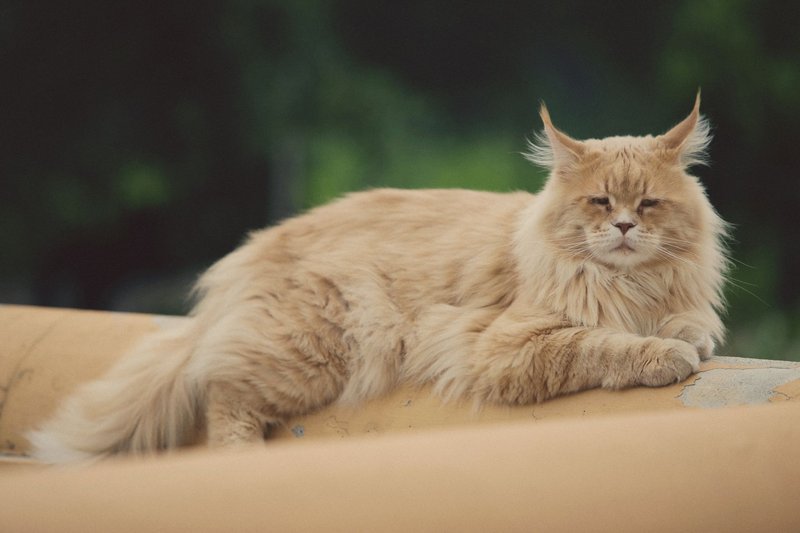
The Maine Coon is the breed everyone pictures when they hear “big fluffy cat,” and the reputation is deserved. Males routinely hit 15-18 pounds, and the genuinely large ones clear 20. One Maine Coon, Stewie, held the Guinness record for longest domestic cat at 48.5 inches nose to tail. These are not exaggerated coats on small frames — they’re large cats with the muscle to match.
The coat is shaggy and uneven rather than uniformly plush: longer on the belly and ruff, shorter on the shoulders, with the famous lynx-tipped ears and a tail like a feather duster. It’s water-resistant, a holdover from the breed’s New England barn-cat origins.
Personality-wise they’re the golden retrievers of the cat world. Talkative in a chirpy, trilling way, often into fetch, and frequently willing to walk on a harness. They want to be in the room with you, not necessarily on you.
Stats
- Weight: 12-18 lb (males to 25)
- Coat: Semi-long, shaggy, water-resistant
- Grooming: 2-3x/week
- Lifespan: 12-15 years
2. Norwegian Forest Cat
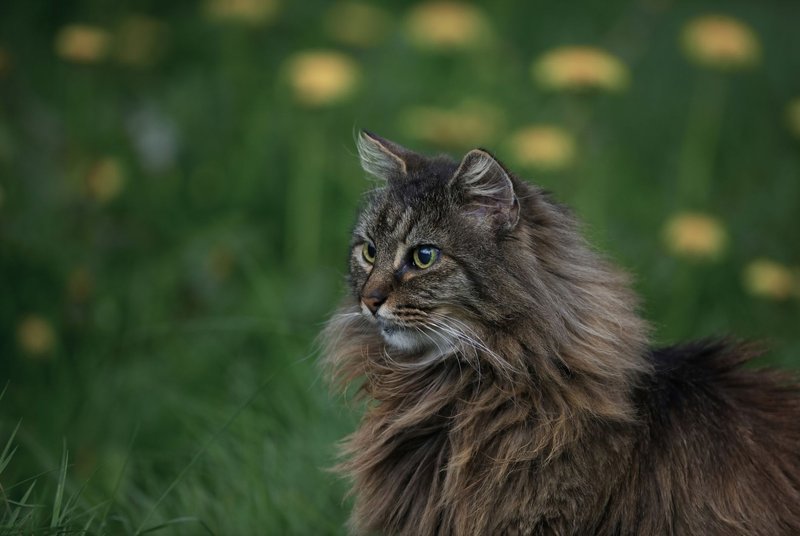
The Wegie is what you’d build if you needed a cat to survive a Scandinavian winter. The double coat has a woolly undercoat and a glossy, water-shedding topcoat, plus a dense ruff that flares out around the neck like a lion’s mane in cold months — then partly molts in spring, so expect a heavy seasonal shed. That winterized build puts it among the hardiest cold-weather cat breeds you can own.
Easy to confuse with a Maine Coon, but the profile is different: a straight nose in a triangular face versus the Maine Coon’s gentler curve, and a slightly more reserved personality. Wegies are calm and self-sufficient — affectionate on their own schedule, world-class climbers, and happy to supervise the household from the top of a bookshelf.
Size lands at 12-16 pounds, with large males reaching 20. The coat resists matting better than most on this list, which makes the grooming load lighter than the volume of fur suggests.
Stats
- Weight: 12-16 lb (males to 20)
- Coat: Long, double, water-resistant
- Grooming: 2-3x/week
- Lifespan: 14-16 years
3. Siberian
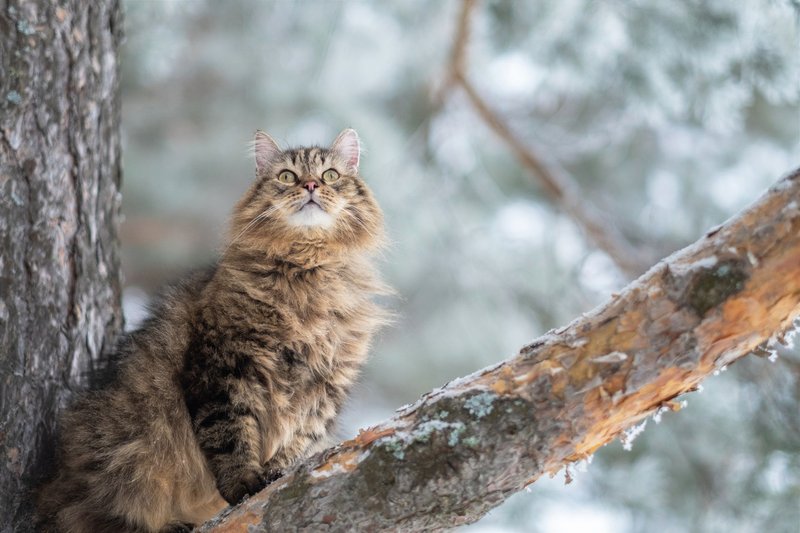
The Siberian is the breed to know if someone in your house reacts to cats. It carries a triple coat — guard hairs, awn hairs, and a dense down layer — so it’s as fluffy as anything here. But studies have found Siberians produce lower levels of the Fel d 1 allergen that causes most cat allergies. Not allergen-free, and individual cats vary, but enough that allergy-prone owners often tolerate them.
They’re sturdy, athletic cats, 12-17 pounds, built round and powerful rather than long and lean. Temperament is the best of both worlds: playful and dog-like enough to greet you at the door, calm enough to settle in your lap. Many are fascinated by water and will paw at a running faucet.
The triple coat does shed seasonally, hard, so the lower allergen load doesn’t mean zero cleanup.
Stats
- Weight: 12-17 lb
- Coat: Long, triple, water-resistant
- Grooming: 2-3x/week
- Lifespan: 11-15 years
4. Ragdoll
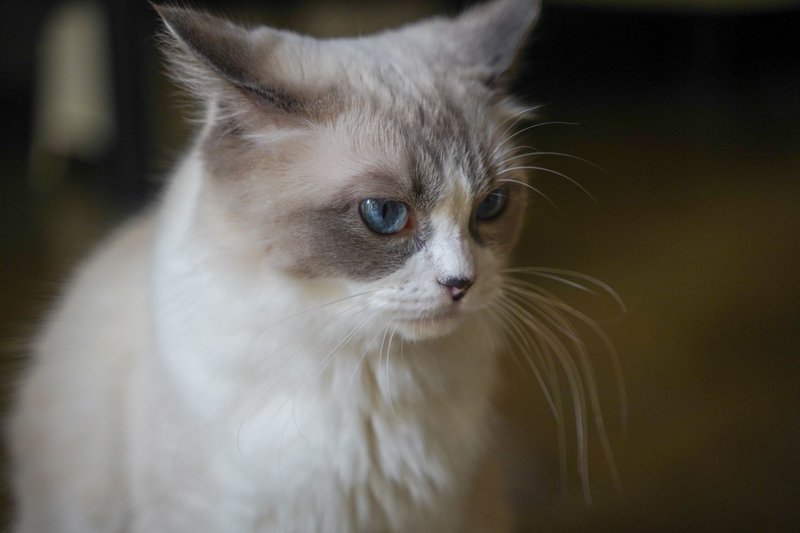
Ragdolls get their name from the way they go limp when you pick them up — a genuinely floppy, relaxed cat that treats being held as a perk. They’re among the largest pointed breeds, with males commonly reaching 15-20 pounds and a slow growth curve that means they’re not fully filled out until around four years old.
The coat is semi-long and silky with minimal undercoat, which has two consequences: it feels like rabbit fur, and it mats less than a dense double coat. Twice-weekly brushing usually keeps it in order. All Ragdolls are pointed, with blue eyes, in patterns like colorpoint, mitted, and bicolor.
Behaviorally they’re the clingiest cat here. Ragdolls follow you room to room, flop at your feet, and want in on whatever you’re doing. If you want a big cat that acts like a shadow, this is it.
Stats
- Weight: 12-20 lb
- Coat: Semi-long, silky
- Grooming: 2x/week
- Lifespan: 12-17 years
5. Ragamuffin
The Ragamuffin is the Ragdoll’s plusher cousin — closely related, similarly large at 12-20 pounds, and just as mellow, but with a denser, rabbit-soft coat and a wider range of colors and patterns (no pointed-only rule, and eyes come in every color). Where the Ragdoll is pointed and blue-eyed by definition, the Ragamuffin throws solids, tabbies, and tortoiseshells.
Temperament is the selling point. These are placid, people-oriented lap cats that tolerate handling well — frequently recommended for families with kids and for first-time owners who want a big, low-drama cat. They tend to stay kittenish and playful into adulthood without the high-energy demands of a more athletic breed.
The plush coat doesn’t mat as readily as a Persian’s, but it’s thick enough to need a couple of sessions a week to stay tidy.
Stats
- Weight: 12-20 lb
- Coat: Long, plush
- Grooming: 2-3x/week
- Lifespan: 13-16 years
6. Birman
The Birman sits at the smaller end of “large” — 10-15 pounds — but earns its place with a genuinely full semi-long coat and a temperament that’s hard to fault. The coat is silky with little undercoat, so it resists matting better than almost anything on this list and needs only a weekly brush to look its best.
Birmans are pointed like Ragdolls, with deep blue eyes, but the signature trait is the white “gloves” on all four paws — symmetrical white tips that breeders prize. The legend ties them to temple cats of Burma, which is where the dramatic coloring story comes from.
In personality they’re gentle and quietly social: less clingy than a Ragdoll, more engaged than a Persian. A Birman wants company but won’t demand to be carried around. Good middle-ground cat for someone who wants fluff and affection without a high-maintenance coat.
Stats
- Weight: 10-15 lb
- Coat: Semi-long, silky
- Grooming: 1-2x/week
- Lifespan: 13-16 years
7. Turkish Van
The Turkish Van is the athlete of the group and the one with the lightest grooming load. The semi-long coat has a unique cashmere-like texture and no real undercoat, which makes it nearly water-resistant — and the breed is famous for actually liking water, hence the nickname “the swimming cat.” That single coat means weekly brushing is plenty.
Size runs 10-18 pounds, and Vans are long, muscular, and powerfully built — these are climbers and jumpers that need vertical space and play to stay happy. The classic “Van pattern” is a mostly white body with color restricted to the head and tail — a textbook example of the bicolor coat patterns you’ll find across cats.
They’re active, intelligent, and bond hard with their people, but they’re not lap cats. If you want a big fluffy cat that will keep up with a busy, interactive household rather than sleep through it, the Van fits.
Stats
- Weight: 10-18 lb
- Coat: Semi-long, water-resistant, no undercoat
- Grooming: 1x/week
- Lifespan: 12-17 years
8. Persian
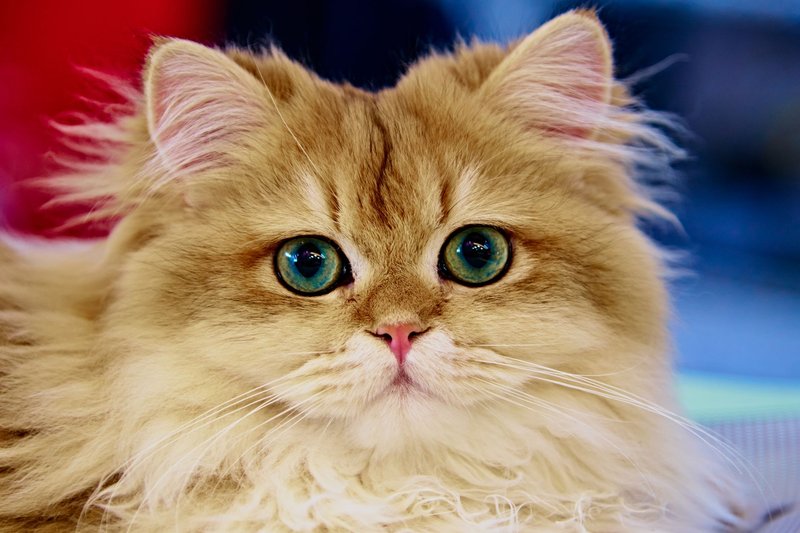
The Persian is the breed people think is huge and usually isn’t. Most Persians weigh 7-12 pounds — the volume is coat, not cat. But what coat: a long, dense double coat that’s the most luxurious here and, not coincidentally, the most demanding.
This is the one breed on the list that needs daily brushing. The undercoat is so thick that skipping a few days produces mats that have to be cut out. Many owners keep their Persians in a “lion cut” to make life manageable. The flat-faced (peke-face) Persians also need their facial folds wiped and can have tear-staining and breathing issues tied to the brachycephalic facial structure — worth understanding before you commit.
Temperament is sedate and quiet. Persians are furniture-with-a-heartbeat cats: calm, undemanding, content to lounge. If you want serenity and don’t mind the daily comb, they deliver.
Stats
- Weight: 7-12 lb
- Coat: Long, dense, double
- Grooming: Daily
- Lifespan: 12-16 years
9. Himalayan
The Himalayan is a Persian crossed with the pointed coloring of a Siamese — so it has the Persian’s body, the Persian’s enormous coat, and the blue-eyed colorpoints of a Siamese. Weight matches the Persian at 7-12 pounds, which again means the size is mostly floof, but the coat density is unmatched outside its Persian parent.
Everything in the Persian section applies here: daily grooming is non-negotiable, the dense undercoat mats fast, and the flatter-faced lines come with the same facial-fold cleaning and potential breathing considerations. Plan the grooming routine before the cat arrives, not after.
What you get for the work is a strikingly pretty, exceptionally calm companion. Himalayans are sweet, quiet, and home-bodies — slightly more playful than a standard Persian thanks to the Siamese influence, but still firmly in the lounge-all-day camp.
Stats
- Weight: 7-12 lb
- Coat: Long, dense, double
- Grooming: Daily
- Lifespan: 12-15 years
Grooming Reality Check
Fluff is a maintenance contract, and the breeds on this list — along with the wider field of long-haired cat breeds — sign very different ones.
The daily club: Persian and Himalayan. Their dense double coats mat within days if neglected. Budget 10-15 minutes a day with a steel comb that reaches the skin, plus periodic professional grooming or a lion cut.
The two-to-three-times-a-week group: Maine Coon, Norwegian Forest Cat, Siberian, Ragdoll, and Ragamuffin. Thick coats, but with enough texture or guard hair that they don’t pack into mats as fast. A wide-tooth comb plus a slicker brush, with extra sessions during the spring and fall sheds.
The weekly crowd: Birman and Turkish Van. Silky, low-undercoat coats that mostly take care of themselves. This is the lightest grooming load you’ll find on a long-haired cat.
Whatever the breed, the tools matter more than the schedule: a metal comb that reaches the undercoat does more in five minutes than a soft-bristle brush does in twenty. Start grooming in kittenhood so the cat treats it as routine rather than restraint.
Shedding and Allergies
Two things people conflate: shedding and allergies. They’re not the same problem.
Shedding is fur on your couch, and every cat here does it, heaviest in spring and fall when the double and triple coats blow out their undercoats. The lowest-shedding options are the single-coated breeds — Turkish Van and Birman — simply because there’s less undercoat to lose.
Allergies are about the Fel d 1 protein in saliva and skin oils, not the hair itself. No long-haired cat is truly hypoallergenic, and “low-shedding” doesn’t mean “low-allergen.” The standout here is the Siberian, which research suggests produces less Fel d 1 than average — counterintuitive for a triple-coated cat, but it’s the protein, not the floof, that counts. If allergies are the deciding factor, spend time with the specific cat before committing, since levels vary individual to individual.
What It Costs
Big fluffy cats are an investment twice over: the purchase and the upkeep.
Purchase price from a reputable breeder typically runs $1,000-$2,500 for most breeds here, with Maine Coons, Ragdolls, and Siberians often at the higher end, and rare colors or show lines climbing past $3,000. Adoption is dramatically cheaper and these breeds do turn up in rescues — Maine Coon and Ragdoll-specific rescue groups exist.
Ongoing costs add up beyond food and vet care: grooming tools, occasional professional grooming (especially for Persians and Himalayans), and more frequent lint-rolling and vacuuming than a shorthair owner ever deals with. The flat-faced breeds can also carry higher vet bills tied to their facial structure. Factor the coat into the budget — a large fluffy cat is a long-term grooming commitment as much as a pet.
FAQ
What is the biggest fluffy cat breed? The Maine Coon, by a clear margin. Males commonly reach 15-18 pounds with the largest exceeding 20, and the breed holds records for length. Ragdolls and Ragamuffins also reach 20 pounds but tend to be less consistently large than top-end Maine Coons.
Are there large fluffy cat breeds that don’t shed? No long-haired cat is non-shedding — fluff and shedding go together. The lightest shedders here are the single-coated Turkish Van and Birman. If you want minimal shedding specifically, a long-haired breed isn’t the right category.
Which large fluffy cat is best for allergies? The Siberian. Despite a thick triple coat, it produces less of the Fel d 1 protein that triggers most cat allergies. It’s not hypoallergenic, but allergy-prone owners often tolerate it better than other breeds. Spend time with an individual cat before deciding.
Do big fluffy cats need professional grooming? Persians and Himalayans usually benefit from it because their dense coats mat fast; many owners use a “lion cut.” The other breeds can typically be maintained at home with a steel comb and a slicker brush, plus extra effort during seasonal sheds.
How big do these cats actually get? Genuinely large breeds — Maine Coon, Ragdoll, Ragamuffin, Norwegian Forest Cat, Siberian — run 12-20+ pounds. Persians and Himalayans look big but usually weigh 7-12 pounds; their size is coat, not body mass.