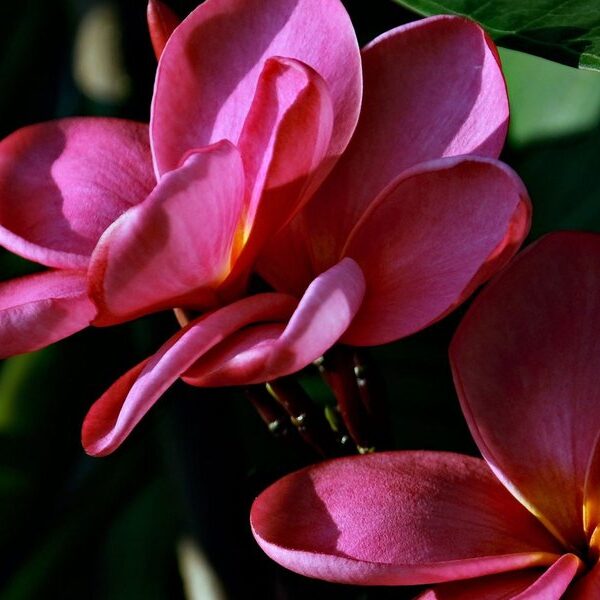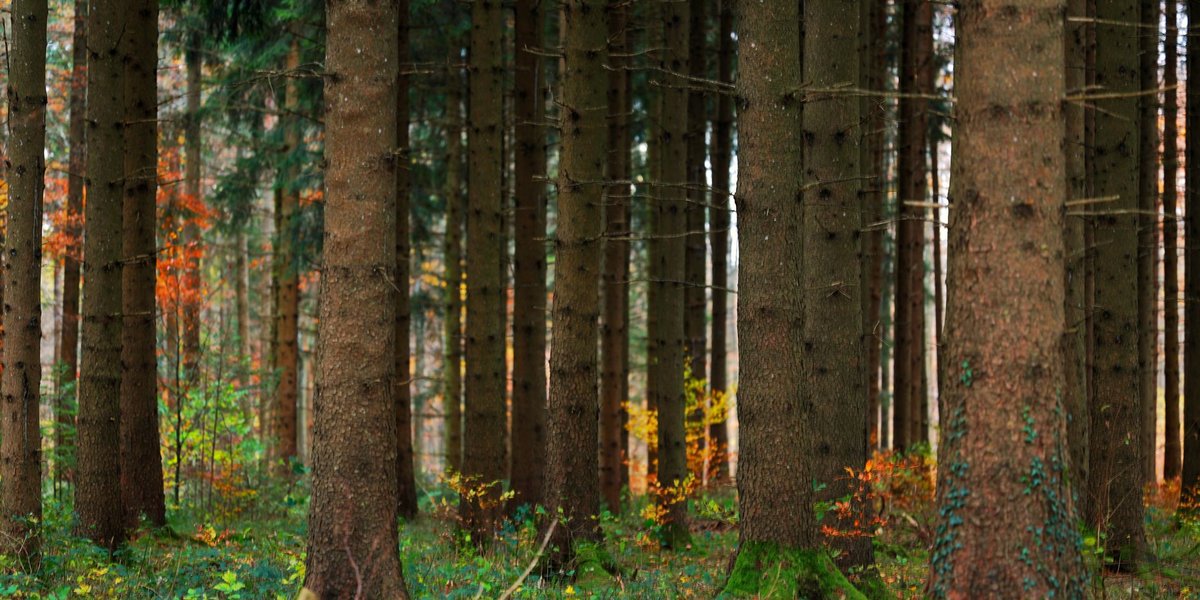
Walk into a temperate forest in April and again in August and you’d swear you visited two different places. The April version is open and bright, the floor carpeted in wildflowers racing to bloom before the trees leaf out. By August the canopy has closed, the floor is deep shade, and those spring flowers have vanished underground. That timing isn’t an accident. It’s the single most important thing to understand about temperate forest flora, and most plant lists skip right past it.
This guide is organized the way a forest actually stacks up: from the tallest canopy trees down through the shrubs to the mosses on the rocks. For each layer you get the species that define it, how to tell them apart, and why they grow where they do. A quick-reference table sits at the top if you just want names and numbers.
Table of Contents
- What Makes a Forest “Temperate”
- Quick-Reference Plant Table
- Canopy Trees
- Understory and Small Trees
- Shrubs
- Wildflowers and Forbs
- Ferns, Mosses, Lichens, and Fungi
- How Temperate Forest Plants Survive
- A Note on Region
- FAQ
What Makes a Forest “Temperate”
Temperate forests grow in the mid-latitudes — roughly between the tropics and the boreal zone — where there are four distinct seasons and enough rain spread across the year to keep things green. The defining feature for plants is the cold season. Winters get cold enough to freeze, so the vegetation has to deal with months when photosynthesis is barely worth the effort.
Two broad strategies answer that problem. Deciduous trees (oaks, maples, beeches) drop their leaves and go dormant. Evergreen conifers (hemlocks, pines, firs) keep needle-shaped leaves that resist freezing and drying. Most temperate forests are a mix of both, which is why you’ll find a maple and a hemlock growing side by side. The classic “temperate deciduous forest” of eastern North America, Europe, and East Asia leans hardwood; the Pacific Northwest and parts of Chile and New Zealand tip toward evergreen temperate rainforest.
The plant communities organize themselves into vertical layers, each with its own light budget. The canopy hogs most of the sun. Everything below it is competing for the leftovers, and that competition shapes nearly every plant on this list.
Quick-Reference Plant Table
| Common name | Scientific name | Layer | Mature height | Native range |
|---|---|---|---|---|
| Sugar maple | Acer saccharum | Canopy | 25–35 m | E. North America |
| American beech | Fagus grandifolia | Canopy | 20–35 m | E. North America |
| White oak | Quercus alba | Canopy | 25–30 m | E. North America |
| European beech | Fagus sylvatica | Canopy | 25–35 m | Europe |
| Eastern hemlock | Tsuga canadensis | Canopy (conifer) | 20–30 m | E. North America |
| Flowering dogwood | Cornus florida | Understory | 5–10 m | E. North America |
| Eastern redbud | Cercis canadensis | Understory | 6–9 m | E. North America |
| Witch hazel | Hamamelis virginiana | Shrub | 3–5 m | E. North America |
| Spicebush | Lindera benzoin | Shrub | 2–4 m | E. North America |
| Mountain laurel | Kalmia latifolia | Shrub | 2–5 m | E. North America |
| Trillium | Trillium grandiflorum | Forb | 15–40 cm | E. North America |
| Bloodroot | Sanguinaria canadensis | Forb | 15–30 cm | E. North America |
| Wild ginger | Asarum canadense | Forb | 15–20 cm | E. North America |
| Bluebell | Hyacinthoides non-scripta | Forb | 20–50 cm | W. Europe |
| Christmas fern | Polystichum acrostichoides | Fern | 30–60 cm | E. North America |
| Common haircap moss | Polytrichum commune | Moss | 5–20 cm | Northern Hemisphere |
Canopy Trees
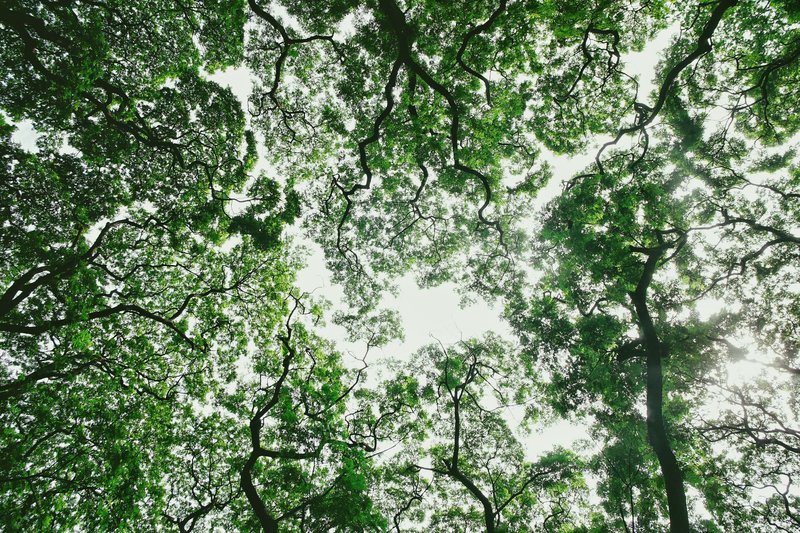
The canopy is the forest’s roof and its engine. These trees capture most of the incoming light and set the rules for everyone below. In a mature temperate deciduous forest, a handful of species do most of the work.
Sugar maple (Acer saccharum) is the tree that makes New England turn orange and red every October, and the one tapped for maple syrup. Five-lobed leaves with smooth, U-shaped notches between the points — that’s the quickest ID, especially against the red maple, whose notches are sharp V’s. Sugar maple is intensely shade-tolerant as a seedling, which is why it tends to dominate old, undisturbed forests: its babies wait patiently in the gloom for a gap to open.
American beech (Fagus grandifolia) keeps smooth, elephant-gray bark its entire life, which is why it’s the tree everyone carves initials into (please don’t). Young beeches hold their coppery dead leaves through winter — a trait called marcescence — so a beech understory glows tan against the snow. The nuts feed everything from bears to blue jays.
White oak (Quercus alba) anchors drier ridges and slopes. Look for leaves with rounded lobes (no bristle tips — that distinguishes white oaks from red oaks) and pale, scaly bark. White oaks can live 300 years or more, and a single mature tree can drop thousands of acorns in a good “mast” year, then almost none the next. That boom-and-bust acorn cycle ripples through the whole food web, feeding everything from squirrels to the opportunistic omnivores that work a temperate forest, which gorge in a mast year and scramble in the lean one.
European beech (Fagus sylvatica) plays the same ecological role across Europe that American beech plays in the east — dense shade, smooth gray bark, a forest floor kept nearly bare by its own canopy. Beech forests are so dark in summer that the famous spring wildflower displays in European woods finish before the leaves fully expand.
Eastern hemlock (Tsuga canadensis) is the conifer in the mix, and it casts the deepest shade of any tree here. Flat, short needles with two white stripes underneath, and tiny cones the size of a thumbnail. Hemlock groves stay cool and dark even in midsummer, creating their own microclimate. They’re under serious threat from the hemlock woolly adelgid, an invasive insect that the USDA Forest Service tracks across the eastern range.
Understory and Small Trees
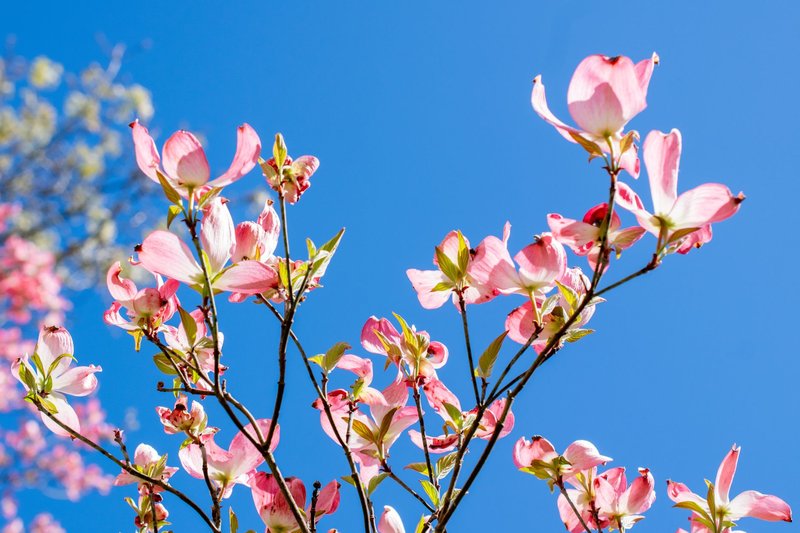
Below the canopy live the small trees built to make a living in partial shade. They flower early, before the big trees leaf out and steal the light.
Flowering dogwood (Cornus florida) is the showstopper of the eastern understory. Those big white “petals” in spring are actually bracts — modified leaves — surrounding a cluster of tiny true flowers. The bark breaks into small square blocks like alligator skin, and the leaves turn deep maroon in fall. Dogwood blooms time the arrival of spring for a lot of woods-walkers.
Eastern redbud (Cercis canadensis) does something genuinely odd: it flowers directly on its bare branches and even the trunk, a trait called cauliflory. The result is a small tree dripping with magenta-pink blooms in early spring, before its heart-shaped leaves appear. It’s a legume, related to peas, which is why the spent flowers turn into flat little seed pods.
Shrubs
The shrub layer fills the gap between knee height and the small trees. These are woody plants that have given up on reaching the canopy and specialized in the middle zone.
Witch hazel (Hamamelis virginiana) flowers in fall — sometimes November, after its own leaves have dropped — with spidery yellow ribbons for petals. It’s the source of the astringent in your medicine cabinet. The seed capsules ripen a full year later and fling their seeds several meters with an audible pop.
Spicebush (Lindera benzoin) announces itself with scent: snap a twig or crush a leaf and you get a clean, citrusy-spicy smell. The dried berries have long been used as a woodland seasoning, in the same tradition as the forest plants foragers turn into spices farther north. Clusters of tiny yellow flowers hug the bare stems in early spring, and the females produce bright red berries. It’s the host plant for the spicebush swallowtail butterfly, whose caterpillars mimic snake eyes.
Mountain laurel (Kalmia latifolia) forms dense, often impenetrable thickets on acidic mountain slopes. The flowers are tiny engineering marvels — each one holds its ten stamens under spring tension, and when a bee lands, they snap forward and dust it with pollen. Beautiful, and toxic to livestock, which is one reason it spreads where grazing has thinned everything else.
Wildflowers and Forbs
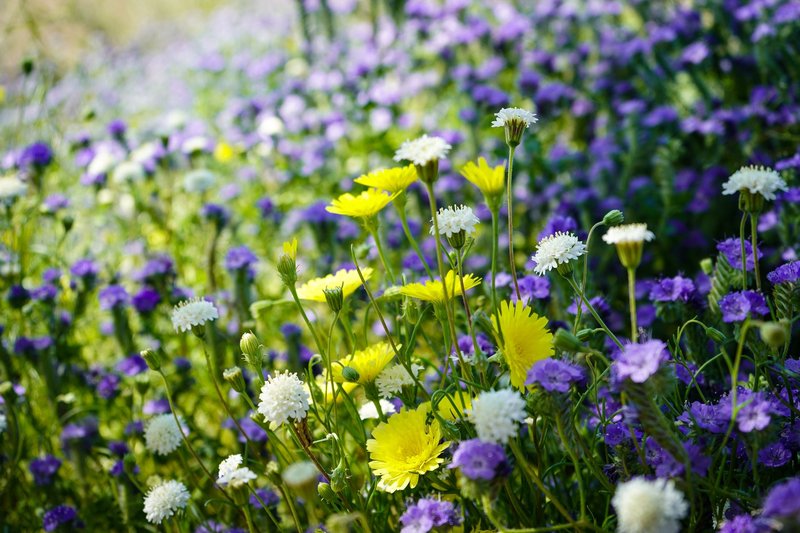
Here’s where the seasonal timing from the intro pays off. The forest floor’s herbaceous plants — the forbs — include a special group called spring ephemerals. They emerge, leaf out, flower, set seed, and die back to the ground all within the few weeks between snowmelt and canopy closure. They’re exploiting a narrow window of sunlight that slams shut in May.
Large-flowered trillium (Trillium grandiflorum) is the poster child. Everything comes in threes: three leaves, three petals, three sepals. The flowers open white and fade to pink as they age. Trilliums are slow — a plant can take seven to ten years from seed to first flower — so a hillside of them signals a forest that’s been undisturbed for a long time. Picking the flower can kill the plant, since it takes the leaves with it. Many are spread by ants, which carry the seeds for the oil-rich attachment, a relationship called myrmecochory.
Bloodroot (Sanguinaria canadensis) opens a single white flower wrapped in a curled, lobed leaf, often before the leaf fully unfurls. Break the root or stem and it bleeds orange-red sap — that’s the bloodroot. The flowers last only a few days and close at night.
Wild ginger (Asarum canadense) hides its flower. Two fuzzy, heart-shaped leaves sit at ground level, and the dull maroon flower tucks underneath them, right on the soil, where it’s pollinated by ground-dwelling insects. The root smells like culinary ginger but isn’t related to it.
Bluebell (Hyacinthoides non-scripta) is the European equivalent of a trillium hillside — and arguably more dramatic. In April and May, ancient British and Atlantic-coast woodlands flood with a haze of nodding violet-blue flowers, all blooming in the brief window before the beech and oak canopy closes. Roughly half the world’s bluebells grow in the UK, and the species is protected there. Kew’s botanical research flags hybridization with the invasive Spanish bluebell as the main threat to the native plant.
Ferns, Mosses, Lichens, and Fungi
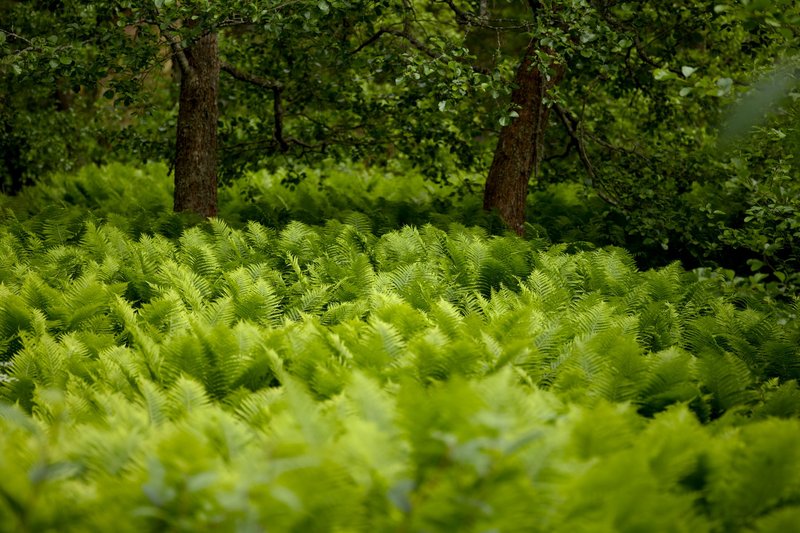
The bottom layer doesn’t bother with flowers. Ferns reproduce by spores, mosses by spores, and fungi by their own ancient machinery. They thrive in exactly the deep, damp shade that defeats most flowering plants by midsummer.
Christmas fern (Polystichum acrostichoides) stays green all winter — hence the name — when most ferns have collapsed into brown mush. Each leaflet has a little “ear” or thumb at its base, like a stocking, which is the fastest way to ID it. It grows in neat, fountain-like clumps on shaded slopes.
Common haircap moss (Polytrichum commune) is one of the tallest mosses, forming dense green-to-bronze carpets that can be deep enough to sink a boot into. Up close, the leaves look like tiny pine needles. Mosses have no roots and no internal plumbing, so they live where water is reliably present — north-facing slopes, streambanks, rotting logs.
Lichens aren’t plants at all but a partnership between a fungus and an alga or cyanobacterium. On temperate forest trees you’ll see them as gray-green crusts, leafy lobes, or hanging strands. They’re famously sensitive to air pollution, which makes a tree thick with lichen a quiet sign of clean air.
Fungi are the forest’s recyclers and its hidden infrastructure. The mushrooms you see are just the fruiting bodies; the real organism is a vast underground web of mycorrhizal threads laced through the soil and wrapped around tree roots. Through that network, trees trade sugars for nutrients and even shuttle resources between each other — research summarized by Nature describes how these fungal connections move carbon and warning signals among trees.
How Temperate Forest Plants Survive
Every species above is solving the same set of problems. The solutions are worth understanding on their own, because once you see them you start reading the forest instead of just looking at it.
Leaf drop and dormancy. Deciduous trees pull the valuable nutrients out of their leaves, abandon the rest, and shut down for winter. It’s cheaper to regrow leaves each spring than to defend them through months of freezing. The fall color is the chlorophyll breaking down, revealing pigments that were there all along.
Shade tolerance. Plants of the understory and floor run their photosynthesis on far less light than canopy trees need. Sugar maple and hemlock seedlings can survive for years in deep shade, biding their time until a canopy tree falls and opens a sunny gap.
Spring ephemeral timing. The wildflower strategy — bloom in the brief, bright window before the canopy closes, then retreat underground — is one of the most elegant adaptations in any forest. These plants store energy in bulbs and rhizomes and spend most of the year invisible.
Deep and spreading roots. Mature trees anchor against wind and tap water and nutrients from a wide soil volume. Many forbs invest in underground storage organs that outlast the visible plant by months.
Mycorrhizal networks. Most temperate forest plants partner with fungi at the root, trading sugar for water and minerals the roots can’t reach alone. It’s not a nice-to-have; many tree seedlings simply fail to establish without the right fungal partner in the soil.
Animal partnerships. From ant-dispersed trillium seeds to bird-dispersed beech nuts to spring-loaded mountain laurel flowers, a huge share of temperate flora outsources reproduction to animals — which is why a healthy forest is a tightly linked system, not a collection of independent plants.
A Note on Region
Most of the named species here come from eastern North America, because that’s the textbook temperate deciduous forest. But the structure repeats around the world with different cast members. European temperate woods swap white oak and sugar maple for sessile oak, European beech, and hornbeam, and trade trillium carpets for bluebells. Climb into the mountains and the cast shifts again — the flora of the Pyrenees blends these woodland species with alpine specialists you won’t meet on the lowland forest floor. East Asian temperate forests — the most species-rich of the three — host their own maples, magnolias, and a stunning diversity of understory shrubs. The Pacific Northwest and southern Chile push toward evergreen temperate rainforest, where sword ferns and mosses dominate a floor beneath towering conifers.
The layers stay constant even when the species change: a canopy, an understory, a shrub layer, a floor of forbs, and a ground layer of ferns and mosses. Learn to read the layers and you can walk into a temperate forest on any continent and know roughly what you’re looking at.
FAQ
What’s the difference between temperate forest flora and temperate rainforest flora? Temperate rainforests get far more rain — often over 1,400 mm a year — and tilt heavily toward evergreen conifers, ferns, and mosses rather than deciduous hardwoods. Think coastal Pacific Northwest or southern Chile versus the deciduous oak-maple-beech forests of the eastern US and central Europe.
When is the best time to see temperate forest wildflowers? Early to mid spring, in the few weeks between snowmelt and the canopy leafing out. That’s when spring ephemerals like trillium, bloodroot, and bluebell bloom. By early summer most of them have already died back to the ground.
How can I tell a native plant from an invasive one in a temperate forest? It takes local knowledge, but a few common invaders are worth knowing: garlic mustard, Japanese barberry, and multiflora rose in North American woods, and Spanish bluebell hybridizing with native bluebells in Europe. A dense, single-species thicket that crowds out everything else is often a red flag. Local extension offices and the IUCN maintain region-specific invasive species lists.
Why do some forest floor plants flower before the trees have leaves? Light. Once the canopy closes, the forest floor can drop to a few percent of full sunlight. Spring ephemerals evolved to do all their growing and flowering in the bright window before that happens, then go dormant for the rest of the year.
Do all temperate forests lose their leaves in winter? No. Deciduous species do, but temperate forests are usually mixed, and the evergreen conifers — hemlock, pine, fir — keep their needles year-round. In temperate rainforests, evergreens dominate and the forest stays green all winter.