TLDR
Canada has roughly 140 native tree species, and almost all of them are either conifers (needles or scales, cones) or broadleaves (flat leaves, seeds in keys, nuts or catkins). Most of what you’ll see on a given trip comes down to about a dozen species, and which dozen depends on where you’re standing. Sugar maple dominates the east, white and black spruce run across the boreal belt, and western red cedar and Douglas fir own the Pacific coast.
Table of Contents
- Conifer or broadleaf: the two-minute key
- Pacific coast: the giants
- The boreal forest: Canada’s biggest woodland
- Great Lakes and St. Lawrence: maple country
- Prairies and parkland
- Atlantic Canada
- Provincial and territorial tree emblems
- Record trees
- Summary
Conifer or broadleaf: the two-minute key
Start here, because it cuts the field in half before you look at a single leaf.
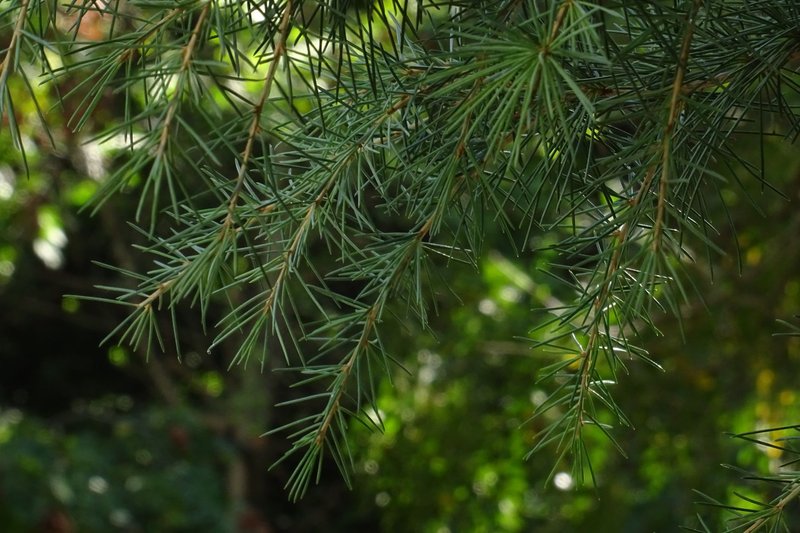
Conifers carry needles or tiny overlapping scales and make seeds in cones. Most stay green all year. Canada’s conifers include pines, spruces, firs, hemlocks, cedars, larches and junipers.
Broadleaves have flat, wide leaves and make seeds in other ways: winged keys on maples, nuts on oaks, catkins on birches and aspens. Nearly all drop their leaves in autumn.
Two exceptions trip people up. Tamarack (larch) is a conifer that turns gold and drops its needles every fall, so a “dead” evergreen in October is probably a tamarack. And in Pacific British Columbia, arbutus is a broadleaf that keeps its leaves through winter.
Then sort conifers by how the needles attach:
- Bundles of needles (2, 3 or 5 per bundle): pine. Count the bundle. Eastern white pine has five, which spells W-H-I-T-E if you need a mnemonic.
- Single needles that roll between your fingers (square): spruce.
- Single needles that are flat and soft: fir or hemlock.
- Flat scale-like sprays: cedar.
- Soft needles in tufts on short spurs: larch or tamarack.
For broadleaves, check whether leaves grow opposite each other on the twig (maple, ash) or alternate (oak, birch, aspen). Opposite is the quickest tell in the whole system.
Pacific coast: the giants
The coastal rainforest of British Columbia grows the largest trees in Canada, helped by mild winters and rain measured in metres.
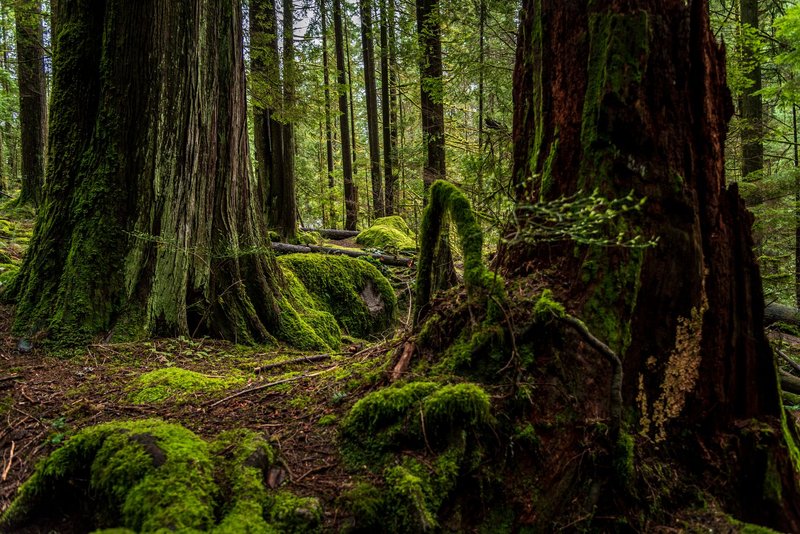
Western red cedar is the province’s official tree and an icon of Indigenous Pacific Northwest culture, used for totem poles, longhouses, canoes and woven bark clothing. It isn’t a true cedar; it belongs to the cypress family. Look for flat, lacy sprays, stringy reddish bark that peels in long strips, and a flared trunk base. Crush a sprig and it smells like pencil shavings.
Douglas fir is not a true fir either. The giveaway is the cone: every scale has a three-pointed bract poking out, which First Nations stories describe as the back legs and tail of a mouse hiding in the cone. The bark on mature trees is thick, corky and deeply furrowed.
Sitka spruce grows along the fog-soaked outer coast. Its needles are sharp enough to hurt, and it holds Canada’s height record (see below).
Western hemlock has drooping leader shoots, a tell you can spot from a distance, and needles of mixed lengths on each twig.
The boreal forest: Canada’s biggest woodland
A wide belt of forest runs from Newfoundland to the Yukon, and it covers more of the country than any other forest type. Natural Resources Canada reports that Canada holds about nine percent of the world’s forest area, and much of that is boreal. It isn’t diverse. It’s repetitive, and that’s the point: cold winters weed out everything but the tough ones. The animals that depend on it follow the same logic. Who eats whom in the taiga walks through that food web, from snowshoe hares and red squirrels up to the predators that hunt them.
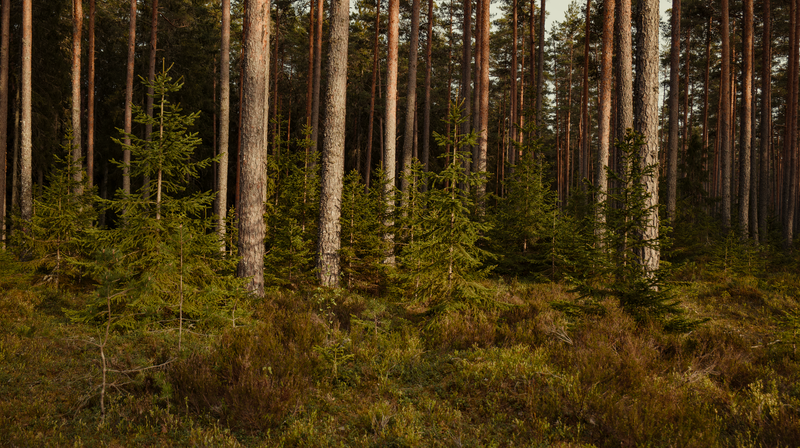
Black spruce is the signature tree: short, scraggly, with a thin top crown like a bottle brush. Its small cones hang on for years, sealed with resin, and open after fire. That’s why you’ll often see dense black spruce stands regrowing right after a burn.
White spruce is taller and cleaner, with bluish-green needles that smell skunky when crushed. Its cones are longer than black spruce and fall after releasing seed.
Jack pine grows in sandy, poor soils, with short needles in pairs and cones that curve inward along the branch, also fire-triggered.
Tamarack fills bogs and wet ground with that deciduous-conifer trick mentioned earlier.
Trembling aspen is the most widely distributed tree in North America. The flat leaf stalks make the leaves shiver in the faintest breeze, and the pale greenish bark has dark, eye-shaped scars. A stand of aspens is often one single organism, with trunks connected by roots and all turning gold on the same day.
White birch (paper birch) has chalk-white bark that peels in thin horizontal sheets. It’s a reliable find from coast to coast, and one of the few broadleaves that reaches the northern edge of the treeline.
Great Lakes and St. Lawrence: maple country
South of the boreal, in southern Ontario and Quebec, the forest turns mixed and richer.
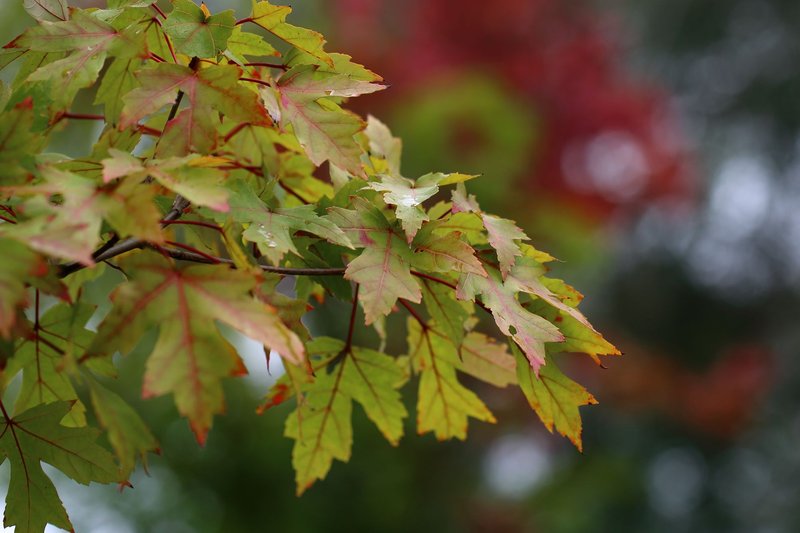
Sugar maple is the star. The leaf has five lobes, smooth-edged with U-shaped gaps between them, which separates it from red maple’s sharper, toothed outline. The bark is grey and furrowed in vertical plates. Syrup comes from the sap, which runs at about 40 litres of sap per litre of syrup. Autumn colour goes from yellow to red-orange, and it explains why the southeast turns into a tourist route every October.
Eastern white pine towers over the canopy, with soft blue-green needles in bundles of five and long, narrow, slightly curved cones. It was the tree behind the square-timber trade that built early Ontario and Quebec.
Red oak, American beech and yellow birch round out the hardwood mix. Yellow birch has bark that peels in golden-bronze curls, and its twigs smell like wintergreen if you scratch them.
Eastern hemlock and eastern white cedar grow in cooler, damper pockets. White cedar clings to limestone cliffs along the Niagara Escarpment; some of those trees are over a thousand years old.
Prairies and parkland
Grasslands cover the southern Prairies, and trees stick to river valleys, shelterbelts and the parkland band to the north.
Trembling aspen again dominates the parkland. Along rivers, plains cottonwood grows with deeply furrowed bark and heart-shaped, toothed leaves. Manitoba maple (box elder) is a fast, scrappy opposite-leaved tree with compound leaves, found in prairie towns everywhere. Bur oak reaches the western edge of its range in Manitoba, with big, fat-fringed acorns. In the foothills and Rockies, lodgepole pine takes over: tall, straight, needles in pairs.
Atlantic Canada
The Maritimes mix the eastern broadleaves with a conifer-heavy Acadian forest.
Red spruce is the characteristic species, and balsam fir is its common neighbour. Balsam fir has flat needles, upright cones that fall apart on the tree, and blisters of resin in the bark you can pop. Nova Scotia’s coast also carries black spruce and tamarack, and red maple brings the fall colour to wet ground.
Provincial and territorial tree emblems
Every province and territory except one has chosen an official tree.
| Province or territory | Official tree |
|---|---|
| British Columbia | Western red cedar |
| Alberta | Lodgepole pine |
| Saskatchewan | Paper birch |
| Manitoba | White spruce |
| Ontario | Eastern white pine |
| Quebec | Yellow birch |
| New Brunswick | Balsam fir |
| Nova Scotia | Red spruce |
| Prince Edward Island | Red oak |
| Newfoundland and Labrador | Black spruce |
| Yukon | Subalpine fir |
| Northwest Territories | Tamarack |
| Nunavut | None (no native trees grow in most of the territory) |
Record trees
The Carmanah Giant, a Sitka spruce in Carmanah Walbran Provincial Park on Vancouver Island, is among the tallest trees in Canada at roughly 95 metres. Next to it, the tallest eastern white pines are around 50 metres, so size is a west-coast game. Old-growth Douglas firs and western red cedars on the island also run past 1,000 years.
The oldest trees in the country include eastern white cedars on the Niagara Escarpment, growing slowly on bare rock and out of reach of loggers.
Summary
Canada’s trees look overwhelming as a list of 140 names. They stop being overwhelming when you ask two questions: conifer or broadleaf, and where am I standing. Learn sugar maple, white pine, white and black spruce, trembling aspen, white birch, Douglas fir and western red cedar, and you can name most trees you meet in this country. Add the leaf, bark and cone cues above and you’ll be right more often than most field guides would let you be.